A DAY IN ALMERIA

16 Jul

It was just over a mile walk to the bus stop from the campsite. Wednesday 15 th July and face masks are again mandatory in Andalucia. The bus passed through Aguadulce before taking a dramatic coast road to Almeria – about a 20 minute ride. The city is associated with Spain’s most famous poet, Frederick Garcia Lorca.

  • Como no me he preocupado de nacer, no me preocupo de morir.
    • As I was not worried about being, born, I don’t worry about dying.
      • Quoted in “Diálogos de un caricaturista salvaje,” interview with Luis Bagaría, El Sol, Madrid (1936-06-10)

Federico Garcia Lorca had more than a casual relationship with Almería. In addition to being the land that inspired him to write the famous “Bodas de Sangre”, also he lived here for three years in his childhood.

Almeria city pays tribute with the “Avenida Federico Garcia Lorca,” better known as “La Rambla”.

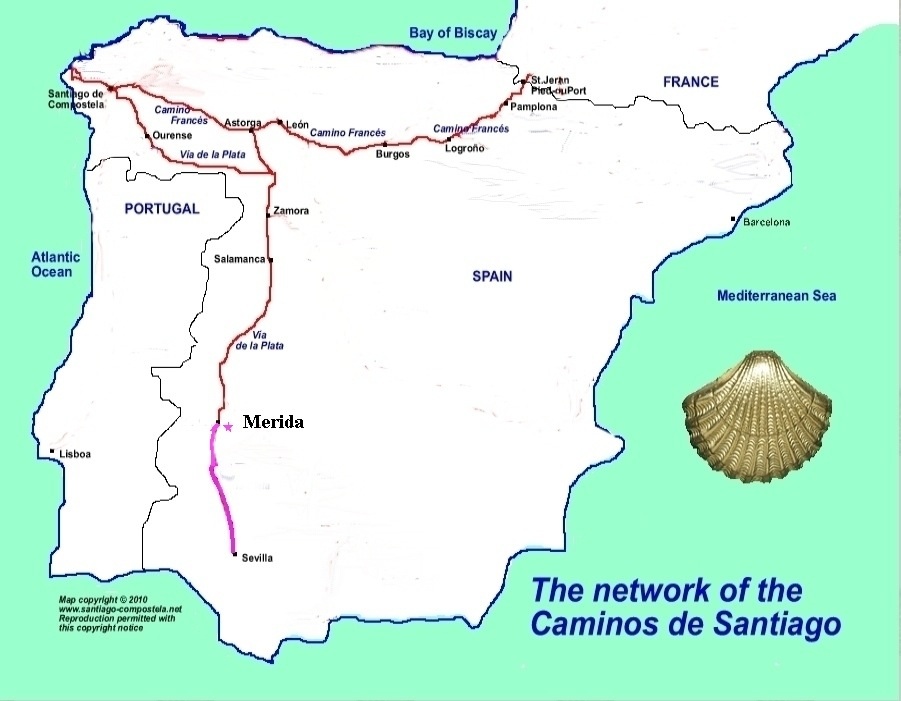
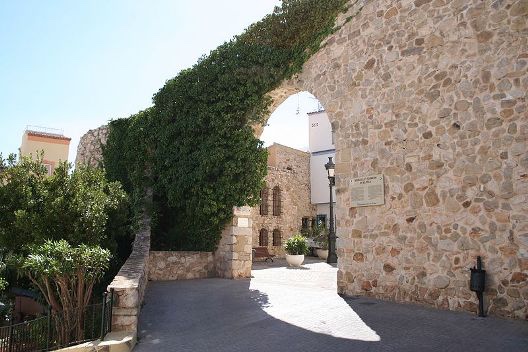
Like the palm- lined Paseo along the harbour front, the Ramblas is very pleasant to stroll along. The Cathedral was sadly closed; a striking building at the heart of the old city. It was begun in 1524 – it resembles a fortress with its six towers – to repel any invasion by pirates, apparently. We found the starting point of the Camino Mozararbe.

We would like to walk this Camino but not in July…April maybe.

Then a coffee in the Arab Quarter

before tackling the Alcazaba Fortress – free admission – It has been well looked after in recent times, ringed by cliffs it serves as a reminder of the past glories of the city. It was the chief port of the Córdoba Caliphate and by the 11 th century the capital. Its chief source of wealth was weaving silk from the silkworms of the Alpujarras. In 1522, there was a devastating earthquake. Today it is a city relivened by Agri euros and a magnet for migrant job- seekers. There are frequent ferries to Morocco and Algiers.

It has a varied history, being used as military camp and its mosque at the eastern end being converted to the Ermita de San Juan, by the Catholic monarchs who took Almeria in 1489.

The Islamic influence is most noticeable in the running water furrowing it’s way through sympathetically laid out gardens with several fountains.

There is a story that a slave girl leapt to her death from the walls after her imprisoned Christian lover has been thrown from them.

We wanted to visit Los Refugios de la Guerra Civil. However, the Siesta still holds Andalusia in its thrall and it was closed until18.00. Hard to understand that a city with so many places of interest, especially its museos, should be closed for the best part of a half day – 21st Tourism . No.

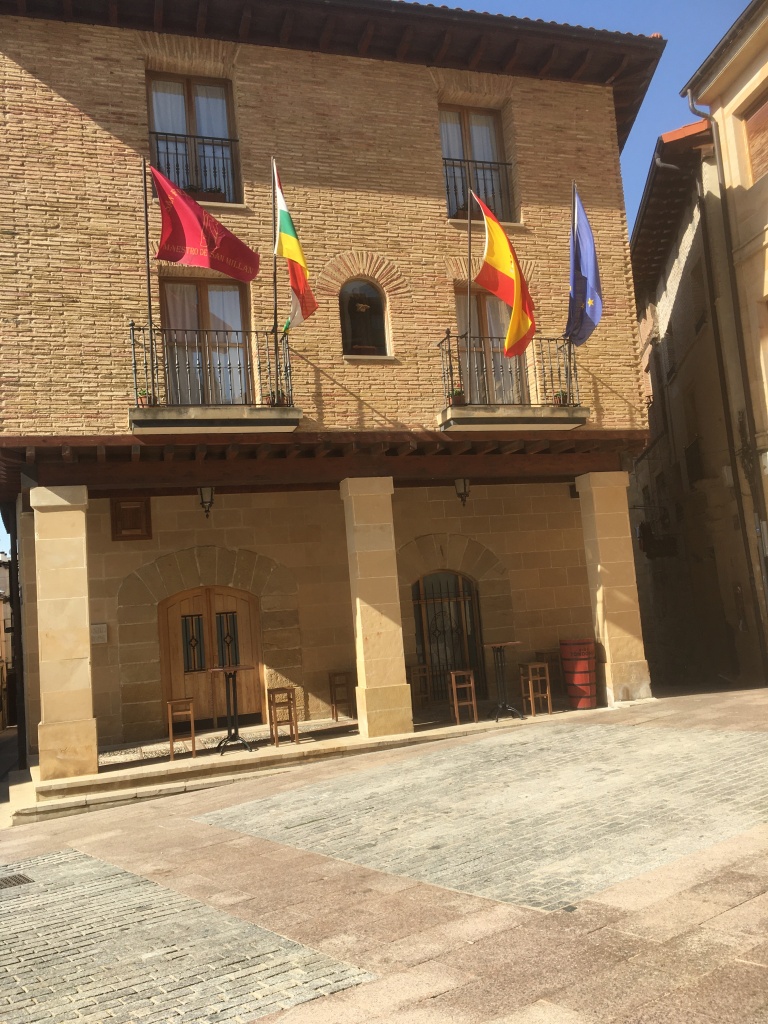
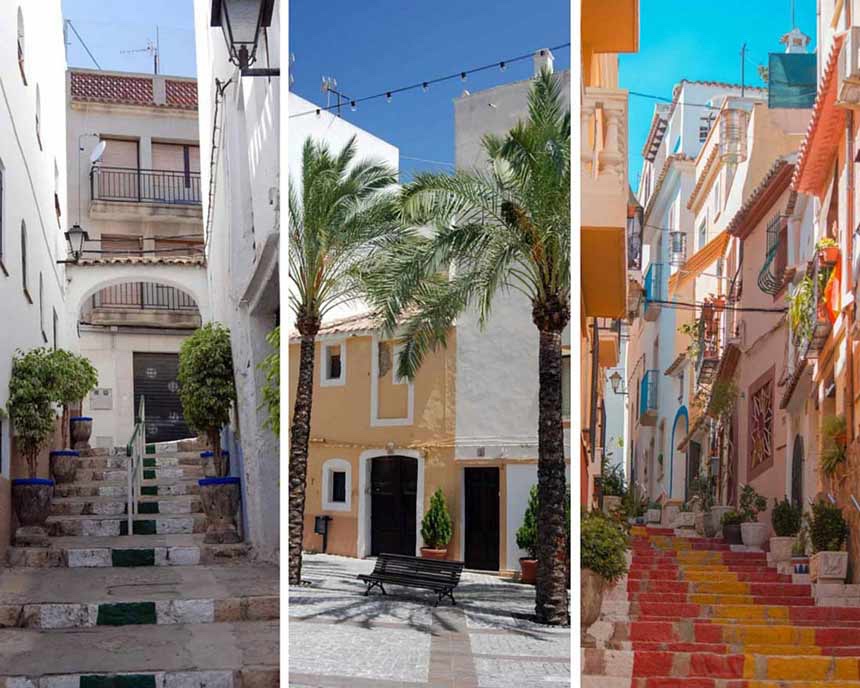
So we made do with a walkabout. The Paseo de Almería was busy and notable for its colourful roof!

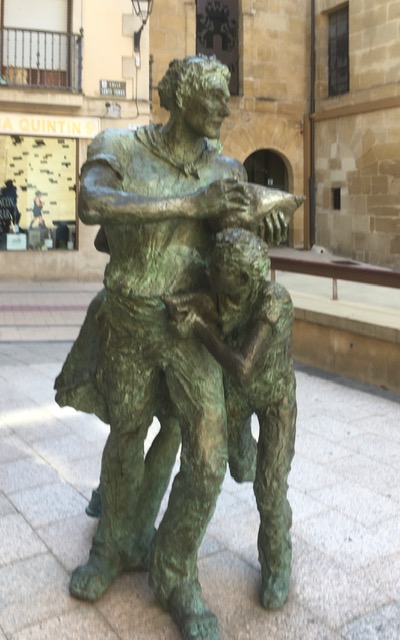
Two souvenirs .

There were quiet spots, too.

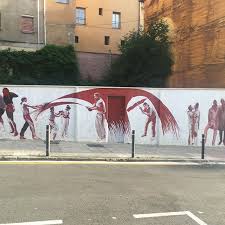
And some welcome, pedestrian only squares.

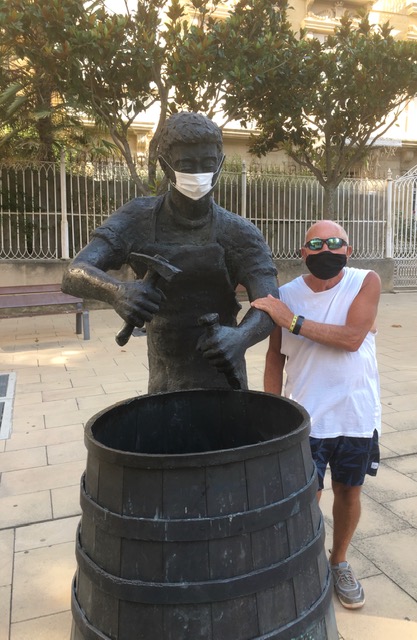
Friendly natives.

An interesting piece of more recent industrial heritage is the Cargadero de Mineral ( Cable Ingles )

Known as The English Cable for loading ore,located in Almeria operated by an English company «The Alquife Mines and Railway Company Limited.

Renovation underway.

The Hacho Bridge operated for more than sixty years. It was even used by both the Nationalists and the Republicans during the Spanish Civil War. Hacho Bridge, which was the largest iron viaduct in Spain, was a major source of employment in the area. Hundreds of people lived for almost a decade near Alamedilla station during its construction. Many continued to live there after it opened, working on its maintenance.

However, in the late 1950s living conditions in Eastern Andalusia, caused by postwar period austerity, meant many people left the area in search of work. At the same time, Spanish railways began to operate heavier diesel locomotives which were unable to use Hacho Bridge due to its maximum load weight.

Ten years later the station at Alamedilla had been closed to passengers. A decade of years later, Spanish railways sold Hacho Bridge to a Madrid scrap dealer together with other bridges on the Almeria line for 1.5 million pesetas.

In November 1978, local people began a campaign to save Hacho Bridge after they discovered that it was to be demolished. The Mayor of Alamedilla, D. Abelardo Corral, appealed to the Governor of Granada, D. José Maria Fernandez Fernandez. In a hastily convened meeting, the provincial government agreed with the local committee and declared Hacho Bridge a Historical Artistic Monument. This injunction was then served on the scrap and demolition company. The Civil Guard were ordered to go immediately to the bridge. They arrived just in time and dismantled the dynamite already installed at the base of trestles.

Hacho Bridge is now protected by a national protection order as a Structure of Cultural Significance.

There is a lot enjoy in Almeria,plus the National Park in nearby Cabo de Gato. It would make a good city break, but make sure you get up and about early to visit sites, before the Siesta!

A fruitful website.

A birthday to remember and Jose came to the rescue, then to Andalucia.

13 Jul

First Three Days’ Drive:- Camping Lac des Varennes.Arrival in Spain.Navarre and the Mediterranean.

11 Jul

You tend to forget that the drive to Eurotunnel is the best part of 200 miles when you leave Calais – although only 40 minutes – it feels like a fresh start, even after windy, wet Kent and Northern France.

Folkestone Eurotunnel
Traditional first day’s breakfast of sausages,hard boiled eggs, looking out at an Aire on the A26

The intention was to get to the Touraine by evening, which proved to be the case,fortunately.

After driving for several hours both at home, on the way to Folkestone and down through France, in rain,mist and foggy conditions it was a great feeling of relief when the clouds disappeared after crossing the River Seine. TheDay temperature climbed up to 27** as we pulled in to Lac des Varennes. All the hallmarks of a Good French campsite – swimming,sandy beach,greenery and a large pitch with a lakeside view. Not to mention a bar – and an ice cold Pelforth by the lake.

Our Dutch neighbours came over for a chat after this opening remark – “ We are sorry you are leaving the EU”… we found we had much in common, both political,y and socially.

Campsite flags

Dinner was a defrosted, “all in one” pork dish prepared by Hannah and after a good night’s rest, we were greeted with sunshine.

The second day – the intention was to reach Spain,via Tours,Poitiers and Bordeaux. It was on the latter’s Rocade that the first “ bouchon” was met. It took a while to clear the wine capital and traffic only thinned out after the turn-offs for Paris and the seaside. Then the driving resumed its normal pace – 67 mph – on excellent roads.

Crossing the border at Irun involved no formalities, despite COVID-19 and the N121a was taken. Driving through the foothills of the Pyrenees was delightful even if there were a few bends to navigate. After an hour,Camping Izarpe was chosen for the second night of the holiday – a relatively new site,open all year to operate as a skiing base in the winter and a walking / relaxing base in the summer,complete with swimming pool.

Hannah braved it…Nothing new there!

Another impromptu conversation with a friendly, Spanish guy who had lived in Nottingham for 18 years, now resident in nearby Pamplona; very welcoming as was the campsite restaurant where we had dinner, after managing to decode most of the menu which was in Basque!

Overhead, large,predatory birds hovered – gold and black markings – I thought they might be after my Patatas Bravas !

Day three and the intended destination was The Communidad de Valencia. The drive initially went through Navarre,which is traditional Basque in the North of the region, but more inclined towards Castile in the South. A beautiful area, undiscovered by most tourists. For example, Navarre does not figure in index to the Rough Guide to Spain.

Lonely Planet described it thus:-

“ The soft greens and bracing climate of the Navarro Pyrenees lie like a cool compress across the sunstruck brow of the South, which is all stark plains, cereal crops and vineyards,sliced by high sierras with Cox combs of raw limestone “.

Driving by and through really charming,small villages with eye catching,red geraniums hanging from balconies.

Pamplona tends to hog the limelight ,which we bypassed en route,

We should have liked to explore both Olive and Tudela as we sped effortlessly along the Autovia Mudjedar, with its Moorish sculptures on bridges and intersections.

for the most part we were driving at 1000 metres plus, above sea level – a really enjoyable day’s journey brought us finally to Camping Valencia – 14 km out of the city,however,and situated close to the beach. The intention being to have two nights here, a rest day before Sunday’s drive to Almeria,300 miles further south and somewhere to celebrate Hannah’ birthday.

This route starts at the Somport Tunnel and bypasses Zaragoza on the way to Valencia, through Aragon – a name with such historic connotations – and is an excellent alternative to routes South via Barcelona, or Madrid, avoiding them both. The scenery was ever changing and the road not at all busy.

Well organised site,mainly Spanish guests – only downside was the so called supermercardo – Nisa in Wylde Green everytime!

It didn’t quite work out that way at first.

The Portuguese Internal Camino from Porto 2012

28 Jun

SECOND OF THE “FORGOTTEN” CAMINOS

It seems highly appropriate to begin transferring from my little journal about the Portuguese inland camino from Oporto to Santiago de Compostela on PORTUGAL DAY, June 10th.

Afonso Henriques was proclaimed the first King of Portugal in 1139 and the country remained a kingdom for almost 800 years thereafter, until 1910 making it the oldest-country of Europe.

Portugal Day 2020: Every year, Portuguese people across the globe celebrate Portugal Day on 10th June. The day marks the death of Luís de Camões on 10th June, 1580.

Camões is considered to be Portugal’s greatest poet. He is best known for his work “Os Lusíadas”, the national epic poem of Portugal that celebrates the nation’s successes and rich history, dedicated to King Sebastian who died in the Battle of Alcazarquivir in Morocco.

The day is about the celebration of Portuguese culture, heritage, traditions and food. This celebration is not limited to Portugal alone. With Portuguese folk scattered around the globe, different customs have appeared: festivities in Macau are still vivid despite the area being handed over to China by Portugal in 1999; celebrations in Brazil, Canada, and other parts of the world remind people of the Portuguese people and their culture.

On a currently topical note:

Portugal was the first European nation to participate in the transatlantic slave trade

Portugal was a major player in the global slave trade, taking slaves from West Africa to the Americas. It was also the first colonial power to abolish slavery, some 50 years before Britain, Spain, France, and the United States.

——————————————————————————————————————–

THE PORTUGUESE INTERNAL CAMINO SEPTEMBER 2012, 260km TO GO

A group consisting of myself – a retired headteacher, Mac , another retired HT; Dave Jones, former owner of the Sutton Runner and his wife,Teresa, a vicar in Solihull,; Edwina, retired special needs teacher and her husband Geoff, a retired police officer, congregated at Stansted airport to take a flight to Oporto.

First photo of the Camino – hope we ‘re not on a wing and a prayer.

To avoid the Oporto suburbs ,Colin Jones CSJ Chairman and Camino organiser, had booked us in to a

Residencial some way out of the city. By taxi it was 12 euros for the six of us. We met up with Colin and a colleague of his, Simon, who was a vicar from Perry Beeches – in a parish there for 21 years! He had more than a passing resemblance to the images one sees of John the Baptist – and on a brief introduction seemed a pleasant guy. They had reached Oporto after walking the Camino from Lisbon, two weeks previously.

We were directed by Colin to the DOLORES restaurant nearby, where we were assured of a good welcome and meal. It was great meal and I was pleased to reacquaint myself with Vinho Verde and a couple of glasses of port. Boa Saude!

An early start for the first day’s walk, leaving at 08.00. Mac and Colin looking at the route.

An incongruous statue at the front of the Residencial.

Not an ideal walking scenario to start with as we walked along the side of the N 306 – not too many HGVs, but fast-moving traffic and some blind bends. Once in the countryside, the main crop was maize and because of high walls and fences, not much of a view across what was mainly flat countryside. Sooner than expected, we arrived at a beautifully located hotel -Quinta San Miguel – for the night.

I spent some time by the pool which was very warm and so a beer was called for. Then some washing.

Can’t imagine that we shall find anywhere else so luxurious – a camino? This is not what some might call it!

A white port for aperitifs and then dinner – pork tenderloin with a mushroom sauce, preceded by starters and home made vegetable soup. Tomorrow there will be less walking on roads, according to Dave, and from then onwards.

The following day promised to be very warm again. We left at 09.00 and I soon found myself ahead of the group. I wasn’t hurrying, just in to a comfortable stride. Except for the occasional shade from woodlands, it was a baking hot day. Maize in abundance and vines grown on trellises, sometimes edging the fields. There were a number of “crevasses” – ancient, narrow donkey tracks – and an occasional eye-catching entrance.

Every cottage garden had rows of cabbages – think Caldo Verde.

I stopped at a couple of bars along the way for agua con gaz, coffee and an energy drink, plus stops at two “Fuentes” to replenish water supplies. The temperature was 38*.

A pleasant section.

Crossed the River Carado by way of an ancient bridge into Barcelos.

A very impressive Old Town and Market Square.

A helpful lady in the Tourist Office gave me a map, plus directions to our accommodation, Hotel Do Terco, next to a modern shopping mall of the same name. The usual routine of shower and sock wash – had to use a sock as a plug! For the first time, I had experienced some soreness in my feet – probably due to the heat: my two toes were reddened, with a little bleeding and the sole of left foot was sore. I soaked my feet for a while, applied copious amounts of foot balm, then lay on the bed for 30 minutes, cooling down. Mac had yet to arrive so, feeling refreshed, went in search of a cold drink which I eventually found in a small square in the shopping mall – the site of an old convent, apparently. I ordered a Super Bock and an agua con gaz.

I had read John Brierley’s guide book to this camino and we had a similar distance to cover the next day. Strangely, it had been so hot today that I had not eaten much – a good breakfast at the Quinta – a peach, one of Hannah’s cakes that she had made for me and some grapes ” foraged” along the way. As I was sitting in the square, the others arrived – two hours after me. They had felt the heat and looked almost exhausted. Apparently, they had had to make frequent stops because of the heat. 17.45 – second Super Bock – felt better already. Fortunately, everyone had recovered by 20.00 when it was time to go for dinner at a local restaurant, specialising in regional cooking. I had an amazing starter of roast chorizo, delivered on a ceramic, boat-shaped platter – flames licking, lips licking. For our main course, Mac and I shared Riz de Mariscos – exceptionally good. I passed on dessert and had a glass of port instead.

Having written that I never had foot trouble on a camino, I rarely ever have tummy trouble either, but in less than 24 hours I experienced both. I woke at 04.00 with the ‘runs’, but got back to sleep, thankfully. A litre of fruit juice with breakfast, in retrospect, was probably not a good move – though everything else had. We still managed to set off on time, walking through Barcelos.

You cannot leave Barcelos with out being regaled by this famous legend.

The Legend of the Cockerel of Barcelos

The medieval stone cross that can be seen in the Archeological Museum of the town is related to the legend of the Cockerel of Barcelos

According to the legend, the inhabitants of Barcelos were very disturbed by a crime, the perpetrator of which had not been discovered. One day a man from Galicia, who was suspected of having committed the crime, passed by Barcelos and was arrested. Ignoring his pleas of innocence (he said he was on his way to Santiago de Compostela to fulfill a vow), he was condemned to be hanged.

Before he was executed, he asked to be taken to the presence of the judge, who was dining with some friends, and once again protested his innocence, but noone believed him. And then he pointed to a roast chicken on the table and exclaimed: “As surely as I am innocent will that cockerel crow if I am hanged.”

And what seemed impossible actually happened. When the pilgrim was being hanged, the Cockerel stood up on the table and crowed. The judged rushed to the gallows and saw that the knot of the rope around his neck was caught, thus prevented him being hanged. He was released and sent on his way in peace.
Years later, he returned to the town and built the monument to São Tiago and to the Virgin Mary.
The colorful representation of the Barcelos Cockerel was adopted for many years as the symbol of the Portuguese tourism.

It was an enjoyable walk through the countryside, although there was no cafe for 3.5 hours, with muggy weather at first. I enjoyed a cheese and ham roll, plus an americano and agua con gaz.

At 13.30, I was the first of our group to arrive at Casa Fernandez and was given a warm welcome – it was rather like “The Cabin in the Woods”, situated in a small holding, a decent- sized house adjacent to the garden and clothes-washing area. It had two bedrooms available for couples and a bed under a gazebo, in the garden.

I had to borrow this photo – I slept bottom right.
Mac getting his washing done.
Reverend Simon working on a translation for Theresa’s Phd.

The hostess provided beers and nibbles, and later a litre and a half of home made white wine with more nibbles. We were joined by Mia from Holland, Paul from Denmark, Woody from Germany, and then later by Valter and Isabel from Oporto and Anna from Germany, by which time more beer, wine and shrimp savouries had been dispensed. At this point, Simon had to retire for a siesta in the gazebo. I put some music on the I-pad and a very convivial mood set in.

Dinner was provided in the farmhouse style kitchen – a long dining table and seating for all of us with a bit of a squeeze. Salad, rice, grilled chicken and ribs with both red and white wine. A lively atmosphere which was enhanced to party level when the hostess brought out a guitar and some bongos. Paul volunteered for the guitar and we worked through a medley of songs by The Beatles, Buddy Holly, German, Danish songs and a Welsh song from Colin, Mac delivered an Irish song or two and I crooned some Billy Fury – a marvellous European evening of laughter and song. Most of us made it back to the bunkhouse, the Reverend Simon to the pergola. The two couples had their own rooms. There were separate loos and showers in the bunkhouse, I should add. Breakfast was provided in the morning and without any pressure from our amazing hostess, we made our donations, because there was no price list and although this was different from any other albergue you might experience, the tradition was the same – a donativo.

[Some time afterwards I received a parcel from Portugal from my camino amigo, Valter, with whom I am still in touch.]

This superb T shirt
The friends he met along the way.

Before setting off, Simon expertly applied a long Compeed plaster on the crack in the sole of my left foot; I put two plasters on those troublesome toes. Dave said that as we get older our arches drop and our feet get bigger. This is when I learnt that for serious, successive day walking like a camino you need boots at least one size bigger than your normal shoe size.

It was short walk to Ponte de Lima, a very old town on the camino and one which I had visited before, though in very different circumstances. We walked through small holdings, along sandy paths, small streams and bridges and, approaching the Lima Valley, hills became visible in the distance.

A tiny chapel – closed as most were.

I met up with Colin and Simon at a cafe about 5 km out of Ponte de Lima and soon we were walking alongside the river into the town, with its distinctive bridge in the distance.

On approaching this picturesque and interesting town, I noticed the restaurant where Barbara, our son, Tom, then aged one and I had lunch some 30 odd years previously. We had driven in from Praia de Ancora where we were camping. Ponte de Lima is famous for its horse market held on the riverbank.

There was some confusion as to the whereabouts of our accommodation and it was discovered that it lay 10 km out of the town. At this point we bade farewell to Simon as he had to return to his duties in Perry Beeches. Colin and I then took a taxi – a Mercedes for 9 Euros – to the residencial. It looked a pretty place, with pool and orchards. Unfortunately, being a Monday, the bar and restaurant were closed! There was no restaurant nearby and 2 km to the nearest bar, to which Colin and I walked for a ham roll and a beer for lunch. By this time Mac and co had been contacted and were not best pleased to find that there was a taxi ride involved, so they had lunch in Ponte de Lima. Meanwhile, back at the residencial, Matilde, the receptionist, kindly offered to make dinner for us and she would drive to get necessary provisions. The camino provides…

“Matilda told such dreadful lies,
It made one gasp and stretch one’s eyes…” by Hilaire Belloc

[Matilde, who spoke excellent English, was tickled by this poem – I sent her the full version later.]

The following morning, taxis were taken to the bridge to recommence the camino. We were forewarned about a 4 km climb and we fell in behind a line of 20 Danes on a camino whose luggage was being transported. I felt fortunate to come across a cafe before the climb and met up with Isabella.

Refreshed, I made the ascent and was glad to have my hiking poles as it was difficult under foot in places. I enjoyed the fine views and the descent eventually was along a Roman road.

I found the residencial, after spotting the yellow arrow at a roundabout.

I went about the usual routine of washing clothes etc. Colin arrived and we had a couple of beers and a sandwich. I then walked over to the albergue to meet up with the others at a bar and spent a good hour or so there .A car took us to a speciality restaurant for bacalhau – an enjoyable meal.

A very grumpy owner gave us a basic breakfast at 07. 00 and we were glad to be on the camino by 08.00. A dog followed me for 80 minutes, with no encouragement. Anna said that it had followed her yesterday from Ponte de Lima! I stopped for coffee and one of Han’s cakes at 10.00, met up with Valter and co. It was very hot as we walked along quiet ways and gulleys until the Minho valley came into view – quite a vista.

Valenca is a fortress town of massive proportions.

The yellow arrows disappeared and so I walked across the fortress, asking for directions as I went. There was a touristy market taking place and it was quite busy. I reached the hotel, somewhat hidden outside one of the gateways to the fort.

I went through the usual routine at the hotel. Noone else had arrived so went for a cheese roll and glass of wine about 3 pm, next door. I guessed [ rightly ] that the others – they had stopped for lunch somewhere along the way.They arrived at 16.00. By thIs time i had gone to the Turismo for a town Plan. Went for a walkabout and met up with Isabella, Valter, Anna – they were pissed off because the local Albergue was closed. So they would have to walk on towards Tui. We exchanged Phone numbers and e-mails. Met up then with Mac and we had a Vinho Verde until everyone recovered enough to walk into the fortress for an evening stroll.

The gateway

Much of it was closing down as the tourists had departed. We struck up a conversation with some Americans and Paul, the Dane, next to the battlements.

it was at this point that Teresa came up with the expression ‘Ensuite Pilgrims”. I clocked that we were not keen on albergues !

[ It became the nom- de-plume of my Blog ]

Exited the fortress by way of a chapel.

It was then on to a restaurant by the hotel, with the Americans and Paul. I enjoyed caldo verde , followed by vitello. The others, who had eaten a massive lunch, managed to persuade a bemused waiter to bring egg and chips – that well known Northern Portuguese speciality ! Some good red wine and an enjoyable night. Tomorrow is a “Rest Day”.

Breakfast was on the third floor with great views, enhanced byPortuguese bacon sandwiches !

Valenca is very close to the Spanish border – we would be walking in to Spain the next day. I accompanied Colin for a short train trip along the Minho to Caminha, the ferry crossing point from Portugal.

Portuguese tiles at the Station.
I am an unashamed train geek
Views leaving Valenca for Caminha

Caminha is lovely place and an important stop on the Portuguese Coastal camino with a picturesque square and chapels.

St Christopher – out of favour nowadays.

A light lunch.

We walked down to the ferry departure point.

[Within a year or two, I would be taking that ferry across to Spain on my Solo Portuguese coastal camino ]

I was wearing sandals as I still had some abrasions on a couple of my toes. I went to a helpful Pharmacia, washed feet on return to the hotel and applied some balm.

Drinks at 19.00 and dinner at 20.00. The next day we would walk in to Espana. Dave reminded us to put our watches forward an hour.

21.09.12 – There had been some rain overnight and so it was cloudy and humid as we crossed the Minho in to Spain.

Tui is a place where I would have liked to spend more time with its impressive cathedral of Santa Maria. The camino goes down by the left of it and there, on a doorstep, I spied a simple array of Camino shells for sale. I immediately stopped and made a purchase for my rucksack, as mine had been crushed in the hold on our flight over!

This walk began very enjoyably – even the street signs wished us well.

114 km from this point along quiet ways, with the occasional stream, cruceiro and sculpture.

Came across Anna at his point ,re-packing!

Eventually, I found a well-situated restaurant and enjoyed a tuna bocadillo and a beer whilst chatting with Diane from Brazil.

But what was to follow en route?

After a descent from the restaurant to a plain, the arrows pointed along a sign reading “Poligino” – industrial estate – nothing unusual in that as they are often found on the outskirts of towns and cities, but it was the smell – a mixture of granite dust and fish canning. Then along a straight road for the best part of 4 km. There were Peugeot and Citroen dealerships – at least they didn’t stink – a complete contrast to the first part of the day.

[ The local confraternity have now re-routed the camino away from the poligono ]

Eventually, I crossed over a railway bridge and made my way through the outskirts of O Porrino, and after asking a local, (I always ask someone under 30 as there is more chance they will have some English), I found Hotel Parque situated on what might have been a pleasant square except for the temporary presence of a fun fair and a building site opposite.

O NO PORRINO ! The room was adequate, on the third floor, but was not 3 star as displayed. Mac arrived, and at 18.00 the music and the funfair started up. Apparently, it was the middle of the town fiesta, which lasts from 12-23 rd September. We were next to the Old Town.

There we met up with Paul from Denmark for a couple of beers and tapas. We then made our way through the crowds, quickly passing the karaoke stage to a square where we were serenaded by a Galician band.

The streets were brilliantly illuminated and we sat watching the passegiata for a while. We found the others in a different bar and I ordered patatas aioli with some calamares, two glasses of Rioja and all was good. We returned to Hotel Parque with the funfair in full swing. Despairing of getting some sleep, we downed two Fundadors, I shut the bedroom window, drew the blinds and put in two sets of ear plugs and dropped off to sleep. After a paltry breakfast – I would not recommend this place – we left to start a 9 km stretch.

A very enjoyable walk, enjoyed a coffee and a cold drink at Mos, then a steep climb.

I chatted to two Canadian-Koreans, members of the Legion of Mary, then took a long drink from a fuente and refilled my flask – ice cold – delicioso! Eventually, I arrived at Redondela, where the Portuguese coastal camino joins the central – a quirky place with a wonderful railway viaduct.

We were to rendezvous by the albergue, a restored 16th century building next to the River Alvedo, from where we were to be transported to a casa rural.

I ordered a jamon y queso bocadillo and a beer and found myself chatting to a gentleman who turned out to be the owner of the Casa Rural.

When some of the others arrived, four of us were taken by car miles away – I had no idea where. It was a characterful, stone building adjacent to a swimming pool where we lounged for a few hours until dinner, which was served in the kitchen of the main house – soup, salad, potatoes and red peppers, grilled meat – cake, fruit and coffee. Next morning, breakfast was a simple affair of toast, cake and coffee. I got some hot water for my Earl Grey teabag. Then we were driven back to the camino to recommence our walk to Pontevedra. There was a change in the weather – overcast and gusts of wind. After one and three quarter hours of walking, I came across a little cafe, just as it started to rain. A friendly, young waitress served me an americano, agua con gaz and a tapas and pretty sello for my pilgrim passport, too!

I got chatting to a Spanish guy and two ladies from Lisbon, with whom I set off in the rain. We descended to a bridge that is famous for being the site from which Napoleon’s troops were dispatched in the Spanish War of Independence. The girls offered to take my photo there and I reciprocated .

They had proper rainwear.

Walking on, I passed acCruceiro and a small chapel where there was a Sello to be obtained.

Just on the outskirts of Pontevedra, there was a small children’s playground where there were some imposing religious sculptures dedicated to peleginos. It was an incongruous setting.

Colin had said we were staying at the Hostal de Pelgrinos and just as I passed under the railway bridge, there was (or so I thought), the sign. I booked myself in ,handed over my passport and went up to my room. It was then I realised my mistake – wrong place. I gave my apology to the boss, but, after some further confusion, I eventually found the right hotel. There were three settings with virtually the same name a hostal, a residencial and eventually the hotel! It was then about 14.00, so after a bath and some washing, I enjoyed a bocadillo of calamares and two Mahous. There were still some blustery showers, but I did a little exploring of what is a very interesting pilgrim town, with the fine Basilica de Santa Maria and other beautifully appointed churches and squares.

The others eventually arrived about 17.00. I found a bar and began writing up the day’s saunter. We ended up in the restaurant of another hotel for dinner – the lamb chops were excellent. The next day we were bound for Caldas de Rei – a Roman spa town. Geoff was not well so he went by bus. I walked through the town and out over the Roman bridge.

I stopped at a cafe for for a coffee and a ‘Rockstar’ – Spanish Red Bull ! It was a cool, showery start to the day, but a pleasant walk.

Passing small farms

I plodded on, crossing a main line rail track at one point – STOP, LOOK ,LISTEN .

Single track high speed.

There wasn’t much in the way of refreshment opportunitie,s but fortunately I came upon a cafe just as a heavy shower kicked in and lo and behold the two Lisbonites were there, plus a German couple, Hans and Monica. They had stayed in the almost brand new albergue in Pontevedra and had been very impressed with their experience. I walked on, crossing the N 550 a couple of times.

25 miles to Santiago de Compostela

I found the hotel without any problem – the room overlooked the river and downstream, a Roman bridge.

I went down to the bar and had the biggest bocadillo ever! Went back to the room and lay down for 30 minutes and then did a walk around the town.

Interestingly, Caldas de Reis has the only church in Spain devoted to St Thomas A Beckett.

Presumably he made a pilgrimage through here.

I bumped into the German couple again and shared a beer with them in a pleasant riverside bar, then back to the hotel where I had an aperitif with Mac and then on to a nearby restaurant for Padron peppers, steak and salad.

Another dampish start to the day (25/09/2012), setting off for the outskirts of Padron. It was easy walking at first, in light drizzle, through forests and along paths strewn with pine needles.

After 8km there was a welcome cafe -enjoyed Hannah’s cake ,a coffee and an Aquarius – I was refreshed. Colin came in just as I was leaving. Heavy rain followed.

Despite the rain, it was very humid and along a forest track I came across a picnic spot where I changed out of my soaking T shirt into a lighter vest.

Fruits of the season.
And another express.

I met up with Colin and we made our way to the accommodation in Pontesecures, on the River Ulla. The Casa do Rio was unmanned when we entered at 13.00. A phone call confirmed the receptionist would be there by 13.30.

It was a lovely room. We walked into the village in the continuing rain and found a menu del dia for 9 euros – pulpo, steak, dessert and a liqueur. Meanwhile, Mac had arrived at the hotel and made his way to the bar, as I had the key to the room. The others went for a meal and I had a peaceful interlude, catching up on e-mails, the Guardian crossword and some music. The rain was still falling as I decided to go for a stroll through Pontesecures hoping for tapas. I visited four small local bars in total – all welcoming at the sight of a bedraggled Englishman in a bright yellow NY City rain top. The tapas were great – fabadas – one with beans, one with chick peas and sardines on crusty bread. I was making my way back, when I came to the fourth bar whose furniture was made out of lumps of wood and wine was from the barrel. The owner of this modest place took an interest and recommended some local white wine, served in a porcelain dish – the bouquet was indeterminate – but delicious. I had a couple. When I went to pay, he told me the wine was called ‘Vino de Paix’ and he gave me the dish. I was so surprised and grateful – it only happens on a camino!

On returning to the hotel, where the others had remained, I got into a conversation with two guys, one was a candle maker and the other an HGV driver, both members of the local canoe club, situated next door.

The paper mill opposite the hotel

26/09/12 and it was a little brighter as I peeked out of the bedroom window at the paper mill. This was the last day on the camino and Santiago de Compostela the destination.

From left to right – Dave, Theresa, Mac, Colin, Edwina and Geoff – ready for the off.

We crossed the ancient bridge over the river Ulla into Padron, which is named after the “pedron”, a Roman stone underneath the altar in the Igrexa de Santiago. It was this stone, according to legend, that the boat carrying St James’ body and his disciples moored up against before the corpse was transported by ox and cart (provided by Queen Lupa) to a burial site on which Santiago Cathedral was subsequently built.

The weather changed to rain for a while and then a spectacular sight.

It was an easy walk, criss-crossing the N550 from time to time. I walked with Colin for a time and stopped for coffee and a bottle of lemon Kas. There were two stiff climbs through woodland.

We passed a forbidding looking church on the main road – The Santuario de Esclavidos – but it has an interesting story. It is 18th Century Baroque: legend has it that the church was built after a sick pilgrim was cured when he drank from the fountain on his way to Santiago in 1732.

Over a railway line with good views of the valley below.

On the outskirts of Santiago, I reached a modern suburb where I found a cafe. Feeling myself flagging a little, I had a monster energy drink. Whoosh!

That’s what I felt like before my sugar /caffeine rush..

I walked on past the city hospital and up a hill in to Santiago. I realied that I was on the opposite side of the city to the hotel, so I backtracked to the ring road.

From there I took a 4 euro taxi ride to the hotel, signed in, enjoyed a hot bath and some final clothes washing. Then out for a sandwicha mixta con huevo in the bar that I had used last year.

I bumped into Dave, Teresa and Mac, the latter with a calf strain. To make matters worse, when we got back to the hotel he couldn’t find his camera. We went to reception – no camera, back to the Pilgrims’ office – no camera, though I picked up my compostela while I was there. Mac was extremely brassed off. Later, when we met up with Colin and co in the cathedral square, Colin asked Mac if he had lost anything and then handed over his camera, which he had picked up outside the hotel – lucky Mac! Dinner and then to bed, feeling exhausted, possibly as much to do with completing the camino as a loss of adrenalin. I slept well.

27/09/12 was a fine day. We ate breakfast round the corner, then did some shopping and had a walkabout. I accompanied Mac to a specialist pharmacy where he was fitted with a strong calf support.

He was very brave…

We entered the cathedral early for the Pilgrims’ mass.

As usual, the highlight of the mass was the swinging of the Botumfumeiro across the sanctuary – photos are a little blurred.

We met up with the Lisbonites and other pelegrinos we had seen along the way.

We made our way to the garden where we had lunch last year, 10 euros for 3 courses and coffee, plus Orujo! Excellent. We walked past some eye- catching doorways.

Here’s looking at you babe…

Then I went to do a bit more shopping and bought my baby grandson, Tom, a Galician cow that mooed when pressed.

You get the idea…

And for myself the inevitable T shirt.

I also picked up a litre of Spanish gin and brandy, wrapped in a towel and placed in the middle of my rucksack as I made my final pack.

I had a glass of wine with Mac in our local and then on with the group to find a place for dinner. After a lot of time wandering around, it was decided to go back to the same place as the night before. With so many places to choose from I wanted to go somewhere different and so I found Casa Manolo.

We enjoyed delicious chuletas and a jug of wine. A group of friendly Americans insisted on buying me an Orujo. It was a good evening with plenty of laughter amongst fellow pelegrinos – agreat way to finish the camino.

PS This was a great walk of 260km through the centre of Portugal and Spain. I met some pelegrinos with whom I am still in touch on Facebook. Given the opportunity, I should like to walk this camino again because it was a BOM CAMINHO .

Over the last few days, I have enjoyed writing up another forgotten camino as a Blog. Looking out on the garden today (18th June, 2020) at heavy rain, I feel it has been a worthwhile lockdown activity and I look forward to seeing sunny skies over Iberia soon.

My Forgotten Caminos of September 2011 and 2012.

10 Jun

This the 2011 Camino – a section of the Del Norte from Luarca

It was to be seven years between my first Camino from Sarria on the CaminoFrances in 2004 and the Camino del Norte 2011. The Sarria Camino was undertaken for a charity – the Alton Castle Youth Centre. This Camino “proper”was undertaken as a result of persuasion by my friend Mac.

This description of the del Norte will be faithfully transcribed from my little spiral notebook, purchased in a Chinese bazaar in Aviles. And why now? Well, I have time on my hands for a number of reasons, wet weather being one. I have put off writing up this Blog for years because of the perceived difficulty of transferring the photos and matching them to the account… no more prevarication.

It was to be a small group and all I knew was that the “Leader” was Rev. Colin Jones, President of the Confraternity of St James, with his right hand man Dave Jones, former owner of “The Sutton Runner”. No relation by the way.

[ Little did I know at the time that this was to be the beginning of an enduring love affair with the Camino ]

The journey was relatively painless ,initially. A flight to Asturias airport and the transfer by bus to Luarca, the starting point of our walk, but not the beginning of the Camino del Norte. However,the times of buses did not comply with the leader’s notes and so two taxis were called to take us to Aviles, from where we were to travel by bus to Luarca. By this time, the party was made up four men and three women. There was still time to kill, so we decamped to the Placa d’Espagne, archetypal with its arcades and families chatting whilst children were scattered about happily playing. The bus didn’t leave for Luarca till 21.00 and so a Spanish style fast food dinner was had at the bus station, chorizo, egg and chips. It was a long, tiring day and at times I felt myself getting impatient with the group…This was not to be an exception!

I had enough time to have look around Luarca as it grew dark, lovely little fishing port and a beach, but being September, it had a post-holiday feel about it.

I ought to point out that Mac had recently been suffering from kidney stones problems and was advised to be extra careful to take on board plenty of liquids. This was to cause us some concern at the outset of the pilgrimage.

Before the first day’s walk began, a cheerful English lady approached us in the square. Renee was her name and she joined our group, just like that! She was a recently widowed, Anglican vicar from Wiltshire and was walking the camino for two reasons. First to raise some funds for her village school, via sponsorship, but more importantly to “mourn” her husband, as she had been so busy that there had not been the time. Renee proved to be one of the cheeriest pelegrinas you could wish to meet.

A great Pelegrina

We set off in light drizzle and recently purchased rain gear was immediately donned by the group. Colin, our president, in discussion en route, stated that ‘Life is a series of film quotes’, so there you are. I also got to know Peter, recovering from prostate cancer and Maime, in her 80s, who recalled that, one time in Santiago, her late husband had fallen out of bed, [ after some vino ] and cut his head open – he had to be taken to hospital, but eventually recovered sufficiently to enjoy the city. In her younger days, they had cycled all over the world, including Turkey and Canada.

I remember the first coffee stop and sharing some biscuits I had packed.

From right to left are Susie,from Bilbao,Sue and Maime.

I hope you like my super expensive poncho.

Seated to the left is Colin across from Peter and Dave Jones standing.

We reached the pension at 15.30 after a 09.15 start – 20 km. A very pleasant place with a terrace to match – a quiet drink and then in to town to meet up with the others who were staying elsewhere. We enjoyed a good meal of salad, then Surtidos – fish dish with superb country bread. We got to know another pelegrina, Maureen, who worked in higher education, and had done the Via de la Plata in six weeks. She has an MA in Peace Studies and now works in a voluntary capacity.

the weather was still quite humid, surprisingly, being so close to the Atlantic. It was a lovely walk the next day, ocean views, river valleys, farms and villages.

Mac was struggling with the kidney problem and probably had over-egged on his water consumption. So, after a rough night he decided to take a bus to our next stop and have a day’s rest.He also took a tablet that his urology consultant had given him – together they did the trick and happily he was able to resume his camino the next day.

My best side!
Checking the route
Notice how the scallop shells change orientation – the difference between The Asturias and Galicia, but the fleches are always consistent.
Those were the days of carrying all your kit – 11/12 KG – and smile! later on I had to buy some Aloe Vera to ease an aching left shoulder.

[ As I read my notes, I am increasingly aware of the difficulty of choosing photos to match the narrative – now I know why I put it off for so long! ]

The hospitality in the Asturias is second to none and in Navia, at a bar, the owner came out with trays of ham, cheese and fiery chorizo, skewered on pieces of bread. The whole group had arrived by now when she reappeared with hot pork on bread. A discussion ensued about the origins of such hospitality with Tim and Maureen. Could it be traced to seven centuries of Moorish occupation? The three of us could recollect similar instances on our collective travels in Morocco, Turkey, Jordan, Africa – generally Muslim countries.

After copious helpings, we returned copious thanks and walked on. That evening, Mac and I had a meal together where a friendly English-speaking waiter gave us a table near the TV to watch the highlight of the evening – Spain V Chile – fiasco of a result -3-2. We had a very good steak and salad though.

Next day we were bound for Ribadeo, an quaint seaside fishing resort. Inevitably beginning with a climb, the Cantabrican sea was often in view.

In Ribadeo, we stayed at Hotel Bouza on the sixth floor, with great views I remember.

Peter had mistakenly booked himself in to the hotel for the next day and there were no free rooms for that night as a fiesta was taking place. Similarly, Maime had not booked in and the only place she could find was 3 star hotel for 91 Euros! By now you will have ascertained that members made their own accommodation arrangements for the most part. Mac’s wife, Margaret, had arranged most of ours, thankfully.

Hotel Bouza was 24 euros for B & B -and very friendly too. There were other little cameos that caused some consternation and for others, myself and Mac included, amusement. The fact that Colin shared rooms with Maureen; they had worked as Hospitaleros previous to this camino – ” Well he is a rural dean…” Wonder what the bishop would have made of it all? However, this was purely a financial arrangement – twin rooms are 50% cheaper than singles.

The next day looked to be a long trek of 31 km and Dave the route master said there would be nothing in the way of refreshments for 21 km, so we stocked up the night before on snacks and drinks. As it turned out we found a coffee stop after 90 minutes walking!

Hmm…

As ever there was stiff climbing, but rewarding views of varied Swiss-like scenery.

For some time I accompanied myself with a camino playlist on the I-pod. Music always helps and Richard Thompson weighed in with a couple of Pilgrim songs. We eventually lunched, sitting on the wall of a tiny village schoolhouse. I had a baguette, a tin of tuna, a capsule of olive oil – from breakfast -and a bag of crisps, followed by a peach, tetra pack of fruit juice and water – all for 2.45 euros. Viva Espana ! 15 km to go so the rest and lunch were more than justified. Later, just as I was wishing it was all over, a bar came in to sight. Maime bought me a drink as a thank you for retrieving her water bottle that she had accidentally dropped over a fence at lunchtime – who says small deeds don’t go unrewarded ?

Me and my drinking buddy, Maime.

After crossing a Roman bridge we reached “Casa Gloria”, a purpose-built set of rooms with ensuite facilities. The delightful owners also ran the local patisserie and invited us help ourselves from a tempting array of ice cold confections – what better welcome after walking in 85 *? Vanilla slices – muy buen. The grounds were given over to fruit trees and free range chickens, and it is here that I first saw my first quince tree with its amazing pear-shaped fruit – pendulous delights!

[It came to me a couple of years later to plant one at my allotment – still waiting for it to fruit, despite heavy blossom these past two years ]

Both Mac and I were somewhat relieved to have made it and an ice cold beer was enjoyed in the town square. Then it went a bit pear-shaped as our leaders began to worry about dinner: it was Sunday evening and both places they had been recommended before the walk were closed. I wandered off and found bar restaurant Union, whilst enjoying a sidra, I realised they were cooking and so a good meal was had of melon, house starters and ‘ox ‘steak with excellent wine, too.

Breakfast next morning at Casa Gloria consisted of yesterday’s cakes and nescafe. The charming host showed us proudly around the delicatessen and after a kiss on both cheeks from Senora, we made our way to Mondonedo – a short walk, but inevitably beginning with stiff climb.

On arrival, there was further confusion about accommodation and who had made the bookings. Colin denied responsibility and being a cleric must have assumed some kind of infallibility, even though that is usually a Catholic claim. Whilst he and Dave went off to salvage some rooms, Mac was making friends with some bemused locals.

I went for a walk around the square

Mac, Peter and myself found a beautiful square by the basilica, surrounded by hills that seemed to press down upon it. We enjoyed a couple of beers and eventually our leaders appeared with tidings of great joy – good rooms and food were to be found in the seminary behind the church. This brought us to another impressive square. We registered at 1.45 pm and for 29 euros we had ensuite rooms, five course lunch with wine and breakfast the following day. The refectory could seat 80 comfortably and it turned out to be a great find…the Camino provides…most times!

Beautiful stonework but the inside smelt musty.
” Buen Camino” from our friendly receptionist

The evening was spent wandering around the town and finished with a plate of pulpo at the Bodega de Catedrale. That was after adminstering some of my Aloe Vera to the feet of one of six Spanish pelegrinas from Bilbao. Meantime, Mac was administering lots of advice.

Next morning, day seven, I awoke to low level noises, disturbing the tranquility of the seminary, set in such stillness. After breakfast, we set off for a 16 km walk, beginning as ever with a steep climb. A cluster of wind turbines set upon a ridge greeted us.

We climbed a total of 3200 feet

Ambling along tarmacked lanes and forest tracs through eucalyptus and pine. The sun was shining but there was plenty of shade. We came close to a new motorway at times – yet unfinished – which should be a spectacular drive in the future. We saw three pilgrims in all and as it was quite isolated, no coffee stops.

I fell into conversation with 83 year old Maime, who set a good pace. She told me her husband had worked for Sun Alliance and she had been a lecturer in FE. However, in the 70s the college was closed down and after a year’s travelling with her husband she applied for a deputy headship in a secondary school, in Burton-On Trent (she lived in Derby). To her surprise she got the job. Later, the headteacher told her that it had helped that she was Scot, as there were a lot of Scottish miners amongst the parents! ‘Horrendous’ was her description of the school, but she still enjoyed her five years there. Maime is only 4 feet 6 ins, but a spirited and determined lady who reminded me of my grandmother, Pheobe – another character. My abiding memory of Maime was her hill descent technique – slaloming, zig-zagging down the hills with a couple of us behind her – it must have looked hilarious. More hills, deserted lime kilns and then we were dead lucky – a drink by a cemetery!

I thought only pandas ate bamboo shoots

By this time, the group had fractured in to two groups – Renee,Susie, Sue and another Colin had moved on – they were trying to walk on a frugal budget, staying at Albergues – some might say the authentic way. Our group of five or so was sometimes spread out over a kilometre. Outside our destination I spied the foursome at a welcome sight – a bar. Much needed coffee and agua con gaz. They had got there early to ensure they had beds in the albergue which opened at 13.00: their rucksacks were lined up against the albergue’s closed door in sequence of arrival – the traditional way. We were booked in to to a hostal locally, by El Presidente…or so we thought. It unravelled: after waiting for him for thirty minutes to traipse up to the aforesaid hostal, we made our way in to the village nearby and fortunately found rooms in a comfortable pensione. The group seemed hell bent on the “Menu del Dia”, but I’m not one for heavy lunches, so I opted out and washed some clothes, showered, organised my rucksack before ordering a foot long bocadillo and a cold Estrella de Galicia, drunk from a frosted glass – only happens in Spain.

Today had probably been the least enjoyable section – the walk would have been more enjoyable if we had stopped occasionally for a “bag break” – to give some relief to my left shoulder which still ached even after Dave Jones’ well meaning advice to adjust my rucksack straps. I decide that from now on I should stop where and when I needed…and smell the flowers. There had been too much equivocation these last two days about accommodation etc;

Anyway, after my lunch I went for a walk around the village and found myself heading in the direction of the albergue. I came across “Colin 2” as he became known – originally from Salford, he had lived in Eastbourne for 41 years. Lovely man. He had walked from Geneva to Le Puy previously. We spent the best part of two hours chatting in glorious sunshine. He had been in Jordan about the same time we had been on holiday there and we enjoyed our reminiscences of that wonderful country. The three pelegrinas came by whilst we were chatting and Renee invited me to join them for dinner in a Parrillada opposite our place. So, I eventually made my way back to the pensione and sat outside with a tinto verano, then the barman brought me some tapas – muy buen. For 19.50 euros for the night this place was a gem.

The “Pelegrino” menu was nine euros: I had mussels in a light vinaigrette, roast sardines and potatoes. Suzy from Bilbao ordered some local, special white wine, this was in addition to the chilled red already provided. Membrillo and cheese came later, too. Maime and Peter joined us, plus a German lady Renee had made friends with at the albergue. It was a very relaxing and enjoyable evening. It was probably the most enjoyable night of the whole camino – and we had some good ones.

Day 8 and 85 miles or so to go, apparently. We left Abadin at 08.30, after a breakfast of tostada and a couple of americanos. I bought water from the bar, in case there were no stops allowed…Overcast but warm weather, , a landscape of small farms, more pasture land than arable.

A brisk pace along country lanes, criss crossing the A8/E70 several times. In places some attempts at crosses had been woven in to the fences.

I stopped after an hour and a half for a drink, there was to be no cafe for three and a half hours. We sauntered on…

I took a comfort break and a drink and found myself alone, so on went the Camino playlist on the Ipod.

Farms a plenty and the usual suspects.

We came across an ancient crossing point.

And more ancient tracks.

We had not seen as many churches as one might expect on a camino, but this was a very interesting one, its ‘cementery gotico’ is a national monument

We then reached Vilalba, a ribbon development of a town. We passed the simple albergue where four of the group were going to stay. The others were staying in different places, but Mac and I were booked in to the Parador! Margaret had found a deal when booking the accommodation months ago. The Parador is at the end of what passes for the old town, and is recognisable by its tower.

The receptionist had excellent English and appreciated Mac’s sense of humour . I have to indulge myself with more than usual photos now – not everyday you stay in a Parador – I’ve not stayed in one since ! Sadly…

Managed to separate the beds.

His and His.

I booked a Turkish bath for 5.30 – needed three cold showers in and out! The cheapest menu in the Parador was 20 euros and didn’t include wine or bread, and breakfast was 10 euros, so we opted out of both. Our receptionist recommended two places in town for regional cooking – one was called The Trough she said, pronouncing it ‘trow’. Something lost in translation?

Floodlit scene after returning from dinner in town .

We left the Parador just before 08.00 patted the bull’s snout for luck and had breakfast in a little cafe round the corner for 2.90 euros.

We met the rest of the group at 08.30, and as it began to drizzle there was frantic activity as raingear was applied – leggings, ponchos, hats. Surprised they didn’t put gloves on!

I took my anorak off after ten minutes because of the humidity. There was a good deal of tree cover on this stage.

A mixture of sandy paths and delapidated buildings. Crossings varied from the N634 and the Autovia, to ancient bridges.

After nearly two hours, the mist lifted off the hills and the drizzle stopped, then a coffee stop. Walking on, the scenery was not that remarkable – a pretty stream though.

Dave Jones was struggling with his knee but soldiered on through the 22 km without complaint. We reached our accommodation, ‘Ruta Esmerelda’, which was a petrol station come truckstop on the N634 and a Parillada – always a sign of good value food.

That proved to be the case. Whilst packed with HGV drivers and business people, space was found for us and after Maureen translated the menu I forwent my usual ‘No Heavy Lunches’ rule as the food looked and sounded too tempting. For 14 euros there were six choices for all three courses plus wine, water and gasera. I had red peppers stuffed with bacalau in a cream sauce for starters. For mains I had two roast quails with the inevitable chips – only managed half of them – others had enjoyed fabada and then roast lamb. For postres there was my all-time favourite, rice pudding, the Spanish way, plus other temptations. The staff were an extrovert bunch – on paying our bill, the waitress pointed at Mac and said, in Spanish ‘hombre fuerte’- strongman ! And she hadn’t been drinking. Then she wanted to know if he was married, causing great hilarity. Some went off for a siesta, I borrowed a chair from the bar to sit on the communal balcony in newly arrived sunshine. About 6 pm I walked down to the albergue to have chat with the rest of the group and we had a good catch up on the day. About 9pm I was persuaded (not difficult) by Tim, the only one of our group not to have been introduced, to share some salad and octopus for supper. Tim is drugs/alcohol advisor, and a Phd – ‘ Dr Tim’, as Mac christened him.

Day 10 and just under 100 km to go. We set off initially along the N634, though it was quiet. Passed an iconic sight – a horreos – a raised grainstore.

Then on through forests of oak, pine and eucalyptus, pastures, farmyards and maize fields.

We couldn’t make out what this wood carving represented.

By 10.30 we reached a bar – enjoyed delicious corncake and coffee, then on to Miraz, a place very dear to Colin Jones’ heart. That is where the English Confraterniy of St James have refurbished an albergue and very smart it is, too. This was where Colin and Maureen did their stint as hospitaleros – volunteers who run albergues, responsible for admissions, cleaning and the giving of succour and advice to Pilgrims. It has bunks for 26 now, if that’s your kind of thing.

Very impressive.
Rucksacks lined up – looks like a busy night in the albergue.

Whilst Colin continued his inspection, we repaired to the bar next door for a welcome hour’s rest and a pint on Renee.

The terrain changed as we walked on – more granite in the surface, heather – a kind of Mesquita.

It was 4 km before we hit a gravel road, from where Colin had arranged lifts to the next overnight stop. We waited in the gardens of an abandoned house for 30 minutes until two cars arrived to taxi us to a beautiful setting.

Granite is the building material of choice in these parts.
Just relaxing and enjoying the views.
A finca – quite remote – children playing in the grounds – lovely family. I hope it works out for them.

A delicious meal, followed by ‘Orujo Con Hierbas’_- a digestif we would come to love! Mac managed his pork steak and ice cream, despite claiming a toothache! It had been a hot day, so the stone walls were refreshingly cool. We left after a leisurely breakfast and were driven back to the Camino and a change for the worse in the weather – rain, changing from light to heavy drizzle.

Maime and Dave were prepared for it.

My New York open bus ride poncho was on as we embarked on an unmemorable walk, partly due to the weather. I was the only one to stop for a coffee at a tiny cafe – glad I did as the elderly owner poured a shot of Orujo in to my americano! That quickened my step. WET, WET, WET…

It would be another 1.5 hours before the next bar, so I was glad I had stopped earlier. I met up with Tim,Peter and Renee – bought coffees for us all and we carried on afterhad I changed out of my now very wet Africa T shirt and donned my black hooded top – much cooler.

The rain lessened and the walk became more enjoyable – cart trails bestrewn with acorns. We passed a beautiful lake just before the town: the spires of a monastery beckoned and we were booked in to a hotel directly opposite, where we had a good balcony in the sun to dry off our boots, ponchos etc.

On the good ,old AC 934 – AC because we were now in the administrative area of A Coruna

We walked round the corner to a restaurant with its Menu Pelegrino, not to mention a roaring fire around which was draped the wet gear of a group of Bicygrinos – cycling pelegrinos – enjoying their meal. The menu was hearty with potato soup, roast meat and chips, plus drinks and bread 10.50 euros each, including a tip. By the time we came out, the rain had cleared and the sun smiled down. I sat at a bar by the hotel, enjoying a glass of excellent local, white wine, whilst writing up part of this narrative. Two Russian Pelegrinas stopped for a chat: we had met them back at the restaurant and they were on their way to the albergue in the monastery.

It is important to remember that Caminos are pilgrimage routes and some of us decided to attend mass and vespers in the monastery.

Mass was nothing out of the ordinary but I couldn’t help thinking that the deacon reminded me of ‘grandad’ in ‘Dad’s Army’. We then relocated to a sympathetically designed modern chapel in the monastery for vespers. There was a good number of pelegrinos in attendance.

Afterwards we went for a drink a nearby bar. Real Madrid V Getafe was on the TV and I had a plate of calamares and salad for supper. A good night’s sleep was in order as we needed to be up and out by 08.00. We had a tough 22 km to Arzua, according to Dave.

Day 12 and the rain returned to greet us – poncho time again – it was both misty and breezy along lanes, mostly. All views were obscured by the weather – even brollies appeared.

I was walking alone for the best part of two hours – Camino playlist on Ipod. I was tickled by one of the songs, ‘Beautiful View’ by Ron Sexsmith, as it was anything but! Eventually, I came to a bar and chose a pre-wrapped doughnut to go with my coffee – a mistake, but nothing fresh available; it was like eating wrapping paper. I discreetly dumped it in a bin. The coffee was good though.

Mac looking like a supplicant !

The rain diminished, but it was still breezy – a long uphill climb in to Arzua, where I caught up with Colin at Pensione Rua.

I thought this fountain summed up today’s walk.

Arzua is on the Camino Frances – the most populated camino – and there were a number of pensiones located on this pilgrims’ ‘motorway’. I had a shower and was downstairs when Mac arrived. I just sat for a while watching the pilgrims arrive. I had a beer and a bocadillo of tortilla and bacon – delicioso! Dave appeared and quietly announced that it was his 73 rd birthday – we had a glass of wine. There followed a mix up about the meal location – Maureen and Colin strode off, causing panic amongst some, till Dave rang for directions. I went up to the room for a rest, put the ipod on and dozed off. Mac returned at 17.30. I got a text from Renee asking if people were meeting up for dinner later. I arranged to meet Susie, Sue, Renee in the square at 19.30. Susie took us first to a little chapel where we got a sello – a stamp – for our pilgrim passports and then on to a tiny back street restaurant – great menu pelegrino -and well known for the local Arzua cheese.

Titillating isn’t it?

There was pimientos de Padron, roast lamb, merluza – good home cooking, generous portions with wine – 10 euros. Buenas nochas to the pelegrinas and five minute walk back to the pensione, where we had a nightcap.

Day 13 – penultimate day’s walk. Up at 07.15 – usual routine. Thin line of light to the east across the hills, and as I ate the biggest croissant I have ever seen for breakfast, I watched a mixture of pelegrinos and schoool children passing by.

Now that’s what you call a school uniform.

I expected it to be a good deal busier now we were on the Camino Frances, plus the additional high number of Bicigrinos. 22 km to go.

I set off on my own, determined to test myself…and I did.There were two climbs in the first hour coming out of Arzua. The weather was mild, cloudy and misty, but I still worked up a sweat, despite only wearing a black, breathable T-shirt. Didn’t stop at the first cafe, it was packed – being the Frances there would be no shortage. After an hour and a half, I came to a deserted cafe – an americano with a mandatory shot of orujo and a can of ice cold Sprite. Criss-crossing of main roads, cart tracks, sometimes sunk between fields. After recent rain it was muddy in parts. I passed many couples,a lot of pelegrinas – most said ‘hola’ or ‘buen camino’. I could not recall any of this route despite walking it in 2004. The only place I remembered was the night before in the square at Arzua. I passed O Pedrouzo, where we stayed in 2004.

I found the hotel and after 15 minutes on the ‘new’ system, I was checked in. An amicable, English-speaking guy showed me to my room. I ran a bath – luxury because in most 2 star places the showers are good but the baths are so small you have to sit up with your chin between your knees. But here was a full-size unit! Meanwhile, the weather had changed for the better, so socks and unmentionables were washed and hung out on the window sill to dry. Mac and Dave arrived, we had a couple of beers then went to the restaurant for a ‘ligh'” meal of insalada mixta and merluza, melon for postres – best fish of the camino, so far. I took my now dry shower towel out for a spot of sunbathing – flies! So I borrowed a chair from the bar and sat behind a horreos, this place is situated by an old farm. Later, with a tinto verano to hand and the I pod on, I wrote up today’s journey. Camino playlist – ‘Heavy Load’ by Free – resonated with my shoulder ache, though that had lessened considerably. Only Mac,vbDave and I staying here as the others are down the road, somewhere in Sobrado.

[ for some reason I neglected to write down either the village, or hotel name, mea culpa ! ]

I wrote two post cards. One to St Anne’s school, where I was headteacher for a term and now a governor and to Dr Divall at the Hawthorns Surgery, thanking him for his beneficial advice about Ibruprofen and stomach settlers. They worked!

Day 14 – And just over 14km to got to Santiago de Compostela. After hanging around after breakfast, waiting for the others to arrive from Sobrado, we set off with sunny intervals for company. We stopped for coffee after 90 minutes then continued around the periphery of the airport, which I did remember, then up to Mount Gozo.

You can see the Cathedral spires.
This spot is famous because of a Mass celebrated by the Pope here – hence the monument.

A huge complex of Pilgrim accommodation below the Mount.

[ In later years this fell, inexplicably , into disuse and disrepair, though I believe the Junta are going to re-facilitate it ]

Onwards through the suburbs to the city. The first port of call was the Pilgrims’Office, to get the Compostela – only 15 minute in the queue.

The Pelegrinas with their Compostelas

Then to the Cathedral Square to meet up with the others.

Notice the two girls, rear left – our Russian friends.
Mac’s Muscovites
The Cathedral, pre-clean Up
Our hotel – [ have stayed here several times ] – recommended.

La Salle is only a ten minute walk from the centre and is well placed for slightly less touristy bars, restaurants and the bus station. After a couple of tapas for lunch, I went shopping – lots of sales and very tempting shoes. I went in to Springfield – an upmarket H & M. Disappointing. I’ve bought stuff from there previously. I wandered around as you can in S de C.

Galician Piper – Sounds like cats being drowned in a bag..Oops.

I got my watch strap repaired, bought some toiletries, a litre of gin and brandy and, most imporantly, a silk and cashmere scarf for Margaret, as a thank you for sorting out our accommodation. Eventually returned at 19.30. Went to our “local”, tiny ,friendly place, more tapas.

Day 15 – A late awakening at 09.00 and joy…no rucksack to pack, no feet preparation etc. Aches and pains have disappeared. Went to nearby cafe for breakfast – what a treat – freshly squeezed orange juice and a hot bacon bocadillo. Mac and I visited the Museo de Pelegrinos in a beautiful building with free admission on presentation of your pilgrim passport. It was really informative about routes, clothing through the centuries, the legend of St James and the foundation of the Cathedral.

Met up with the others in the Cathedral Square

Everybody looking well, with a feeling of accomplishment – all dressed up for the Pilgrims’ Mass.We took our seats 45 minutes before the start and it was packed. Mass was concelebrated by the Dean of Santiago together with priests from Italy and Germany. The wonderful singing ,inevitably, was coordinated and led by a nun. Then we adjourned to one of the oldest coffee houses in Santiago.

It was then we met Johnnie Walker, guide writer and Alumnus of the Camino.
That’s John on the right.

He led us to a restaurant with a beautiful garden. We ordered Menu del Dia and it was most enjoyable – the setting was leafy and al fresco at its best.

J W treated us to some Orujo

John regaled us with some camino stories and we were then joined by a fellow Scot, Steve, who had given up his job in London and was now a much in demand cantor at weddings, funerals etc. I think looks-wise, he modelled himself on George Michael. We had a conversation about music, the liturgy and learning Spanish. Eventually, we returned to La Salle at 18.30. Did some more washing as the sun was beating down on our window, had a shower, then I went off for a solo walk about. I walked up a hill away from the city, through a public espacio ,parklands and found myself on a steep street which led up to the Praza de San Pedro. it is on the inward route of the Camino Primitivo. I had a beer and some tasty tapas – cheeseballs with anchovy. It had been a memorably enjoyable day – although my fourth time in the city – it still continues to both fascinate and surprise.

The next day we were to catch a bus at 08.45 to go to Muxia, on the Costa del Morte. Hopefully, a fish meal might be in prospect.

Day 16 – It was still quite dark as we left the hotel at 08.00 with full moon overhead. Breakfast at the bus station. 12.50 euros return for a journey that took two and a half hours in a first class Mercedes coach with a female driver. We stopped at a good number of villages and it was a scenic enough trip, spotting pilgrims making their way to Finistere. On alighting at Muxia, we were met by an ex-pat friend of Colin’s who took us on a tour, passing conger eel nets, allotments by the rocks and the church on the ocean’s edge. This was after a coffee at Wimpe’s! No relation.

This is where the conger eels hang out.
The Huertas – allotments
Mac in Captain Birdseye head gear
A stroll around the headland to the church
Santuario da Virxe da Barque, just above the surf.
Statue dedicated to those who live and die by the ocean.

It was 28 * and the beach looked inviting – I had no swimming kit but I did have a small towel, so walked to the far end of a deserted beach and for the second time in my life…skinny dipped…fantastic and surprisingly warm.

Ready then for salad, sardines and calamares with a cold beer.

Restful journey back and after a shower, I went for a walk and found the garden where we had enjoyed lunch with JW the previous day. I ordered a glass of Rioja and when the waiter came he was carrying two glasses .I was about to point this out when the lady who was sat near to me said ‘gracias’ in an undisguised English accent. A coincidence. So we fell in to conversation and she told me she had walked along the Frances from Leon pretty quickly, carrying a notebook. I immediately felt an affinity – and she was writing about her experiences and feelings on the camino, partly undertaken to grieve for her husband who had died suddenly at the end of 2010. She hoped to write a book about grief and the Camino – her motivation struck a chord as I thought about Renee. By further coincidence, she was returning to the UK on the same Ryanair flight as us. We bade our farewells and I meandered a little further in to the city and realised I was lost, so I grabbed a taxi back to La Salle in just enough time to meet up with Mac at our ‘local’ . Same homely welcome and tapas with the drinks. Then five of us went for our final meal at La Bodeguilla de San Lazaro, a few steps away -an excellent meal and a good way to finish.

A brandy at the ‘local’ on the way back to the hotel, then to bed. I had already packed my rucksack ready for an early taxi ride the next morning to the airport at 07.30. All went to plan, check in took two minutes and security was a breeze. The takeoff was slightly delayed, but the time was made up. Then a quick connection at Stansted, changing trains at Tottenham Hale for Euston.

Mac and I at Santiago airport

We had all made our farewells by the luggage reclaim. I left Euston at 12.35. Mac had come through very well after his early health scare: he changed trains at Leicester as he was en route to Sheffield for a wedding. ‘Don’t forget Margaret’s present’ were my parting words.


FOOTNOTE

I filled 48 pages of my notebook, writing about this Camino. Equivalent to 24 A4 pages. I state that only to emphasise that the above Blog is not verbatim, because it would have seemed endless. But the narrative included is how it was written at the time – sometimes in the bedroom, often at a bar. Looking back, I can’t recall with any certainty what my reasons for doing it were, but rewriting the journey has been really rewarding, especially in lockdown – a virtual Camino. Thanks to Mac for many of the photos.

Mac later underwent a procedure for his kidney stones – when he woke up the next day, the consultant told him they couldn’t find any! He had passed them on the way – the camino provides.

As I stated at the outset, Mac was the only person I knew in the group and so, looking back, I was probably over critical of some of the events, but what happens on the camino stays on the camino. I learnt a great deal about arranging a group camino from what went right, which it did in the main, and from what went awry – nobody died!

Since that camino, there have been many more, some with Colin and Dave, many with Mac. They can be followed on this Blog -“ensuitepilgrimblog.wordpress.com – the archives are on the right of the first page, including other misdaventures.

I learnt a lot about myself, too. I could never claim patience as one of my virtues – but I learnt how to count to ten, if not in Spanish! [ I can now! ]

Thanks to Colin for arranging the camino; to Dave for advice on routes, weather and rucksacks; Margaret for arranging the accommodation, pelegrinas and pelegrinos for their cheerful camaraderie; the Spanish people for their patience and hospitality and to my walking amigo and room mate Mac, for his company, day and night!

It has been a great and, at times, tough experience. Now I am looking forward to the next one.

LILLE – QUELLE VILLE

13 Dec

France’s fourth biggest city, Lille.

The charm of this city is that, despite being the largest in northern France, it doesn’t behave like a grand French city – all icy hauteur and spike-heeled arrogance. On a wet Monday afternoon, the outdoor cafés of its central “places” were buzzing, while the slow-moving traffic was patient, not an angry horn to be heard.

Possibly this agreeableness is because the Lillois feel no need to impress. Who would when the heart of your city is such a pleasing cat’s cradle of streets? Paved with stone and lined with steeply gabled houses, handsome in brick and golden sandstone, its 17th- and 18th-century buildings – now elegant shops – hint at its Flemish roots. The city only became French when Louis X1V captured it in 1667.

The house frontages range from quirky to majestic.

The city is nestled close to the Belgium border and is the main city in France’s Nord-Pas-de-Calais region, which like Lille does not really have a reputation for pulling in the tourists, despite being home to two Unesco World Heritage sites.

Lille is very colourful, welcoming and dynamic. It’s a far cry from the grey and rainy clichés of the Nord Pas de Calais region.


Known as “The Capital des Flandres”, Lille is particularly well-known for its culture and its Flemish roots. The city only became French when Louis XIV besieged and conquered it from the Spanish Netherlands in 1667. 


Strolling along the streets of the old city (Le Vieux Lille) is a showcase of the city’s French and Flemish architecture. As shown,above.

The streets are paved with stone and lined with tall red-brick buildings and golden sandstone houses which are now established upmarket shops and flats. 


The Palais des Beaux-Arts museum (pictured below), home to France’s second largest art collection after the Louvre, displays work from Goya, Rembrandt and Rubens.

A survey in 2017 found that Lille was one of the most satisfying and happy places to live in France.

Lille is the third-biggest student city in France after Paris and Lyon, boasting over 100,000 students – many of whom are international. In 2013, the University Lille 1 had more foreign students than any other university in the country, with just over one in five students coming from abroad. 

There is a telling impact even upon that sacrosanct facet of French Life – Food and Drink.

Beer is the drink and burgers the fayre – this May read like heresy but having sampled both this week,I can assure you that in the matter if beer, it was not unusual to find bars offering up to 40 different ales on tap – spoilt for choice.

The burgers are nothing like McDonalds’ – Local beef and imaginative fillings.

Of course, the classic favourites were available too – Carbonnade and Moules Frites,plus a ” Welsh”!

“ The Welch” was listed on many menus and it baffled us. Hannah discovered that it is a speciality dish of the the north of France, ‘Le Welsh’ is typically served in the breweries of Nord-Pas-de-Calais.

A variation on the classic Welsh rarebit, Le Welsh is basically cheese on toast, but with a few added extras – depending on where you are – like beer, mustard or ham

The traditional Welsh, or ‘the Welch’ as it is sometimes called, is made by boiling beer in a pot, adding cheese and pouring it over a slice of toasted bread and ham. The whole dish is then cooked at a high temperature until it turns golden and a fried egg is added on top.

 In 2004, Lille was elected European Capital of Culture and since then the scheme Lille 3000 has pushed to promote the city’s cultural heritage and contemporary artists through regular events and festivals. 


Alongside the highbrow culture, Lille is historically a market town.

General de Gaulle

Charles de Gaulle’s birthplace (the future President was born here in 1890 in his maternal grandparents’ home) is charlmingly small and exquisitely bourgeois.

It is currently undergoing renovation.

Madame Maillot only received visitors once a week, apparently, but allowed grandson Charles to play with his toy soldiers on the tiles of the conservatory floor.

Lille opened the world’s first driverless metro transport system in 1983.

We took the Metro north east to Roubaix, a town whose forlorn, windswept appearance is the unlikely setting for a sumptuous Art Deco lido now a fashionable art gallery, La Piscine: sculptures edge the pool, ceramics fill the tiled shower cubicles, textile samples are on the balconies.

If you only visit one museum,make sure it’s this one.

Included a comical Margaret Thatcher cameo! Lego and Picasso.

But it is the stunning baths themselves which take the breath away.

Even the changing cubicles have been slightly adapted to display objets d’art and textiles.

A walk along the canal and the Citadelle – on the outskirts of Vieux-Lille was a must.

The Citadelle, is an impressive, star-shaped fortress designed by Vauban in 1667 to help protect northern France’s borders. Still in use (by the French Rapid Reaction Corps), the wooded paths around its ramparts are atmospheric with moss-covered tree stumps, wood pigeon,pheasants and a zoo;hard to believe the city centre was barely 15 minutes’ away.

In 2020, Lille will become the World Design Capital (the first French city to do so), with design agencies and other creative enterprises opening their doors to the public, and exhibitions and festivities throughout the year.

Christmas time in Lille

Christmas has really taken over in Lille,epitomised by its Market and street decorations. The Big Wheel looks magnificent at night.

Though modest in size, the market is relatively tat -free and many stalls sell local and regional produce.

No Bratwurst TG !

From Monday to Thursday we walked 60 km in total.

It was effortless because there was so much to enjoy and take in.

Lille is one of the friendliest major cities I have ever visited and interestingly enough,despite the beer and burgers , we saw hardly any overweight people!

We did see and experience politeness and hospitality,usually accompanied with a smile.

Here’s to Lille – Salud!

The Updates for S C Rambleros Camino Ingles – Information

8 Oct

Agreed, the journey seems to take so long and go by so fast!

Rambleros Camino Ingles November Update

“A pilgrim is a wanderer with a purpose

Peace Pilgrim”

We have 16 Rambleros – all flights booked.

Barbara Twort

Hannah Twort

John Twort

Rob Halley

Mike Fowler

Tom Halstead

Roger Gallier

Phil Gambles

Trish Gambles

Anita Wilkins

June Wright

Chris Vann

Sonia Taylor

Denise Sturch

Merlin Rangel

Gillian Fitzpatrick

Thanks for persevering with the Ryanair website, which struggles with the million plus hits it gets each day. I see Ryanair have shut it down for a couple of days in order to give it some TLC.

Transfer from S de C airport by coach to our hotel in Ferrol.

Accommodation has been booked using a mixture of Booking.com and direct contact. Final booking was made,Tuesday 6 th November.

DESTINATIONS,DISTANCES AND ELEVATIONS

I have rounded off Kms.

As you will see, we have a gentle couple of days to begin with.

There are no hills of any significance until the third day.

Breakfast prices, where available, are based on current prices.

Mon 9 th September Transfer to Hotel Almendra ( breakfast €3.50 )

Accommodation in singles and twins.

Tue 10 th 12.5 km to Hotel Kensington (Breakfast & Dinner booked )

Accommodation is in two singles seven singles.

No inclines of any significance until after the Mino/Betanzos stage.

Wed 11 th 13 km to Hotel Iberia, Cabanas/Pontedeume ( buffet breakfast,price tbc )

Accommodation in single, double and quadruple rooms opp. the beach

Thu 12 th 11 km to Hotel La Terraza ,Mino ( breakfast €4.oo )

Accommodation in twin rooms and one double.

Fri 13 th ( hope you are not superstitious)

30 km to Hotel Canaima, Meson do Vento ( breakfast/dinner )

We can break this section down and avoid a hill,by using taxis,if required.

Accommodation in twins,triples and 1 quadruple.

Sat 14 th 24 km to Albergue Camino Real,Sigueiro.

Accommodation in 2 dormitories and mixture of rooms.

Breakfast available.

This refurbished Albergue has the highest ratings of all the places we are staying and very reasonable rates.

Sun 15th 16 km to Hotel Avenida, Santiago de Compostela

Breakfast included.

Accommodation in singles and mainly twins.

Where dinner is not reserved, there will be the option of the hotel, or somewhere in the locality.

More info. nearer the time.

LUGGAGE TRANSFER AND TRAIN TICKETS

We shall be using the Correos for luggage transfer, as last time.

Train tickets,to and from Stansted,can be booked in advance on The Trainline website, from June next year.

As ever, get in touch if you have a query.

Hope to see you out rambling soon.

Regards and best,

Please acknowledge receipt of this message by sending me your

Mobile number.

Rambleros Camino Ingles – December Update

Just as a painter paints,

and a ponderer ponders,

a writer writes,

and a wanderer wanders

CATHEDRAL SQUARE SANTIAGO AT CHRISTMAS

Feliz navidad y un año nuevo y tranquilo.

One wet morning recently I did a rough total of the walking and rambling I had enjoyed this year, including the June Camino and my solo walks.

It is approximate because I don’t count everyday walks,Eg down to Sutton or taking the grandchildren to the park!

Hannah has recently put the Fitbit App. on my phone – so I shall have an accurate daily total – it’s free and no hassle.

The total amounted to 1400 miles – rounded off.

But best to remember that….

“A journey is best measured in friends, rather than miles.”

2019 has Caterina’s Italian adventure booked – not sure of distances

and the Camino Primitivo in June – about 190 miles.

Then the Ingles in September.

I mention these figures simply to remind ourselves of just how much walking we are capable of without excessive training routines – though I have nothing but admiration for those who do follow such disciplines.

With the holidays approaching I thought it would be wise to share the story of a fellow pilgrim. Remember to stroll slowly 😉

Friends- Please Be Careful.

Yesterday I went to a Christmas party. I had a few beers, followed by a few cocktails, followed by a few shots….

I still had the sense to know that I was over the limit. That’s when I decided to do what I have never done before: I took a cab home.

Sure enough, there was a police road block on the way home, and since it was a cab, they waved it past. I arrived home safely without incident. This was both a great relief and a surprise because I had never driven a cab before. I don’t even know where I got it from and now that it is in my garage, I don’t know what to do with it. 🤷‍♂️😂

2019

There will be a request at some point for € 20.00 to pay for our coach transfer from S de C airport to Ferrol.

I shall order our Pilgrim Passports and add them on to the above.

Transfer by train to and from Stansted – I shall be in touch in plenty of time to tell you of the recommended times, in June.

I shall also book the Correos luggage transfers – anticipating € 20.00 .

I now have the latest Johnnie Walker guide to the Ingles, plus a couple of Apps. There have been a couple of diversions made since I last walked it.

STATISTICS – PELEGRINOS NUMBERS THIS YEAR

Below is a link to an inspiring book – a special Christmas present for ladies of a certain vintage, or elderly gentlemen!?

“ Old Lady On the Trail”; Triple Crown at 76 “.

https://www.amazon.com/dp/B07JGDMJF8/ref=as_li_ss_tl?fbclid=IwAR1dczfAhrz3v6fdl2TM5eebY5XqnSpztAEE46KtJZwEnlLCcpXB1aFuXoM&linkCode=sl1&tag=spanishforcam-20&linkId=209664f636ed5dc005454b0f659279c5

As always,please get in touch if you have any queries and I hope to see you all on lots of “ saunters” in 2019.

Regards and best,

John

January 2019 Rambleros Update

Un feliz año nuevo para todos ustedes.

TRANSFER TO STANSTED AIRPORT MONDAY, 9 th SEPTEMBER

Because some of the group are remaining for a longer stay in Santiago, it is not viable to book a return transfer.

So I am proposing to book us all for the journey to Stansted.

A sixteen seater, leaving Sutton at 6 am approximately £20.00 a head.

Please bear in mind that there is limited space,so please pack sparingly.

Nearer the time, I’ll get details of return journey by train from Stansted and inform you accordingly.

I shall order Pilgrim Passports from Santiago later in the year.

I shall also organise the luggage transfers with the Correos in due course.

TRANSFER SANTIAGO TO FERROL

Just to confirm that this transfer by coach, is booked.

Cost € 20.00 per person

TOTAL NUMBER OF PELEGRINOS ARRIVING IN SANTIAGO 2018

You might be interested in the number of recorded Pilgrim arrivals in Santiago de Compostela for 2018.

Data and links, below.

The pilgrim office website now gives the final pilgrim numbers for 2018. A detailed breakdown of the figures can be found by selecting 2018 and “TODOS” in the drop-down menu. This is the summary paragraph as given through Google Translate:

“During 2018, 327,342 pilgrims were received at the Pilgrimage Office; the previous Holy Year in 2010 were 272,417. Of these pilgrims, 164,817 (50.35%) are women and 162,525 (49.65%) men. On foot, 306,028 (93.49%) arrived, 20,787 (6,35%) on bicycle, 318 (0,10%) on horseback, 130 (0,04%) and 79 (0,02%) at Wheelchair.”

Estadísticas antiguas

By nationality, 44% of the total number of pilgrims were from Spain. Of the 183,237 foreign pilgrims, 15% were from Italy, 14% from Germany, 10% from the United States, 8% from Portugal, 5% from France, 4% from the UK and 4% from Ireland.

FRIDAY 13TH JUNE

I reserved accommodation at Hotel Canaima,Meson do Vento last September. Or so I thought!

Then, last week I received an E mail from Ramon, the owner wishing to clarify the rooms booked and to make a contract for a deposit of 25%.

Nothing unusual about that as this is the only accommodation I have had to book directly- the rest have been booked quite straightforwardly with Booking.Com where we pay in full on arrival.

I vowed after last June, to steer clear of menus – a mine field ! However,

Ramon wanted full details, hence my e-mail to you earlier this week.

Thanks to everyone that replied.

Things get lost in translation with Gallego speakers, so now 28 E-mails later, we might be nearing the end of our correspondence.

But I think Ramon is only trying to get everything right for us – it’s an unpretentious place, in an area light on accommodation,but much used by pilgrims. Ramon will pick us up from Bar Avelino on the Camino.

Superstitious? Me?

PS I don’t need any payment for the above deposit.

We can settle the bill when we are there.

And just a thought…..

The arrows and the way

When you feel lost,

Find Your Arrow,

She awaits you always,

And when you find it,

Sigh, smile, go,

You’re already on the path,

A little arrow,

A Great Arrow,

Simple and cheerful,

Alone, now with you,

A true friend,

Left it for you,

Follow, enjoy, live,

Paint your path of light,

Remembering, your good way.

I shall leave you with a great Camino song.

Thea Gilmore singing The Lower Road.

https://youtu.be/ZaP2_fhBPF4

Regards and best,

John

RAMBLEROS UPDATE FEBRUARY 2019

Hola,

Hope everyone has been out sauntering in what has been unusually benign weather this year…so far.

I know that two of our group have recently bought new boots, with the Camino in mind and if you are considering the same, give yourself lots of time to break them in.

PAYMENTS

Occasionally I get asked by Rambleros “ Do I owe you any money?”

Simple answer “ No,not yet!”

But thanks for enquiring.

To date,I have put a deposit down on the transfer to Stansted and one hotel.

I think it will be more straightforward for everyone to wait until I have made some full payments.

These will include payment for the above transfer,the transfer to Ferrol from S de C, the Luggage transfer with the Correos and the Pilgrim passport.

HOTELS

These are all reserved and payment will be made at the accommodation.

I had to put a deposit on one reservation -we will sort that out at the hotel.

The list of our accommodations was sent in the November Update.

The significance of the shell

There are many myths and legends trying to explain the scallop shell of Saint James. This Apostol is represented in Christian art always wearing the scallop shell. Centuries ago, medieval pilgrims wore a shell attached to their clothes during their pilgrimage. This was used as bowl to gather water or food along the way. The shells come from the Costa da Morte, in the shores of Galicia, which is considered the “end of the world”: Muxia and Finisterre.Nowadays the shell together with a yellow arrow is used all along the Caminos the Santiago as sign pointing towards the direction you need to follow. The shell is not only a symbol but also a memento of the journey you take along the Camino.

If you would like a shell, pop along to the fish market at the Bull Ring and enquire at one of the fish stalls.

If you want one with a motif, contact me and I can send you a reliable provider in Spain.

RENOVATION OF THE CATHEDRAL IN SANTIAGO

Please note that the Cathedral is closed for renovation for a year until next January. There will be no Pilgrim Masses there and no botafumeiro.

Pilgrim masses will be held in the nearby church of San Francisco.

Visitors can still visit the Tomb of the Apóstol and the Pórtico de la Gloria in the Cathedral.

http://catedraldesantiago.es/wp-content/uploads/2019/01/Cartel_cambios_misas_enero2019.pdf

Interesting tip for protecting your feet on the Camino.

“A chiropodist helping pilgrims feet in a small albergue near Pamplona was putting slim panty pads in our boots (with wings to go around the insoles). Surprisingly felt quite comfortable but more surprising was after a long days walk the following day my feet and socks were bone dry.

A few days latter I was in a small shop buying some wine and bread and saw a few men in front of me in the queue buying only panty pads. I knew where thay had stayed but the shop girl had a strange and worrying look on her face. 🙂”

https://www.facebook.com/266719113419641/posts/2103737716384429/ New kind of rainwear!

ORUJO A DISTINCTLY SPANISH LUBRICATION

On the June Camino,I recall Rambleros enjoying three different Orujos,one evening!

This little quotation has a funny ending.

“Californian friend and I walked the Primitivo on an orujo-tasting tour (with the few spare hours left after revering the relics of saints in churches along the way). We ended up buying some in a sandwich shop where it was dispensed from a large plastic pepsi-cola bottle. I keep it in the freezer. I find that, after a sip or two, I do not need to floss for several days.”

Just a couple of things to finish.

1. I still need mobile phone numbers from some members.

2. Could you please acknowledge receipt of this newsletter with a simple reply and if you have any suggestions for items to include in future updates, or an enquiry of any kind, please let me know.

I will finish with a story about the Cathedral which I think is fascinating.

See you on a Saunter,shortly,I hope.

Saludes cordiales,

John

Santiago bell ringer from Johnnie Walker.

THE SUNDAY STORY – The bell ringer and his family who lived on the roof of the Cathedral.

Shortly after I moved to Santiago one of the staff of the Cathedral told me that there had once been a bell ringer who lived on the roof of the building. Whether he said it or not I assumed that the bell ringer had lived in one of the towers. That’s not that unusual because even nowadays some Cathedrals and major churches provide accommodation for both priests and staff. For example, many Cathedrals have “live in” caretakers and some Cathedral organists live in housing in the Cathedral precincts.

I thought no more about this until the other day I got a message from Løis Beirøå who lives two doors down. He is the son of an old Santiago family. His father, now wheelchair bound, was a famous champion gaitero, a bagpipe player. The message read, “ John, I’m attaching a curious photograph of the old house of the Cathedral’s bell ringer which was on the roof of the Cathedral. My family knew the last family who lived there. It is a pity it was demolished and not conserved.”

I was astonished at the sight of a little dwelling on the roof of the great medieval Cathedral and I did some research. Some facts emerged from an article published in the newspaper La Voz de Galicia in 2009 by Nacho Miras.

I’ve translated and expanded his article.

This is the story of Ricardo Fandiño, the last bell ringer, who lived in a house 40 meters up on the roof with his wife and children.

Ricardo wrote everything down. Therefore the 20 years he lived on the roof from 1942 to 1962 are well documented.

In Ricardo’s diaries there are drawings, sketches, handwritten notes and even a date stamp on the front of an envelope from the Bank of Bilbao. Although Fandiño died in 1988, thanks to these documents, and the testimony of his children, we can get an insight into what life was like for the last people who literally lived on the roof of the Cathedral.

Ricardo Fandiño was a young tailor from Sobrado dos Monxes. In 1940 when he was 28 years old he is recorded in the residency register of the City of Santiago. Then he got the job as bell ringer in the Cathedral.

On January 16 1942 he recorded in his diary: “I started as bell ringer being paid 180 pesetas a month. This was arranged between the Dean Don Antonio Villasante, my Godfather Don Salustiano Portela Pazos, and the treasurer Don Claudio Rodríguez. At that time all employees had the same salary, 180 pesetas a month.”

Increasingly mechanical means were being used to ring bells in the great churches of Europe. Perhaps the reason Ricardo kept notes is that he realised that he was the last of a trade which would soon become extinct.

As for living in the house on the roof. “The dampness was the worst”, says Jesús Fandiño, Ricardo’s son who, until he was well into his twenties, shared the small shack on the roof with his parents and his brothers Ricardo and Feli.

The small dwelling was located on the roof of the cathedral, next to the tower on the right as you face the facade from the Obradoiro. “The world was different up there, with views over the city that made you a kind of guardian of a watchtower of Christianity.”

The Fandiños lived their lives above the heads of the other Compostelanos; they were the citizens who were closest to heaven. That was very special. “The house would have been three or four hundred years old,” says Jesus, “with a large kitchen, a dining room and two rooms. We stayed there until they began to remodel the roofs and removed all the tiles and we moved to Entrerríos”.

The family was not alone living on the roof. There were also chickens and a rooster that crowed punctually every morning when the sun began to appear behind San Paio de Antealtares. The henhouse was installed in a side nave, flanked by walls which rise many meters above the cloister. The quiquiriquí (cock-a-doodle-doo) of Fandiño’s cock was famous in Compostela just like its owner. And there were no eggs more holy than those from the aerial chickens of the bell ringer.

Diary entry from 1943. Holy Year. “The manufacturer Villasante gave me five pesetas for each peal of the bell as the official pilgrimages entered the Cathedral, “The tailor picked up in his notes.””

“It is said that we kept and killed a pig up there” says Jesús Fandiño Vidal, “but that is an urban legend. Perhaps it was the previous bell ringer. But it is a good story. What we did have were many pigeons to shoot and eat”.

Ricardo was employed first, as a bell ringer when his predecessor, José María González, retired. But the salary of 180 pesetas was hardly enough to feed his family and so he began to take orders as a tailor. At first he worked in a room in the bell tower, next to the house, and from 1961 in a room on a floor below. “With the same skill and skill that handles the bells, turning them with amazing agility, cut a gentleman’s dress of impeccable line”, said a report published by the Diario de Barcelona in 1968.

When the official tailor of the Cathedral, Emilio Quinteiro , died, Fandiño then started to be the tailor to the clergy. The downside, he wrote, is that the priests used to pay him for the work with words and not money, “God will reward you, Fandiño “, words which were useless to buy potatoes in the shops of Santiago. That’s why he always said that he preferred to tailor clothes for men and not for God.

Ricardo Fandiño has been compared to Quasimodo the character in Víctor Hugo’s novel the Hunchback of Notre Dame. However the difference between the two is that Ricardo Fandiño, bell ringer and tailor, actually existed.

S C RAMBLEROS – Easter Update

I’m sorry to inform the group that Gillian has withdrawn from the Camino – she will be missed.

Pat Williams,who has been on the reserve list, is able to take up that place.

Those that know her from our Portuguese Camino, will be pleased to know that Penny has been able to join the group – she made her own arrangements and will be staying in mostly the same accommodation.

I have ordered our Pilgrim passports from Spain and they will cost you €3.00 -We will distribute them on our departure day – correct change please!

Luggage Transfer – Paq Mochilas with Correos – Ferrol to S de C

Expect to pay € 20-25 – not booked it yet.

_____________________________________________________________________

Link below to a photo of a traditional Camino marker stone in place outside the European Parliament – apparently there is one in Glasgow,too.

https://www.cope.es/emisoras/galicia/a-coruna-provincia/santiago/noticias/camino-santiago-corazon-europa-con-hito-junto-trozo-del-muro-berlin-20190403_386692

A short and to the point article – pros/cons of walking poles.

https://sectionhiker.com/trekking-poles-pros-and-cons/

The History of the Pilgrimage

Jerusalem fell to the armies of Islam in 636 A.D., and less than a century later, in 711, Spain was also invaded and conquered. The Moors rapidly reached northern Spain, and sent raiding parties into France. In northwest Spain, however, a small Christian kingdom, including Asturias and present-day Galicia, emerged in the 8th century, and it was in the reign of Alfonso II (r 792-842) that the Apostle’s tomb was discovered near Finisterre.

Relics of the saints were believed to possess great power, and those of the Apostles were especially venerated: Peter and Paul were known to be buried in Rome, and John at Ephesus, although the Virgin was early believed to have been carried bodily into heaven. In ca 800, James was the most senior member of the intercessionary hierarchy whose relics remained undiscovered. He was already believed to have been the evangelist of Spain. Though a few pilgrims to Santiago are recorded in the 10th century, and many more in the 11th, it was in the early 12th century – and particularly under the energetic promotion of Archbishop Diego Gelmírez (1100-1140) – that Santiago came to rank with Rome and Jerusalem as one of the great destinations of medieval pilgrimage. The first cathedral was built over the site of the tomb, and Benedictine houses were established, for instance by monks from Cluny in Burgundy and from Aurillac in Cantal, along the developing pilgrimage route.

Simultaneously with the growth of crusading fervour – Jerusalem fell to the armies of the first crusade in 1099 – the idea of a Reconquest of Spain by Christians took root. It is loudly proclaimed in the so-called Codex Calixtinus, allegedly written by Pope Calixtus II (1119-24) but in fact a compilation by various authors of the middle decades of the 12th century and closely associated with Santiago. It includes the Pilgrim’s Guide, now thought by most scholars to be a school text produced, probably in the 1130s, by a French master, possibly a Poitevin named Aimery, with close links to the Cathedral of Santiago. The two earliest MSS, both 12th century, seem to have been produced in Santiago.

How fast does the Grim Reaper walk? Receiver operating characteristics curve analysis in healthy men aged 70 and over

The difference between water and beer – YouTube,below.

https://youtu.be/q-dkzn45Zo8

IT’S FAR FROM BEING THE ULTIMATE GUIDE – OF SOME INTEREST

https://www.spanishforcamino.com/2018/12/21/your-words/

https://www.irishcatholic.com/bringing-the-camino-home/

A Catholic perspective,but insightful and born out of experience.

https://youtu.be/DS2HhncPCeA Johnnie Walker video

Wishing everyone a joyful Easter.

Please get in touch if you have any queries, or if you require information on any aspect of our Camino.

Regards and best,

John

https://www.facebook.com/439152476156092/posts/2579171832154135?sfns=mo

Sutton Coldfield Rambleros’ Verano Update

Greetings,

Have just returned from sauntering along the Camino Primitivo.

It was a great if at times challenging experience.

Met some great people on the Way, from all over the world.

You can read all about it on “ Ensuitepilgrimblog.wordpress.com”.

We are off to Portugal on 6th July and not back till 31st, so will not be rambling before August.

However, will still be contactable by e-mail, so don’t hesitate to get in touch, if needed.

Check in with Ryanair available from 11 July.

PAYMENT DETAILS PER PERSON

Transfer to Stansted Airport – £ 19.00

Transfer to Ferrol, Hotel Almendra from Santiago de Compostela Airport. – £ 17.00

Correos Luggage transfer. – £ 18.00 ** ( max weight 20 kilos )

Pilgrim Passport. – £ 2.00 ** ( PDF Label to follow )

TOTAL. £ 56.00

PAYMJourne from Hotel Avenida, S de C to airport – shared tax

RETURN FROM STANSTED

There are frequent trains to Bham New St From Stansted.

Advance tickets are now available from The trainline.

Our flight from S de C arrives at 11.45 am.

You have to allow time to clear Border Contol ( passports ) and collect luggage from the carousel.

Would suggest taking a train after 1 pm, but please make your own arrangements.

Times are as follows:

13.00

13.15

13.27

13.45

Most journeys require a change at Tottenham Hale ( About five stops by underground to Euston )

I have used this method and it’s quite straightforward

There are direct trains to New St, though fewer in number and more expensive.

Obviously prices will be cheaper the earlier you book.

Spotted just outside Ferrol,recently.

“Footprints Vanish Quickly,

Memories stay for the

Rest of your Life”

https://www.lasmorenasdeespana.com/blog/vegan-vegetarian-in-spain

Don’t worry, we don’t have any hills like this on the Ingles!

You cannot be serious…

https://www.fundacionjacobea.org/en/ways-of-santiago/the-english-way-a-little-history/

Paddling through

Cold green waters,

My arms get tired.

Walking a Camino path,

It’s the feet.

But the Way is the same,

Following the Songlines

Of the earth.

To be a pilgrim,

Anywhere

What a blessing.

https://www.fundacionjacobea.org/en/ways-of-santiago/the-english-way-ferrol/

Hope you all have some good walks in the months ahead.

Regards and best,

John

Greetings – Autumn Update

Hope everyone is fit,packed,toenails done and ready to go!

There is a lot of important information, below,please take your time.

Transfer to Stansted Airport

I am sorry to have to ask you for an additional £5.00 for the above transfer. This can be paid at the car park on the 9th.

The reason being I became uneasy about the company I originally booked – Castle Coaches – despite recommendation.

They failed to respond to my E mail request concerning acknowledgement of our time and pick up point,for example,and after more phone calls and E mails,received a response which still did not make sense. Hence I have cancelled the booking.

Our new arrangements are with Attain Travel. A little more expensive but local and reliable.

Pick up at South Parade car park 06.00,Monday,9 th September, as originally planned.

There is an attachment at the end of this Update.

The Spreadsheet of Hotel / flight details – Thanks to Hannah

Average room costs

I have been asked to include this. However,it is not as straightforward as it might seem because of the variations between quadruples,sharing,singles etc.

So, a rough guide would be € 27.00 sometimes including breakfast.

Train from Stansted to Birmingham.

Don’t forget your tickets .

Confirmation of receipt of this Update

Please e – mail me to confirm you have received this ASAP,as some Rambleros did not get the Verano update – Mea Culpa.

“My feet is my only carriage

So I’ve got to push on through”

Bob Marley

https://lifewaterwayeng.wordpress.com/. New drinking fountains on Camino Ingles.

ATMS Euronet

Apparently, it is best to avoid using any ATM with this company “Euronet”.

Two reasons, one they usually offer very high amounts to exchange and also the exchange rates can be upto 15% higher than the norm,plus a fee simply for using it.

There are plenty of other ATMs available.

Another general piece of advice is when making payments in shops,restaurants, wherever, you may be asked do you want to pay in your own currency or local currency?

The advice is “ local”.

This applies to all countries ,not just Spain.

Fascinating Figures – Numerical Ones !

138,790 pilgrims arrived into Santiago and received Compostelas from January to June 2019 compared to 123,279 for the same period in 2018, representing a growth of 12.6%.

In June, 49,066 pilgrims arrived into Santiago and collected Compostelas. This represents a 7.4% increase compared to June 2018.

An Analysis of the Pilgrims – June 2019

Of the pilgrims who walked in June, there were 22,942 (50.2%) women compared to 22,742 (49.78%) men. 41,857 (91.62%) walked the Camino, 3,789 (8.29%) cycled, 24 (0.05%) did it on horseback and 14 (0.03%) in a wheelchair.

In terms of nationality; 38% were Spanish and 62% were foreigners. Excluding Spain, the top 8 Countries with the highest number of pilgrims were:

1) U.S.A – 4,089 (14.47%)

2) Italy – 3,917 (13.86%)

3) Germany – 3,673 (12.99%)

4) Portugal – 1,807 (6.39%)

5) France – 1,524 (5.39%)

6) Ireland – 1,157 (4.09%)

7) UK – 1,149 (4.07%)

8) Brazil – 939 (3.32%)

Most Walked Camino Routes – June 2019

1) French Way – 27,346 (60%) The Frances

2) Portuguese Way – 8,523 (18.66%) Central Route

3) Northern Way – 2,631 (5.76%)Camino Del Norte

4) Primitive Way – 1,958 (4.3%) Camino Primitivo

5) Coastal Portuguese Way – 1,789 (3.9%) The one we did last June

6) English Way – 1,737 (3.8%) Camino Ingles

7) Silver Way – 1,363 (2.98%) The Via de la Plata

Source: Pilgrim Office, Santiago de Compostela

Currently on display in the Victoria and Albert Museum,London.

A replica of the Porta de Gloria and a statuette – probably a private commission.

Final Meal Together in Santiago de Compostela.

I have made a reservation for us all at Restaurante Porta Faxeira,which is reputedly Group/pilgrim friendly,Sunday 8 th September.

Menu is €26.oo

First and second courses,dessert,wine & coffee.

I have checked out the Vegetarian menu – it looks good – immediately below.

Entrante: Pimientos de Padrón y Surtido de Quesos – Padron peppers and assortment of cheeses

Primer Plato: Calabacín Gratinado al Horno – First course baked Zucchini ( courgette)

Segundo Plato: Arroz Caldoso con verduras – Second course Ruce with vegetables

Postre y Bebidas – Dessert and drinks

I shall need to know your choices – an exercise for the journey down to Stansted – The translations are mine!

APERITIVOS – Choose three from

aditos de empanada – small pies

casera Croquetas – homemade croquettes

caseras Crujiente de pollo con salsa ali-oli – homemade crispy chicken with ali- oil sauce

Pimientos de Padrón (en temporada) – In season , self explanatory

Queso gallego de tetilla – Galician Tetilla cheese

Champiñones al ajillo – Garlic mushrooms

PRIMO – First Course

Pimientos del piquillo rellenos de bacalao – Piquillo peppers stuffed with Cod

Fabes con pulpo Filloa rellena de marisco – Fabes / Octopus stuffed with seafood.

SECUNDO – Second Course

Merluza del pincho a la crema con patatitas al vapor – Skewers of Hake with cream and steamed potatoes

Costilla de cerdo gallego alimentado con castañas – Chestnut fed Galician pork rib

POSTRES – Desserts

Surtido de postres caseros – Assortment of homemade desserts

Cafés y licores de la casa – Coffees and Liqueurs of the house.

Vino Blanco D.O Ribeiro Vino Tinto Mencía D.O Valdeorras

Interesting Article

http://www.traveller.com.au/how-and-why-you-should-walk-the-camino-h1h389

I hope everyone is looking forward to the Camino.

Here are the approximate daily distances.

Walk Day 10/09 Ferrol to Naron – 10 Km

2 Naron to Cabanos – 20 Km

3 Cabanos to Mino – 10 Km

4 Mino to Meson do Vento 31 Km This section can be

shortened by 10 Km, using taxis.

5 Meson do Vento – Sigueiro 24 Km

6 Sigueiro to Santiago de C. 16 Km

Important Point – If at any time on the Camino you need a break,please let me know,you’ll probably find ten other Pelegrinos want one,t

Your Latest Update – 31/08/19

Includes:-

1. Recent article on “ not so able” pilgrims, from “ Slow Strollers on the Camino Pilgrim Forum.

2. Downloadable link on What To See/Do in Santiago – Correos.

3. Facebook link to a funny,comic act – Spanish Perceptions

4.Muy Imporante – Downloadable link for your Correos luggage label with example and instructions.

5. Downloadable PDF map of Ferrol

1. In 2013…led a group of not-so-able pilgrims for 17 days from Sarria to Santiago. We averaged 5km per day and spent at least 2 or 3 nights in the same place. One woman was planning on walking the Camino in 2012 but had to cancel when she was diagnosed with a large tumour on the brain. She had it removed, underwent radiation treatment and was allowed to join our group a year later, still a bit wobbly at times! One man was doing his10th Camino at age 89 after having a triple bypass. A mother and daughter (72 and 50) had a familial foot problem which made them feel as though they were walkingb on glass. A 74 year-old Irish lady had post-polio problems and needed to use a cross-country walker. When we arrived in Santiago, John Walker arranged for their Compostelas to be given downstairs from the pilgrim office and for us to have special seats in the cordoned off area of the Cathedral in front of the altar. We were all quite choked up when the priest announced the arrival of the ‘Caracoles’ group that day! With a bit of planning anyone can walk a Camino.

2.

https://www.elcaminoconcorreos.com/admin/files/contents/files/Enjoy%20Santiago%20in%201%2C2%20or%203%20days.pdf

Download for the complete guide.

3.

https://www.facebook.com/567275553397220/posts/1653728924751872?sfns=mo

4. Photo of enlarged label with hotels and dates. It is important to include the booking reference on the top of the envelope. No money required! Ref.7400158497

https://www.elcaminoconcorreos.com/admin/files/contents/files/Paq-Mochila-Envelope-2018-2019.pdf

You will need to download two labels as shown in photos.

You can expand the download and then right click outside the image to print off the label.

I used a CD envelope to protect the label after inserting the two labels.

What fun!

5. Downloadable town plan of Ferrol https://www.turismo.gal/docs/mdaw/mdk4/~edisp/turga098261.pdf?langId=en_US. See you all on Monday 09/09 for a 6 am departure – regards & best, john.

The final two days – Cabeza Do Lobo, Ordes, Sigüeiro and finally to Santiago de Compostela

17 Sep

We were now getting acclimatised to clear, brisk starts at 08.30 developing into warm sunshine by 10.00

Walking by a farm yard we were amused by the sight of a rabbit terrifying an Alsatian.

Then we passed a series of fine stone sculptures.

From the sublime to the ridiculous….

At least we were not the only dinosaurs on the Camino!

Everyone remained in good spirits as we made our way through Oak and Eucalyptus plantations.

Coffee stop at the Cruceiro and a chance to buy a picnic lunch.

Eventually we reached our accommodation at Sigueiro, via parkland.

Albergue Camino Real is a privately run Albergue of twenty beds, some of which were in dorms.

Six of the ladies kept each other company overnight, surprisingly none of them wanted to repeat the experience!

The owner was a great guy and provided us with a good breakfast before setting out for Santiago de Compostela – The last leg of 16 km.

There was real Autumnal feel to the morning with mist lying over the countryside.

As on all Caminos there are sections parallel to an Autovia – modern roads were often developed along side centuries old Camino paths.

Snakes Alive? Well, we weren’t too sure…

The temperatures are mild enough in Galicia for Kiwi fruit to thrive.

Hannah found her stride soon enough as we walked along deserted country lanes.

Posada Del Camino,in Castro ,a great barn of a place was welcoming to Pelegrinos.

Before long we were approaching the outskirts of Santiago, passing by the inevitable industrial estate and the last Horreos on the stage.

We were startled by a noisy fireworks display, despite it being midday.

The reason was a procession, carrying a statue of the Madonna, accompanied by the local band.

As we walked along the broad boulevards of the city were hailed by a gentleman outside an old chapel – he was offering to stamp,our Pilgrim Passports ( Credencials), a prayer card and even town plans if needed.

He pointed out where mass could be attended that evening, which coincidentally and conveniently was near to Hotel Avenida, our final stopover at the oddly named St Fiz. Fascinating link about this church.

https://www.google.com/url?sa=t&source=web&cd=3&ved=2ahUKEwiNiI2tstfkAhWEsHEKHbm5BM0Q_UUwAnoECAEQCA&url=http%3A%2F%2Fthewayservices.es%2Fen%2Fchurches-of-santiago-de-compostela-san-fiz-de-solovio-the-church-where-it-all-began%2F&usg=AOvVaw1RTE92J8ap-zMCkQwMPgLV

The Camino took us past many impressive ecclesiastical buildings and sculptures .

Then the culmination for hundreds of thousands of Pelegrinos – the Praza de Obradoiro – Cathedral Square.

And the magnificent cathedral itself.

A group photo was a must.

All the group’s pilgrim passports were collected on arrival at the hotel.

Then taking a moment to grab a quick Sandwicha Mixta Con Huevo,it was on to the Pilgrims’ Office to collect the Compostelas.

Because we were a group I was able to e mail all the required information in advance to the office, thus avoiding a lengthy queue – sometimes it can be hours waiting as the numbers of arrivals each day is so great.

After a few “ Sharpeners” and tapas in my favourite square, everyone was looking forward to a meal.

Dinner had been booked in advance,too, and we had a memorable final Camino meal,together at Restaurante Porto Faxeira – al fresco.

Five of the group were staying on in Santiago whilst ten of us took a taxi at 8 am to the airport for the 10.35 flight back to Stansted and then by train to Birmingham; it was a smooth journey.

The group were great to be with – good humoured even when tired,hot and weary – they looked after each other, too. Enquiring about the inevitable blisters, tummy upset and aching joints – sharing first aid items and Ibruprofen!

Most importantly, they all achieved their goal, some surpassing their expectations. I hope when they look back they will still say it was a

BUEN CAMINO.

Sauntering along the coast at Cabanos into the hills with Sutton Rambleros.

16 Sep

It has been a busy few days on the Camino, to the extent that I got rather behind with the Blog! On arrival, time seems to be taken up with reconnoitering the restaurant for the evening meal, checking on the way out and chatting to Pelegrinos, often over a beer.

Admiring the adventurous take a dip!

Enjoying the sunset.

So, Onwards from Cabanos-Pontedeume, crossing the Eume on its famous bridge.

Then through the medieval part of the latter upwards – the first “ decent” hill. The sun was up and on reaching the summit, there were fine views and a “bag rest” to strip off layers and take on some water.

Fruits of the season, grapevines and a startling brightly coloured fungus.

An interesting addition to a STOP notice.

A welcome stop for coffee, not in the guidebooks, but housed in a furniture and antiques showroom.

Exclusively for Pelegrinos.

We walked on and came to an ancient bridge which I recalled from my Camino along here, four years ago – ideal setting for a group photo.

We reached Mino and Hotel Terraza. Some energetic souls sought out the beach, others shopped locally for an alfresco dinner on the hotel’s terrace.

The next day we were bound for Meson do Vento, via Betanzos. The longest etape of 31.5 Km, including a few hills,in hot sunshine.

A horse munched on,unconcerned as we walked by. Barbara marched on.

We were glad of the frequent stretches of shade. We bade farewell to the Ria as we sauntered inland.

There was a stop at Meson Museo, with its murals and space – unfortunately the service there was frustratingly slow.

Compensations in the scenery – chapels, Horreos ( Stores On stone plinths – iconic structures in Galicia ).

The arrangement with our hotel in Meson do Vento was that they would collect us from

BarAvelina.

So equipped with phone number, groups arriving at different times were able to avail themselves of this lift. The hotel owner went out of his way to help here. Eventually, everyone arrived.

Thirteen of the group completed the entire 31.5 km – hot, tired maybe a little disoriented – but rightly proud of themselves; may had never walked such a distance in one day before.

As always there was good food and drink to end the day.

And so the soothsayer said –

“Life begins at the end of your comfort zone.” – Neale Donald Walsch

Thanks to Han for some of the photos.

Sutton Coldfield Rambleros on the Camino Ingles,September 2019

12 Sep

This is the starting point of the Camino Ingles in Ferrol,Galicia. A party of 15 Rambleros enjoyed a seamless journey to Ferrol, via Attain Travel minibus and trailer to Stansted, Ryan air to Santiago de Compostela, then transfer by coach direct to our hotel.

We enjoyed a great meal at Candido and everyone was in great spirits.

The next morning, Tuesday, we spent exploring Ferrol which has the undeserved reputation as the ” Black Sheep” of Galician cities – supposedly lacking in attractiveness and interest. Having spent time here four years ago I was pleasantly surprised by the upsurge in civic pride in the city evidenced by its cleanliness and rejuvenation. Galerias, Art Nouveau were characteristic of many buildings.And a Fine Cathedral

The shipyards, Arsenal and harbour front all added to the atmosphere.

At midday we were given excellent guided by a very helpful tourist office man and we set off for our first stop, Naron and Hotel Kensington. Early showers had dispersed and we walked along the harbour and shipyard in increasingly sunny weather.

The food is good in Galicia and The Bocadillos are a great Pelegrinos favourite.Traditionally one finds churches and monasteries along the ” Way”.

We enjoyed a Pilgrim menu for dinner at Hotel Kensington.Wednesday found us en route for Cabanas on the Ria, immediately before Pontedeume and the river Eume.

As always the coffee stop was most welcome and in Neda we found a pilgrim friendly bar.

The Rambleros were delighted with Hotel Iberia and the adjacent beach.oThat evening we ate at a beach side restaurant where a long table was provided with a backdrop of a slow, wonderful sunset. The Paella, Padron Peppers and seafood were a treat.

We had enjoyed a great walk and a memorable evening.