Motorhome has gone ( RIP) and much sorrow – dampness was found during a routine habitation check and the costs were difficult to reconcile with,so farewell.Therefore, an apartment rented for a few days on the outskirts of Durham – a city never visited before and long on the wishlist.

I really love Durham more than any place I’ve ever been; some small towns can be really provincial and strangling, but Durham is the best city in the world. – John Darnielle
After arrival at Cheveley Park,Belmont, a local bus was taken into the city, the intention ? A walkabout to familiarise ourselves and a riverside watering hole. We were not disappointed. The city was sunlit and it’s mainly traffic free streets gave it a “ continental “, to use an old fashioned description. Being of scholarly disposition it was not surprising that we chose The Library for early evening refreshments, a riverside gem and not a book in sight.


I found this website to be very informative:- It provides a concise account of the evolution of the city,going back to Roman times although the Roman name for Durham has never been discovered.

Leaving the Romans aside, the real story of Durham as we know it today begins with St Cuthbert, a seventh century Northumbrian saint who at the age of seventeen entered the monastery of Melrose near the River Tweed to become a monk. His outstanding qualities – a fair and placid manner, a remarkable talent for athletics and a reputed gift for working miracles are certain to have attracted attention and not surprisingly Cuthbert quickly gained promotion. Ultimately he was appointed to the post of Bishop on the island of Lindisfarne just off the Northumberland coast. As a bishop, Cuthbert travelled widely throughout the north and played an important part in encouraging people to follow the Christian faith which had only recently been introduced to Northumbria. Later in his life Cuthbert retired from the post of bishop to pursue life as a hermit on the remote island of Inner Farne, one of a group of small islands to the south east of Lindisfarne.
There it remained for a few years until the monks decided to remove the coffin for inspection. On removal of the body, the monks were astonished to find the corpse in a totally incorrupt state – it had not decayed. This remarkable discovery was seen as a miracle and Cuthbert was proclaimed a saint. When the news of the miracle spread, huge numbers of pilgrims travelled from far and wide to visit Lindisfarne.
Here Cuthbert was visited by many pilgrims but for most of the time he was occupied by prayer having only the sea birds and seals for company. It was here on Inner Farne in the year 687 AD that Cuthbert finally died in the fifty second year of his life. In accordance with an agreement made by Cuthbert during his life, his body was removed from Inner Farne and taken to Lindisfarne for burial. Further details on the website .
This made the monastery on the island extremely wealthy from gifts bestowed by the visitors. Sadly, the increasing wealth of the Lindisfarne monastery ultimately attracted visitors of a most unwelcome kind in the form of the Vikings who came to raid and plunder the island for its riches in 793 AD. As the Viking raids on Lindisfarne continued throughout the following century, the monks of the Holy Island were forced to flee to the mainland.

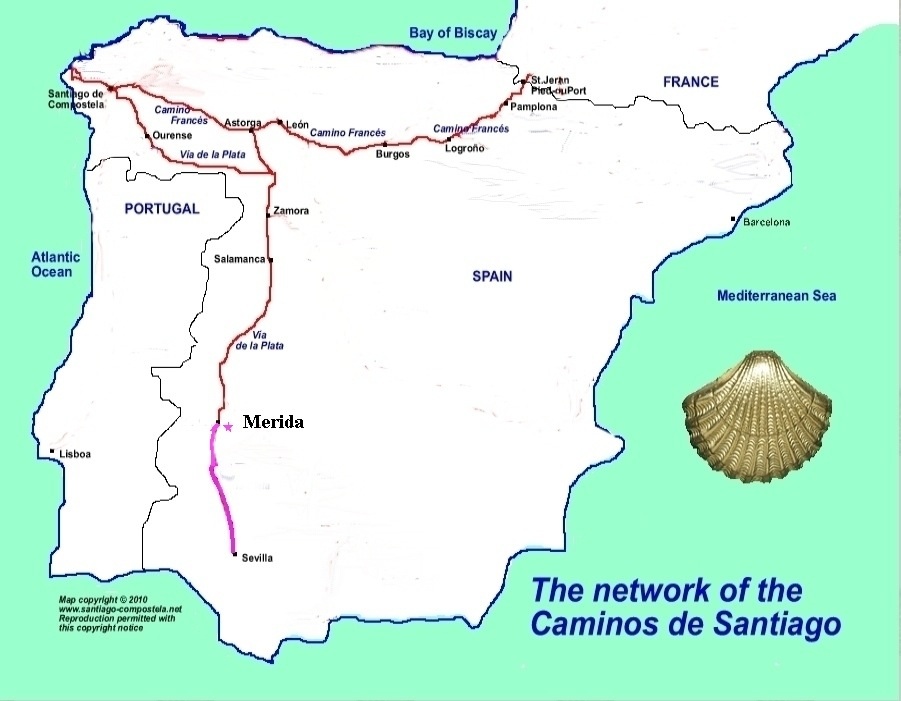
The monks took with them the coffin of St Cuthbert and other valuable relics like the famous Lindisfarne Gospels. For over a century, the monks and their successors carried the coffin around the north of England , settling for a time at Norham-on-Tweed, at Chester-le-Street and at Ripon before settling at Durham in the year 995 AD. The legendary story behind their settlement at Durham is related in the legend of the Dun Cow . There are similarities here with the legends about Santiago and the various sightings of his remains,plus the fact that both Durham and Santiago de Compostella became major pilgrim sites.
Dun was an Anglo-Saxon word meaning ‘hill’, while ‘holm’ meaning island is a word of Scandinavian origin. Dun Holm was later called Duresme by the Normans and was known in Latin as Dunelm. Over the years the name has been simplified to the modern form – Durham.
On learning the name of their destination the monks found that they were now able to move the coffin. Proceeding west through well-wooded countryside they asked a number of local people where they could find Dunholm but unfortunately no-one had heard of such a place. Luckily by chance in an area later known as Mount Joy a milkmaid was overheard asking another milkmaid if she had seen her dun cow – a grey coloured beast that had wandered off on its own. The other maid answered that she had seen the cow roaming about near Dunholm.
When the monks heard mention of Dun Holm they were filled with joy and followed the footsteps of the milk maid as she searched for her cow.
By this stroke of luck or divine providence, they were able to find the site of Dunholm – a wooded ‘hill – island’ peninsula formed by a tight gorge-like meander of the River Wear.
It was on high ground protected on three sides by the steep wooded gorge of the River Wear. The more likely reason for establishing a settlement and a fortress.

The following day’s weather was as forecast – the complete opposite – steady rainfall . Undaunted and prepared, the bus was taken again and we made our way up the hilly streets to the Cathedral.

The Sanctuary Ring.

Most visitors to Durham Cathedral enter from Palace Green via the North Door on which we find the imposing bronze sanctuary ring. This is popularly known as the ‘sanctuary knocker’ but the protruding ring that hangs from the beast’s mouth has always been fixed in place to the door and is intended for grasping rather than for rapping. The whole sanctuary ring is a near perfect replica of the twelfth century original which is now part of the cathedral museum’s treasured collection.
The sanctuary ring features the face of a hideous lion-like beast and represents the ancient privilege of sanctuary that Durham Cathedral once granted to criminal offenders. Criminals could seek refuge at Durham by grasping the knocker and alerting the attentions of watchers who resided in two small chambers overlooking the door.
The aforementioned website gives a really interesting account of the Cathedral as place of sanctuary for criminals in particular.
It is impossible to convey the beauty and history of this magnificent cathedral and there is much more information to be found on the Net. We were greatly impressed by everything we saw and the friendliness of the guides.


Eventually,after an uplifting morning, the Undercroft cathedral cafe provided strong coffee and to one person’s great delight- cheese scones!

After a picnic lunch on the riverside, we continued walking alongside the Wear .

Then, after taking in some of the streets and shops , a taxi ride back home to base, the alternative would have been a 45 minute wait for the bus.


Despite the rain, it had been a great day in canny Durham.


So glad to see you are back traveling again and to have escaped the nastiness of the pandemic.