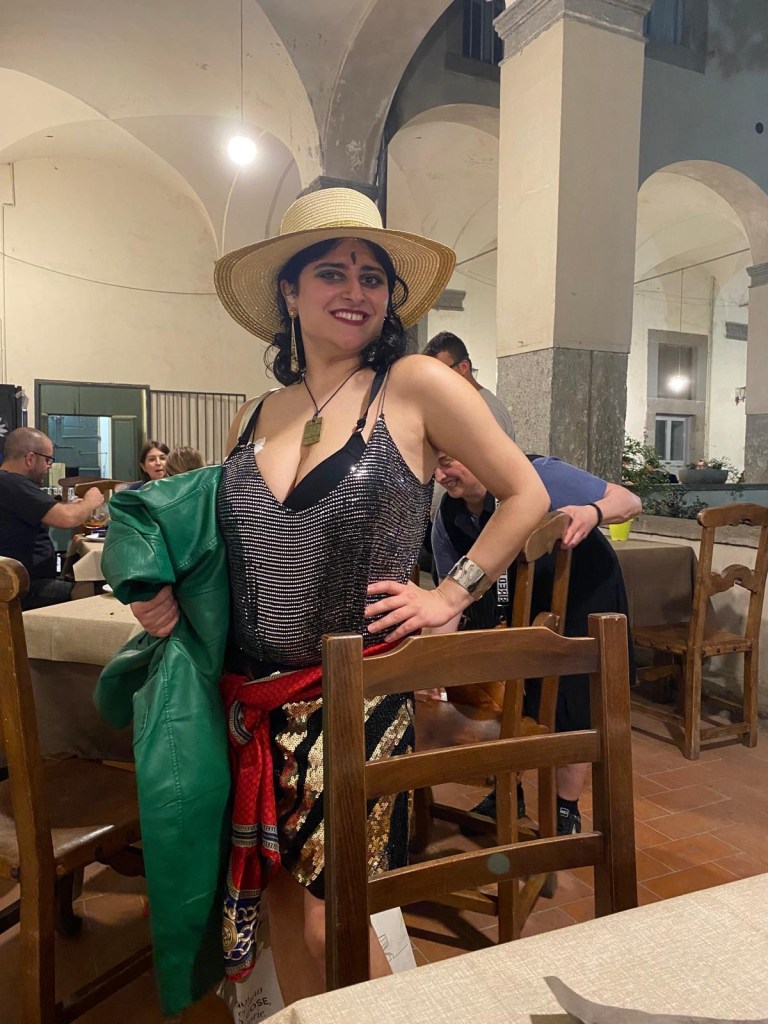
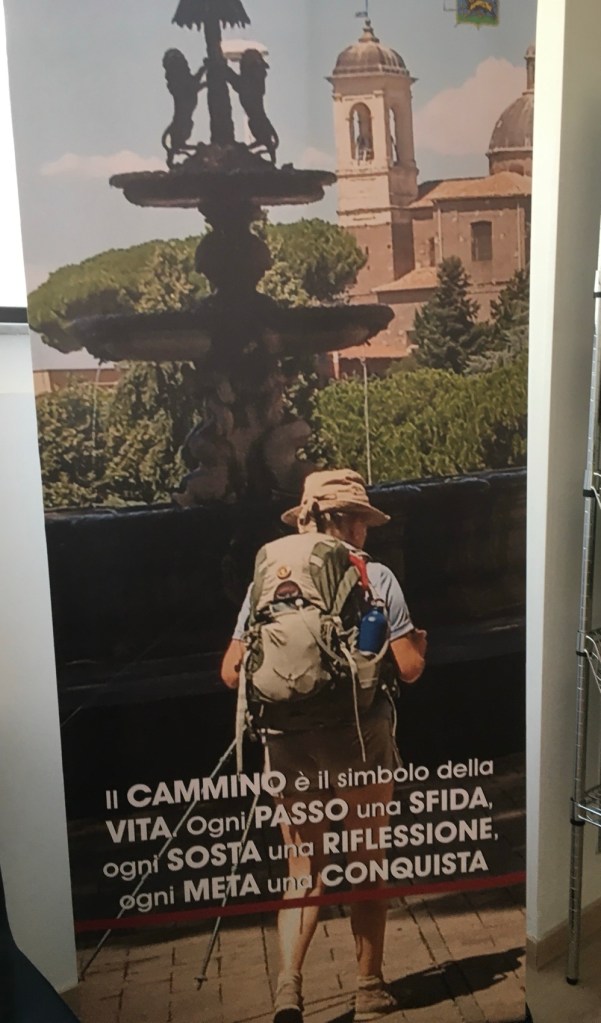
Taken in the Museum,yesterday,with a couple more taken last night Appreciate the message on the bag.No it’s not a cake! It was my dinner in a tiny restaurant near the hotel. It was young heifer with tuna sauce and caper berries – the red cabbage was a treat,too.Leaving Viterbo – Some noble fountains here
We made our way down past the cathedral to the start and before very long we were walking along a very interesting stretch of Highway.
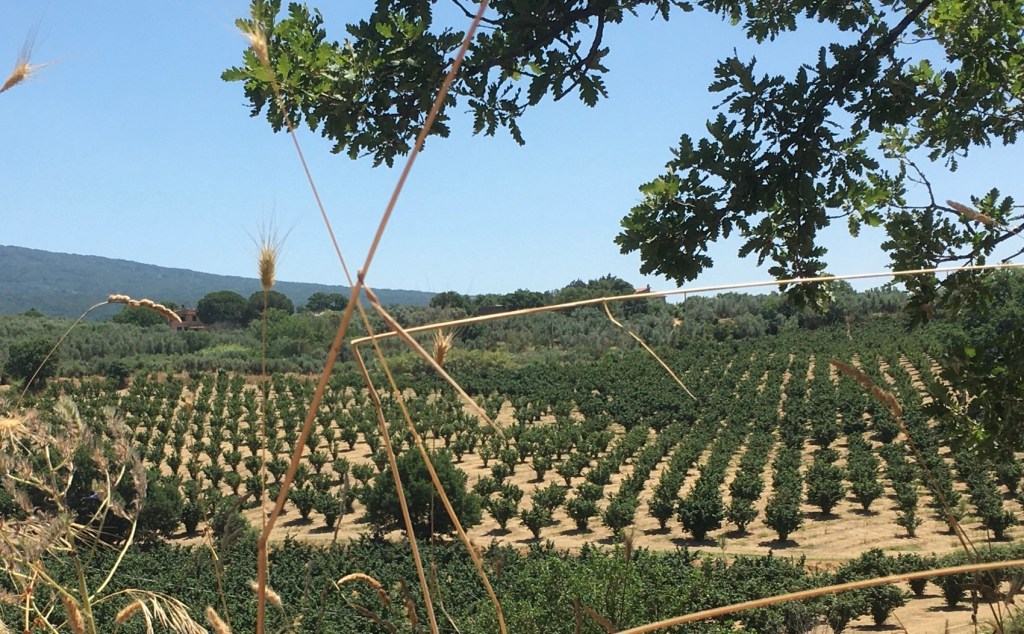
The Vie Cave, or “excavated roads,” are a network of ancient paths carved into the soft, volcanic rock (tuff) of the Maremma region in southern Italy. While not directly in Viterbo, they are nearby and easily accessible, and the area around Viterbo is known for its similar tuff formations and Etruscan history. These roads, likely of Etruscan origin, served multiple purposes, including transportation, defense, and possibly even religious rituals. Quite narrow at the top at times but providing good shade. History and Purpose: Etruscan Origins: The Vie Cave are primarily attributed to the Etruscans, an ancient civilization that thrived in central Italy before the rise of Rome. Transportation: The roads likely served as vital pathways connecting settlements, necropolises (cemeteries), and agricultural areas. Defense: Some theories suggest the deep, narrow trenches offered protection against invaders, acting as natural fortifications. Water Management: The intricate system of trenches may have also helped manage rainwater runoff, channeling water away from settlements. Religious Significance: Some scholars propose that the Vie Cave held spiritual or ritualistic importance, with evidence of sacred symbols and niches found along the paths. Re-use: The Etruscan-built roads were later used and modified by the Romans, medieval populations, and even in more recent times. Not the most photogenic walk thus far ,but we had a break at this picnic bench – rare but always welcome.Already in the high twenties Lazio – the soil a different hue; with some hills to view.Irrigation methods on a grand scale.A Hazelnut plantation.The increasingly numerous Olive grovesAfter a short, stiff climb we came upon a viewpoint looking towards the West and the Med. apparently.Butterfly having a breakI really like this form of naive artwork – it reminded me of a visit to the Museum of Naive Art in Zagreb,Croatia.Rough rather than naive..Last views before descent into rows of Olive groves as we neared Vetrella .This little spot by a gateway offered a “timbro“ – a stamp for your pilgrim passportThere was also a notebook inviting you to offer your thoughts on the Via Francigena.Fruit trees of some description made a change from the olives .A wine store on the last leg ( and ours ) of today’s trail.After 11.26 miles we were relieved to be there – it’s not so much the distances or the terrain – it’s the heat …33* @ 14.00.Our digs for tonight A very relaxing space – the garden – bright, refurbished rooms, too. The first real rain we have experienced started at 17.00 – some thunder – finishing by 19.00. Forecast for the remainder of the week is in the 30s
We had an enjoyable evening at a local bar then restaurant.
Comparing these photos from yesterday afternoon’s arrival.
Car heavy and the usual commercial centre..
With our experiences on our “ free day”…total contrast
But first it is worth capturing a little of a memorable meal had yesterday evening at our host’s Ristorante
It is set in the cloister of an old convent – La Chimera
A corner of what was the cloisterA model of Our Lady of Lourdes at the end of the restaurant corridor recalling its origins.My BBQ mixed grill.
During our meal an accordionist appeared and walked along playing ( to me ) unrecognisable tunes. He stopped at the next table and began playing “ Happy Birthday to You” – inevitably we joined in to much apppause – the young lady who was celebrating her 25 th birthday came round with a bottle of Prosecco .
25 today,25 today! What a smile.
Thursday morning, No rush, no alarm,no packing- it’s a free day and what better place in Tuscia to be than Viterbo? Free means doing your own thing so three of us set off, after a leisurely breakfast, to find the tourist office on one of the main squares. We arrived to find it was closed and “ moving premises”. Undaunted ,we easily found our first destination close by with the unexpected help of two lifts
We bought our discounted tickets by showing our Pilgrim Passports for entry to the Museum, the Cathedral and the Papal Palace, complete with headset .The Cathedral – notice how deserted the square is and it was to be like that during our self- guided tour.The Papal PalaceAn embossed doorway.I’ve included this plaque for Rob, our multi linguist and devotee of Spaghetti Carbonara!
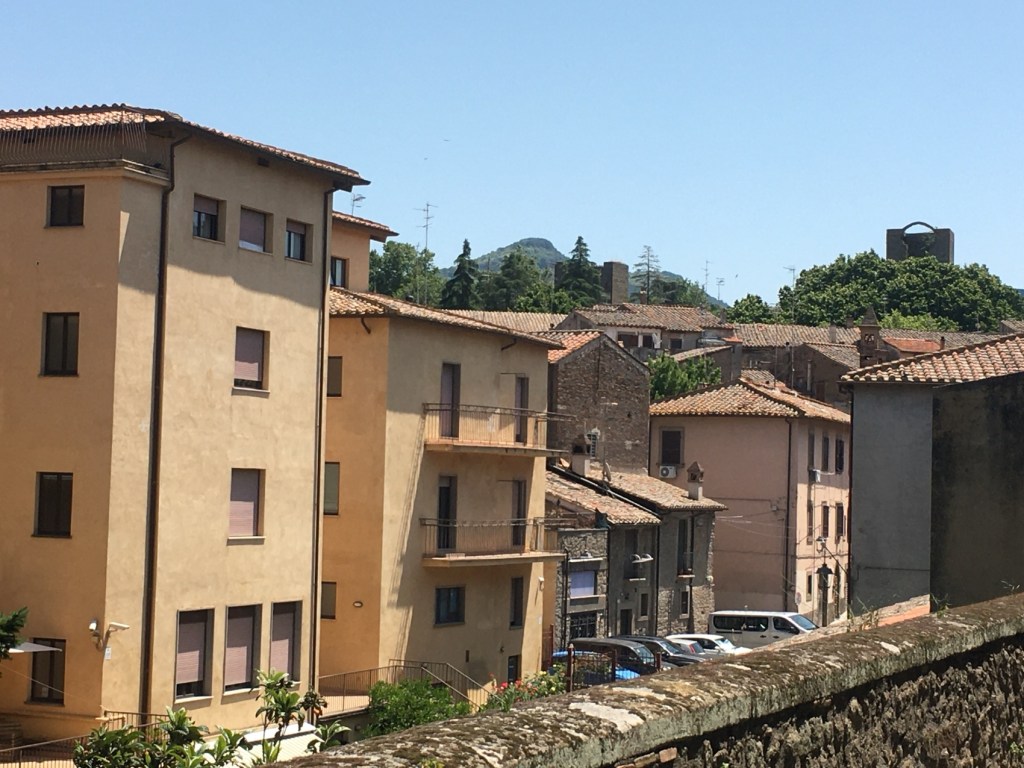
After three tours we were ready for a break and followed this street.A quiet PiazzaAn Americano and ginger beer – you should try it .Vista We made our way to,the Medieval Quarter.Lots of these alleyways off this street
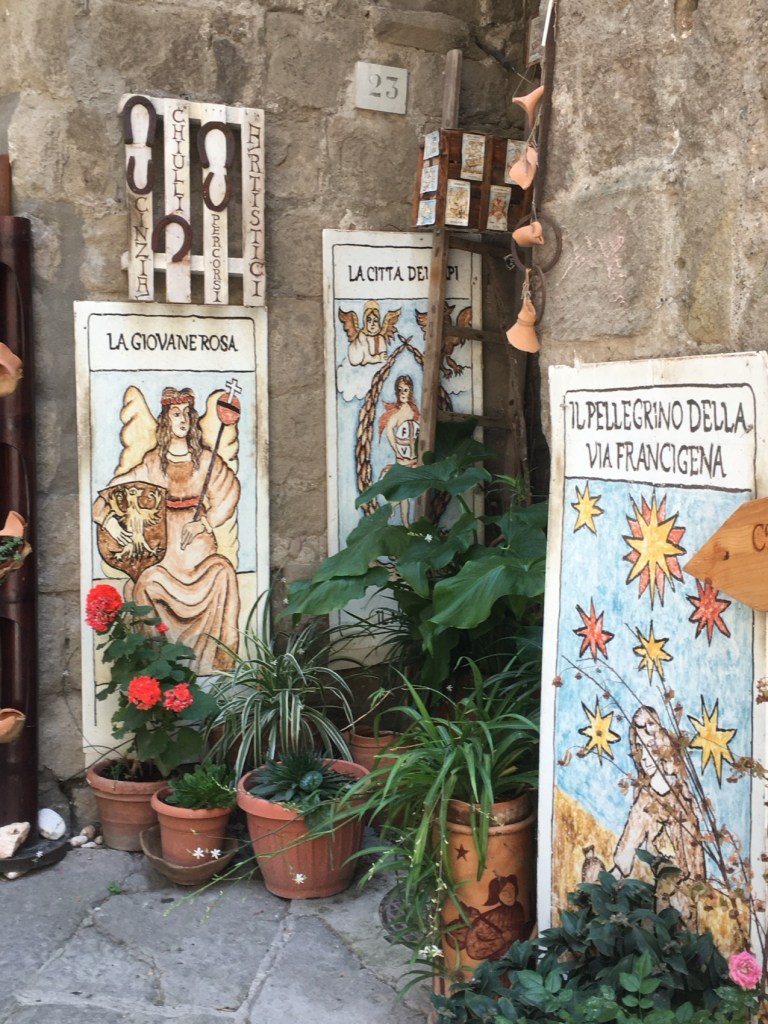
Some attractive shops
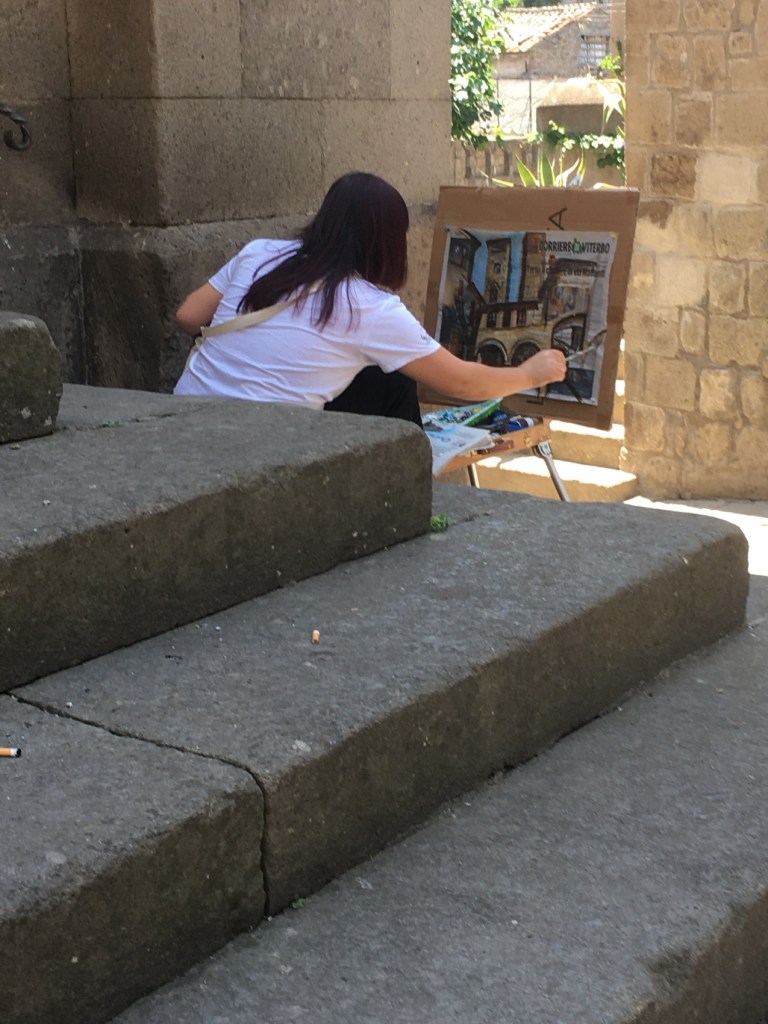
Moving on under archwaysArtist at workFloral stepsMaking our way to a green areaIn the shadeThis place translated as a resort.We walked on above it along the roadFour TowersUn appezzamento di terreno – an allotment- what a setting We decided we needed some lunch at this point.Passing another Marian GrottoA great Porchetta Panini purchased from hereA fountain dominated the piazza where we had our lunch stop in the shade.Walking towards our hotel.We entered the Pilgrims’ office and the device above had been used in 2024 to transport a disabled Pelegrina with a team of four in assistance.- quite some effort I should think.Tomorrow we have choice of two routes out of Viterbo to Vetrella – we shall take the route recommended in the Guide Book which happily happens to be 5 KM shorter.
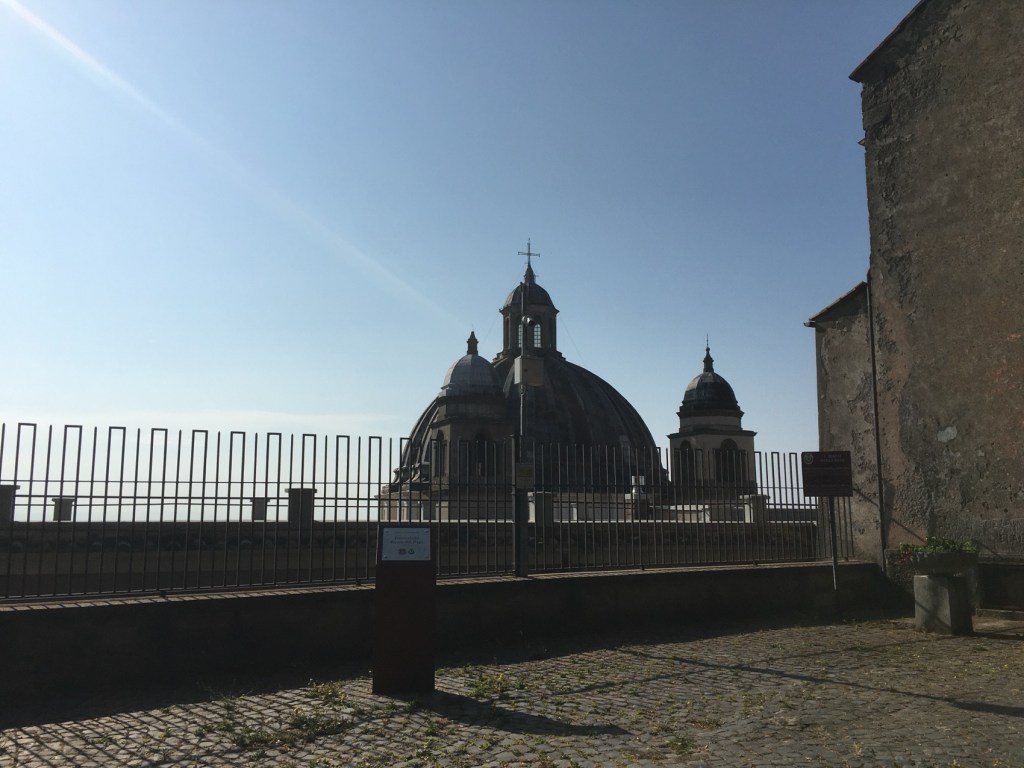
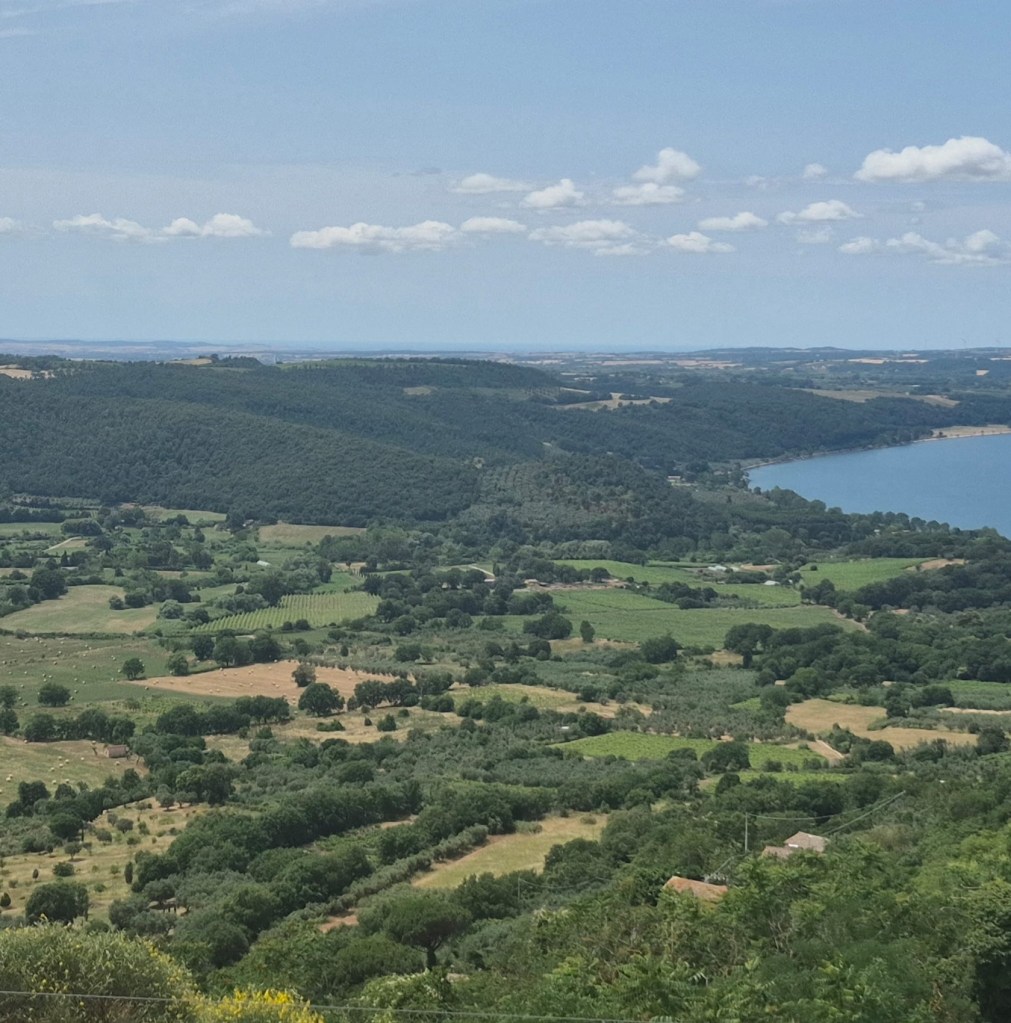
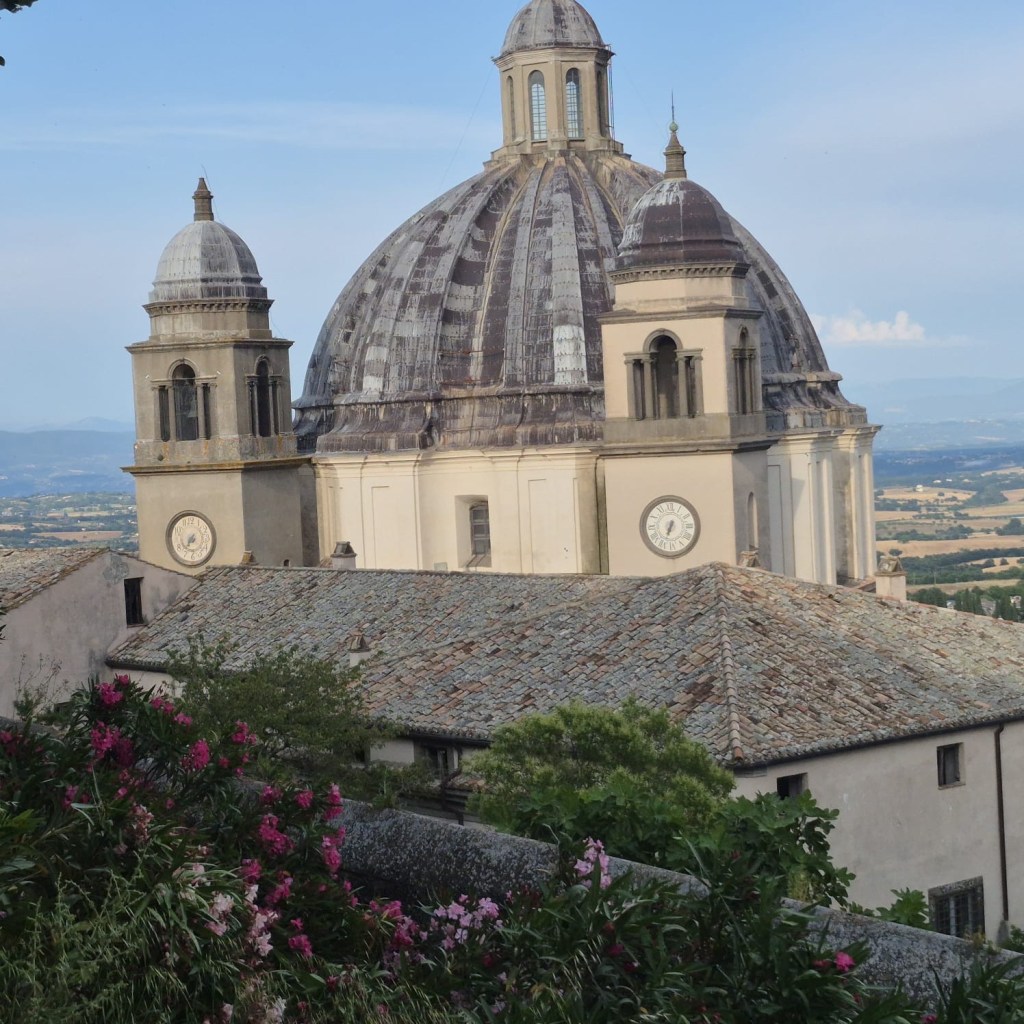
Leaving Montefiascone at its highest pointA pleasant garden with great viewsThe lake Cathedral DomeThen we began a long and steep descentLooking BackCornflowersStunning coloursA Marian Shrine We soon came to the Roman basoli paved path which stretches almost unbroken for nearly 3 km. For two thousand years this has been the passage for kings, emperors, soldiers and merchants.
Look closely – soldier ants on the march bearing crops
All disappearing down the hole.
An impressive railway bridge. Where the district of Viterbo beginsA good thought and farewell
Relieved to come upon this picnic bench as there was nowhere to sit this morning and sadly that has been typical of our experiences so far on the Francigena. It is understandable that there are no cafes between towns and villages as there is no footfall except for pilgrims and the numbers would never be enough to support bars etc.However, some seating would be much appreciated- not all,of us like sitting on the floor and even that option is not always available- beware ants😅.
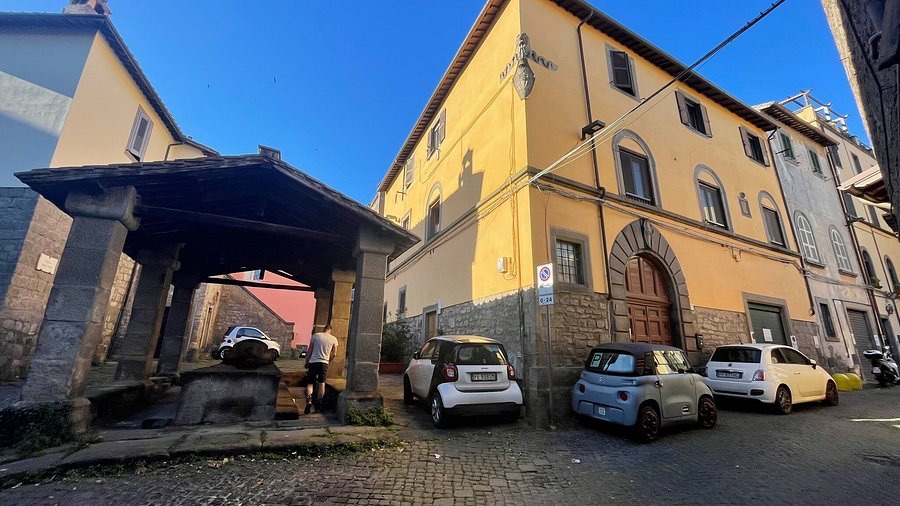
Jubilee year marker stone. Just after leaving this picnic spot I began to feel an ache in my right hip – nothing new but I suspect it was the aftermath of that Kilometre long descent.Although there was not a great deal,of distance to go on what had been an enjoyable walk so far,I felt increasingly uneasy as there is still a week’s walking to do,notwithstanding the rest day tomorrow in Viterbo. After a few minutes we came across a main road and to my relief there was a bus stop – a pleasant young man was waiting there and he assured me that a bus for Viterbo was due. We always said “ The Camino Provides”. As I boarded, I went to offer my credit card but the driver waved me through! It was a long walk from the bus station up to the old town.Turning right after entering the Porto Romano, I followed the phone’s directions for some time – it was quite complicated- eventually I reached the B&B Palacio Romario.I couldn’t make head nor tails of the phone numbers and so I sat down on the edge of the old washing baths opposite the entrance. Fortunately again, after a few minutes, the owner just happened to pop his head out and on spying me , he beckoned me in and in no time at all I was in our room. After a long drink,a banana and a couple of painkillers I feel OK…Thanks Mike for the Roman road photos.We have a rest day tomorrow and time to explore what is reputedly a very historic and beautiful old city.
Or so they say….Lots of shade, undulating walk with some climbs albeit we are walking alongside the lake ,but on a ridge for the most part.Noisy waterfall spilling into the lakeThe end of the lake.We thought this looked an inviting stop until we got close to the pipe where it warned not drinkable ! A Bummer. Last glimpses of the lake for now.We reached Montefiascone around 13.30 ; 11 miles enjoyable walking with a decent hill to finish!This little city must be one of the most underrated and less known. We were very impressed by the history and culture plus the friendliness of the local people.The Cathedral Pelegrinos Lake scene after a hefty shower.
Sunset from the balcony of restaurant Dante – a somewhat chaotic dining experience – but what views.
Leaving Acquapendente – bus services are good and very cheap compared to taxis – today’s fare was €1.10.
Walking along the usual gravel road,very little traffic.
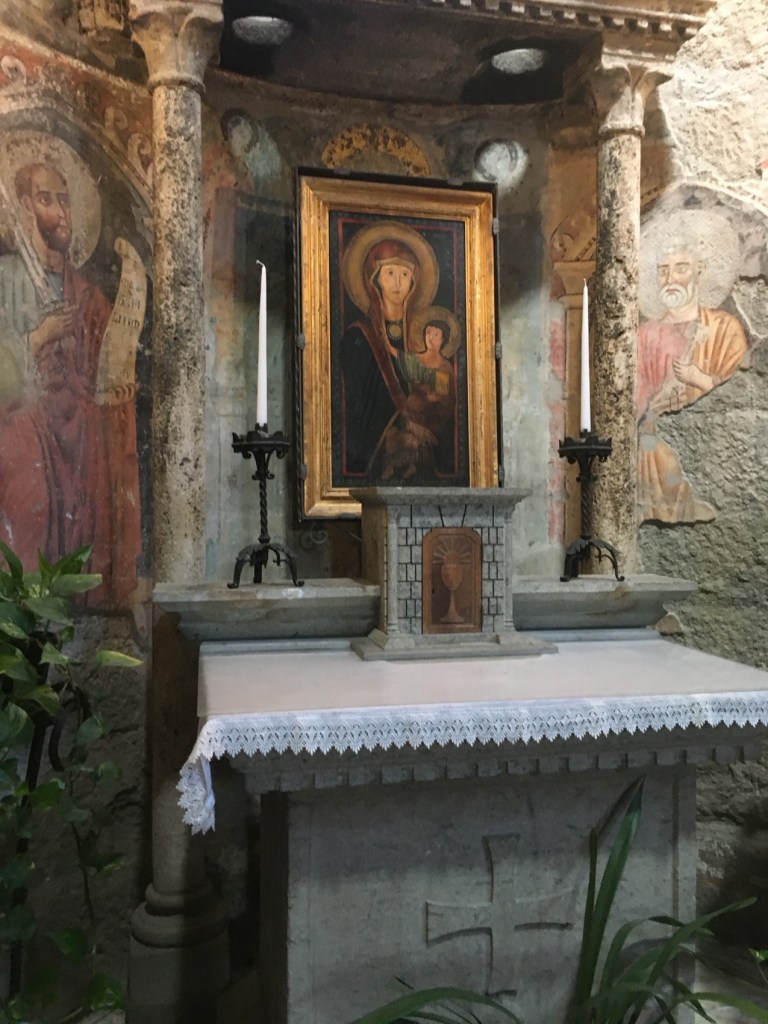
First glimpses of Lake BOLSENA Papal Swiss Guard commemorative plaque in a remote spot.Not quite sure about this!The lakeA kind of geranium growing on the path PoppiesBreak time in the garden of a deserted villa.Reaching the outskirts We were totally surprised by what we found inside this humble looking chapel
FRESCOES EVERYWHERE …
Onwards towards BOLSENA The “ sticks” in the background are actually Garlic!The CastleIn the fountain Quiet time – SiestaSan Christina – our very own Pelegrino !Nearing the hotel- another Agrismo.Hydrangeas are popular in BOLSENA Another fabulous pool settingJune and Christina relaxing after a swim
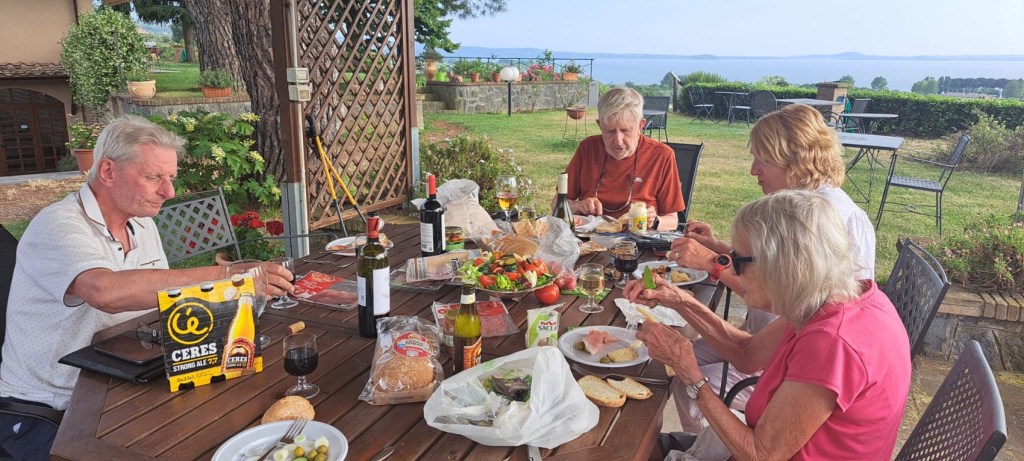
Christina suggested we have a picnic supper overlooking the lake on a table close-by our rooms. Four of us went down to a Carrefour Express which supplied all our needs and we set the fare out alfresco style with our saint’s very own wine
And very pleasant it was,too.Wearing Hannah’s Father’s Day present!Sunset at the end of a very enjoyable day and feast.
Heartwarming cards and presents from Hannah,Daniel and Tom for Fathers’ Day. Great way to begin the day.
Awake at just after 06.00.
Routines are essential for Camino preparation and begin the night before by getting all the packing done barring what is needed for the morning. This includes supplements to take after breakfast, socks and feet bag ready, walking poles by the door so they are not forgotten! It’s important to remember any washing that may be hanging around somewhere. After a shave, attention turns to feet preparation which includes massaging Vaseline into toes and any sensitive spots, putting on polyester toe caps ,a dusting of tea tree powder then trail shoes on. Gear on next, then two aluminium water containers to which soluble hydration tablets are added,plus an other litre bottle of water – all placed in day rucksack along with any other bits and pieces after an application of sun cream. Put all electric leads in case – close it , check the room for any forgotten items – take the case to reception for collection by luggage transfer to that evening’ s hotel, then breakfast usually at 07.00 -07.30 . Hoping to be on the trail for 08.00 most days.
Now after all,that excitement,today’ s stroll.
Sloways, our travel company booked two taxis to take us upto the summit of Radocafani.
An amazing setting.
San Petro The altar piece A view from the wallsA striking statue.
The previous evening it was decided to take taxis down from Radocafani as the descent was 500 metres of steep tracks . Not a great distance, but it would help preserve our knees for the next ten days’ walking.
“A Long and Winding Road…” as they sang so memorably.
The piazza near to our digs in Acquapendente.Locals’ Sunday papers’ Reading club Our nearby piazza Our digs- in a family run hotel,of nine rooms.At about 15.30 as forecast there was a short storm and a spot of rain .Plenty of water for the fountains behind our place.After the storm subsided I went for a stroll. View from the walls.Rapturous sculpture You can just pick out the Basilica to the left from here.A cooling Zuppi Inglese.Artwork underneath town hall arches As promised ,Tom’s Fathers’ Day present – a Wolves themed T-shirt in iconic Old Gold and Black – our present Portuguese manager appointed last year to save us from relegation; which he did. He famously goes to local pubs and mixes in.Great guy and an excellent coach.
Fountain express – a Tuscan special meal – yesterday’s bread and bean soup – a speciality.
This morning we left our homely B&B to have breakfast ( included) at a small Trattoria in this piazza.
A traditional breakfast was enjoyed there,though the choice of teas was a guessing game!June joined us from her hotel as it was planned to cut down the length of today’s walk by taking to 09.18 bus to Abbadia San Salvatore. I got the front seat and we drovec down sinuous county roads and serpentine bends with the driver nonchalantly using one hand most of the time . It was only when we disembarked at Abbadia that I realised we were the only passengers.
After a coffee stop on this busy town it was,decision time.
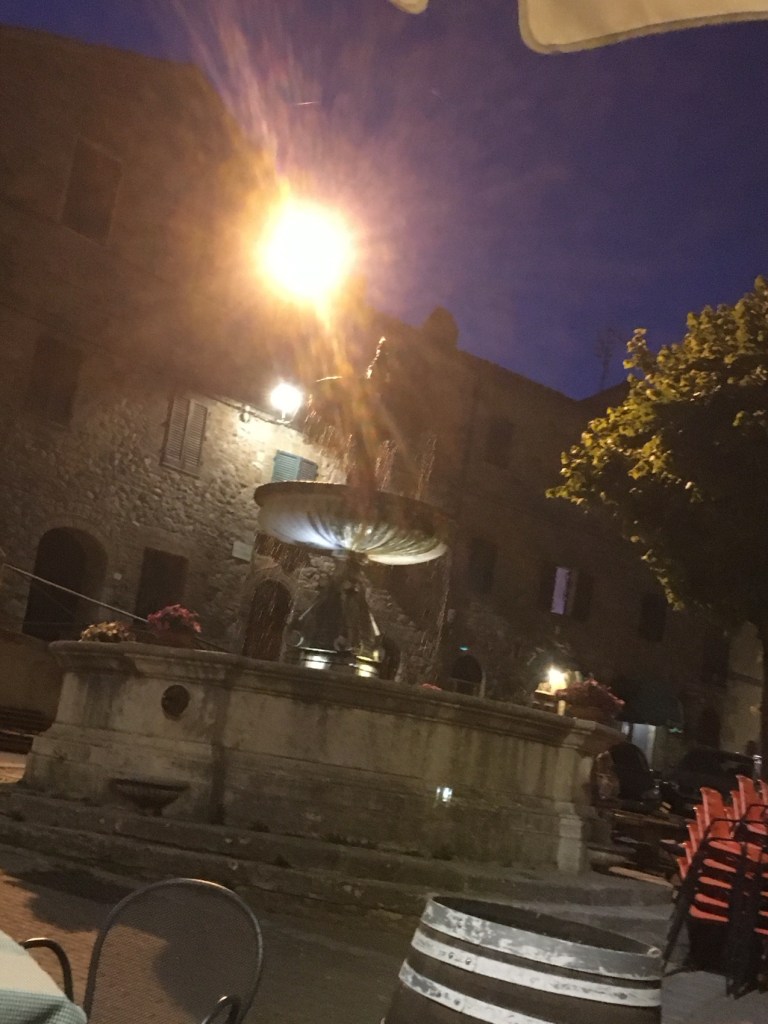
Fountains rule opposite our cafe. There was no option but to use Mapy.com to enable a short cut off the Francigena route. I must admit to being somewhat dubious because main routes are made to enable a safe passage, however, the walk began simply enough.
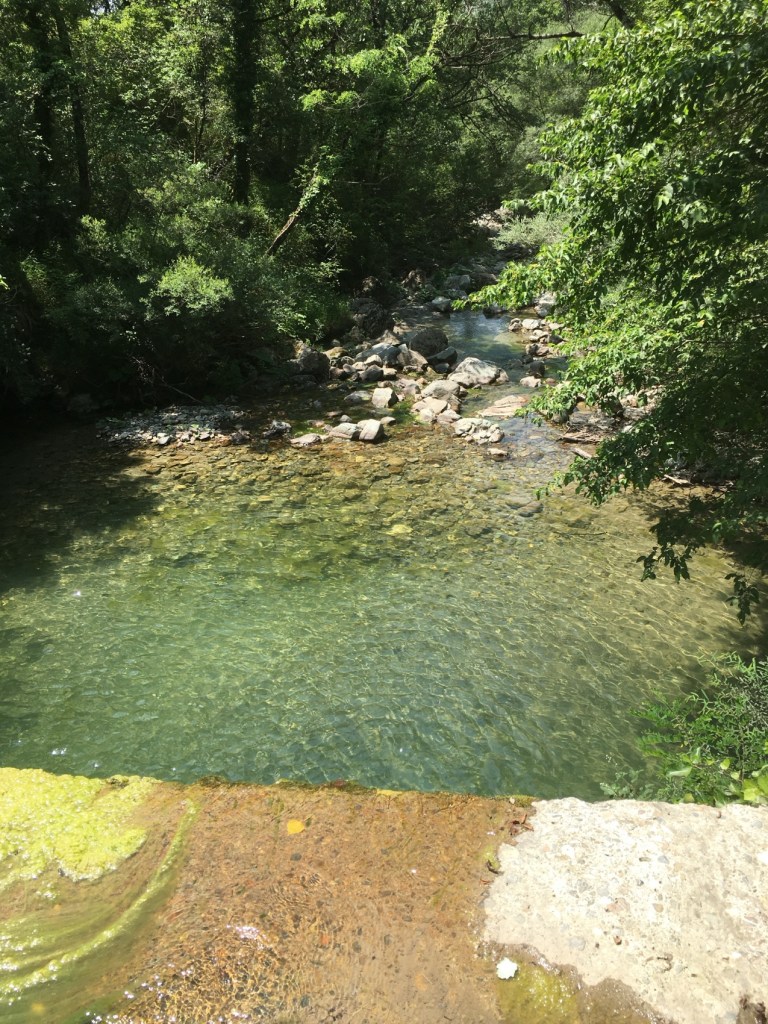
A wall,of wild flowers.A stream which we crossed safely over a concrete bridge .The path was beginning to disintegrate.We then came upon a stream running across our way. Not too deep thankfully.But uninvitingly slimy – we all got cross with our socks dry.From this point on and for a long,uphill,stretch the vegetation became as challenging as the Rocky underfoot conditions. We managed to help,each other across a metre drop onto a small dry stream bed.Yes the views were still enticing.
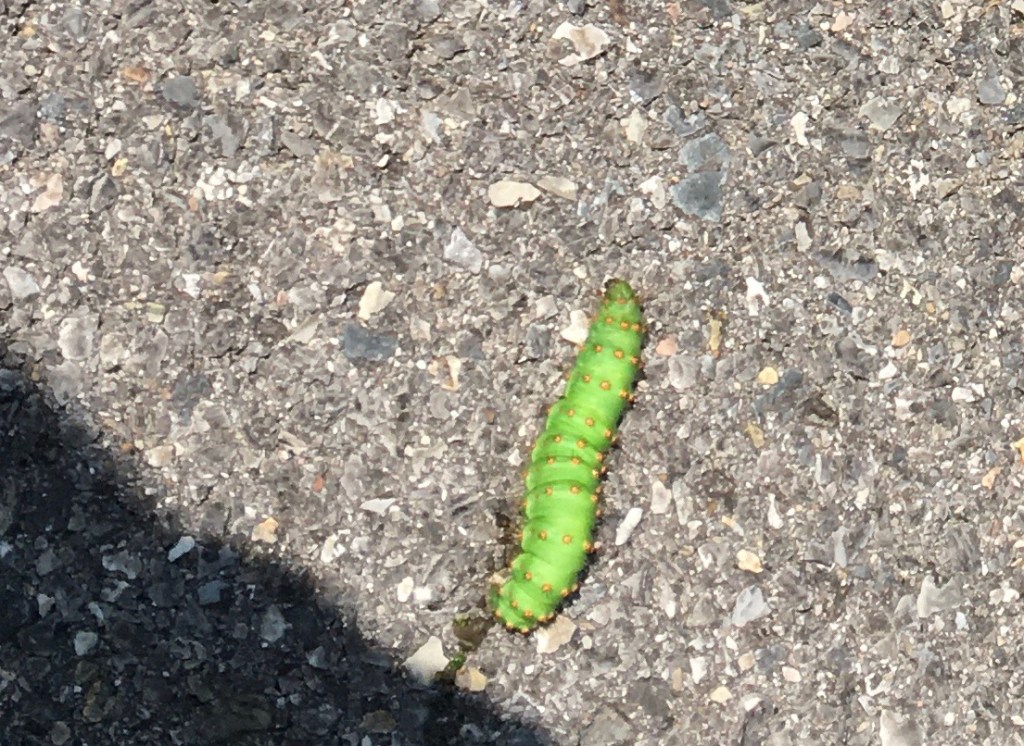
After what seemed an endless climb we emerged on a typical white path – TG.Yellow flora my favourite colour.A caterpillar crossed my path – these have a very unpleasant sting.These were popular with beesI used my bog standard App. Earlier which reassured us were close to our accommodation.La Selvella Agriturismo. A wonderful setting.What a relief after a really hard walk to relax here for a couple of hours
Dinner was served under an ancient tree – it was a very good meal served with panache and a smile . I can’t speak highly enough of enough of the help given to me by the receptionist in acquiring two,taxis to take the group down from the heights of Radificoni the next day as there were no buses on Sundays.
9km we said, it will be a breeze we said…Wrong! Friday 13 th? Nobody in this group is superstitious but perhaps we might avoid walking on that day in the future 🫣
The day began peacefully and uneventfully….But.
June pausing at an advert for an Agroturismo .Wonderful views as ever.Local floraA wild OrchidThis stretch was buzzing with insects – good to see.A lot to choose from but we chose the second one down.We explored this hamlet,but not the tower.A view from the court yardA gorgeous gardenChristina in the frame.Not long until we reached Bagno Vignoni with its ancient hot springs now walled in as a centrepiece of the village, visited over the years by Queens,Popes and Lorenzo the Magnificent We managed coffee here – rather a day trip feel to the place – but interesting, even though you can’t take a dip. The waters flow into the River Orcia.It was at this point things got tricky as a long awaited repair of a pedestrian bridge was still incomplete, which meant we had to find the traffic bridge with no footway.We had to navigate the rest of the way in searing heat using our phones which sent us up and along some tricky,rock strewn paths. This diversion, for want of a better description, added five km to the day and it was slow going, wisely, for some of us.Yes,there it is.By early afternoon and much later than anticipated we reached Castiglione d ‘Orcia and it’s peaceful squareVery welcoming lady served us Agua Frizzante and beers.Salute!An interesting menu and we might revisit in the evening
Then on to B&B Il Vecchietta Via del Cassero, with its wonderful garden and vistas; a medieval house whose stone walks made for a very cool interior
Not thinking of climbing up there but we had a very restful afternoon which helped us all recover from a tough day…but we did it!
The first part of the walk was very pleasant and uneventful ,with good views of the ever enchanting Tuscan countryside.
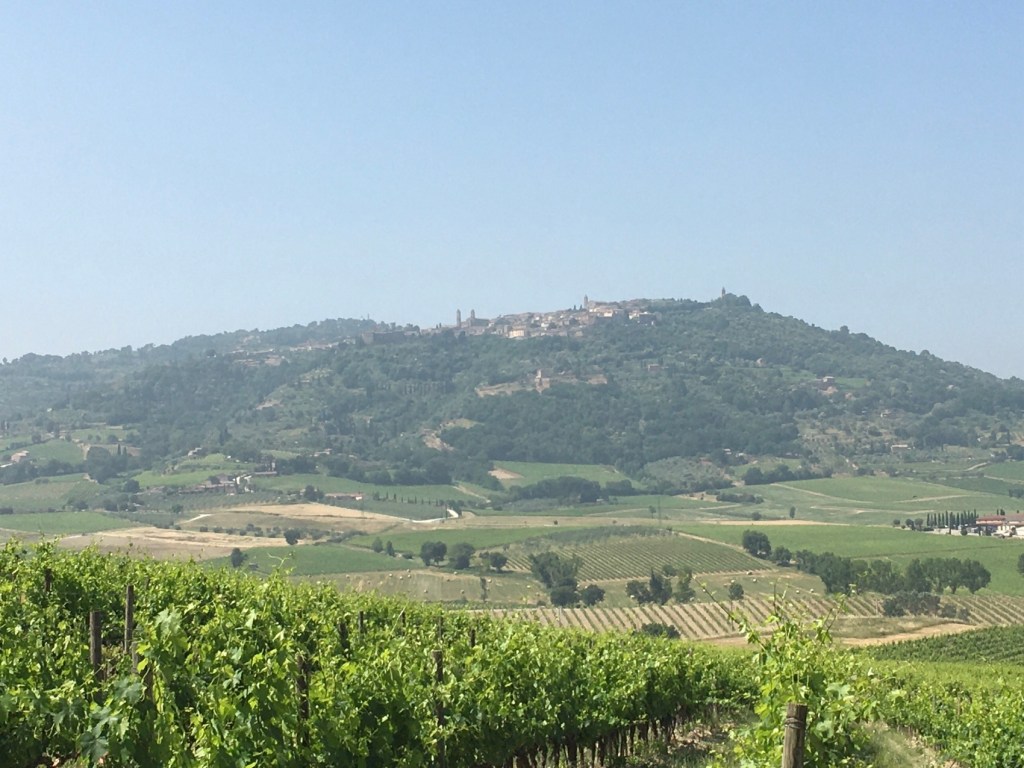
This is a famous wine growing area One of Italy’s (and the world’s) greatest red wines, Brunello di Montalcino is a small wine region in southern central Tuscany, producing particularly impressive wines. In Tuscany, its homeland, it perhaps ranks alongside Chianti Classico. On global markets, it seems to command even greater attention. Cypress Trees and vines dominate the landscapeWe stopped by the Caparzo WineryRather early in the day so temptation avoidedGlad we didn’t have to climb up there The rest of the walk to Torrenieri was along a meandering gravel roadCoffee and a snack in this pleasant little placeWe were to discover later why the flags were out. We decided to take the bus for the last few km as the temperatures were hitting 30* and reached San Quiricio quickly avoiding a long climb.Pelargoniums ruleThe square in San Siricio where we decided to have dinner. The town celebrates a feast day where the four districts parade tunefully to the church with drums rolling and flags waving. We were fortunate to be well placed to enjoy the spectacle.Great atmosphere and a good meal – memorable evening.Sunset at the hotel.
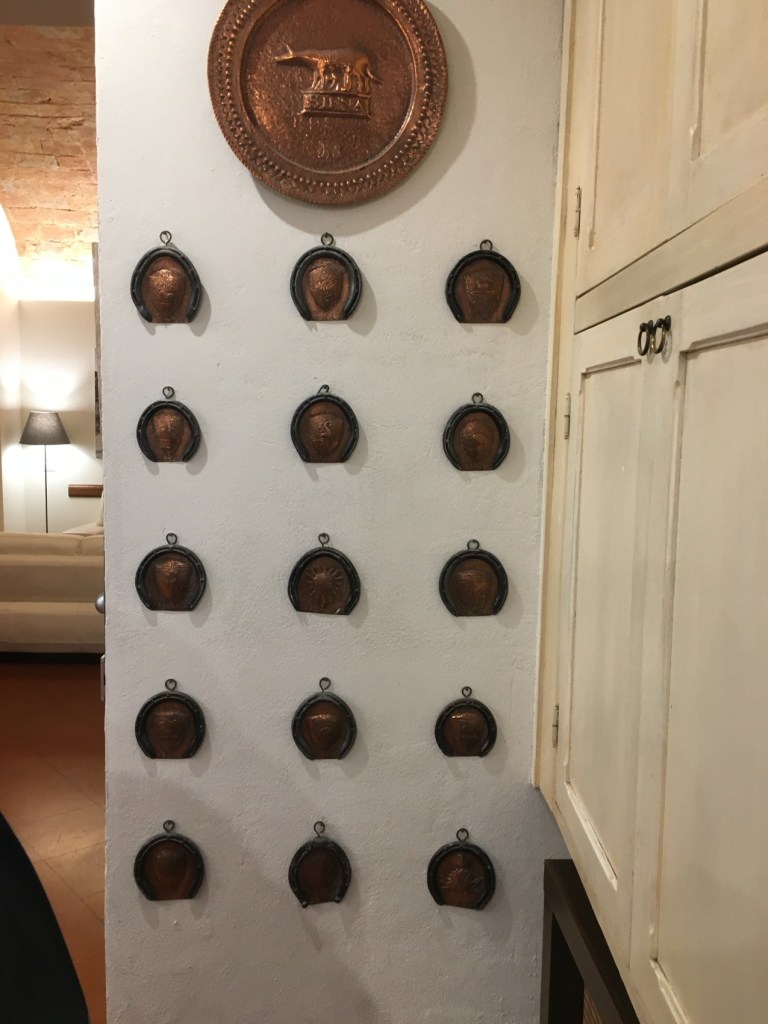
A fond”Farewell “ from our hotel,receptionist.These are horseshoe momentos of the Siena “ Palio”.Christina’s photo as we prepare to,start the walk. We walked down hill and around the Siena Salumi factory into the Tuscan countryside.A communal laundry washing point.
Up the hill and another solitary sink for scrubbing.
Wonderful vistas as you are soaping up.
We walked for some way alongside a single track railway, passing through fields of Alfafa and young Sunflowers
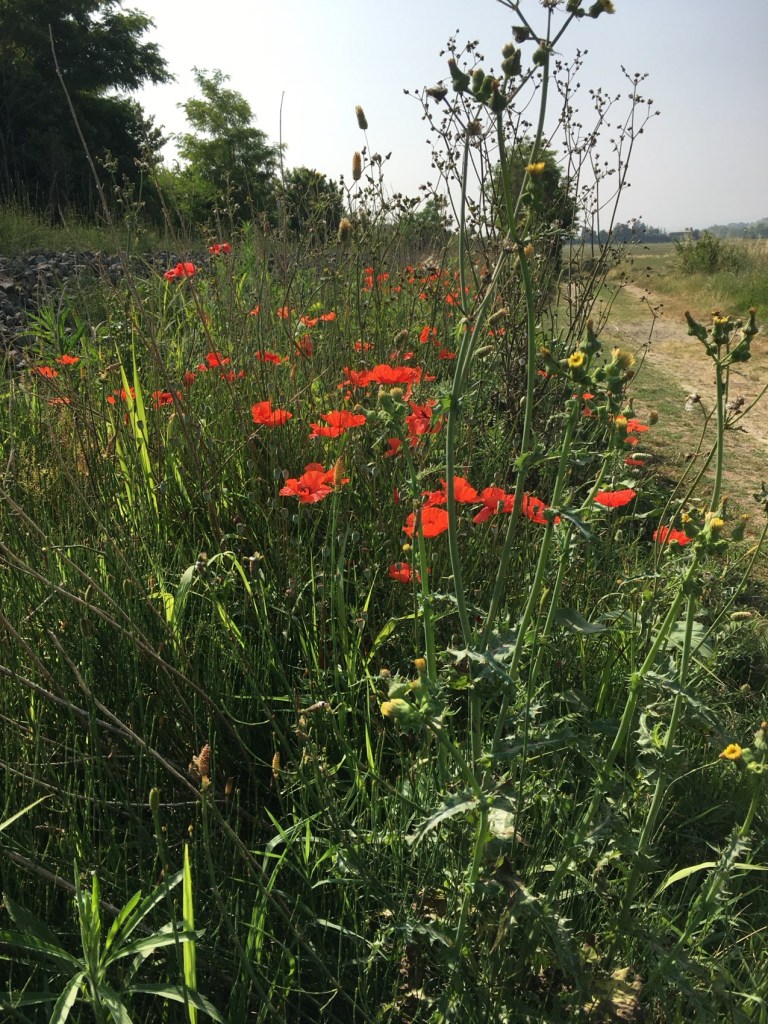
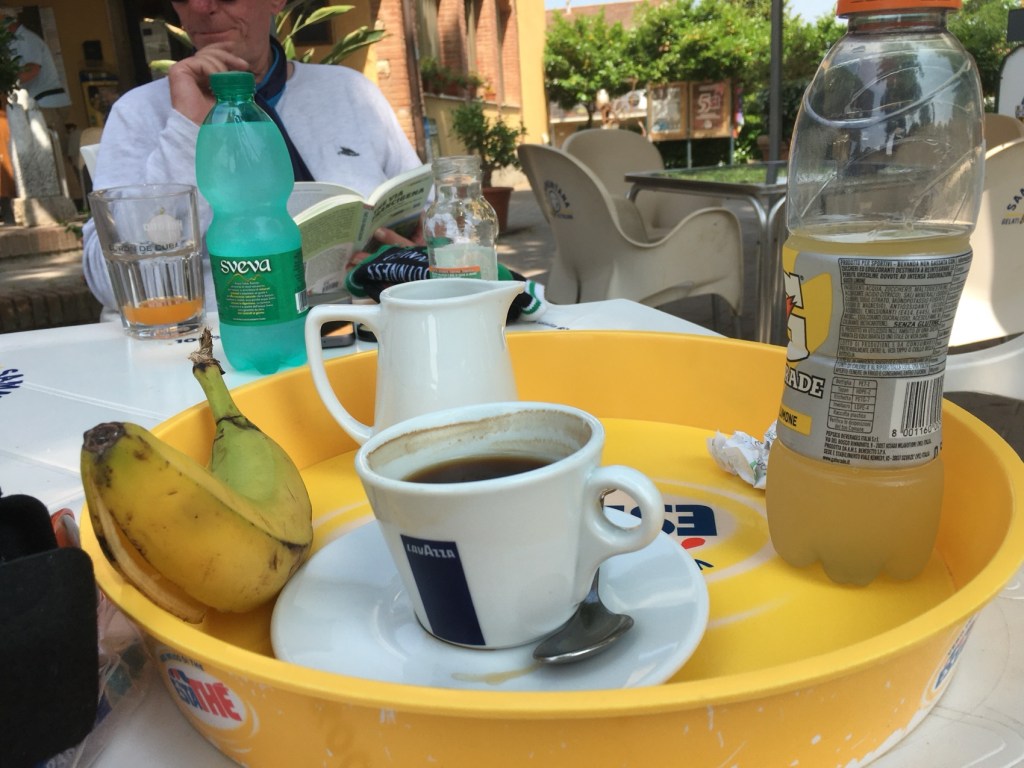
Splendid poppies, too.We crossed over a solitary bridge and eventually reached Ponte d’Arbia for a welcome break.Americano , Gatorade and a babana – default morning break for me.
A welcoming place for pilgrims and we had a chat with French group who apart from a large group of Aussies yesterday are the only folk we have met on the Via,so,far.
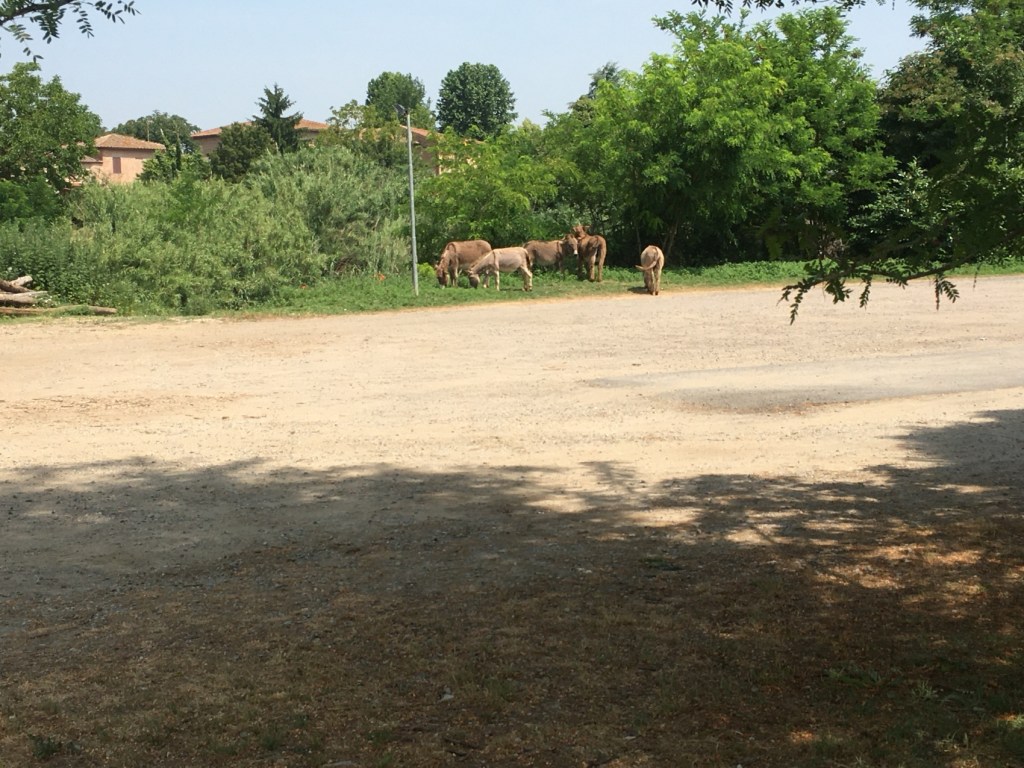
A saucy tray.We were leaving via its famous bridge which Tom had discovered escaped bombing by the Germans in the war.The Francigena did not cross the bridge because there was no footway,but directed us to a nearby pedestrian crossing.We got a great view of the Ponte from the pedestrian bridge A tethering of donkeys aside the river.A less peaceful,scene - Barking mad dog and Englishmen - glad he was not on the loose.One of a number sculptures we passed on our way up,a steepish climb.The climb begins.These were on the approach to the summit.One of a number of views.Going down…Buonconvento in the distance Almost full bloom.
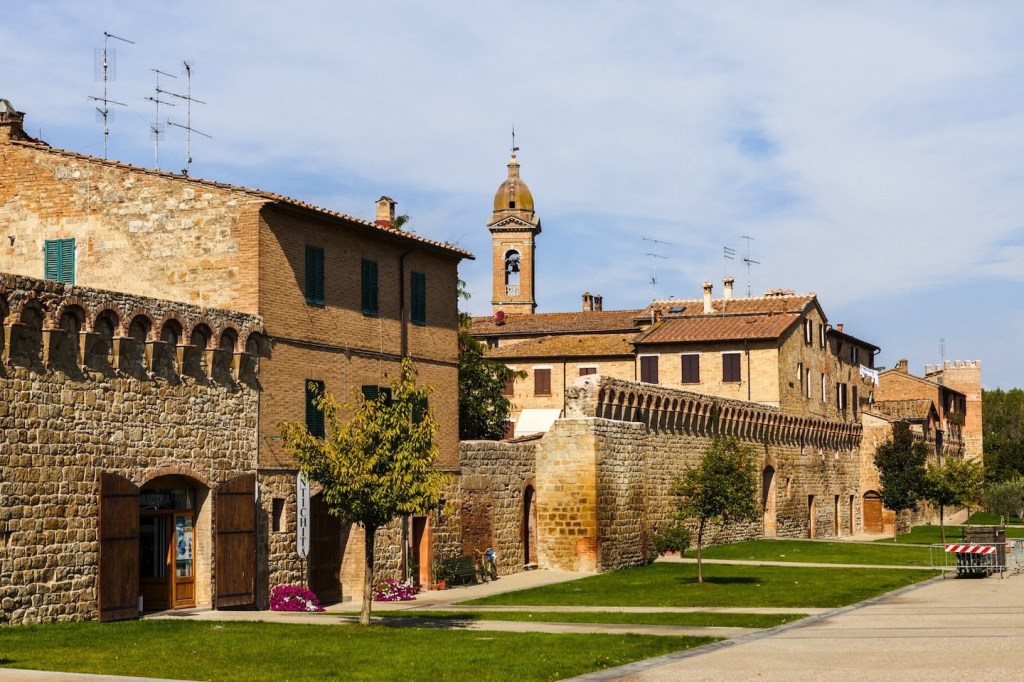
Buonconvento, only a few kilometres from Siena, is one of the most beautiful villages in the whole of Italy according to ANCI classification. Enclosed within a city wall built in 1379, the medieval village originally only had two entrances at opposite ends of the main street: towards the north is Porta Senese, where the original wooden doors and windows with metal fittings remain, and towards the south Porta Romana, which was destroyed in 1944 by the retreating Germans.
Via Soccini runs right through the historic centre, and was named in memory of the ancient family whose members included illustrious jurists, as well as a couple of heretics who organised various doctrinal Socinianism movements that developed during the sixteenth century.
The aforementioned doorsThe high street.Beautiful settingWe were all in agreement that this town had a really atmospheric feel of the Francigena – and that was before we had a beer.Then on to our comfortable accommodation and a siesta for some.Hotel Ghibellino
The name “Buonconvento” translates to “happy place” or “fortunate community” in English. It comes from the Latin phrase “bonus conventus,” which refers to a gathering of good people in a place that is enjoyable and beneficial. The town’s name reflects the historical setting as a safe and welcoming location for travelers on the Via Francigena, a historical pilgrimage route.






















































 ensuitepilgrim's Blog