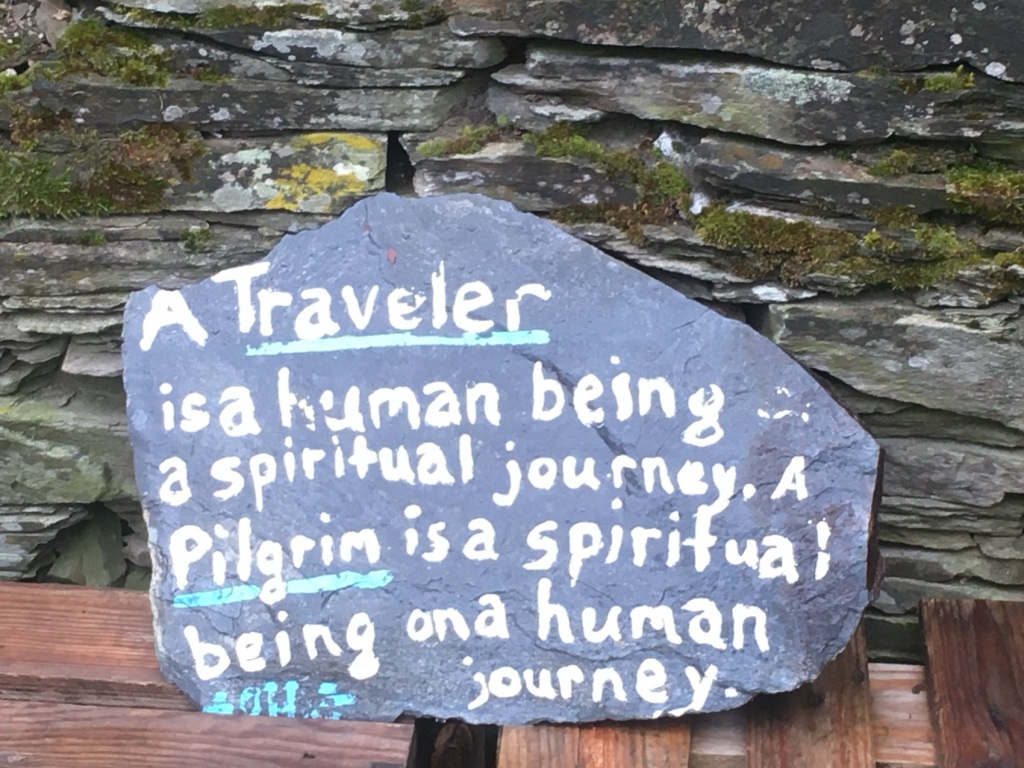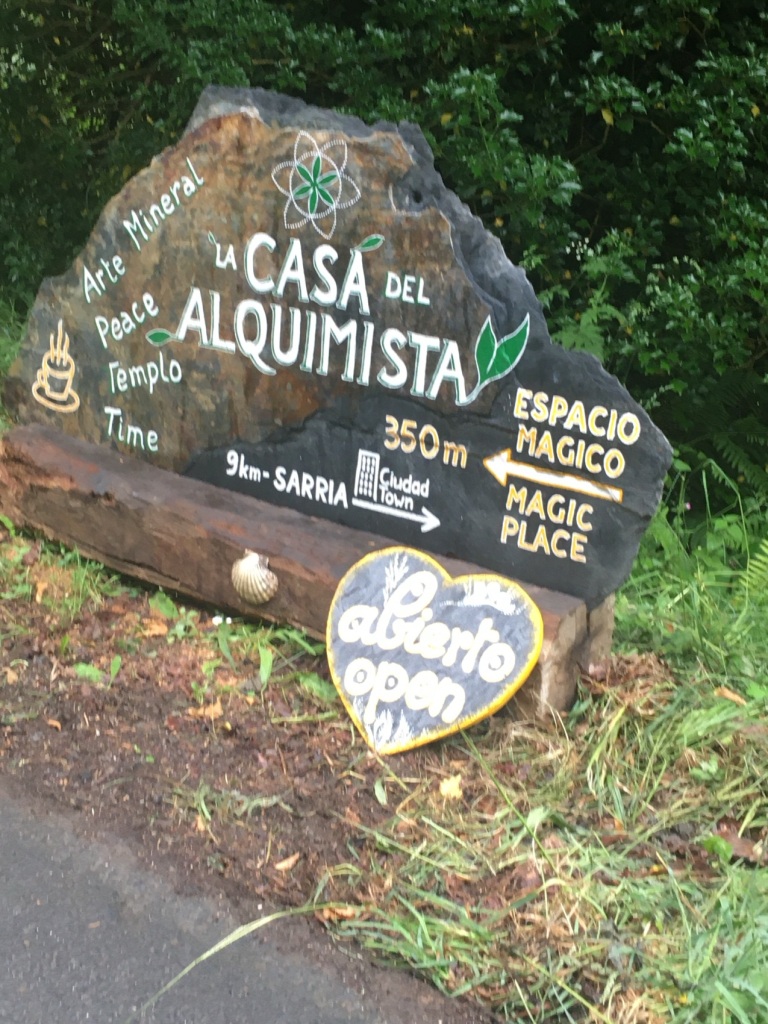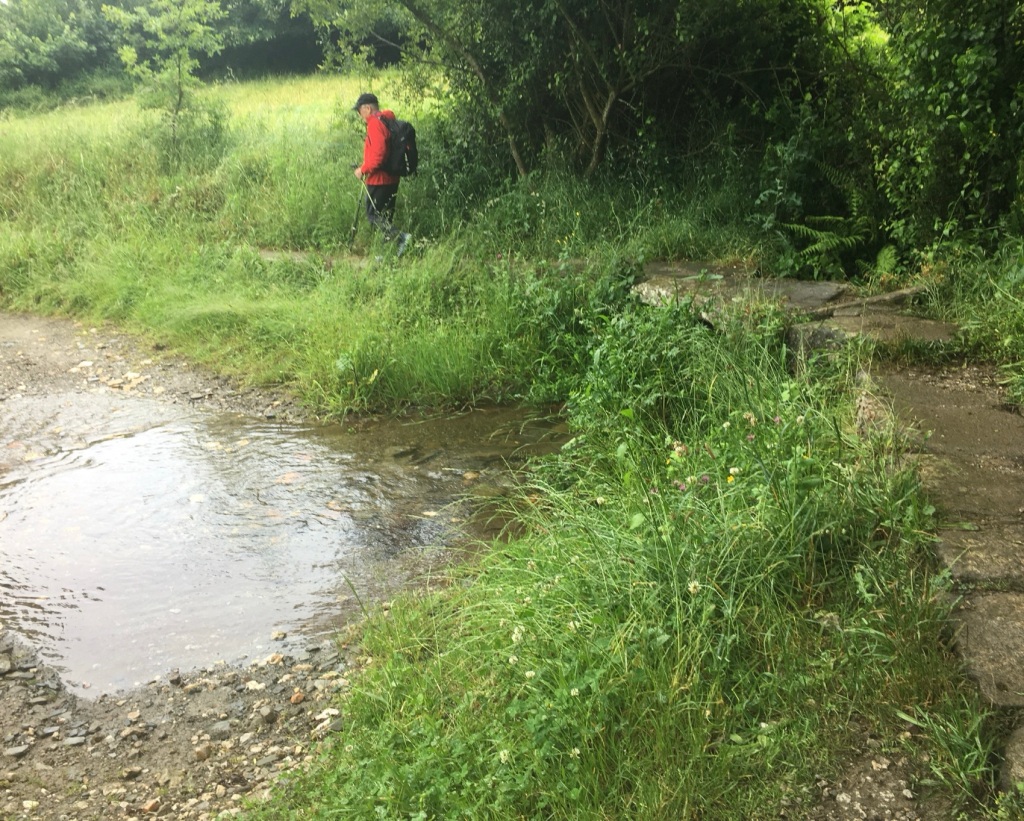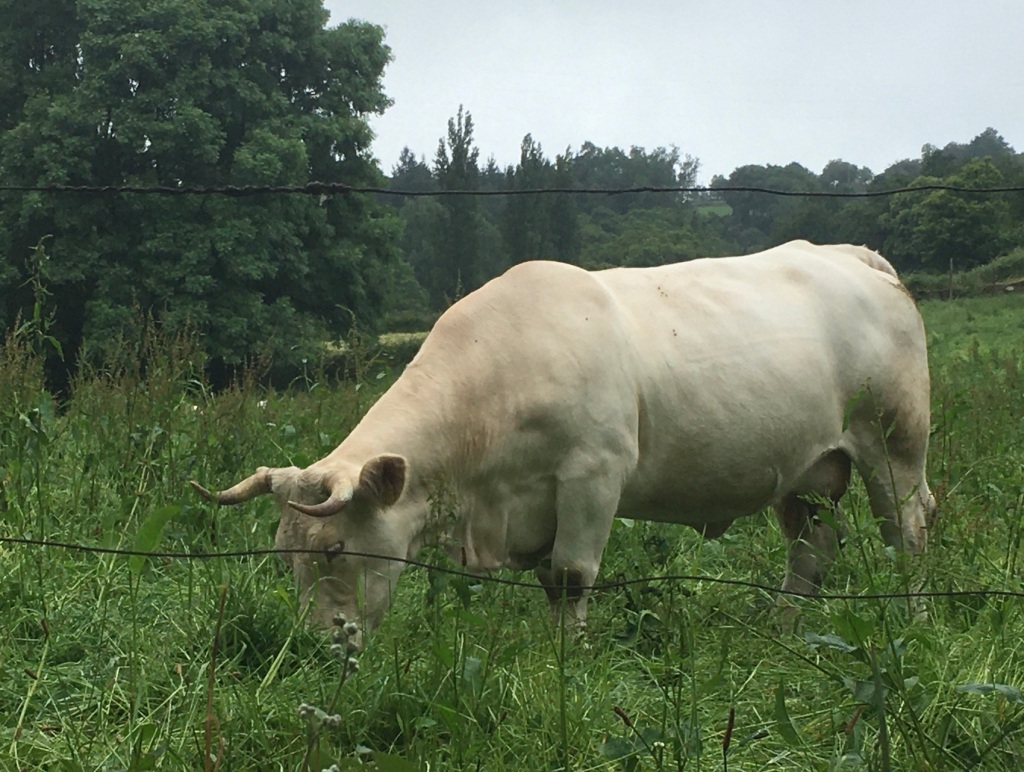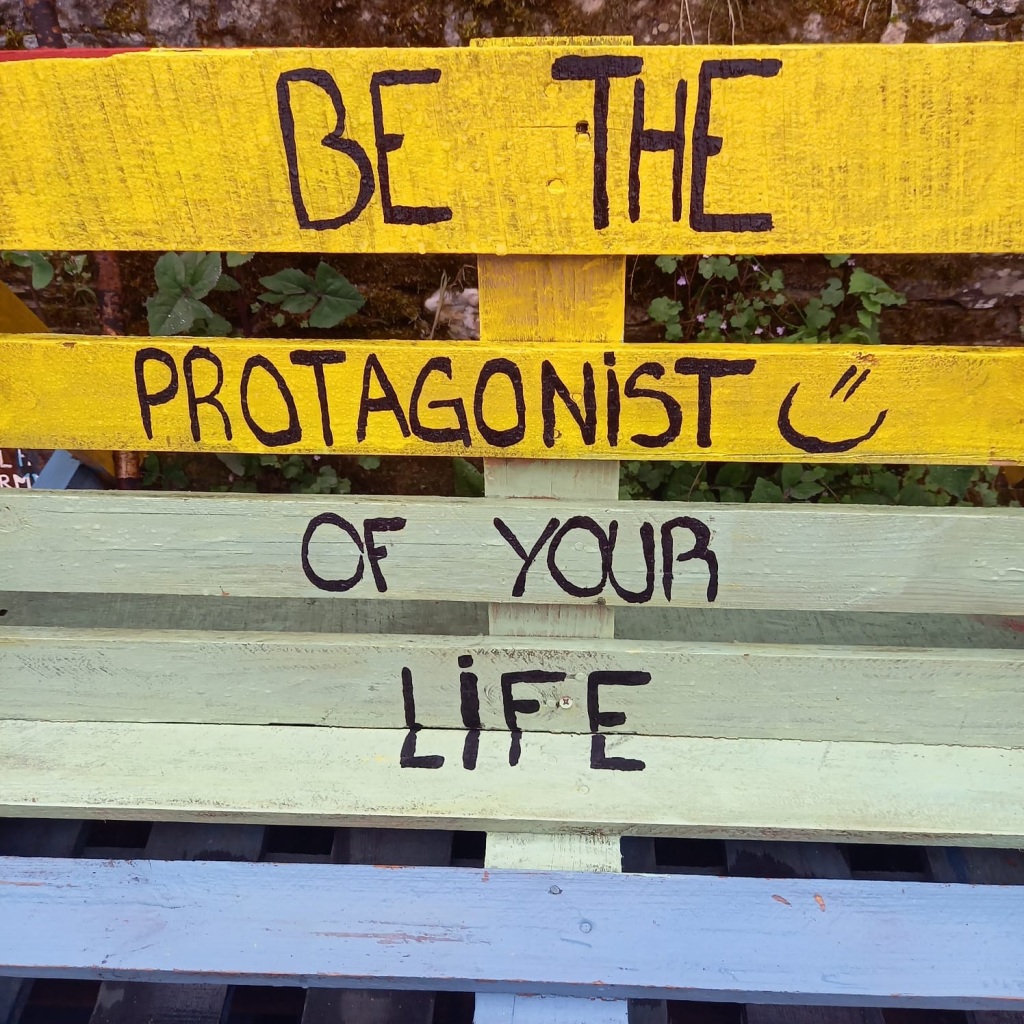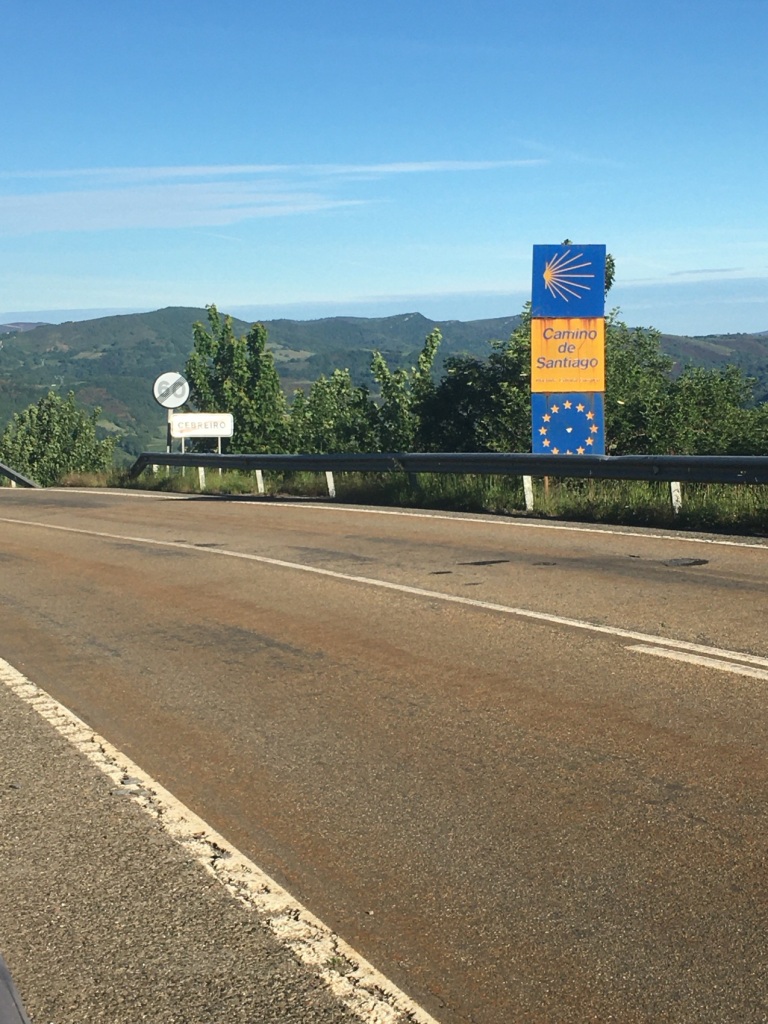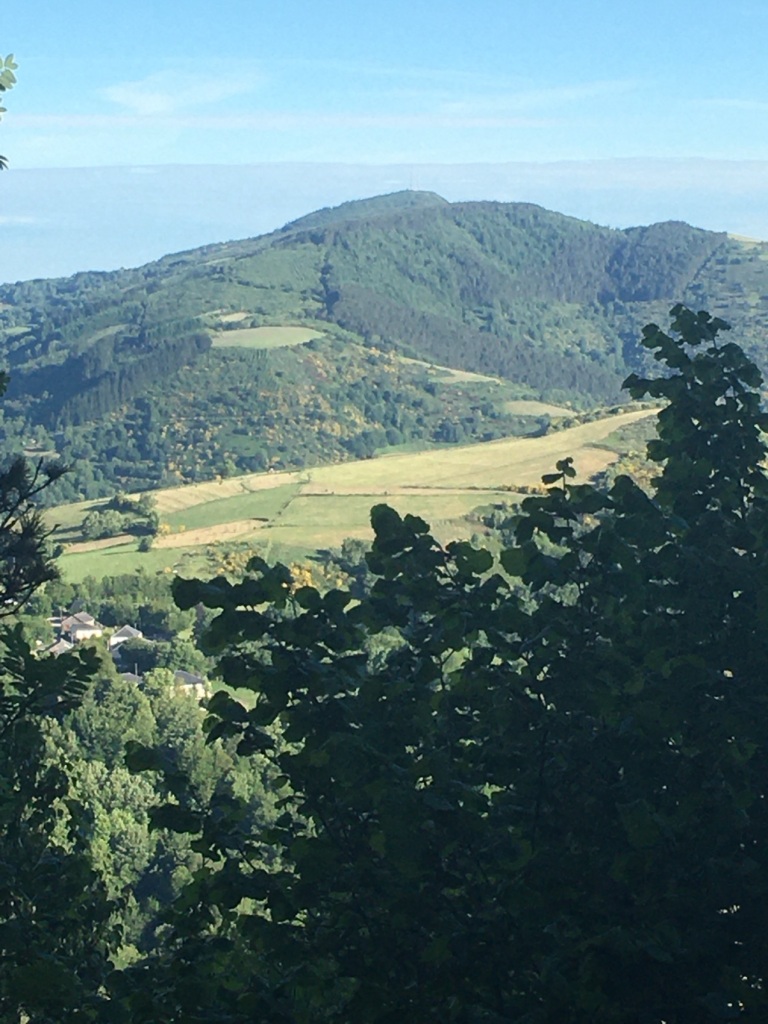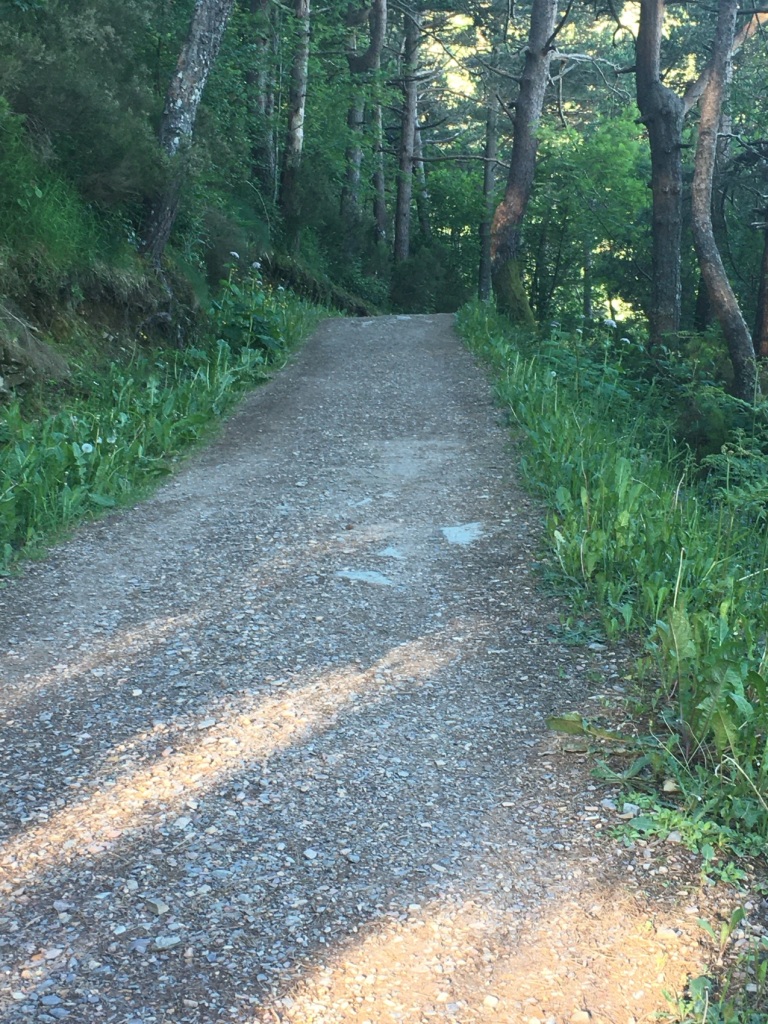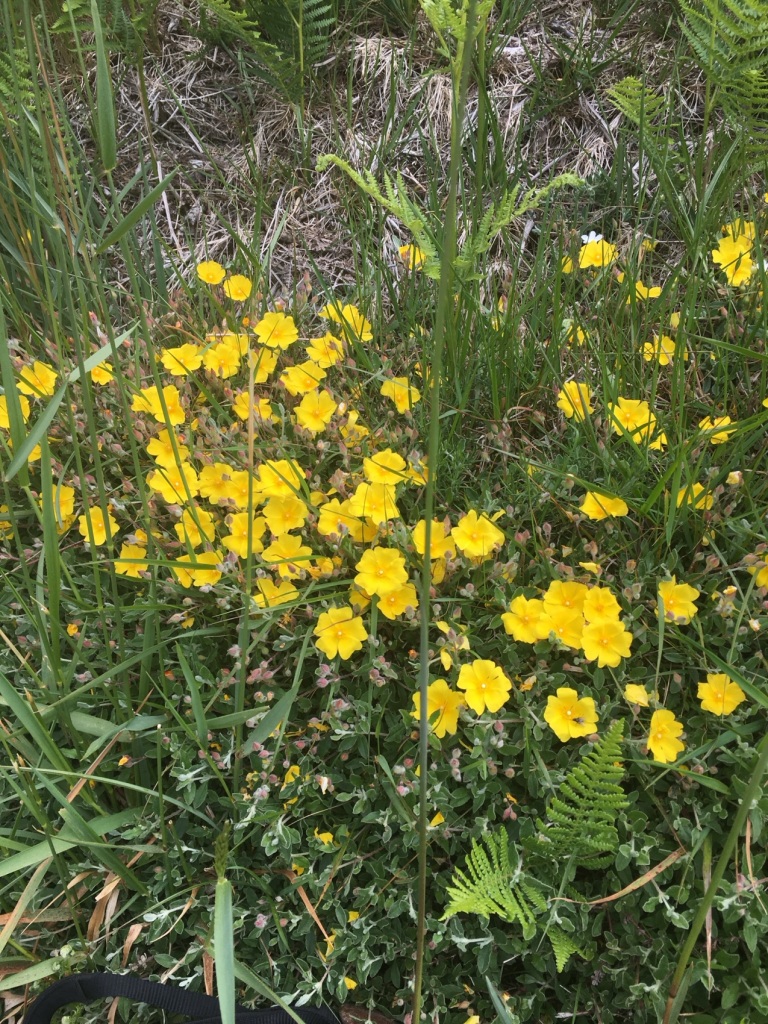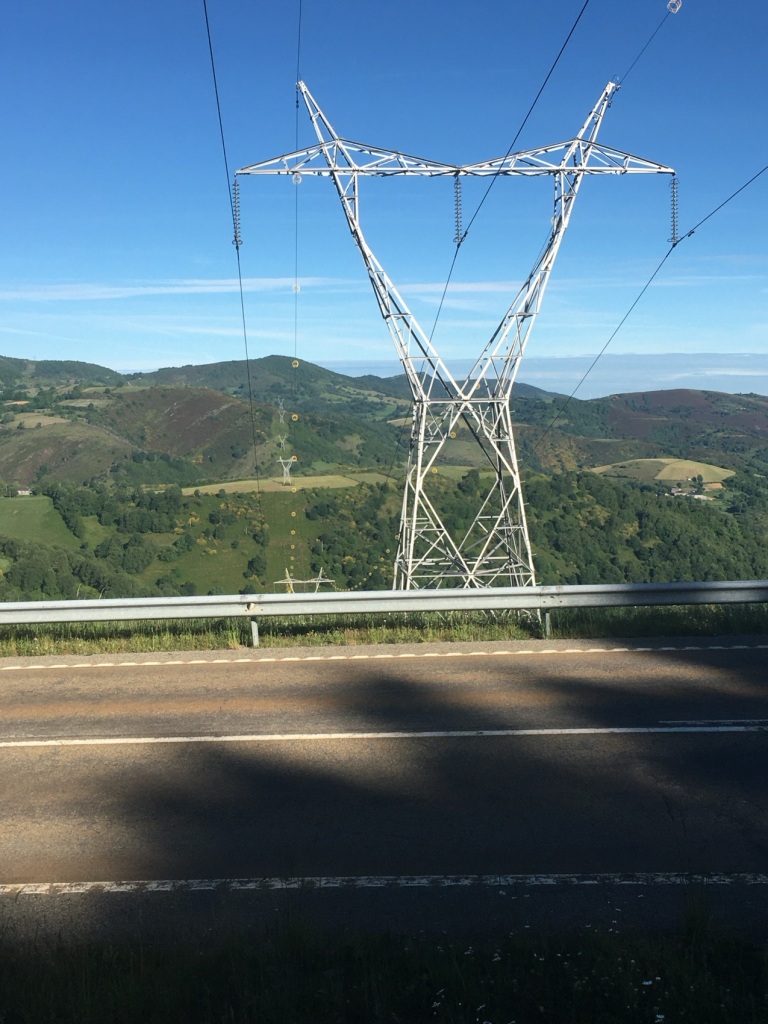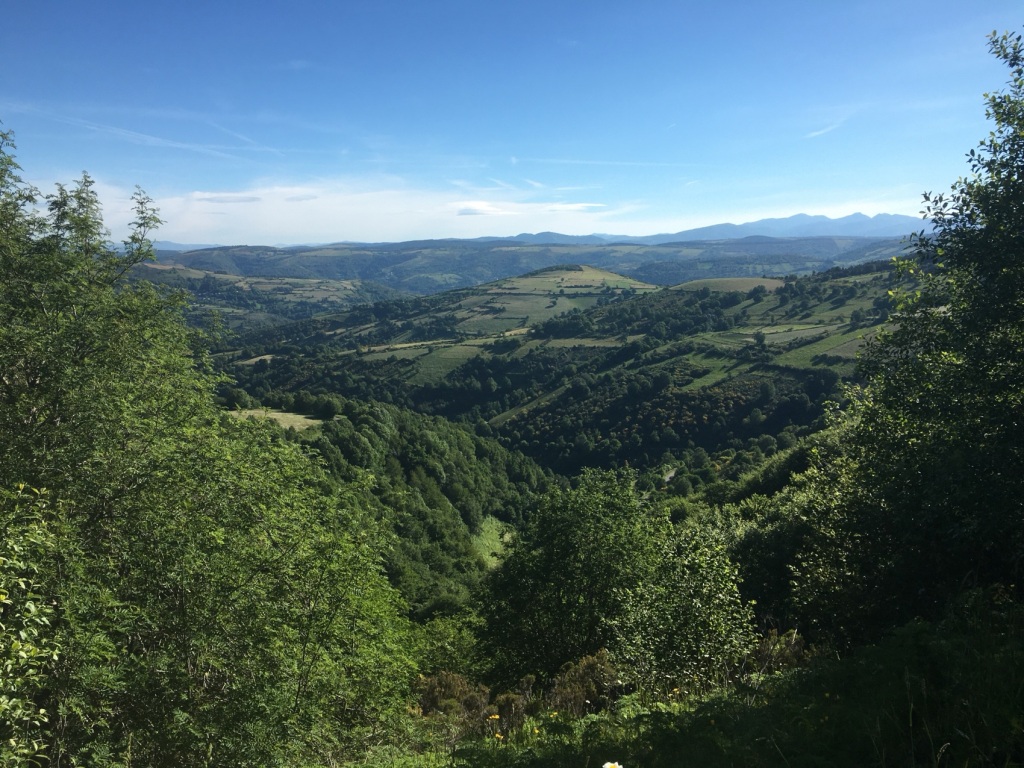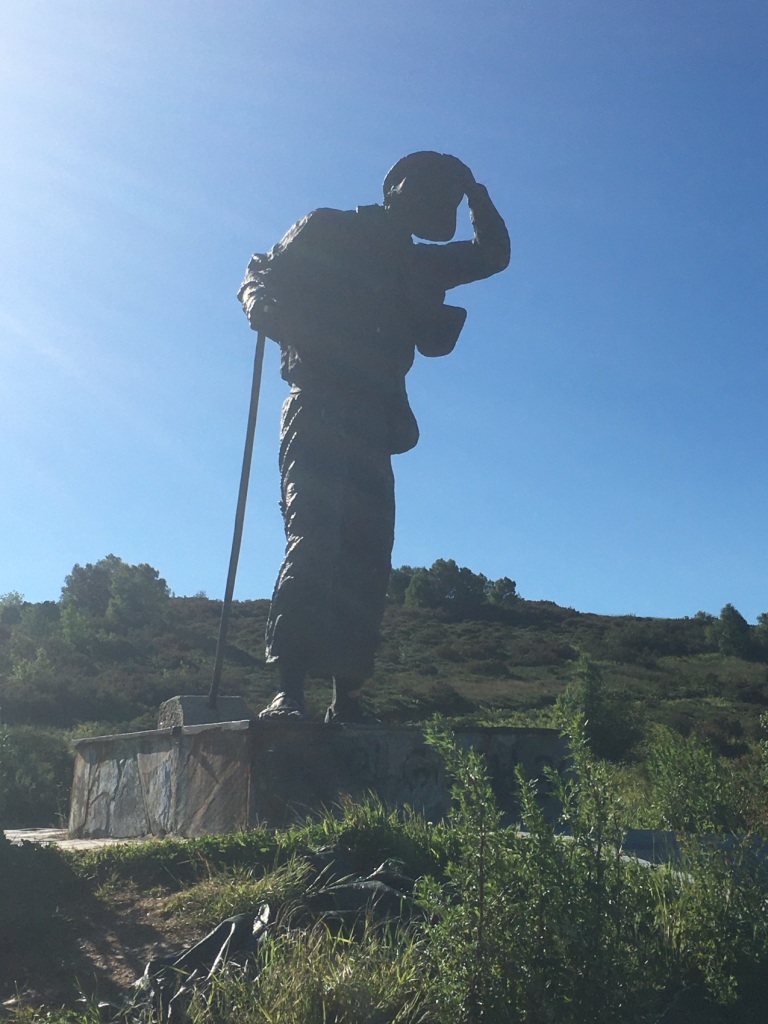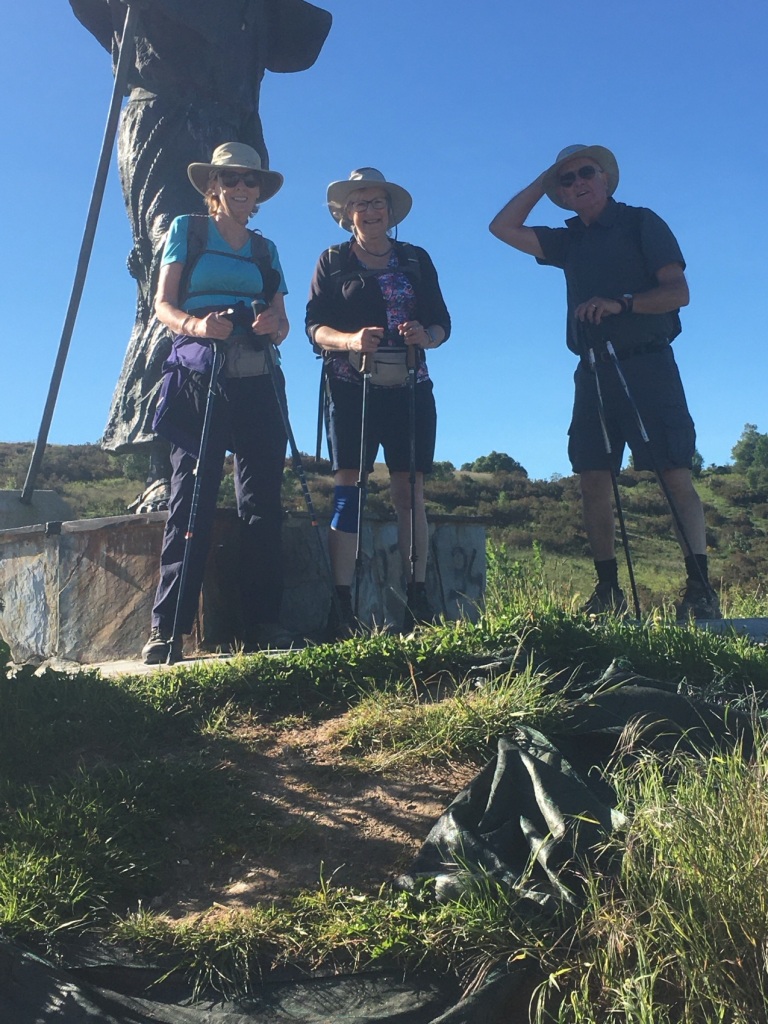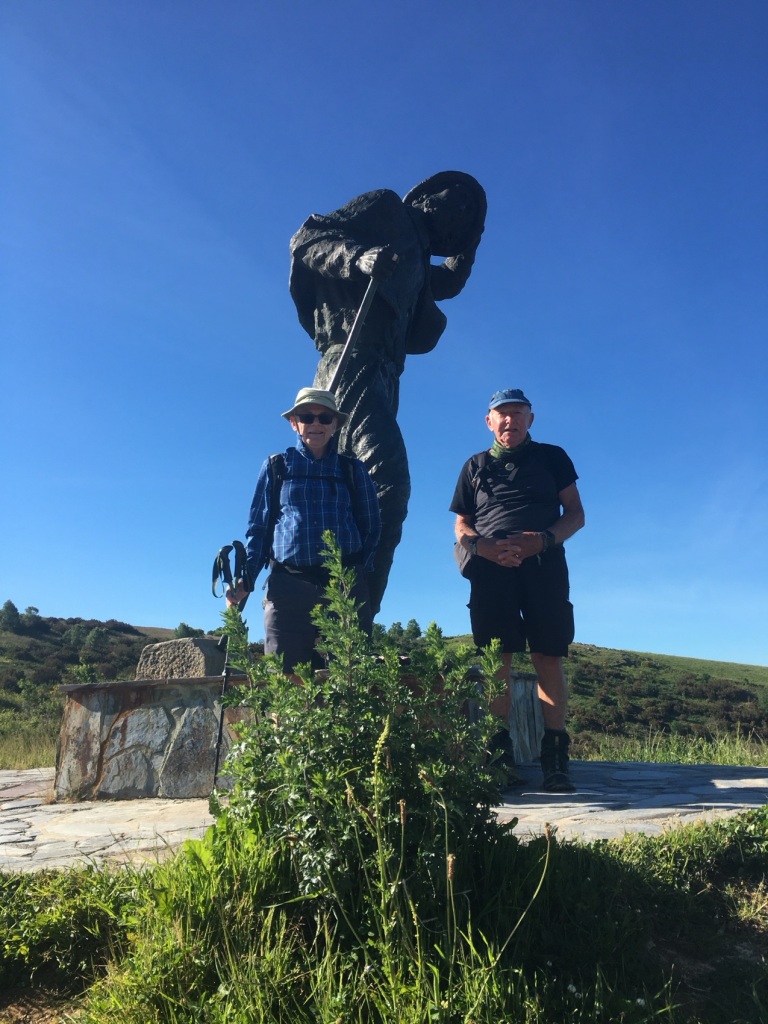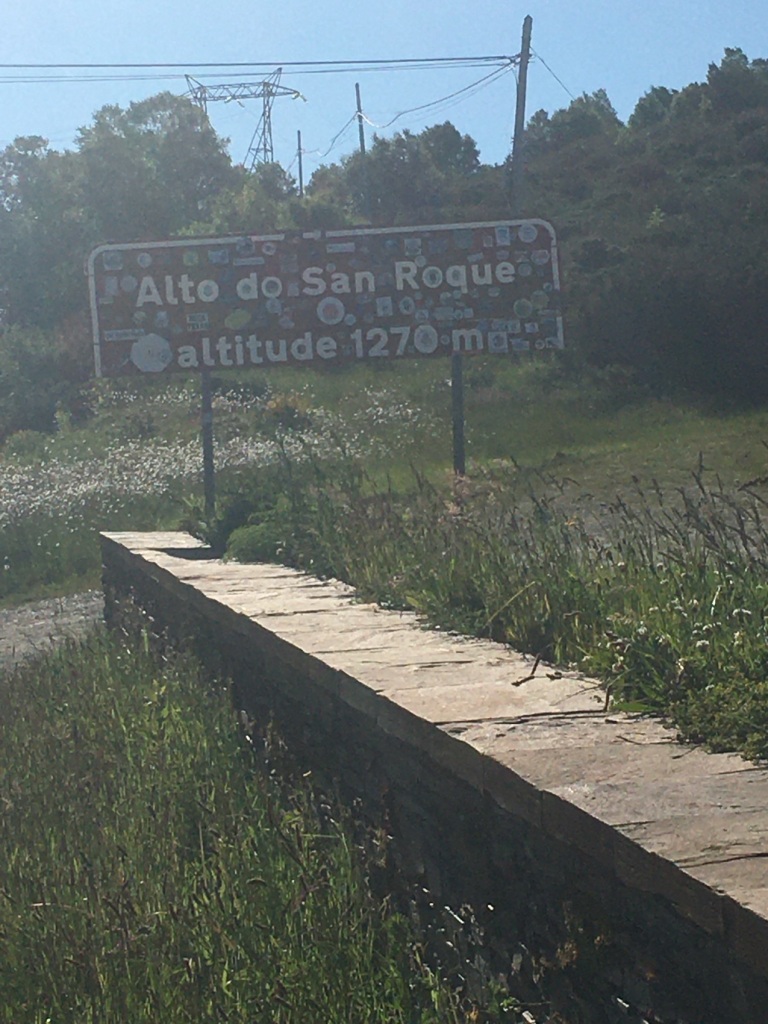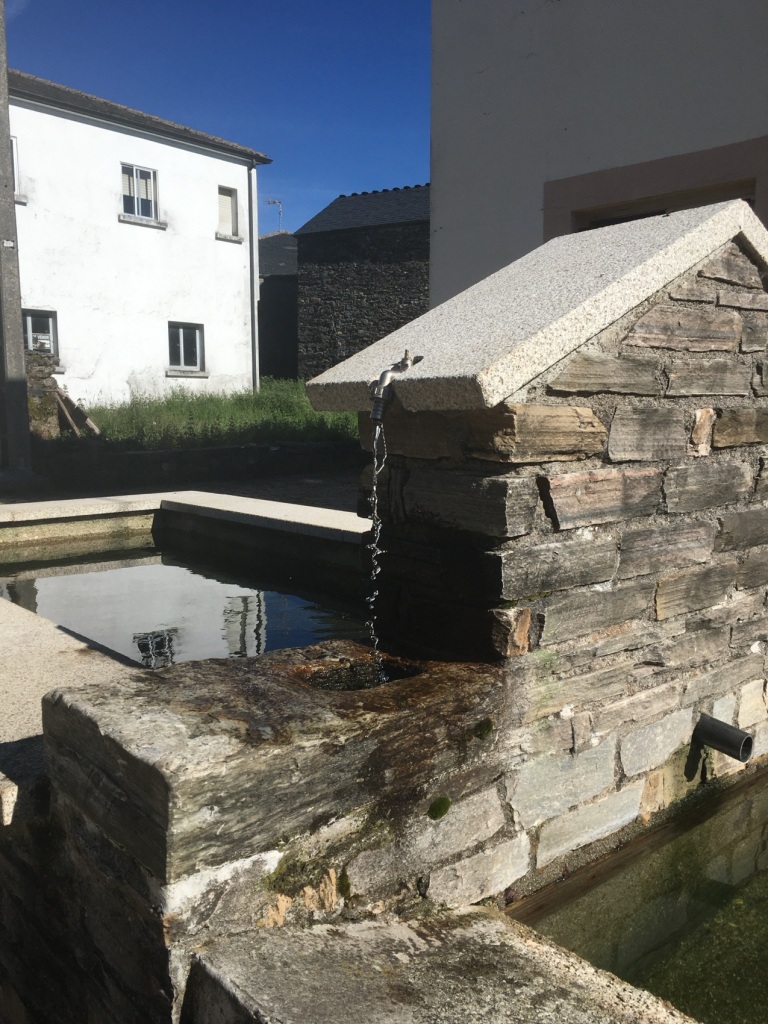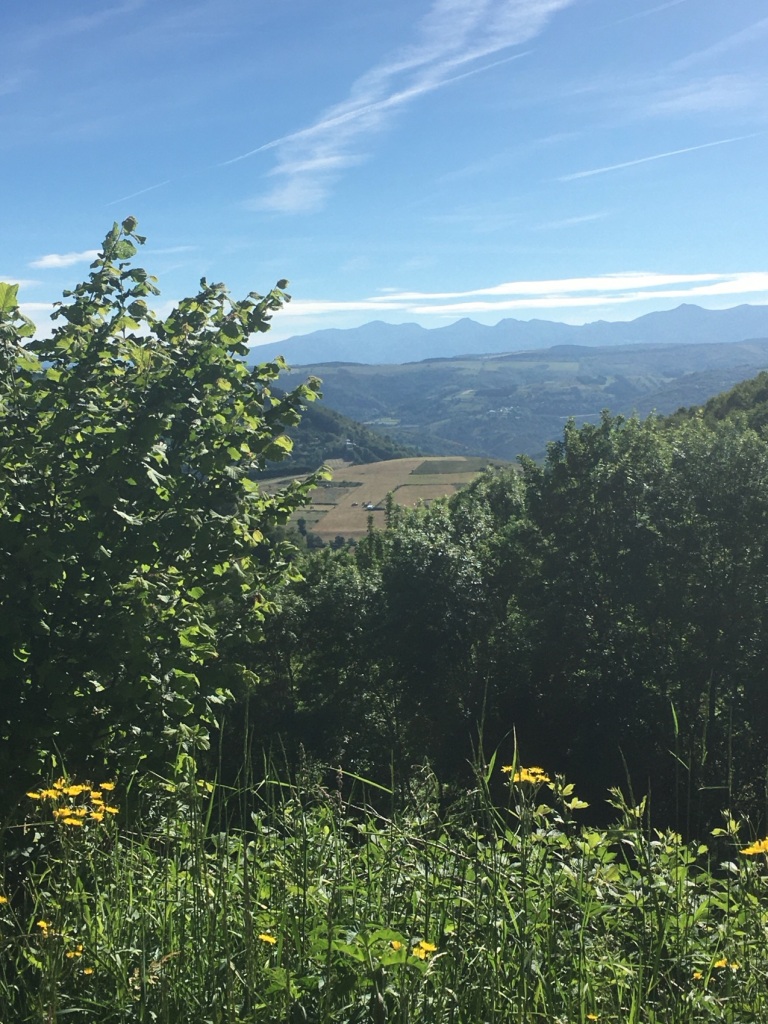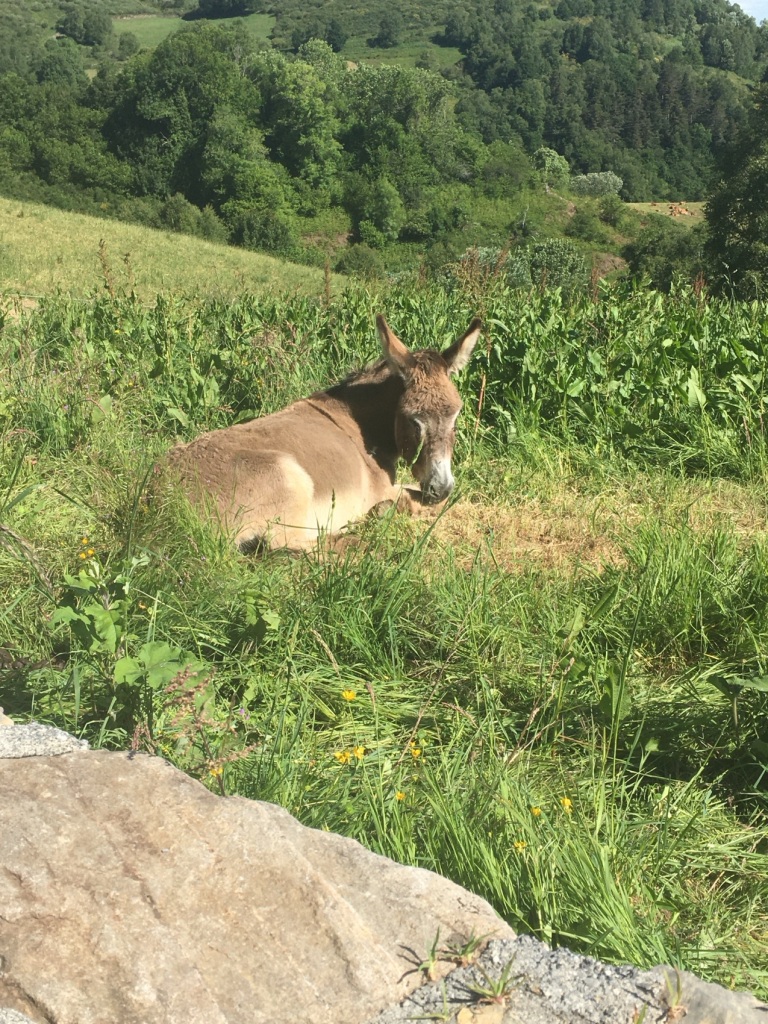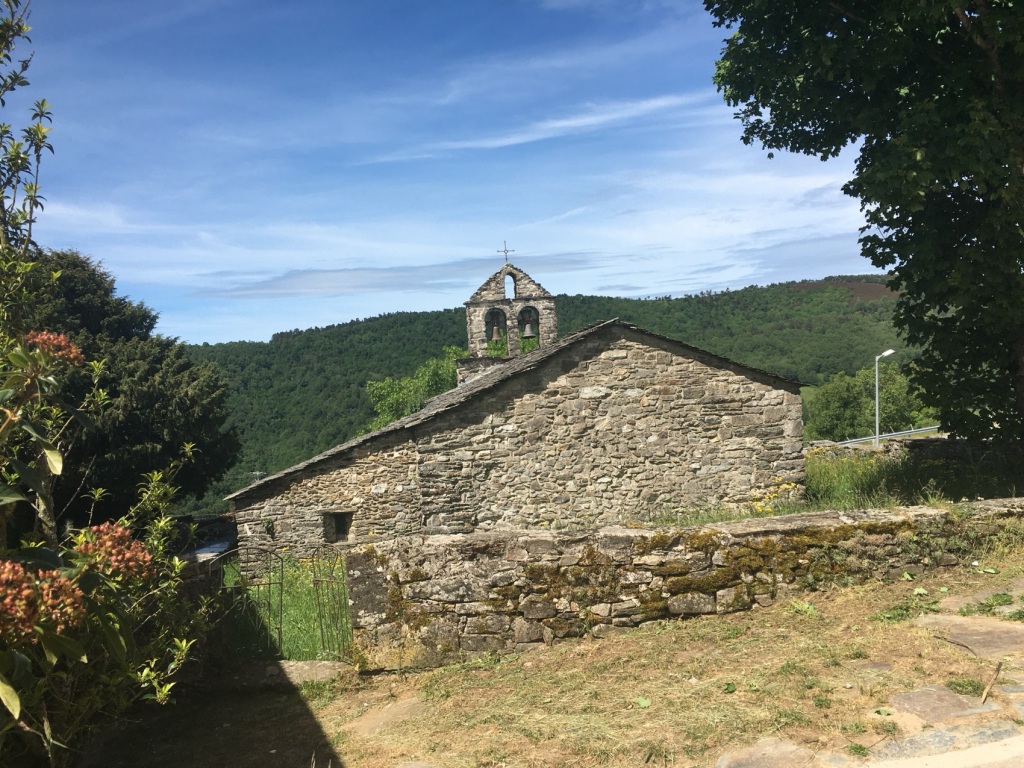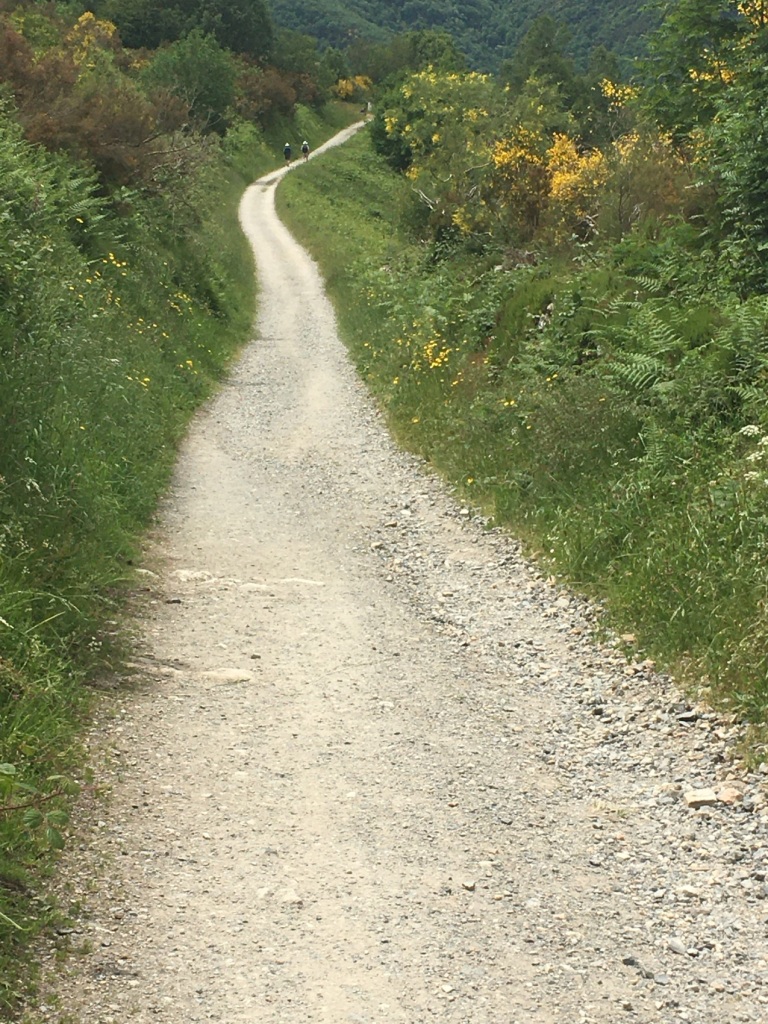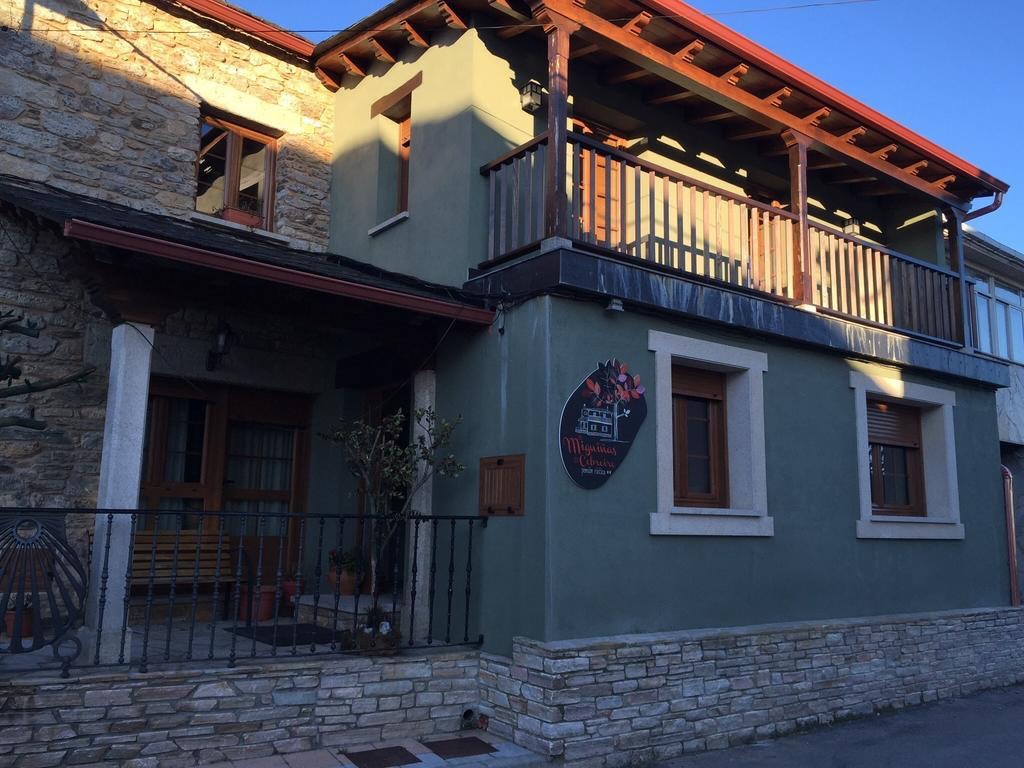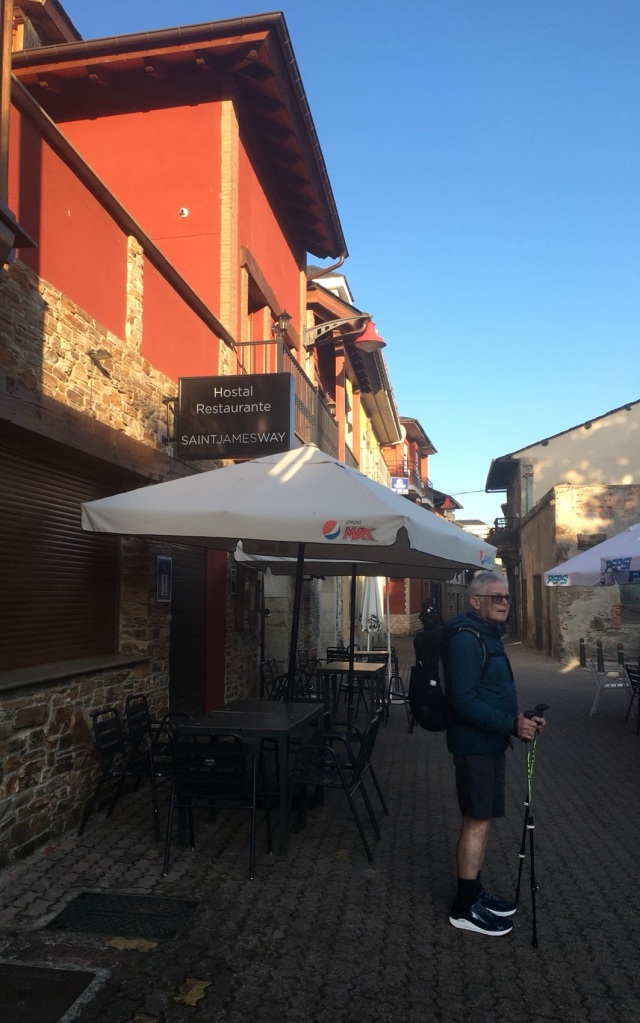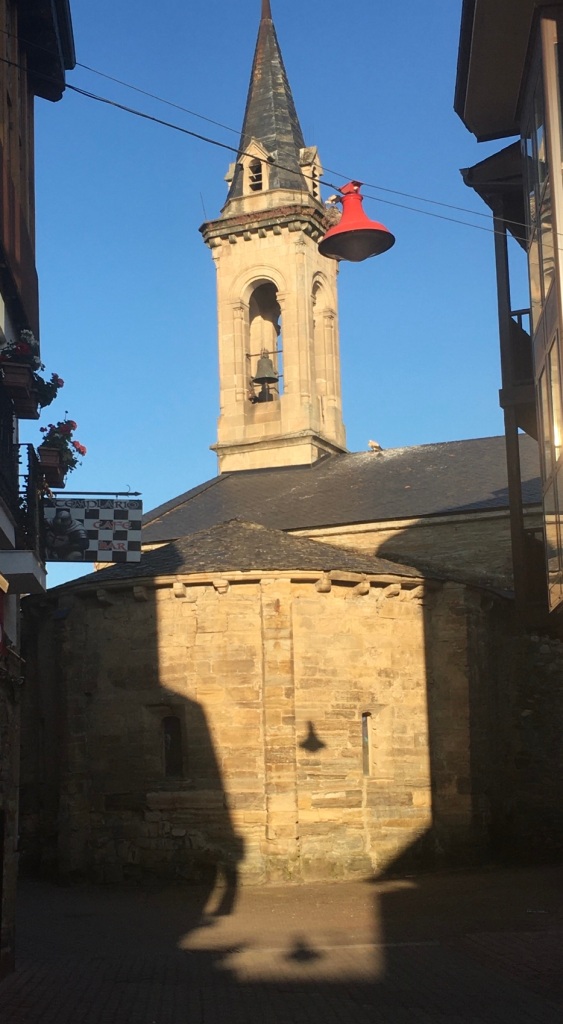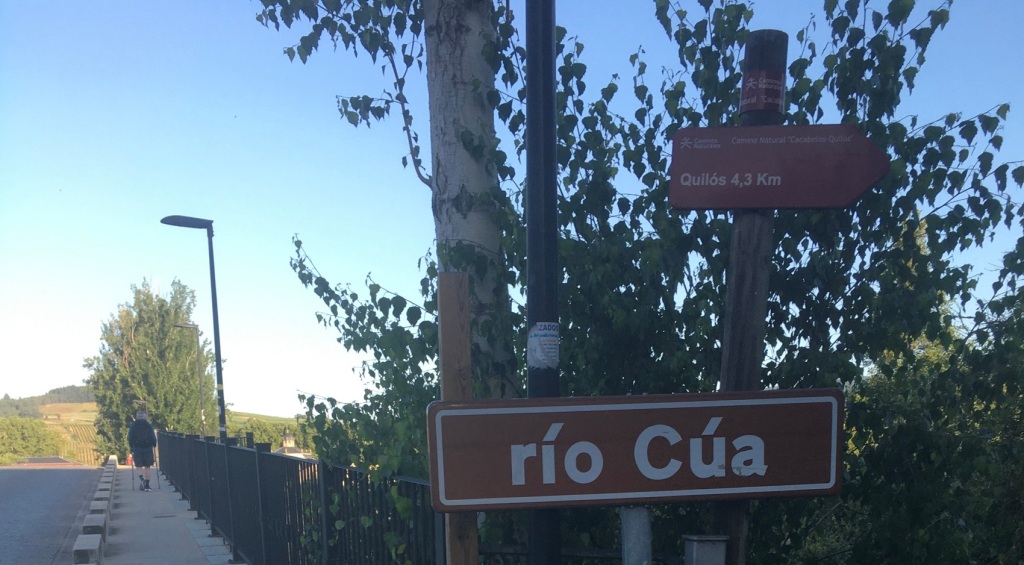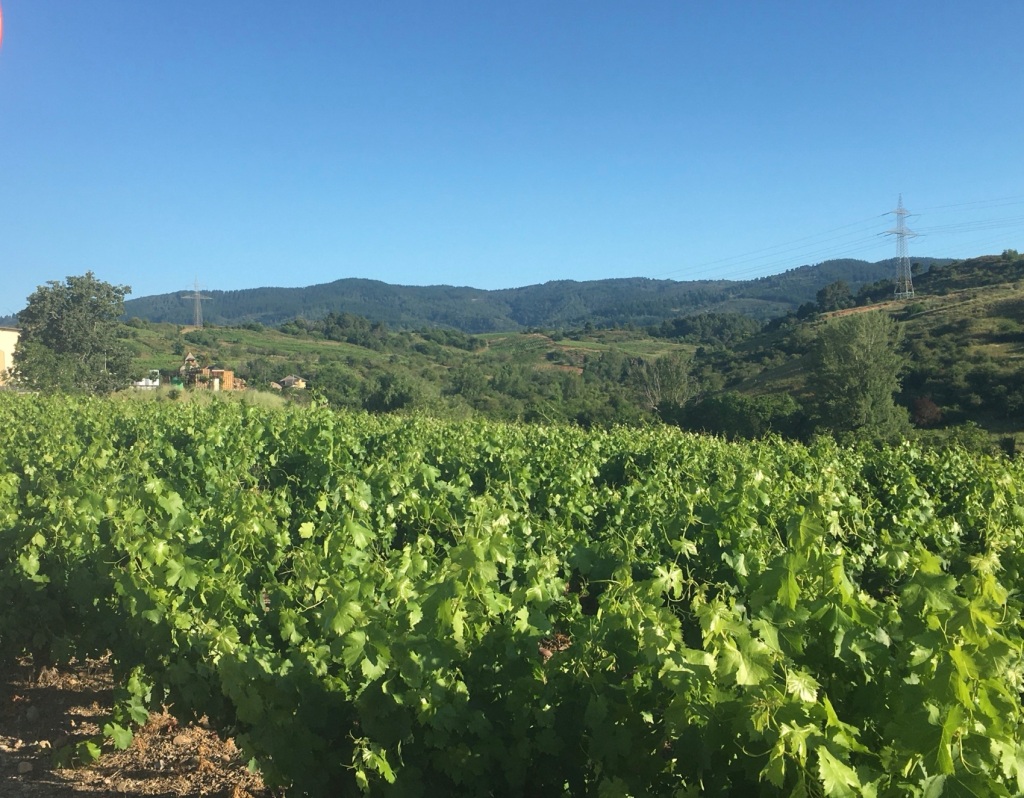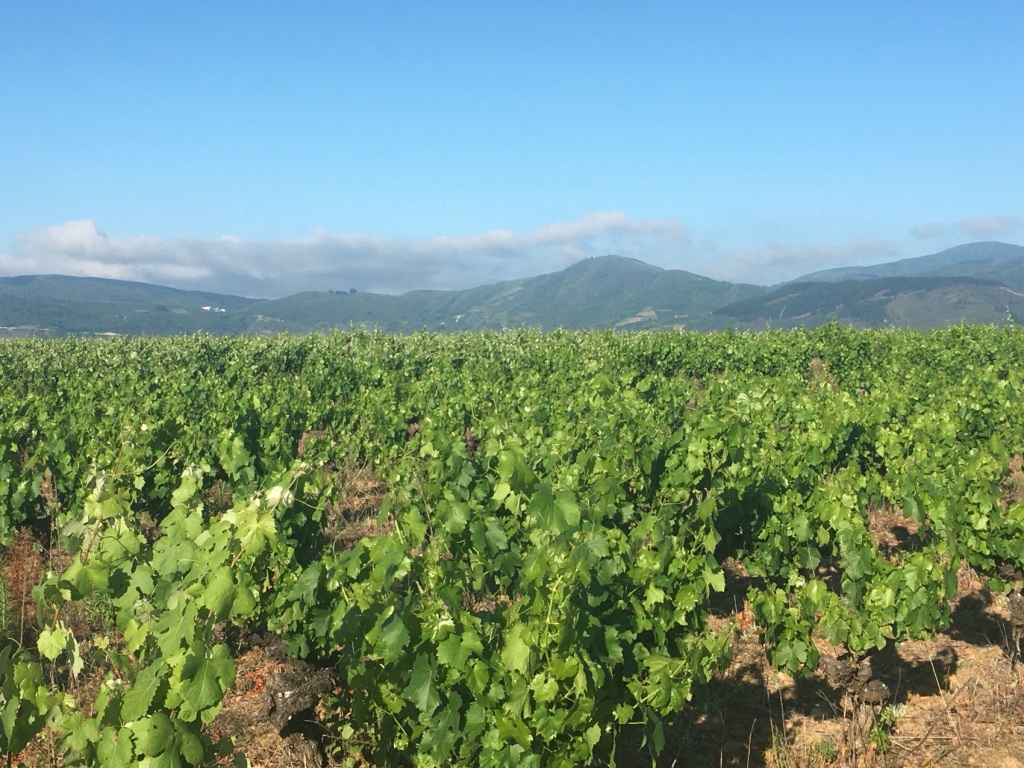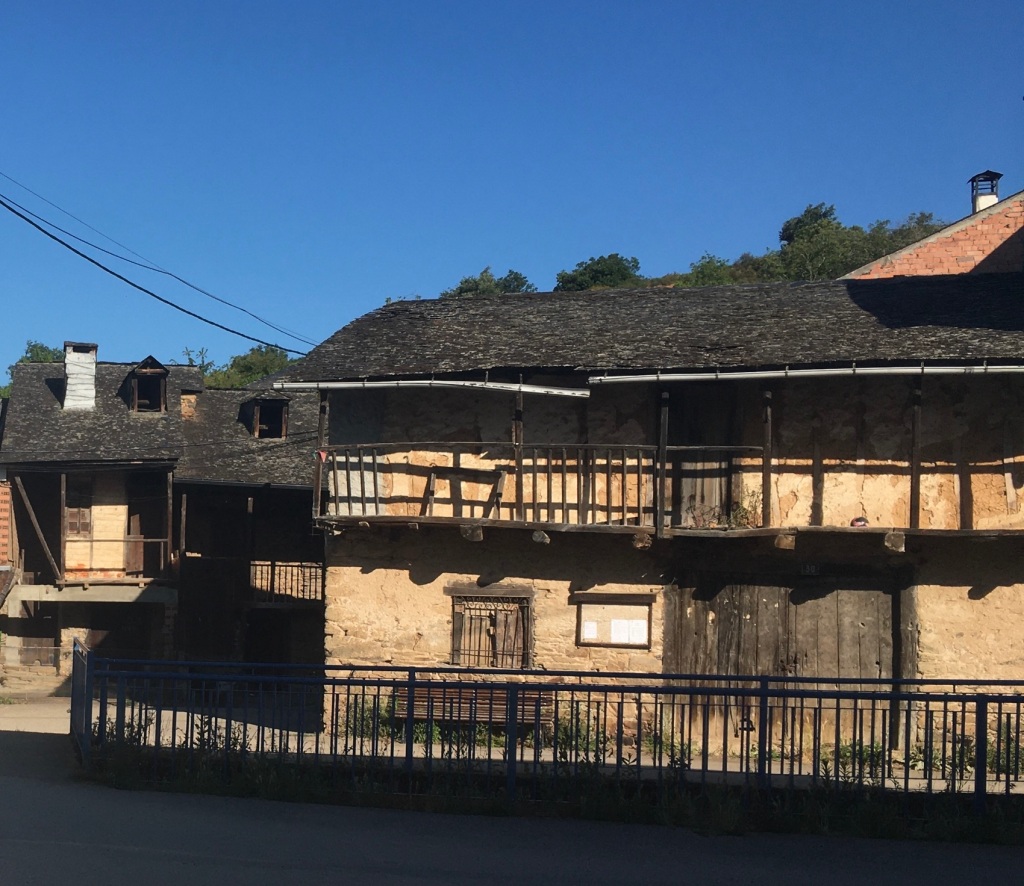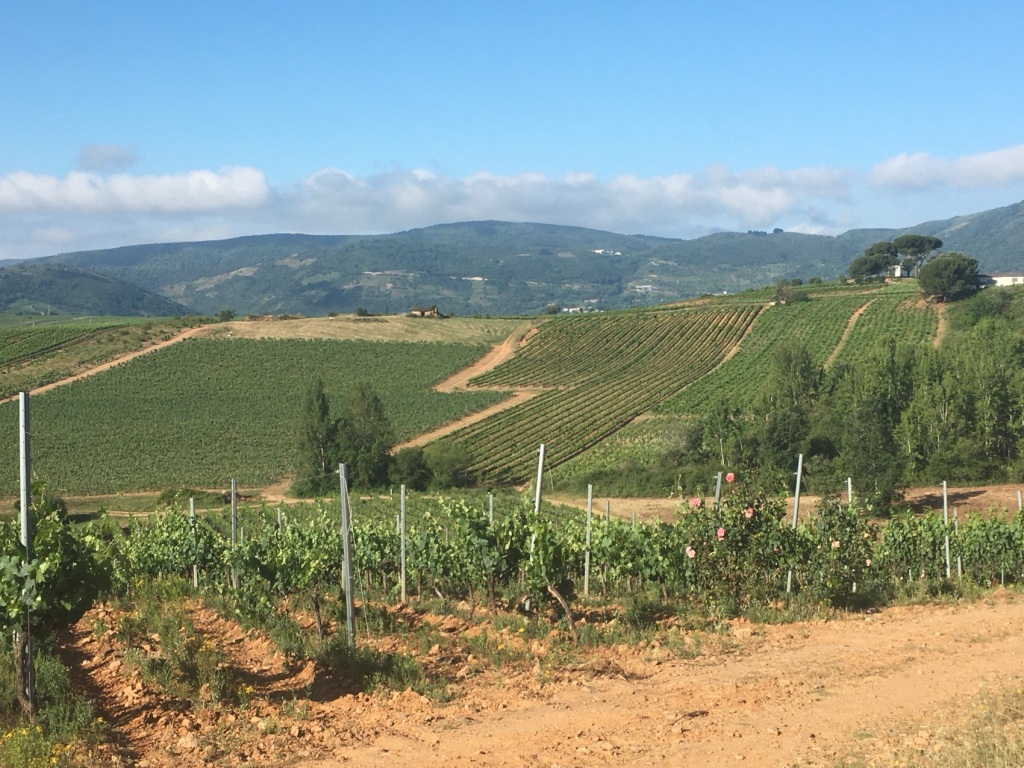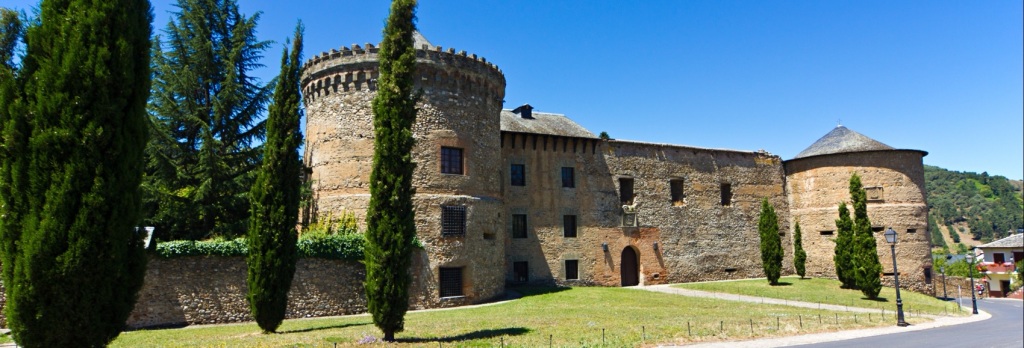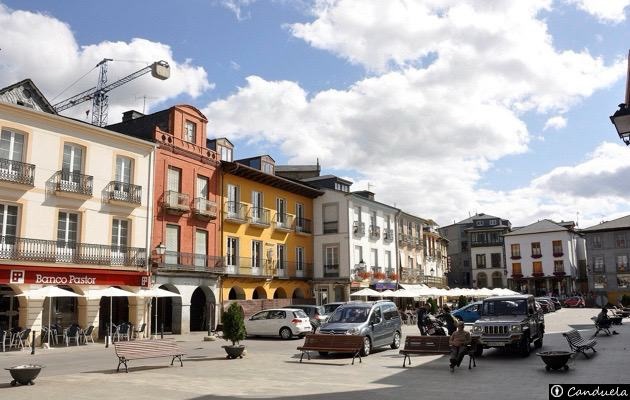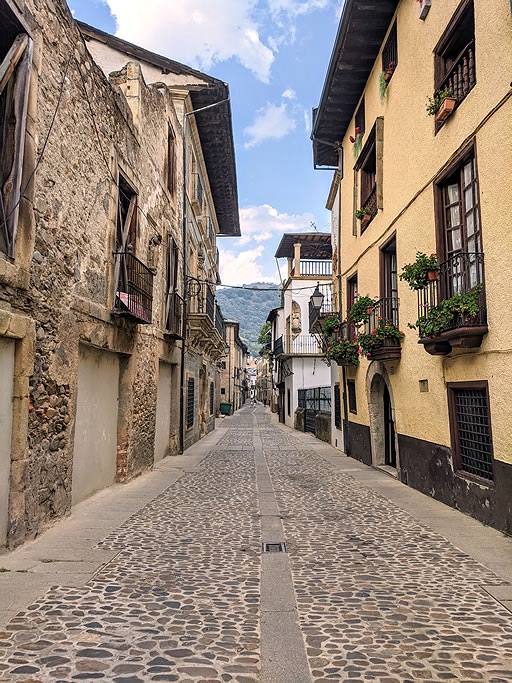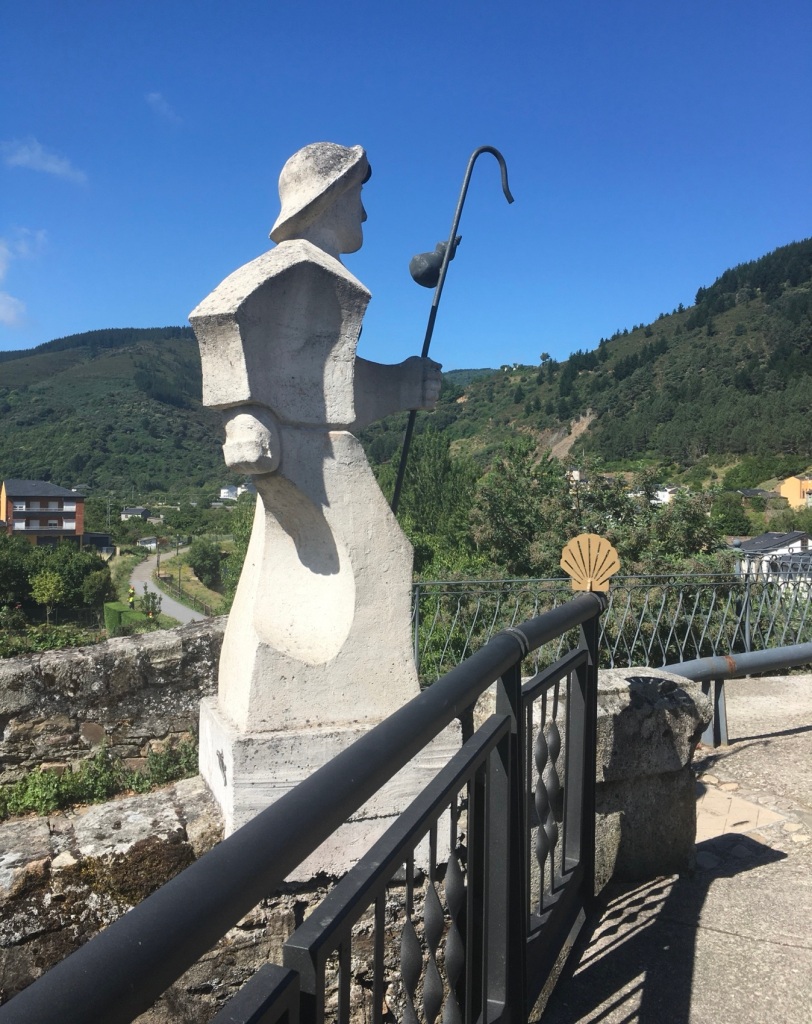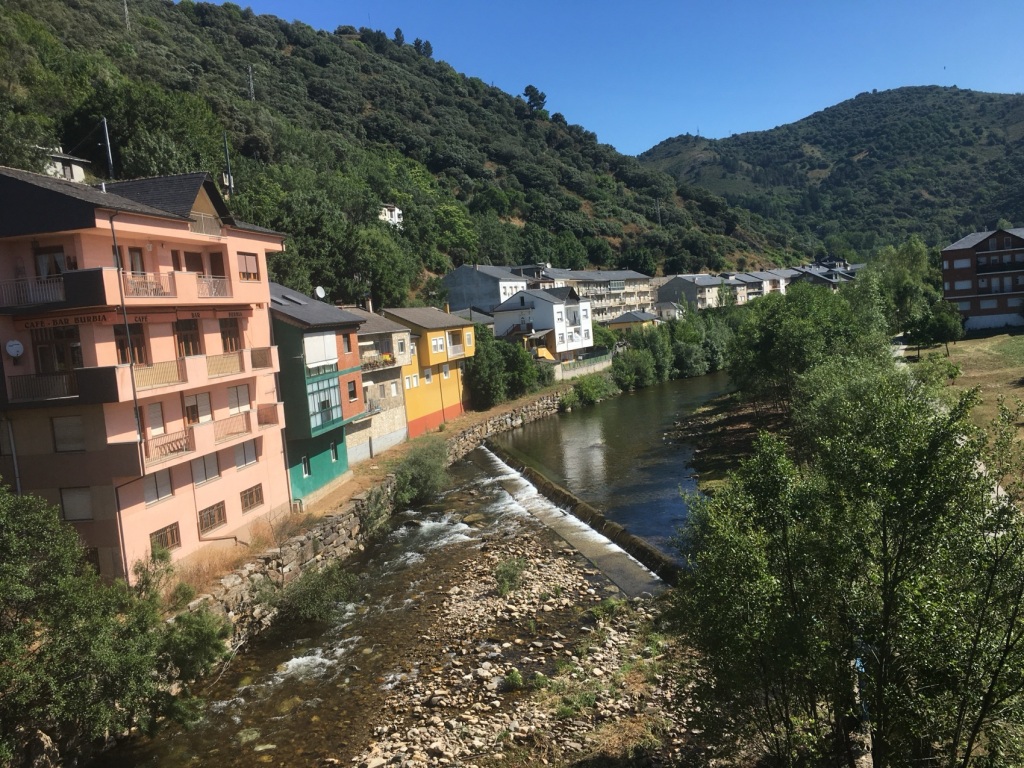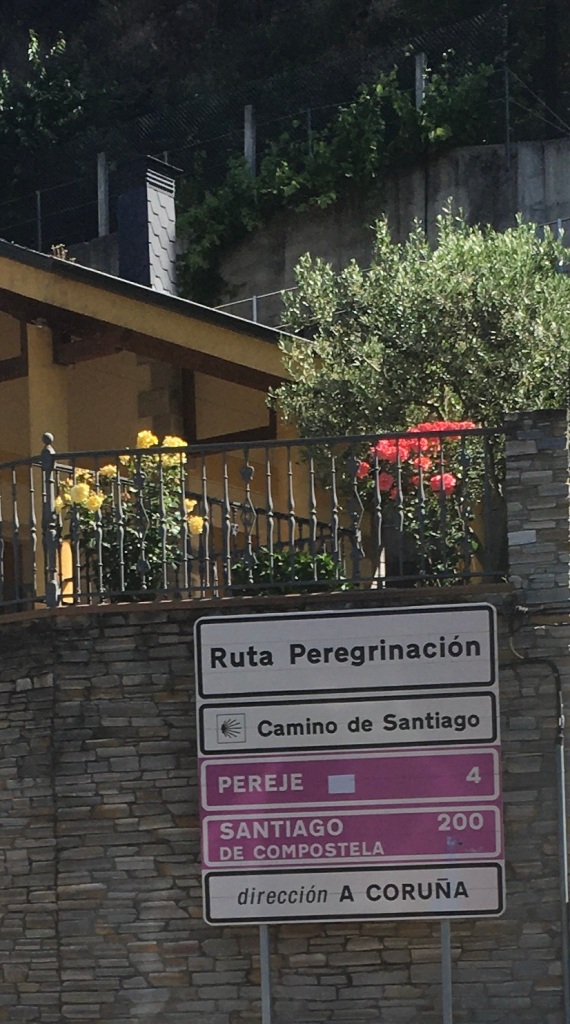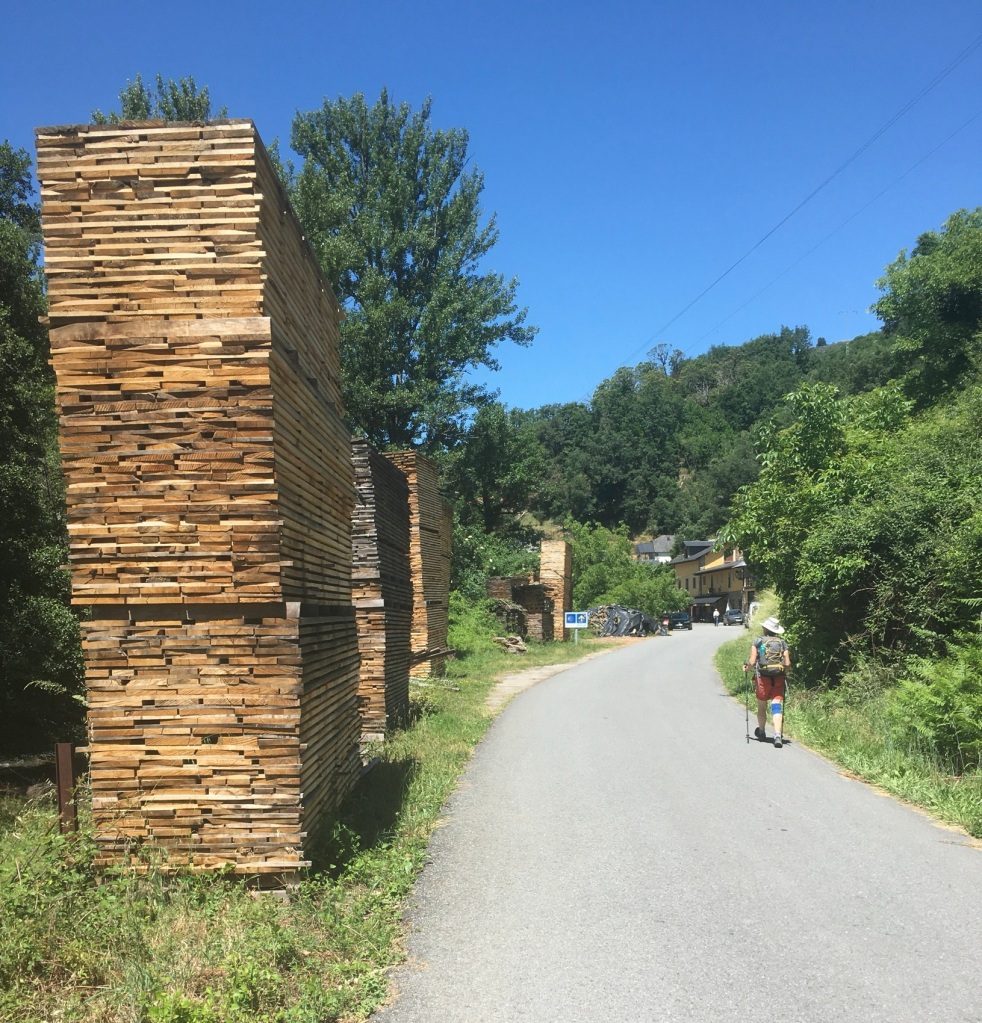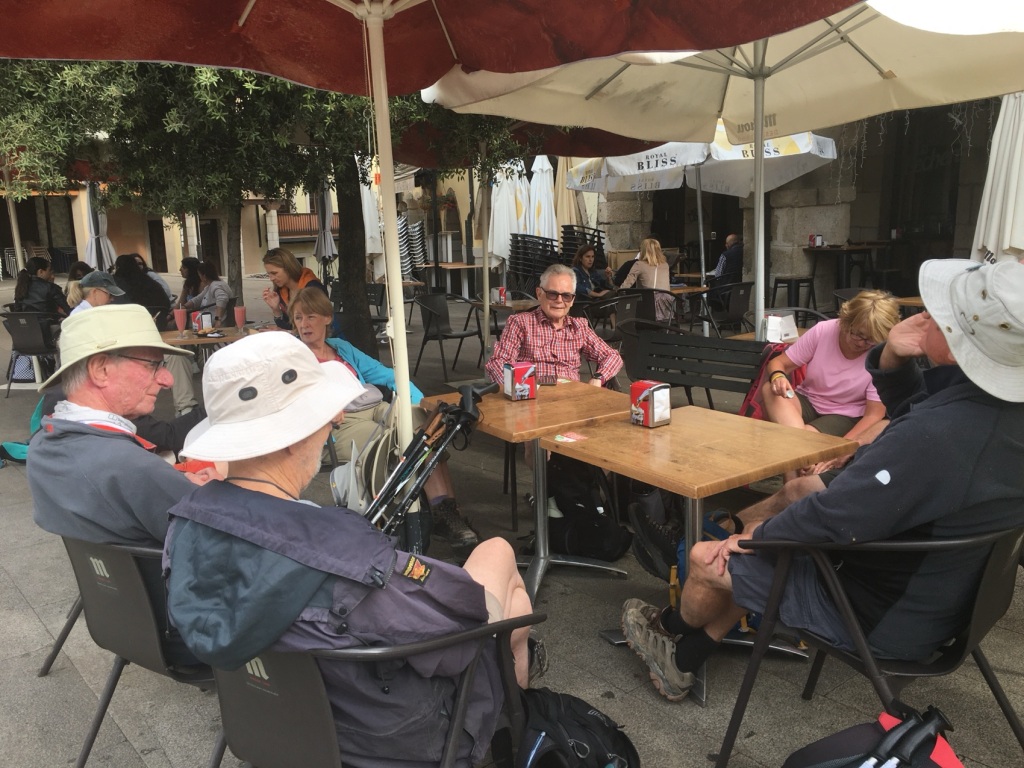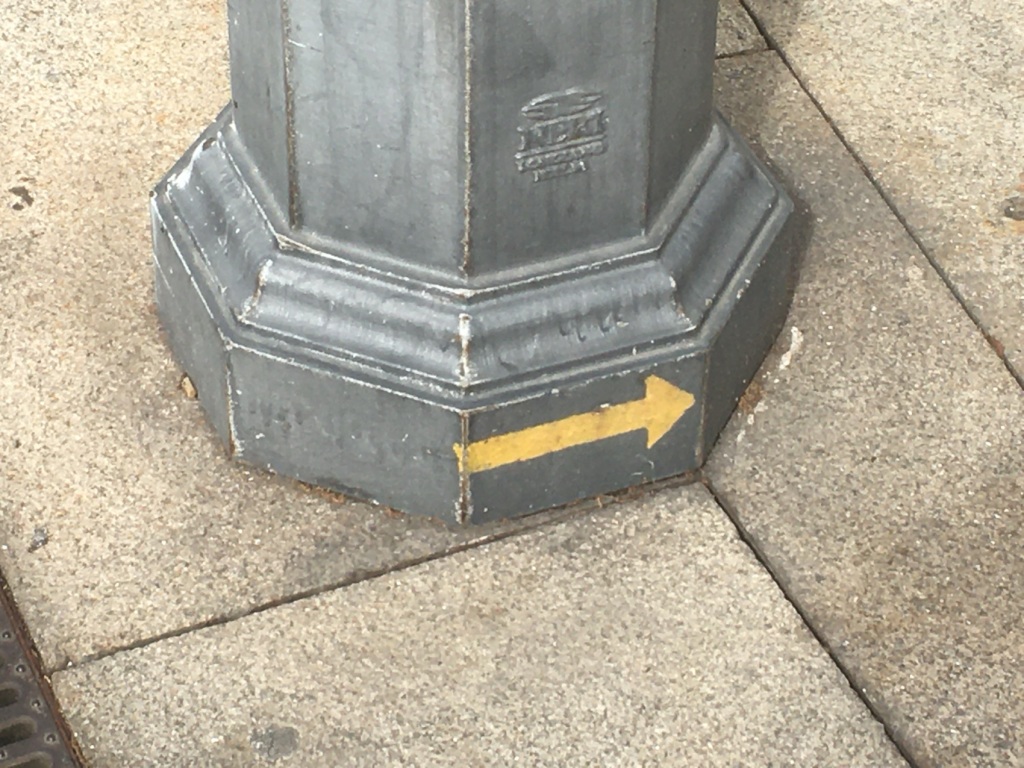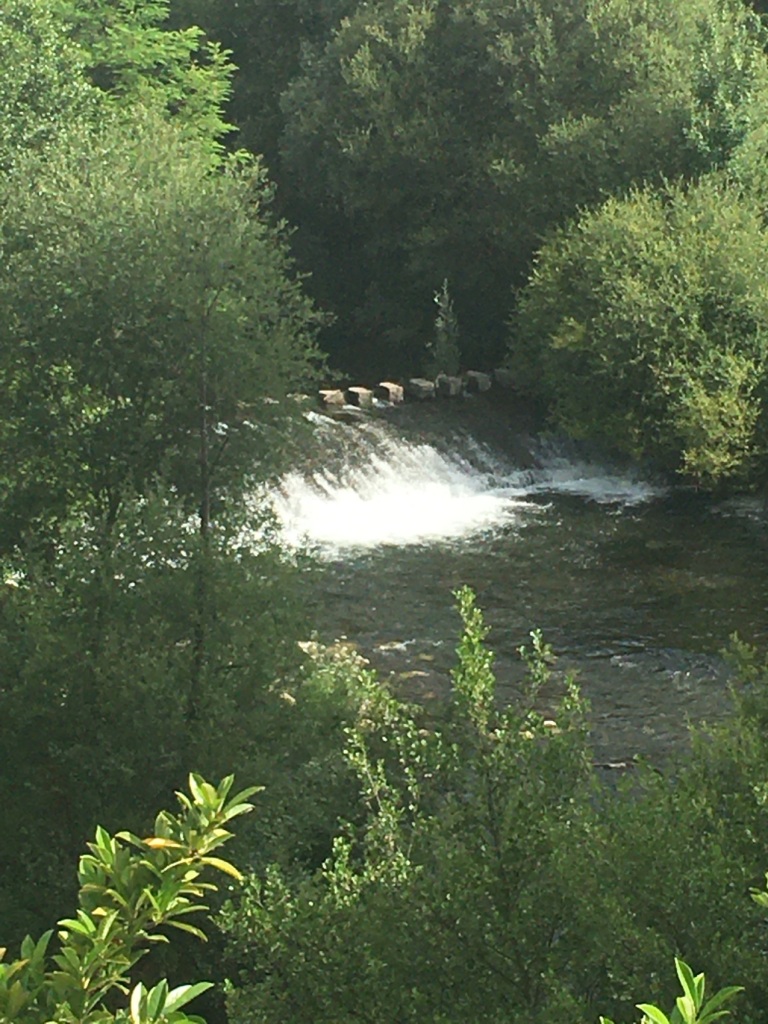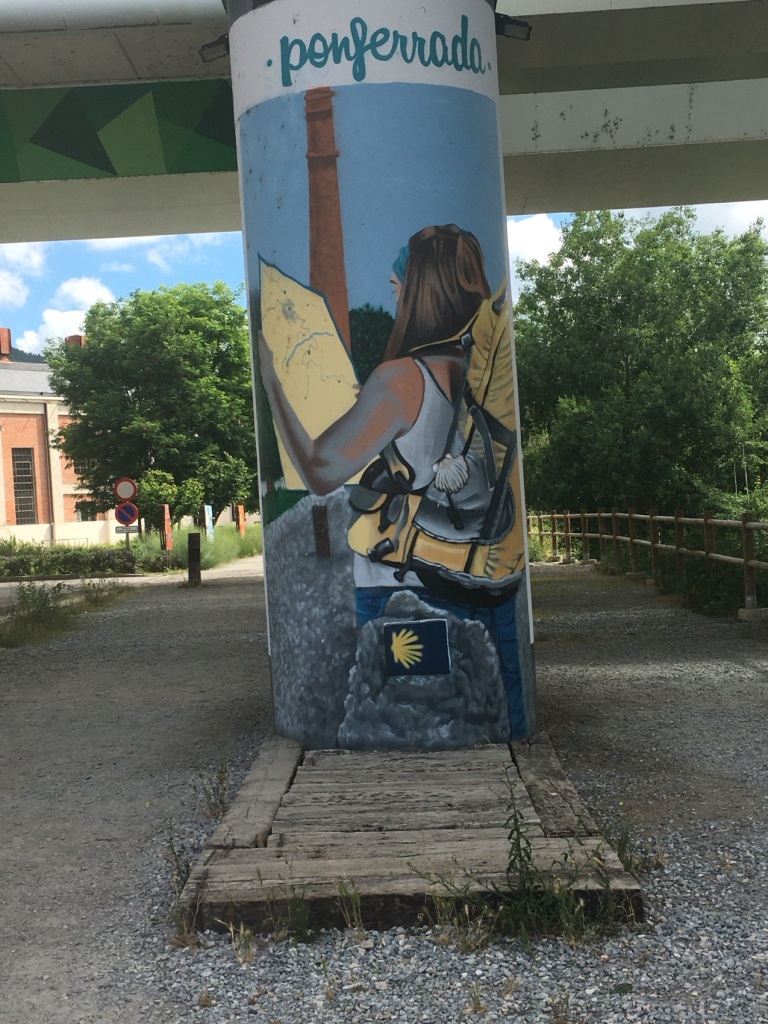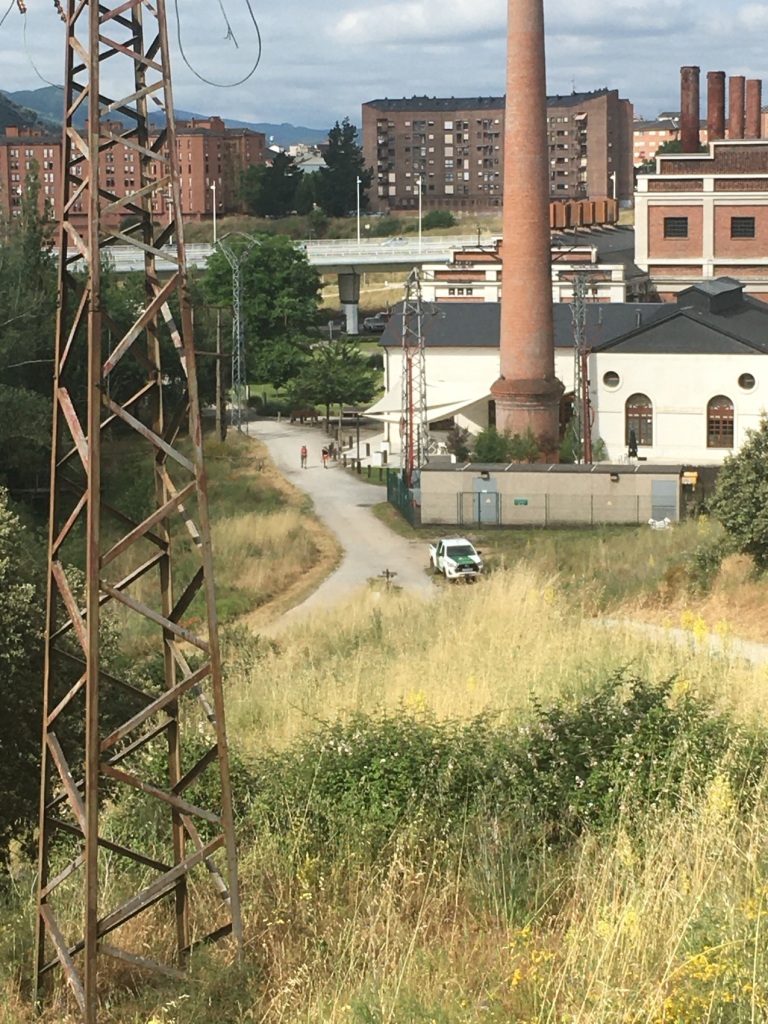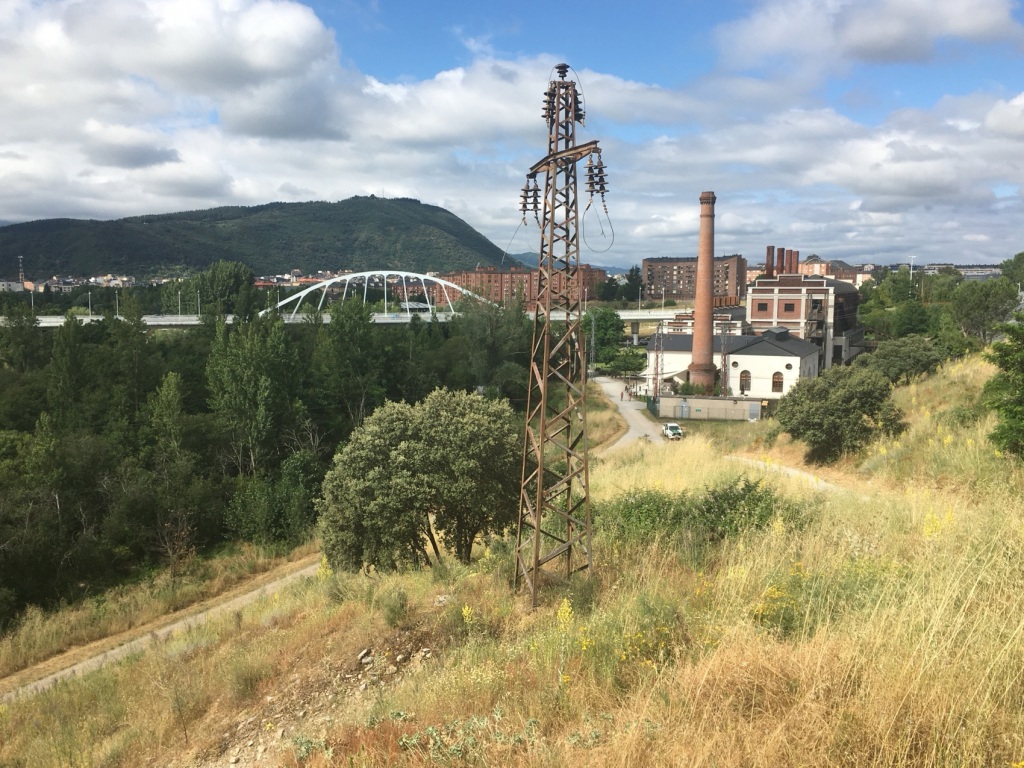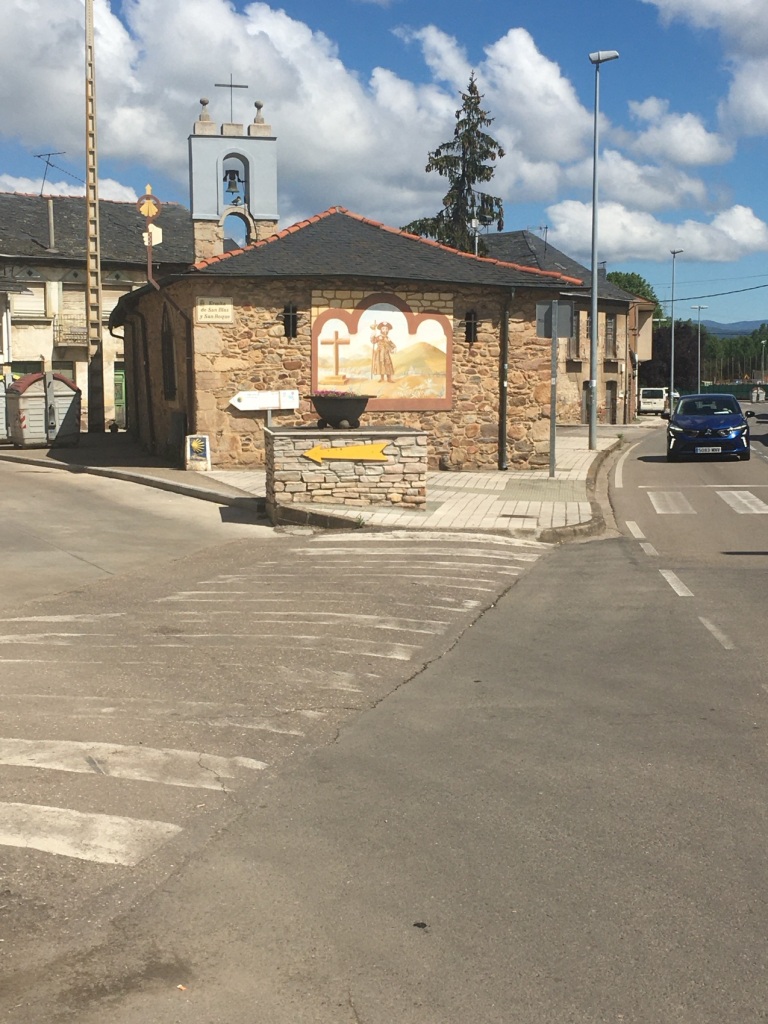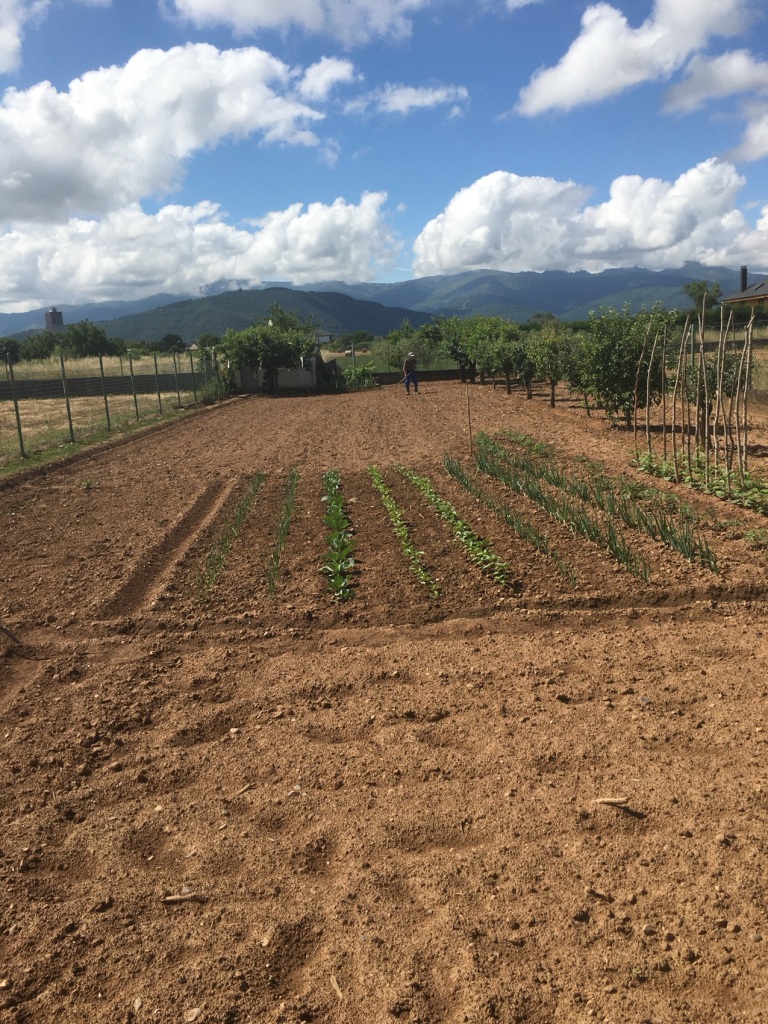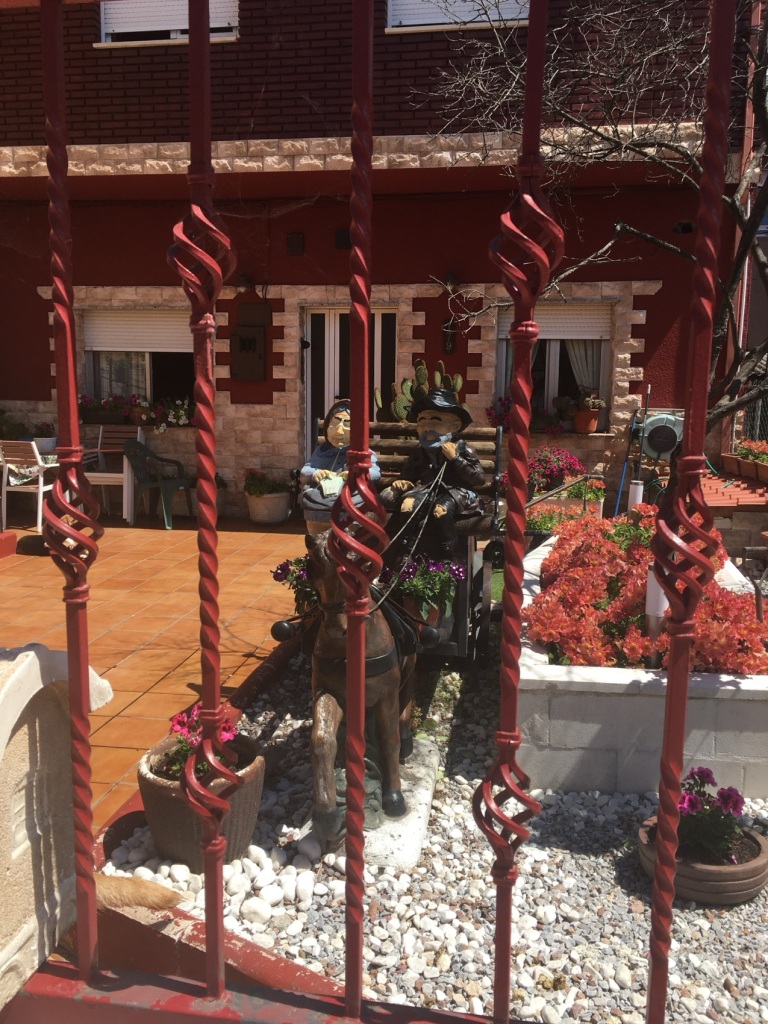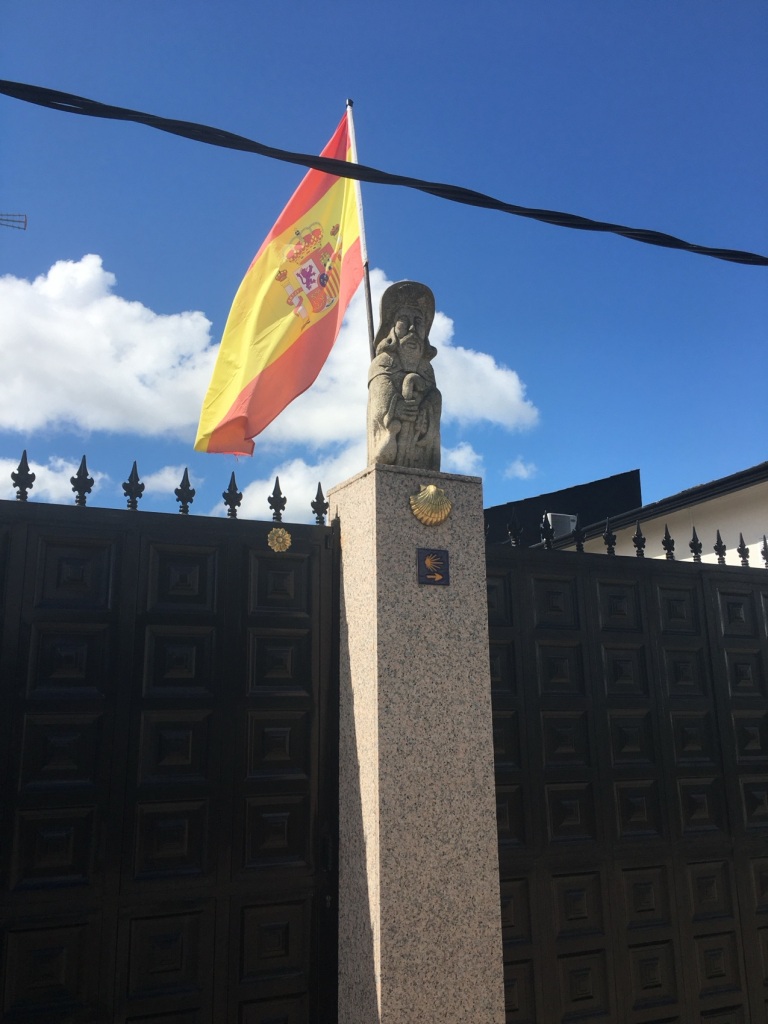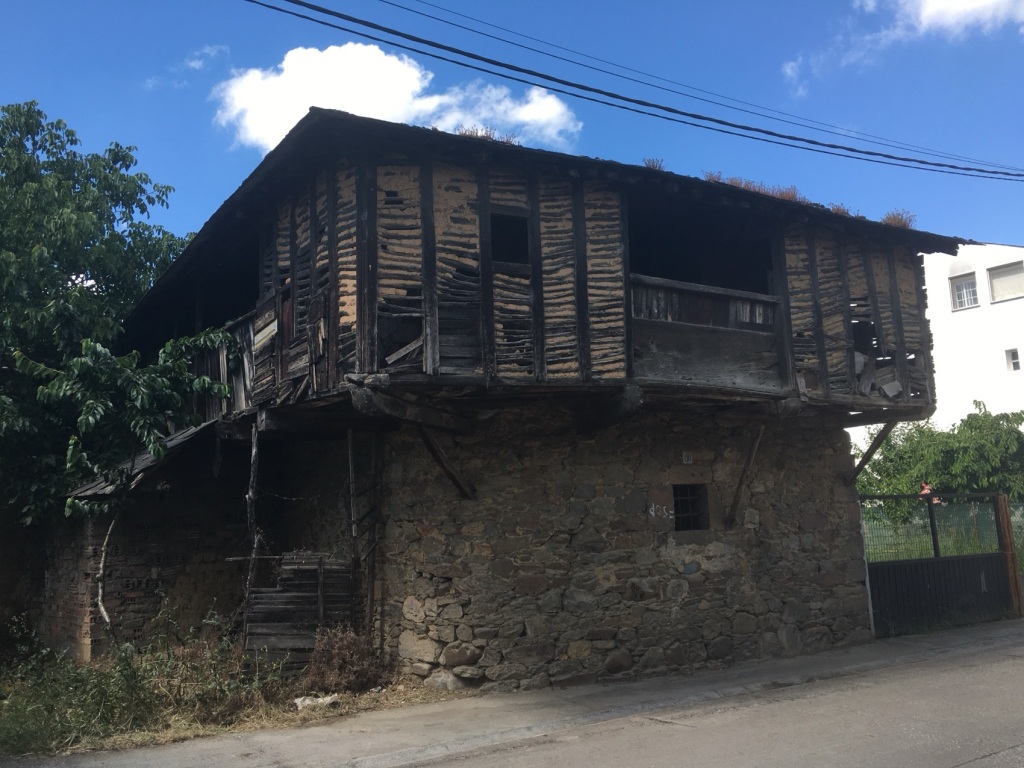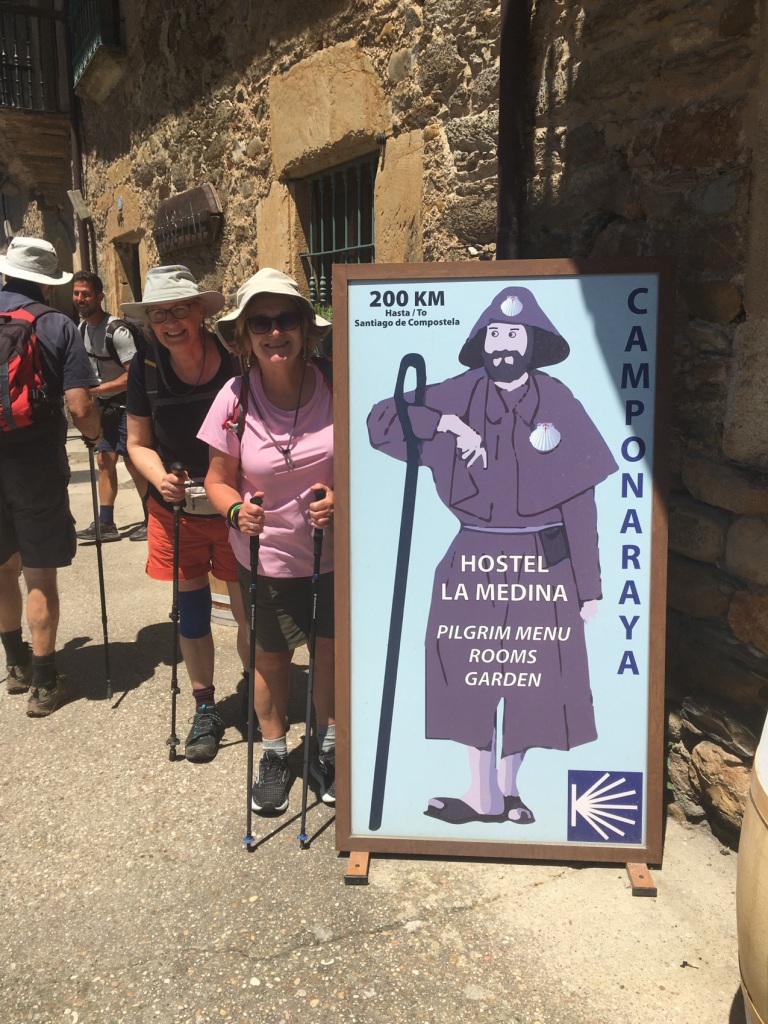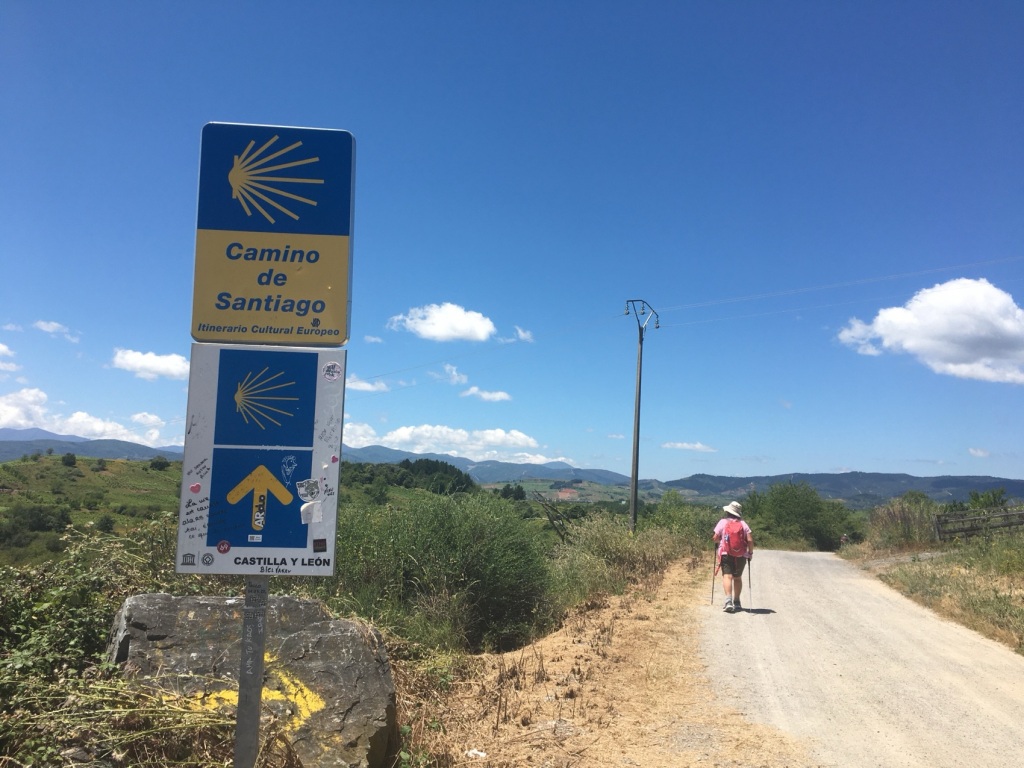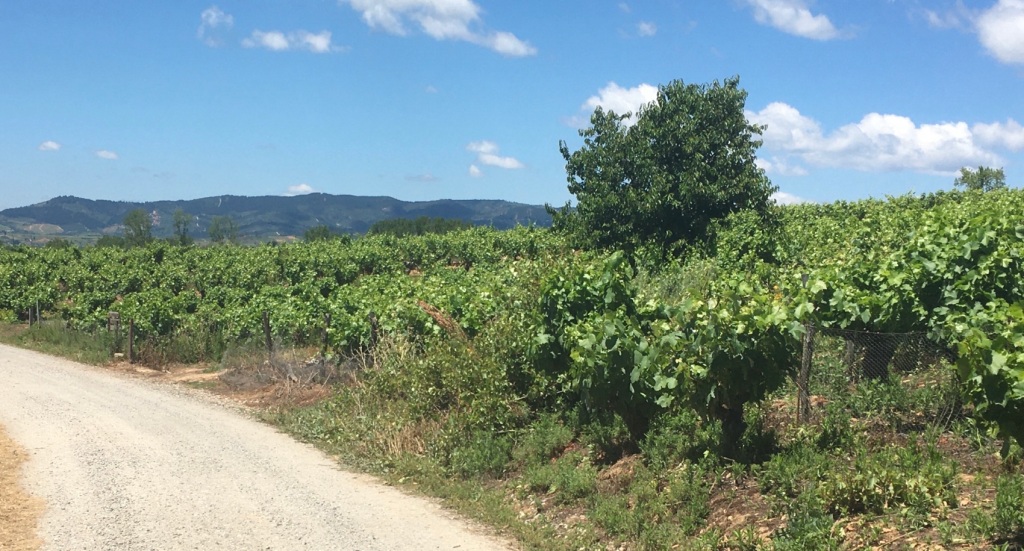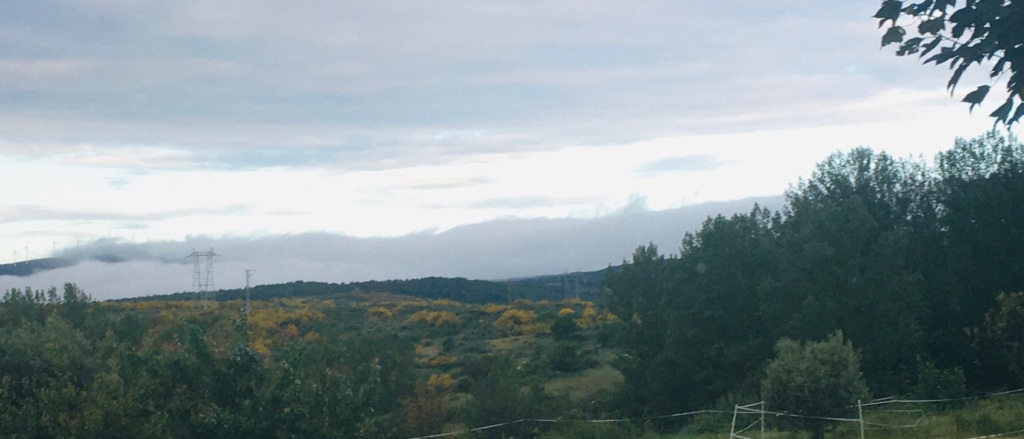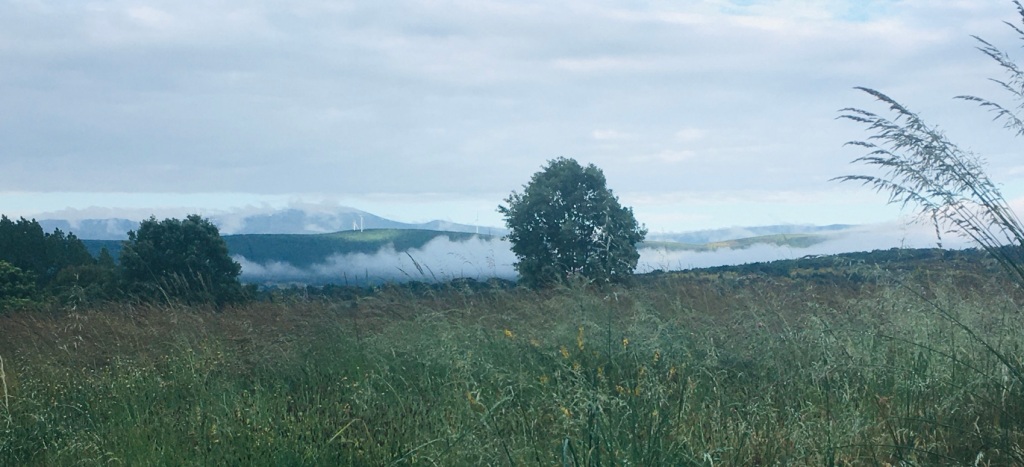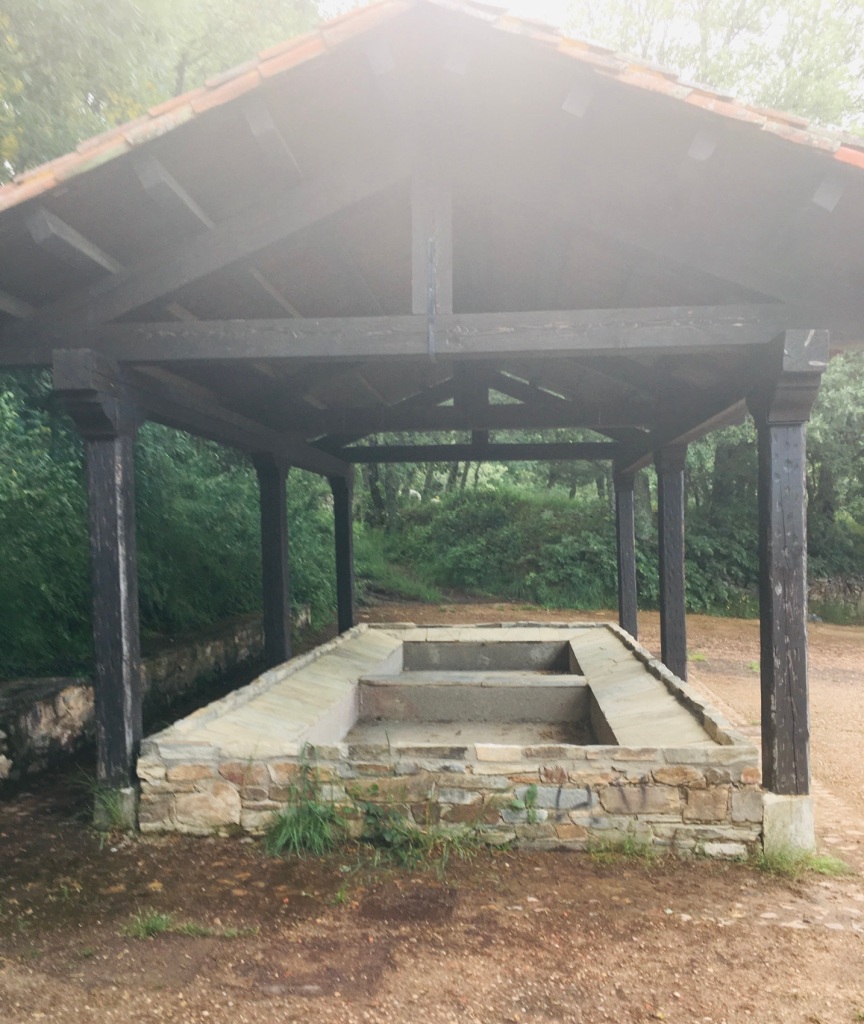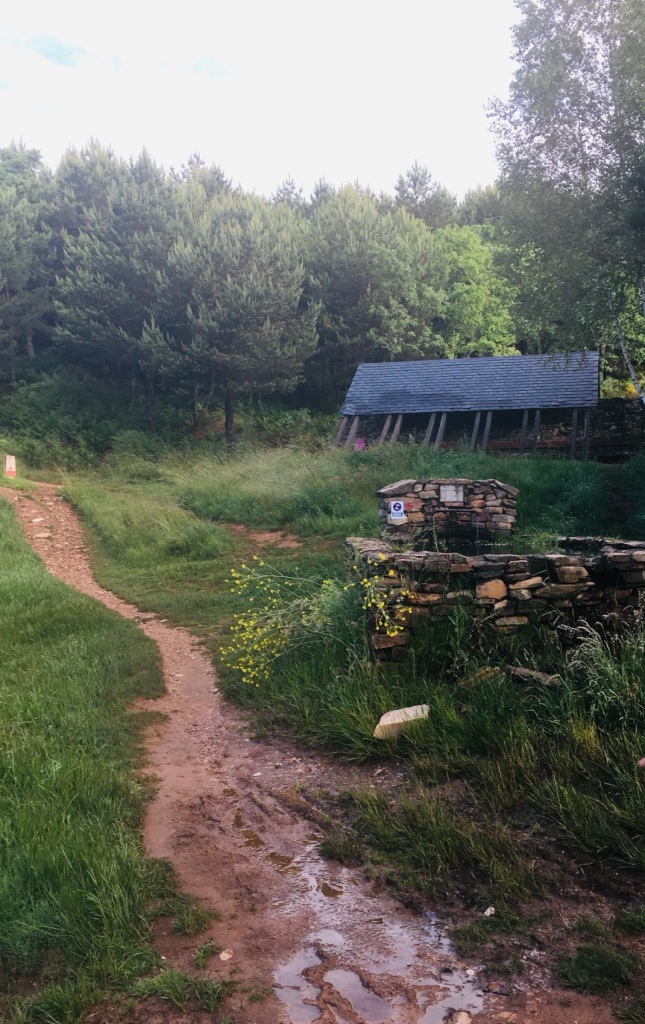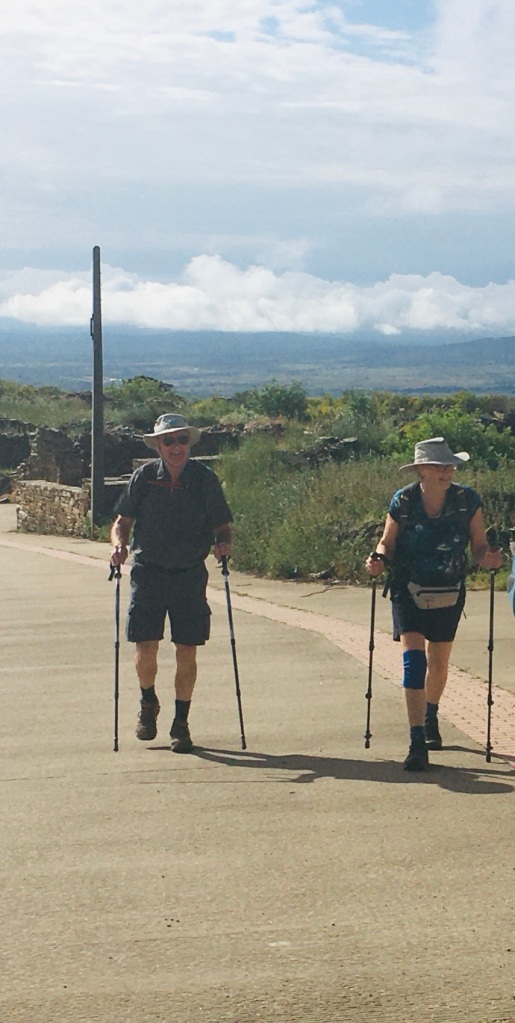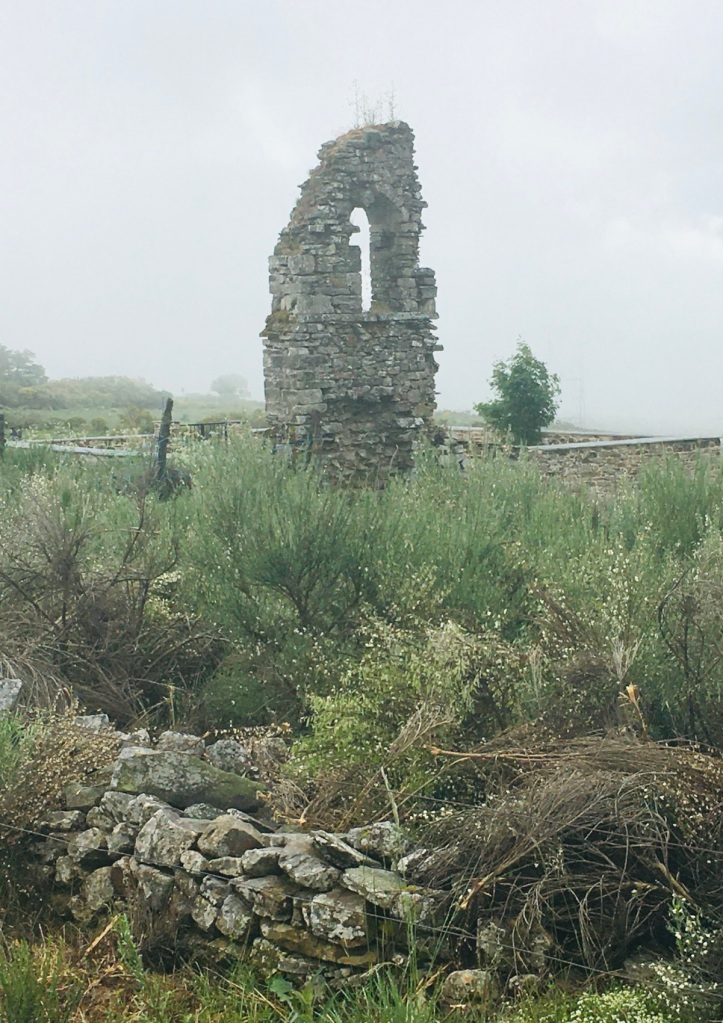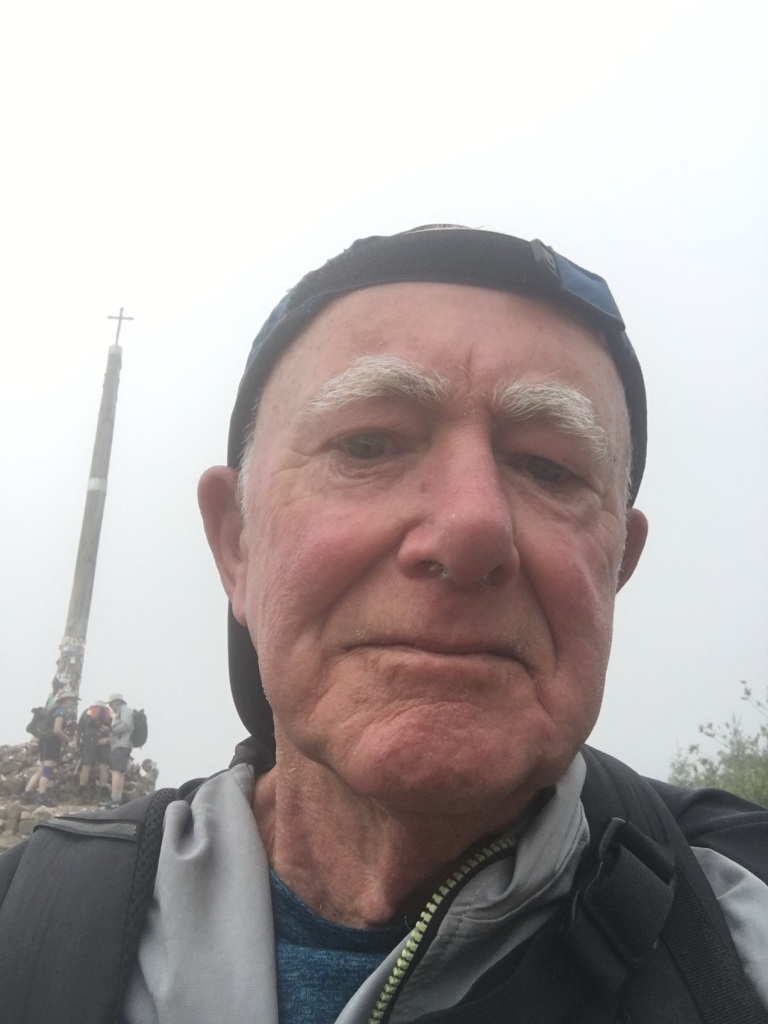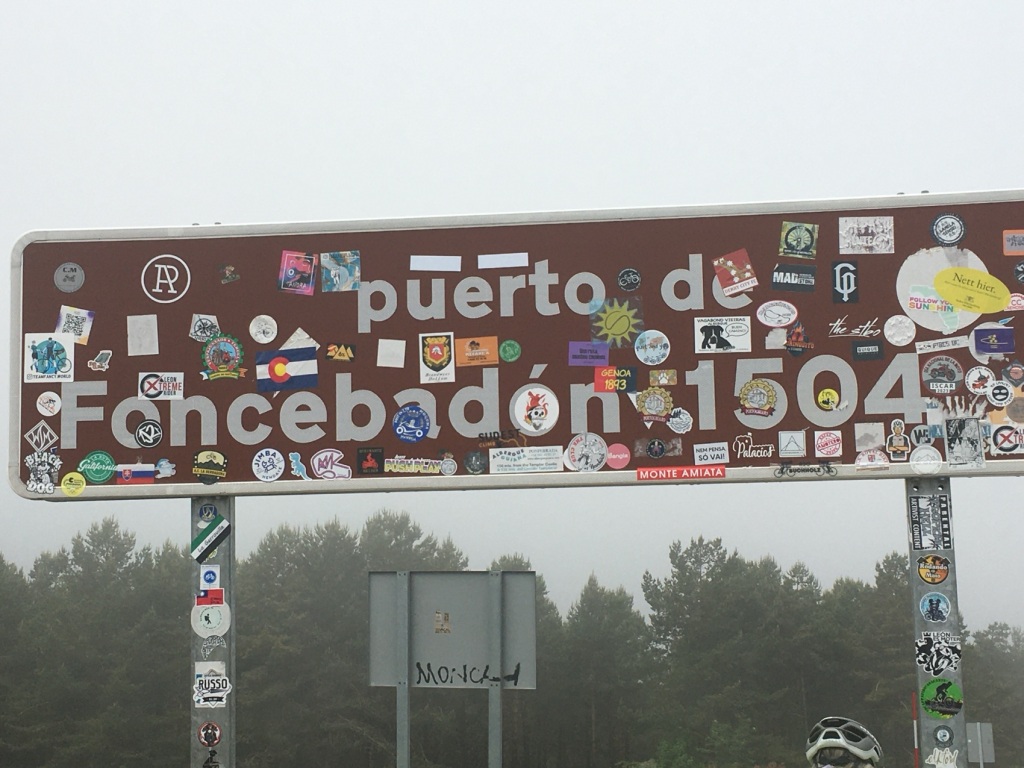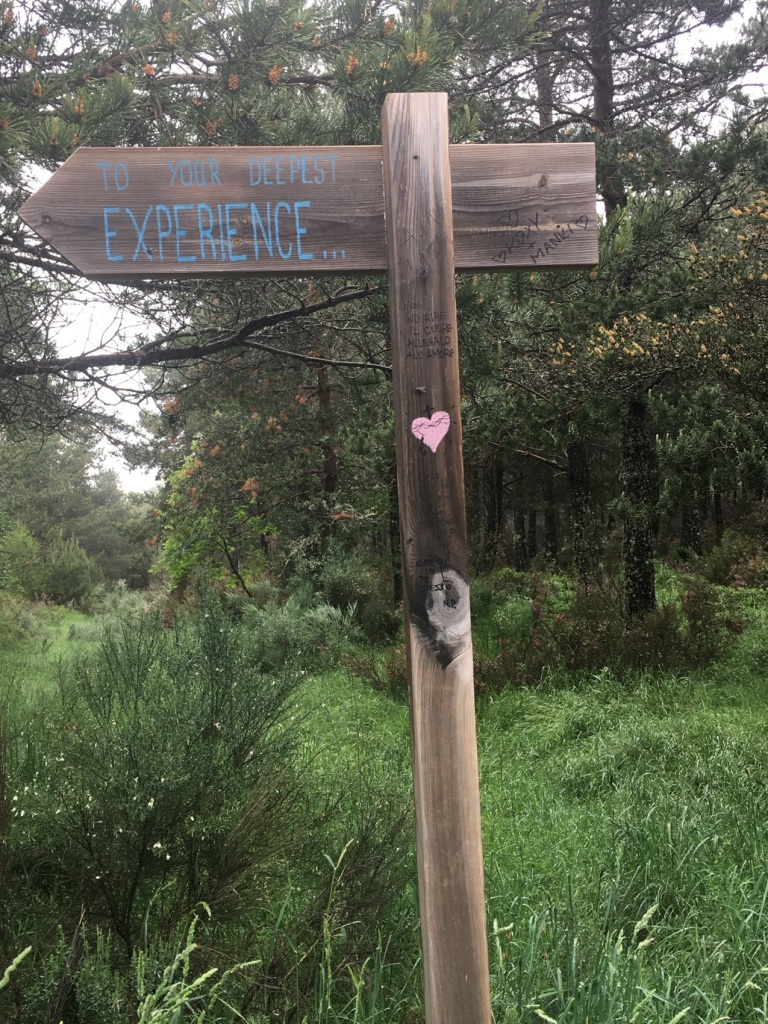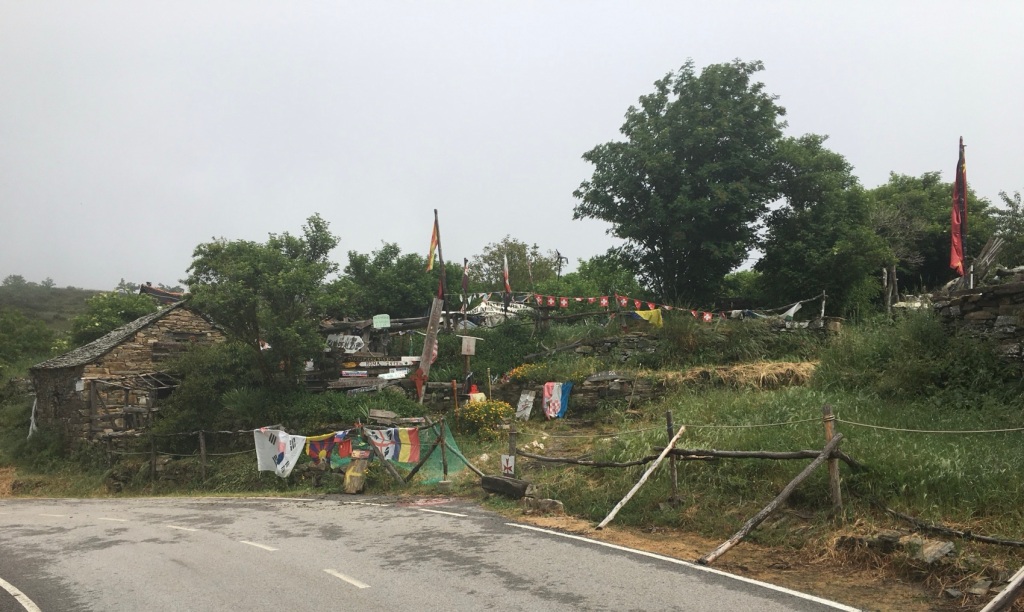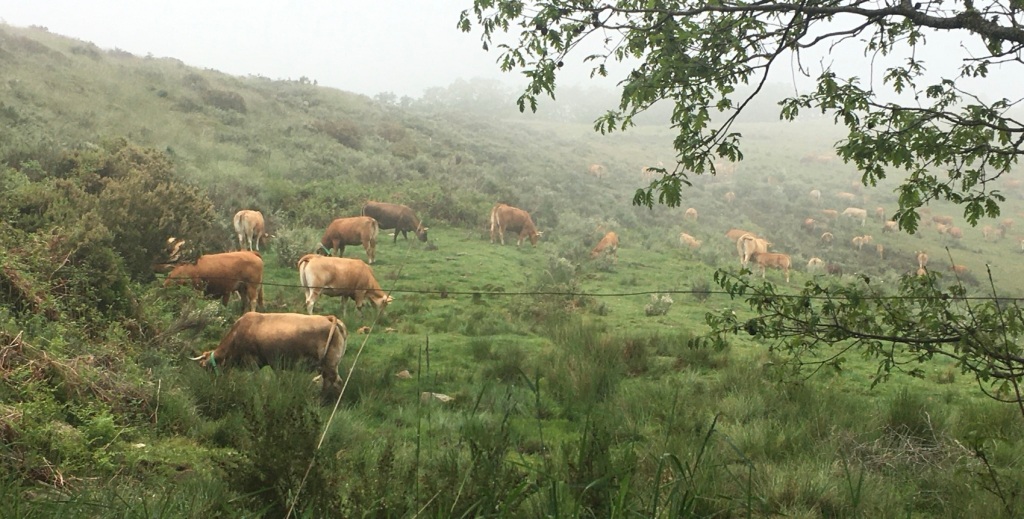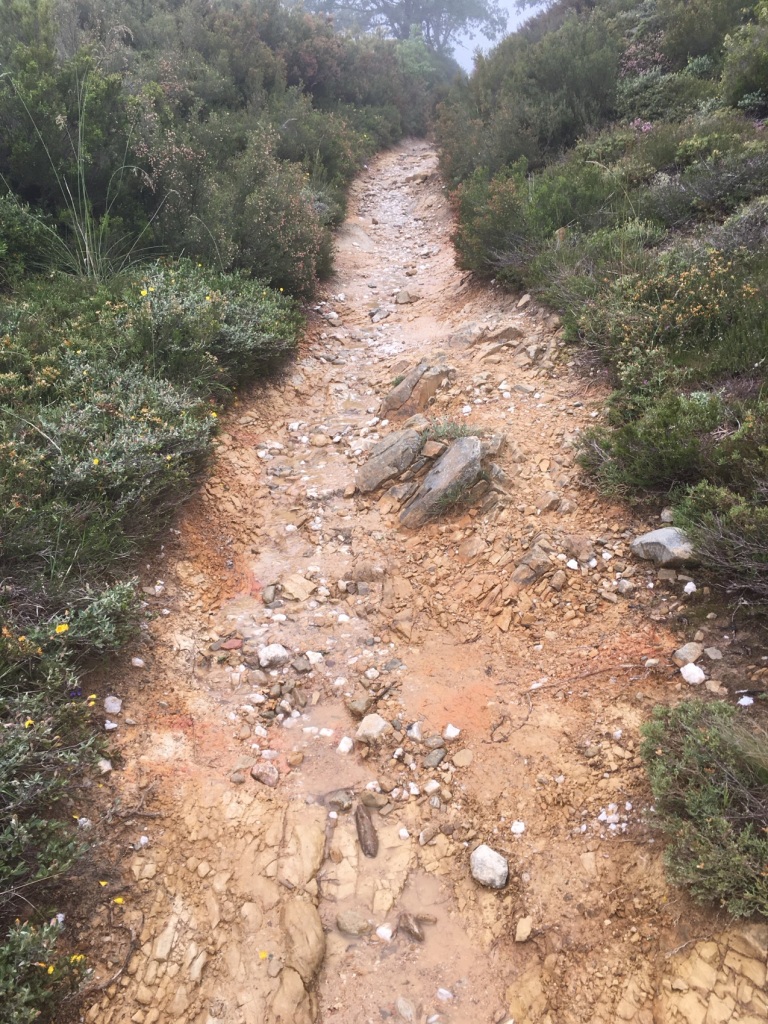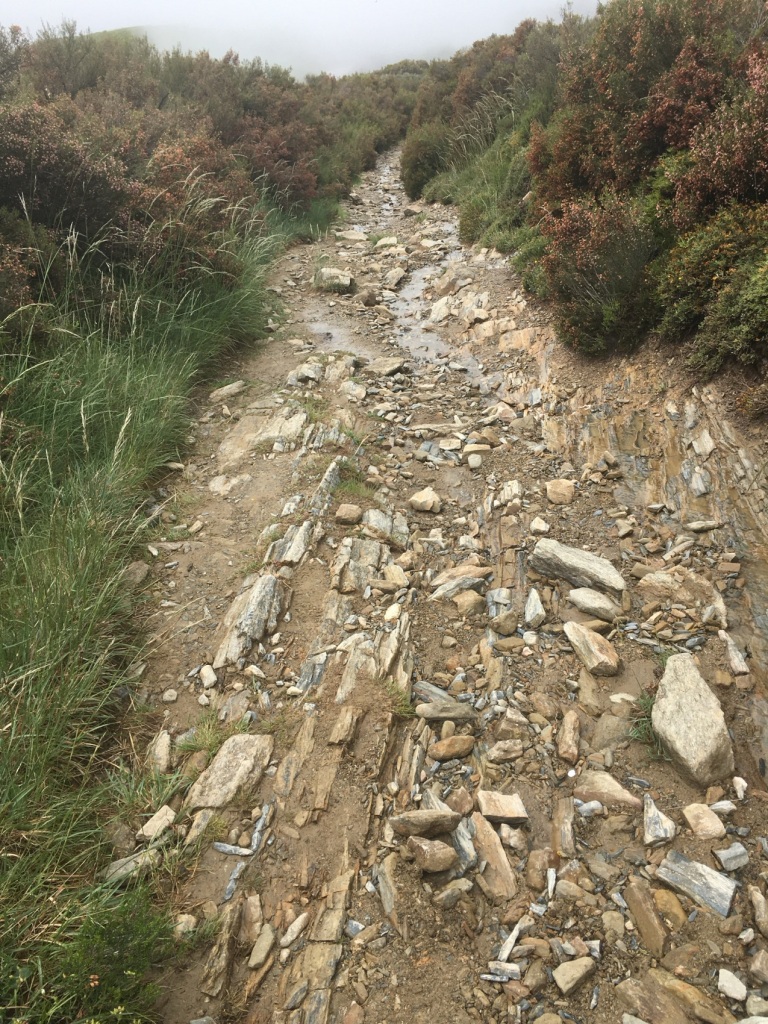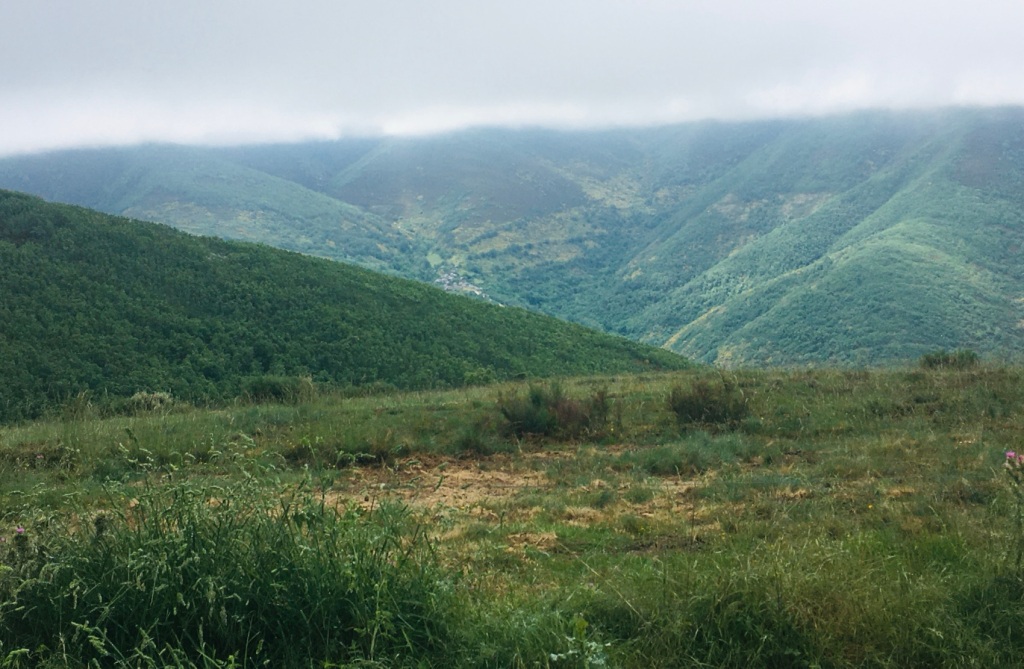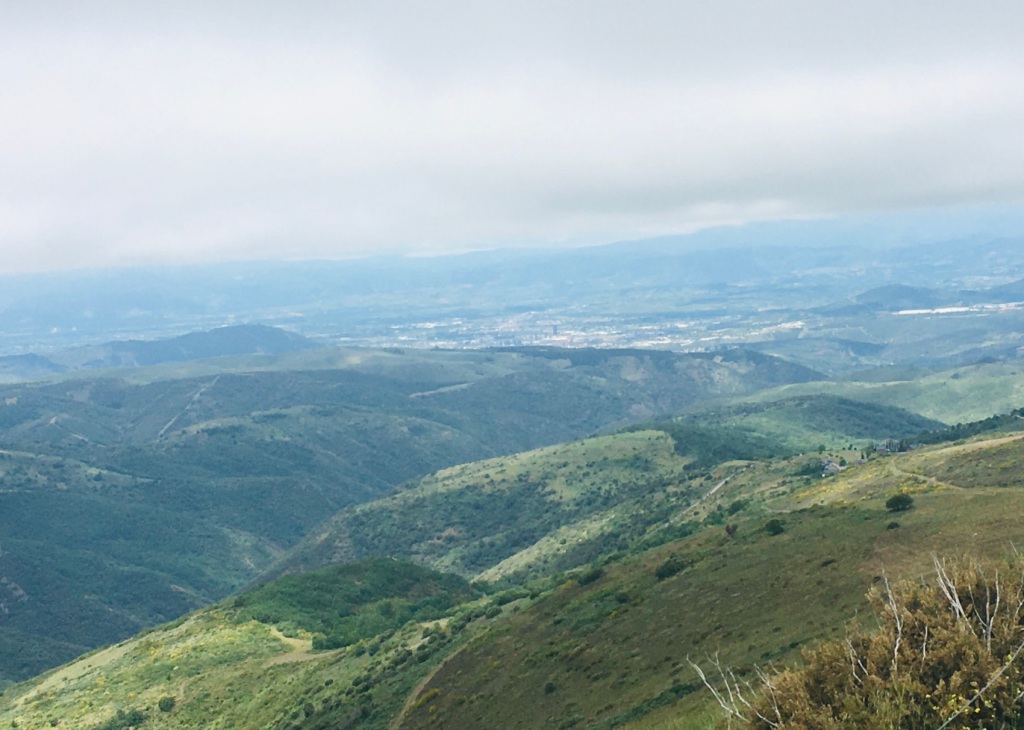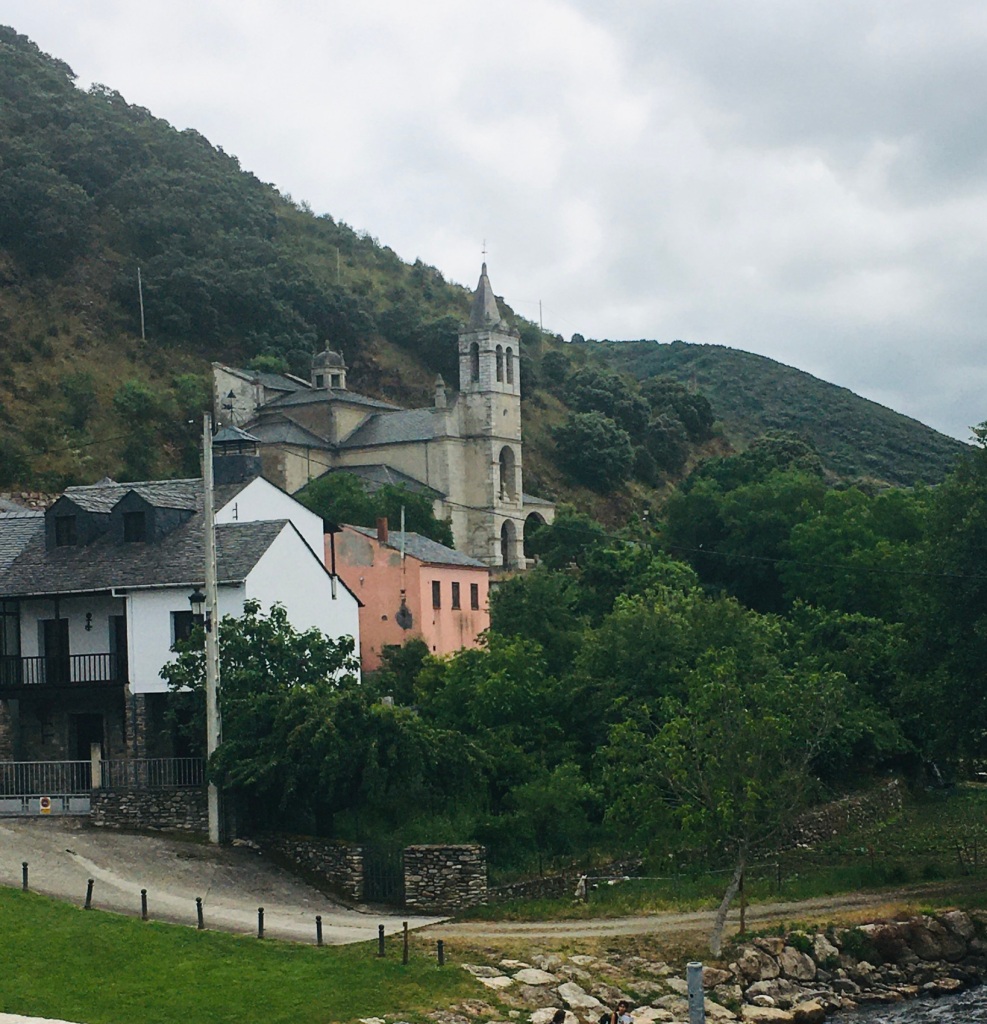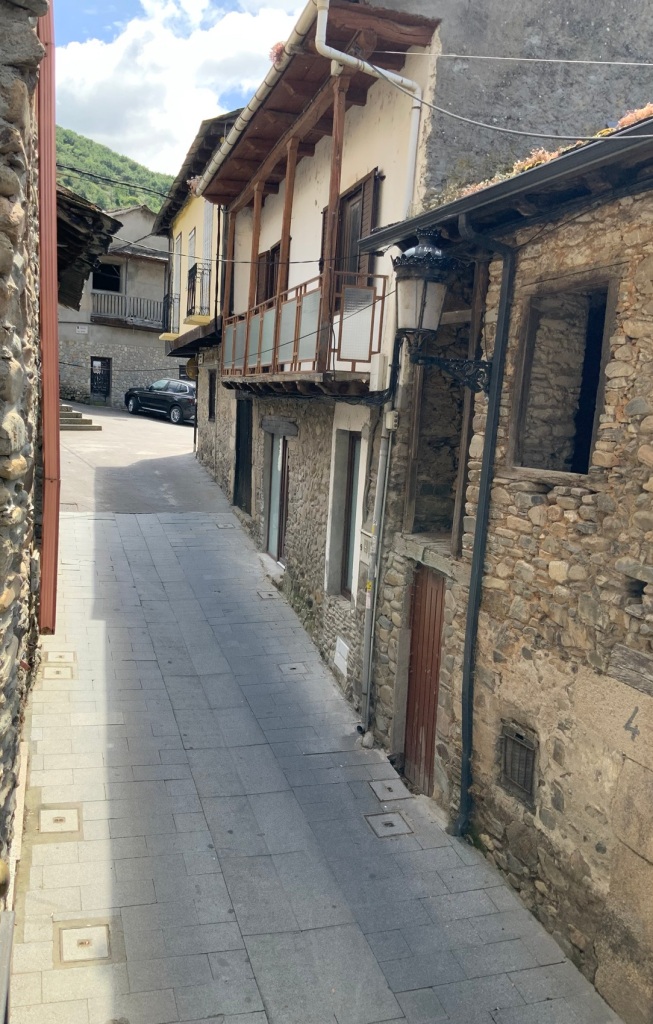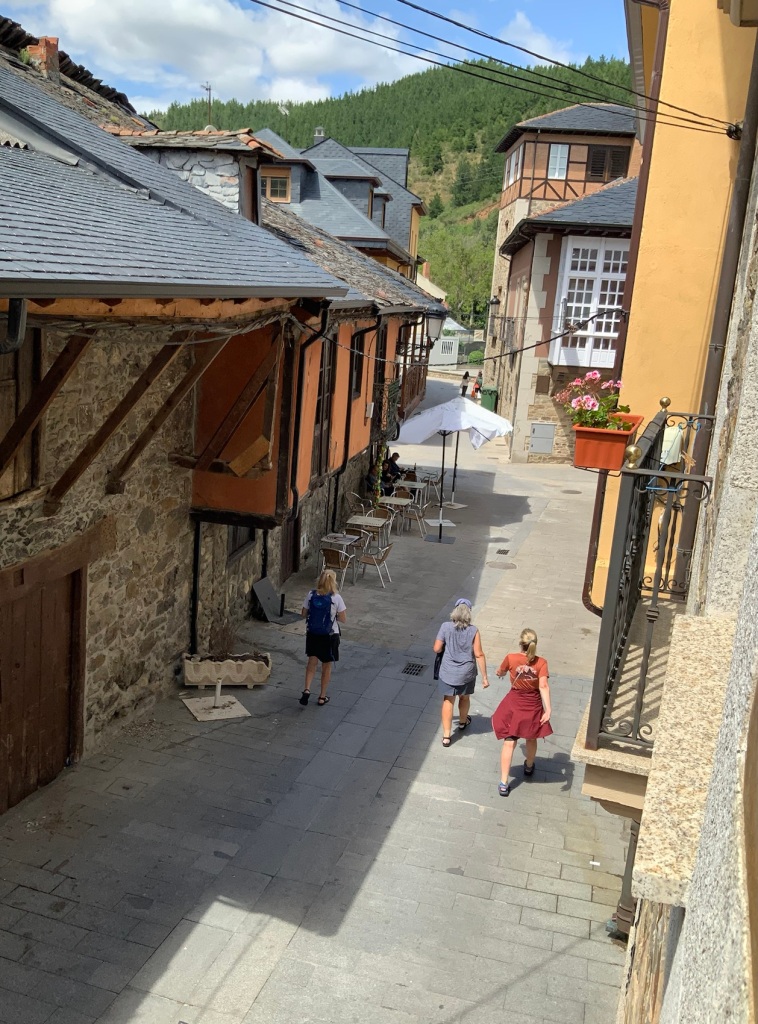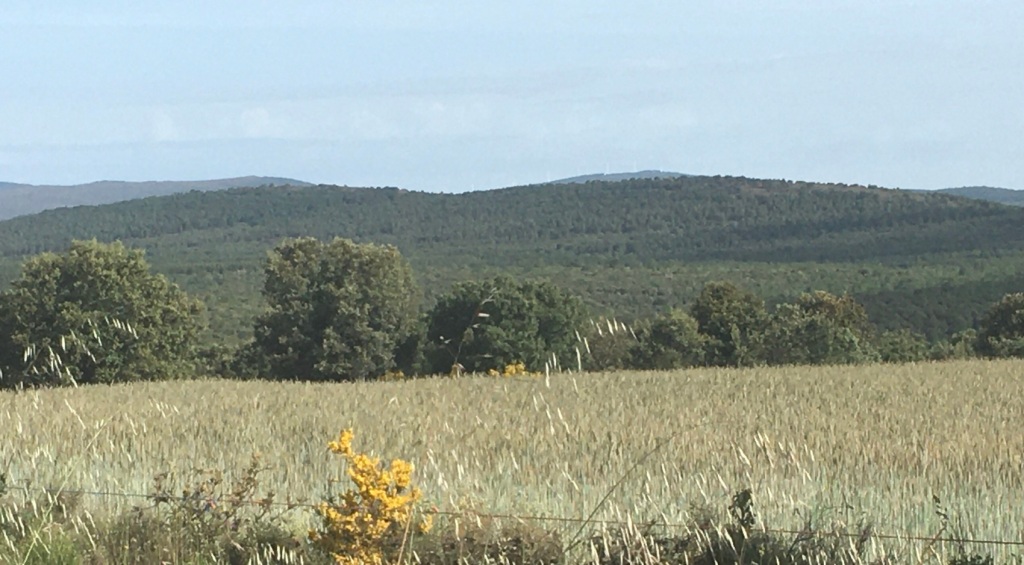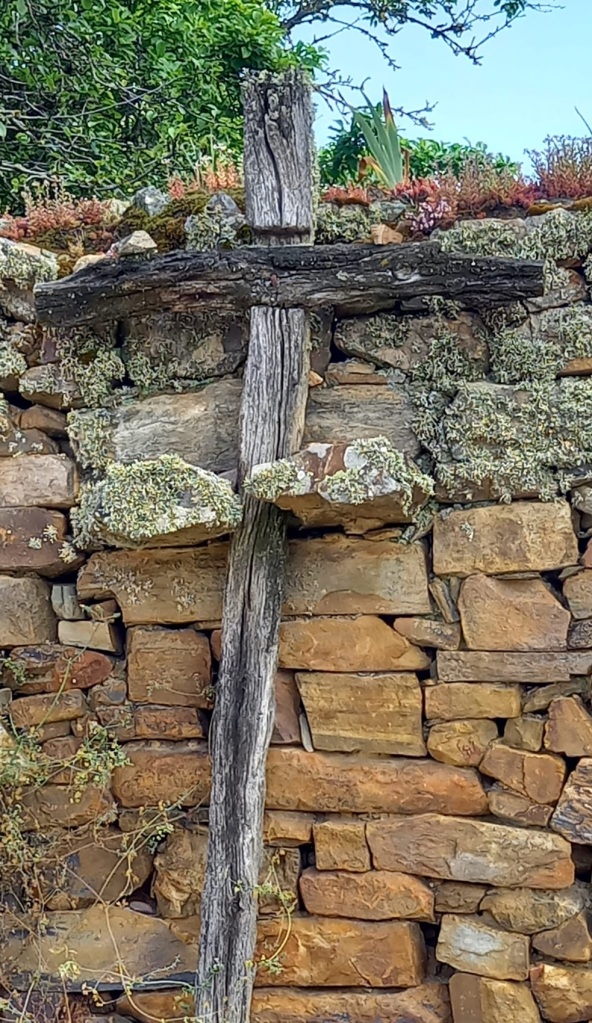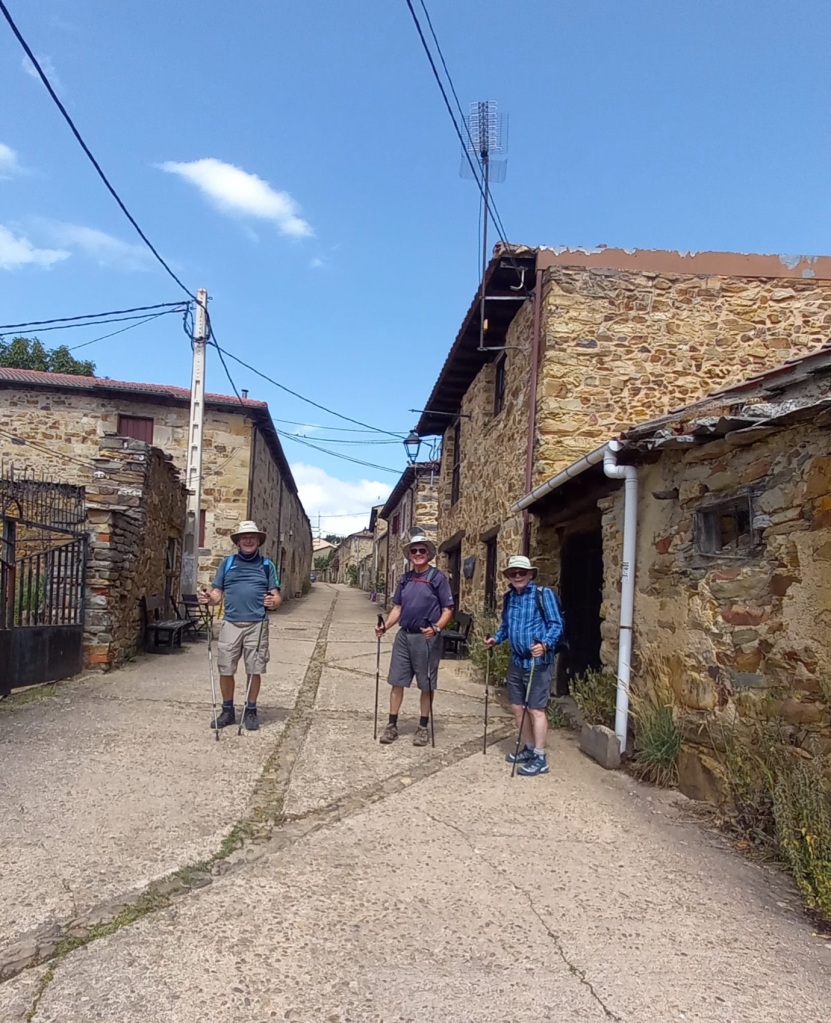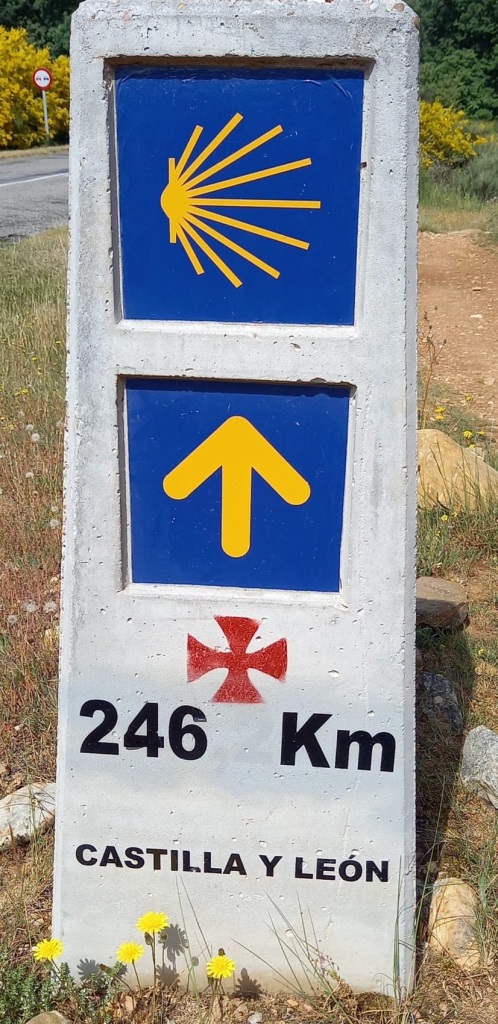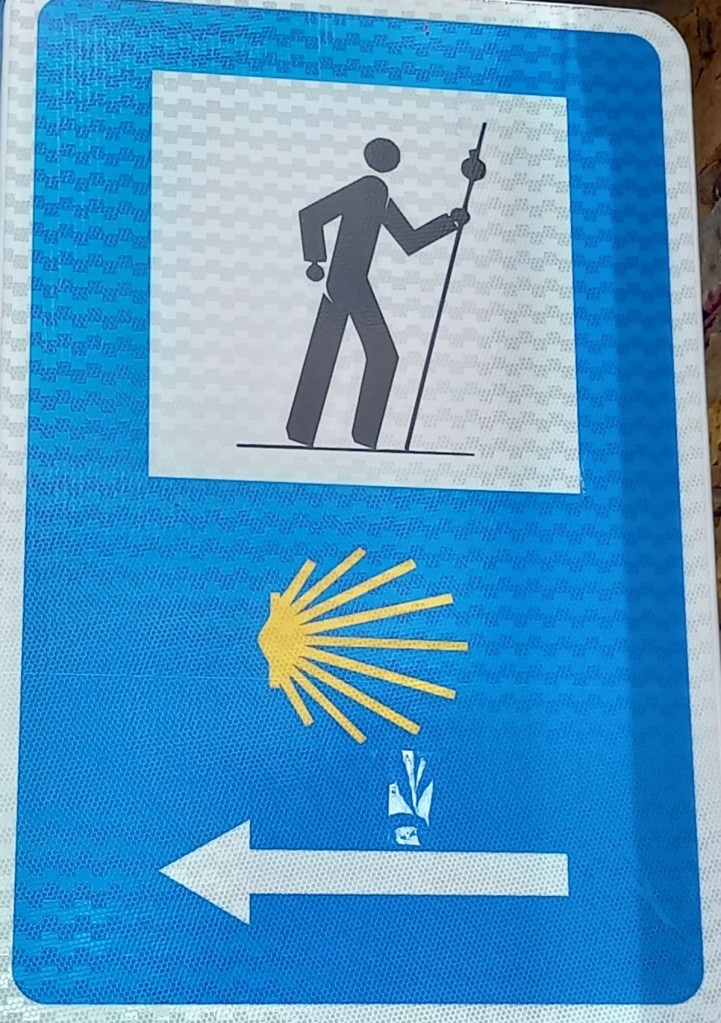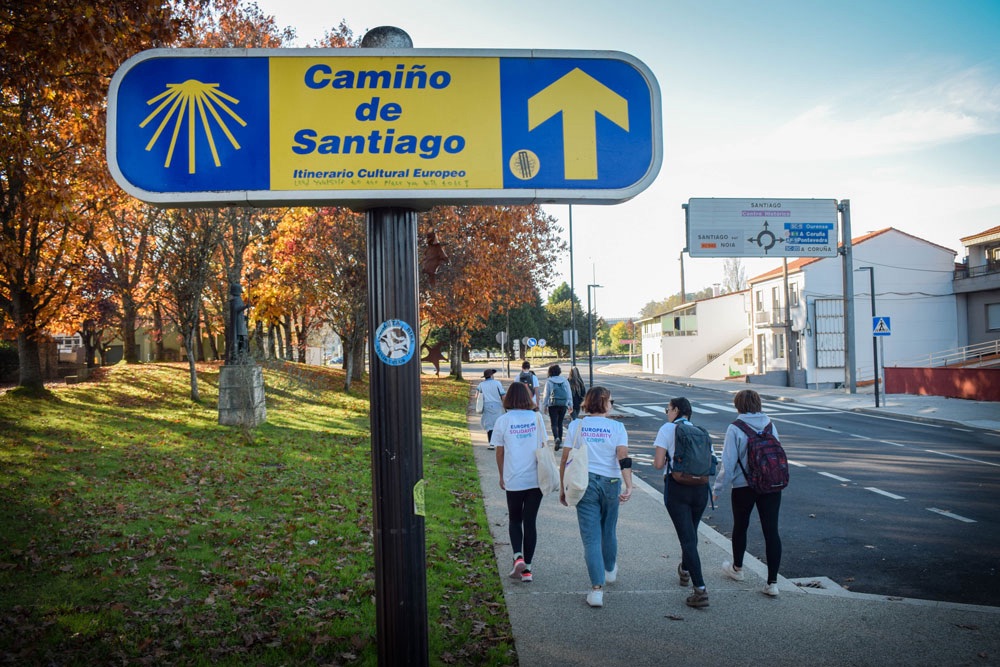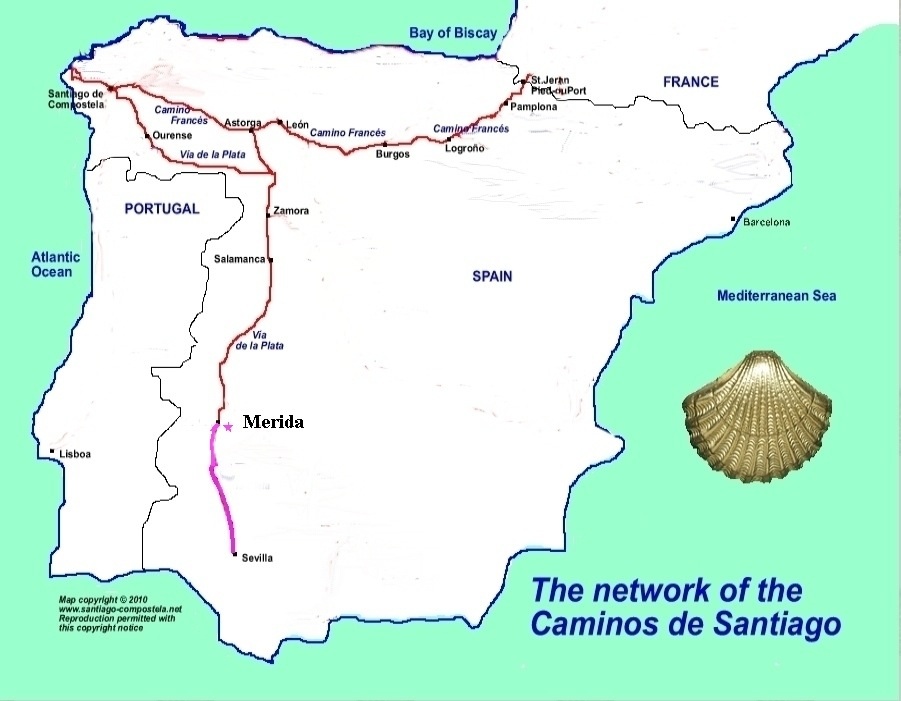
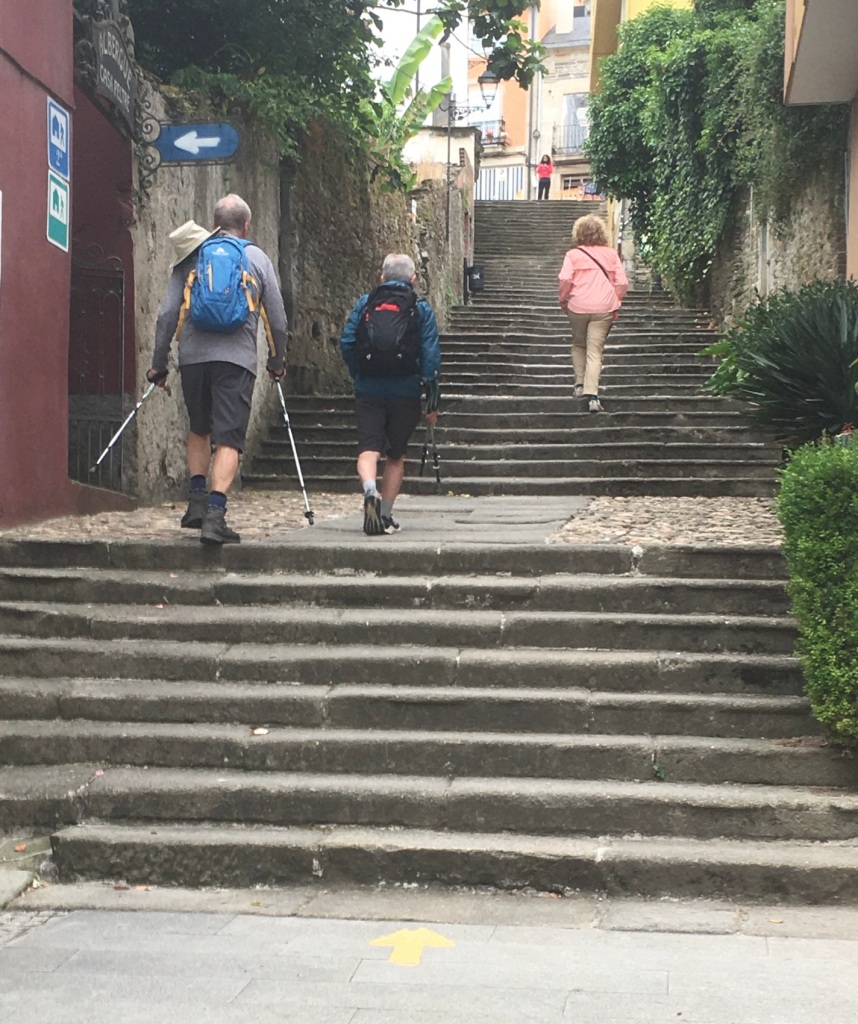
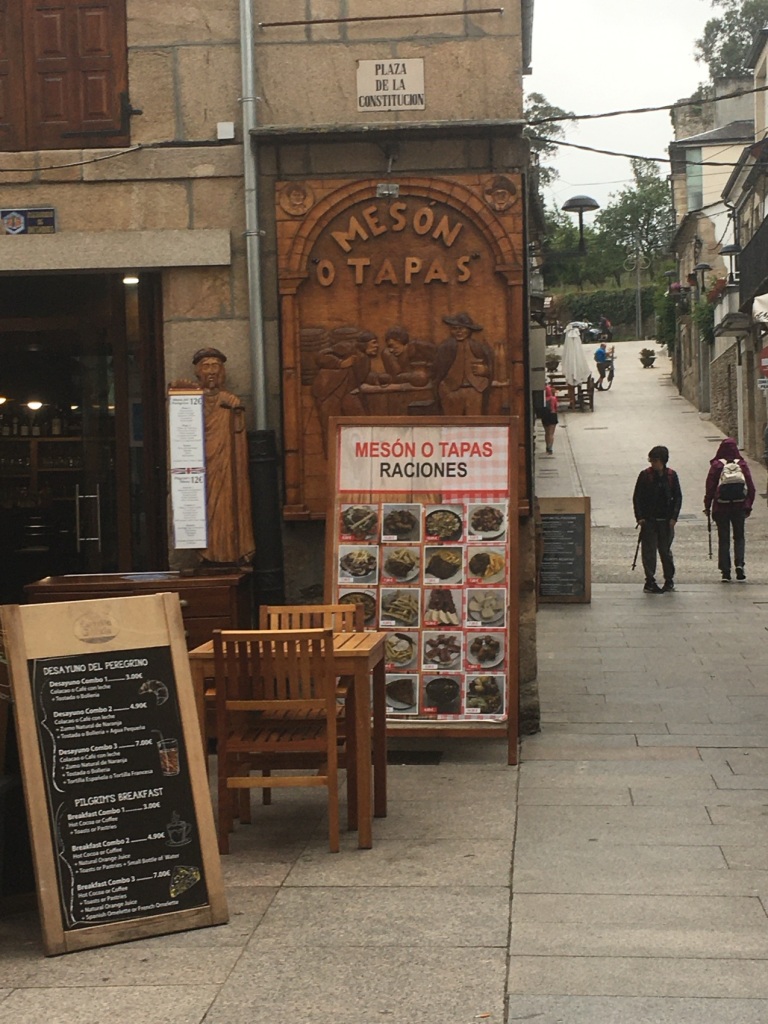
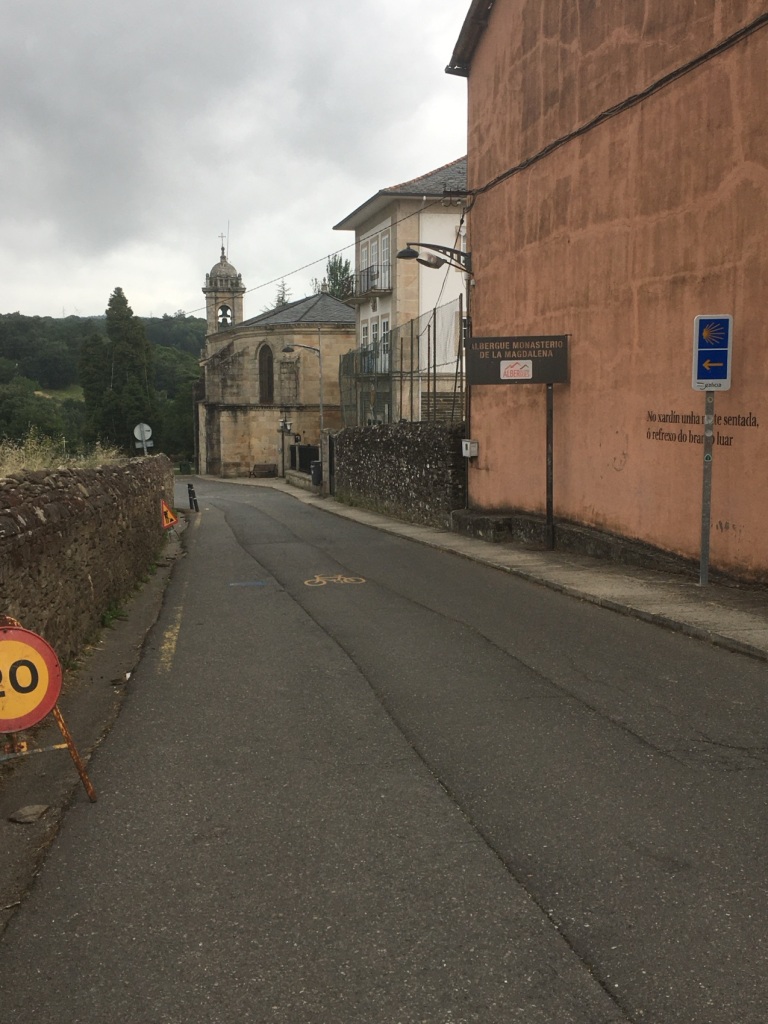
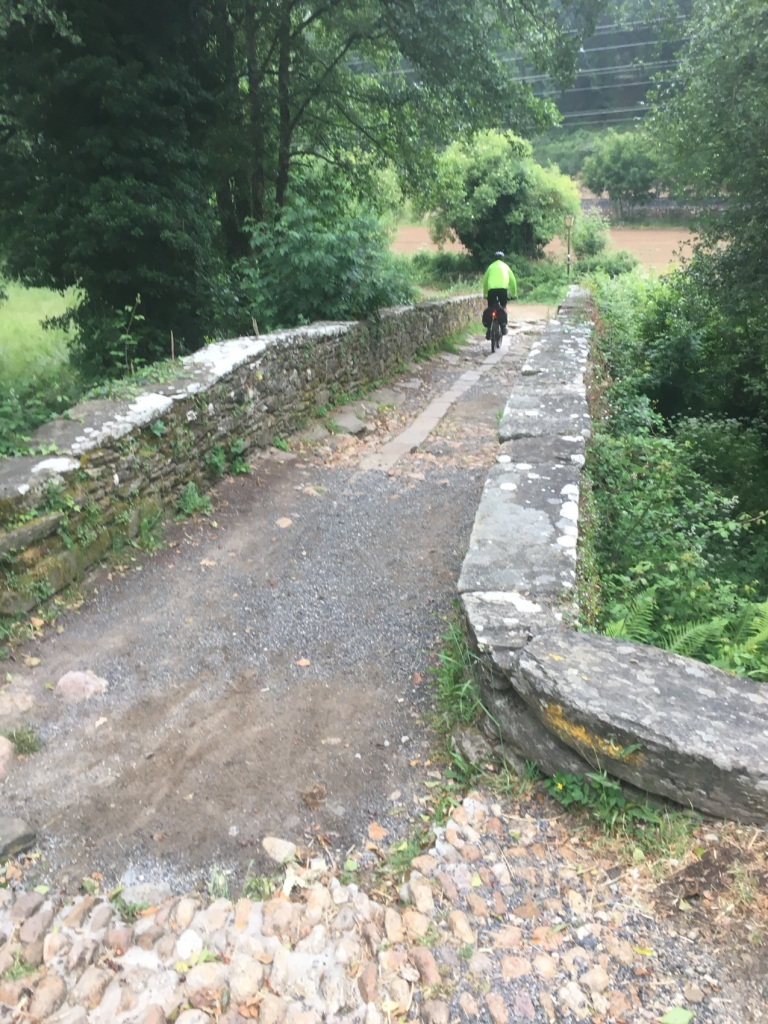
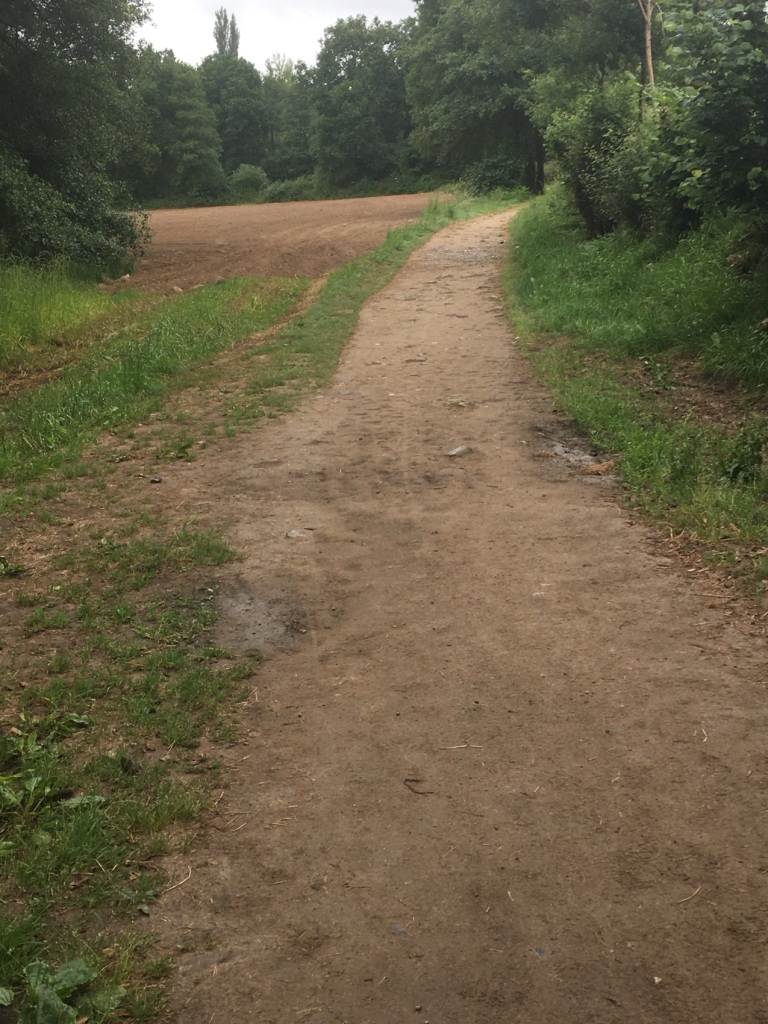
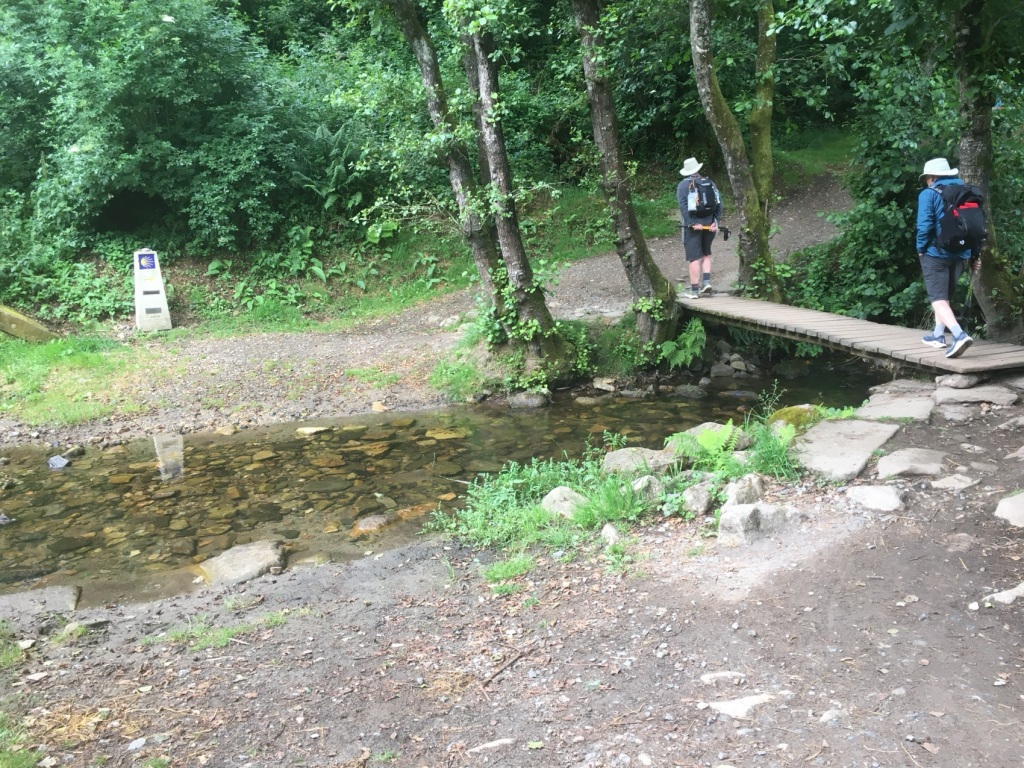
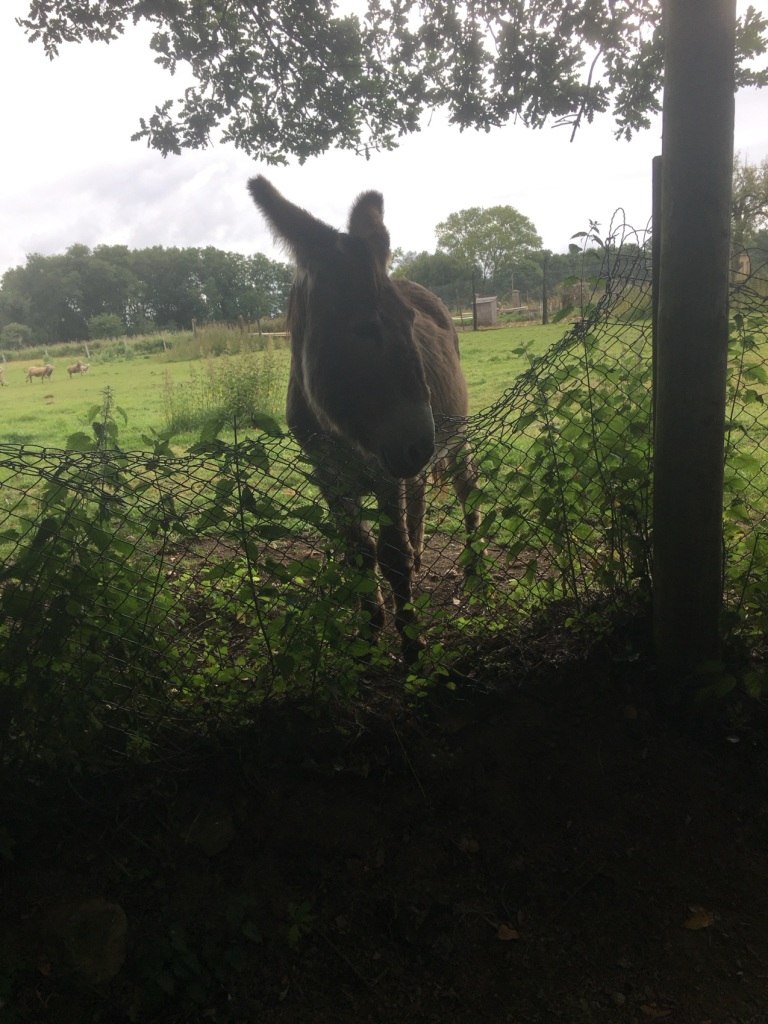
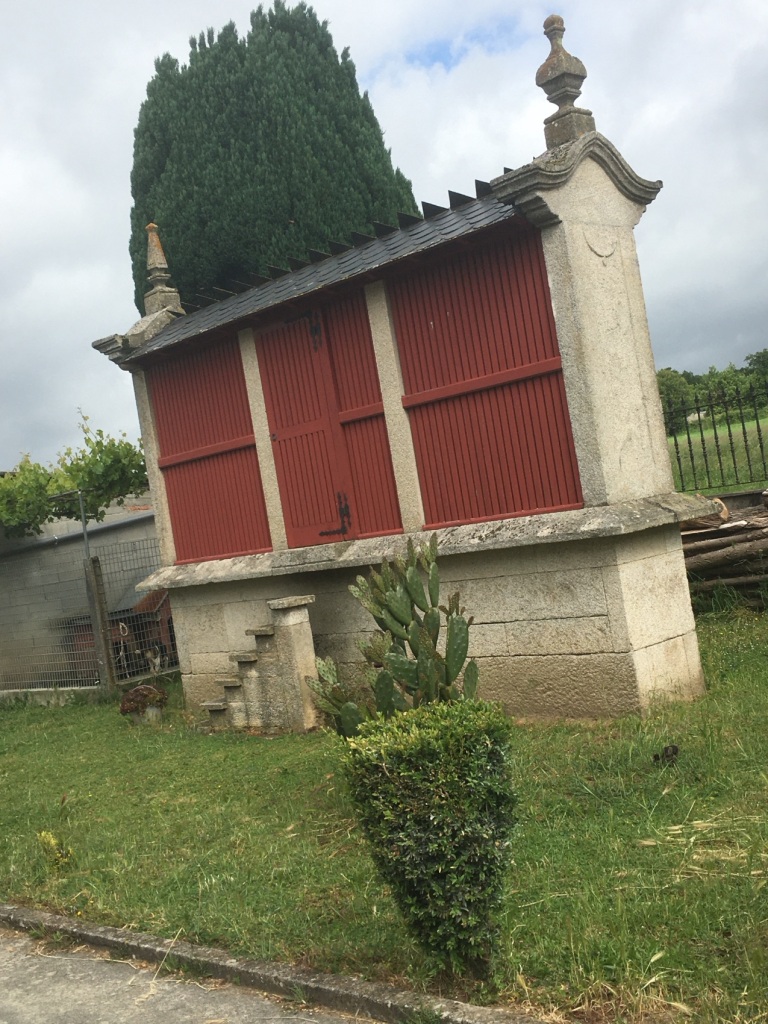
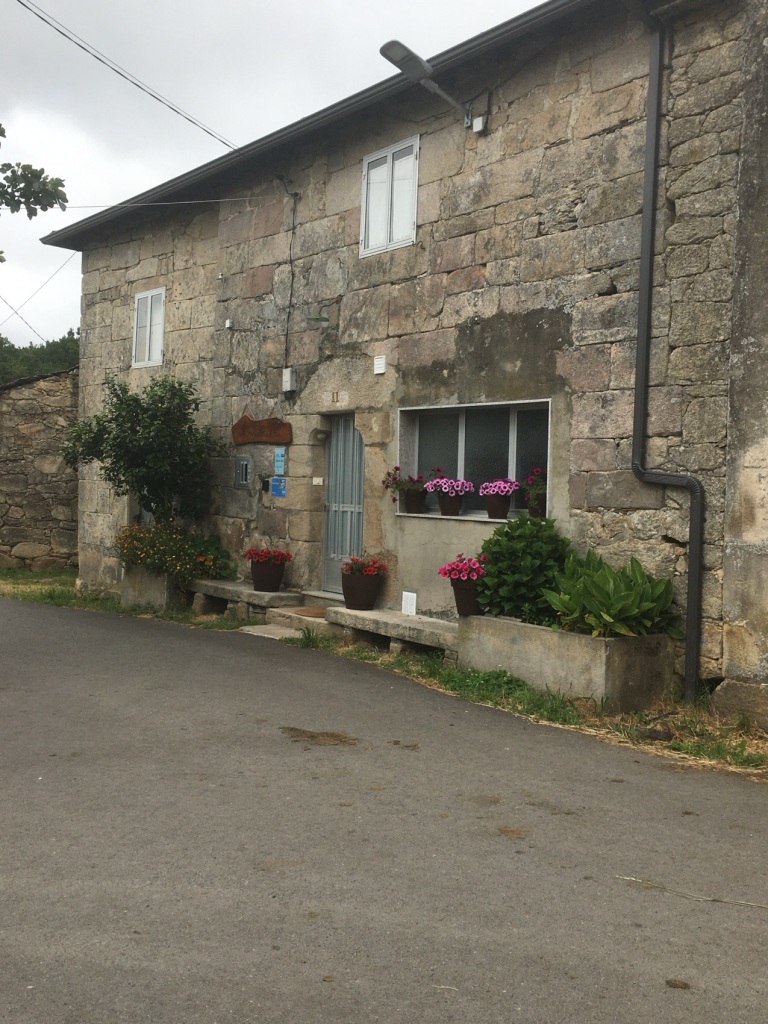
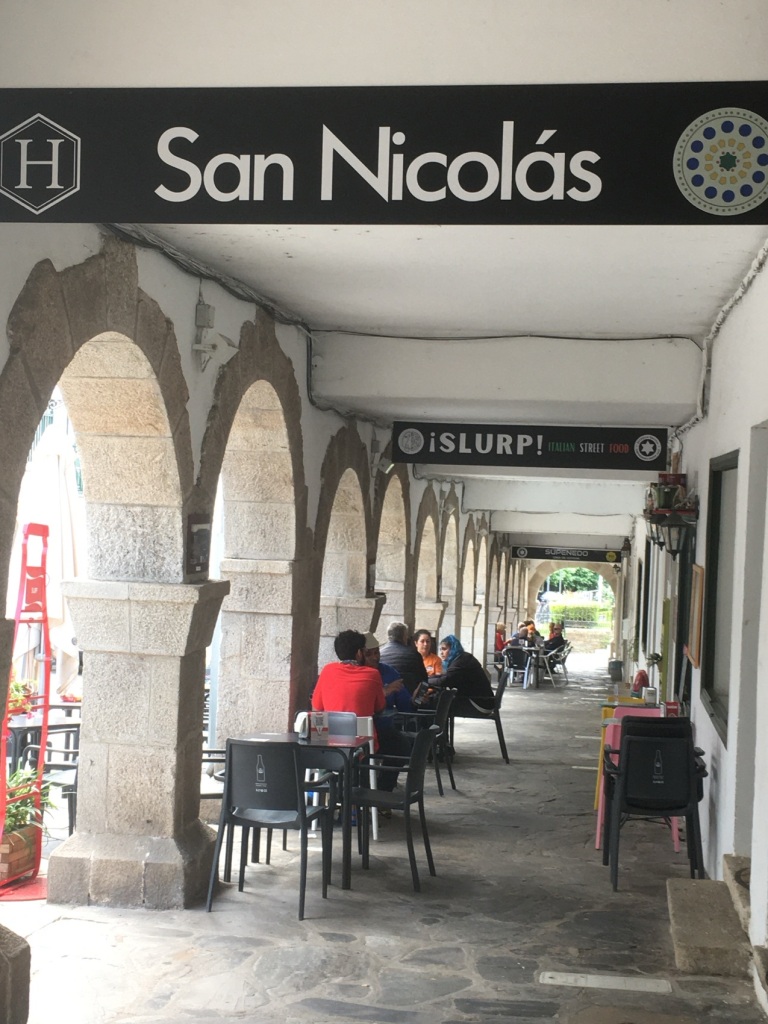
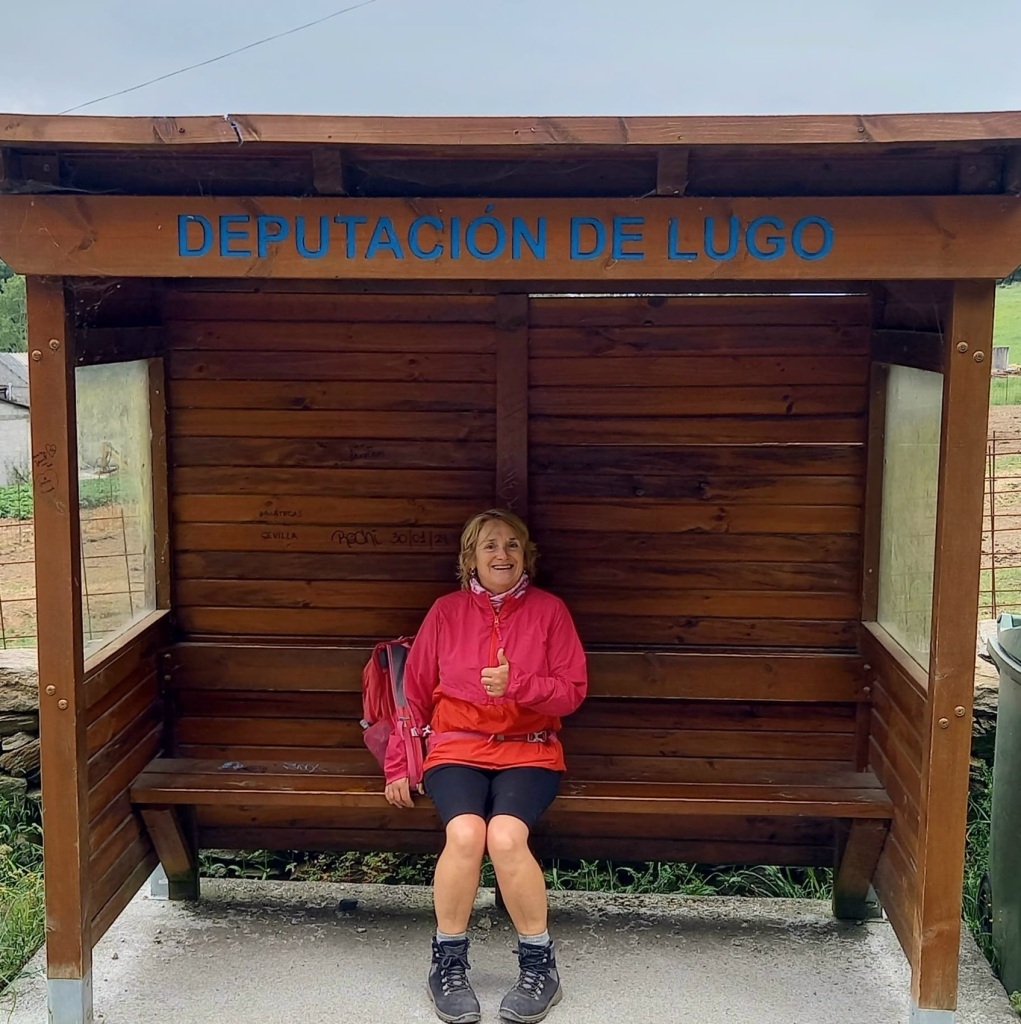
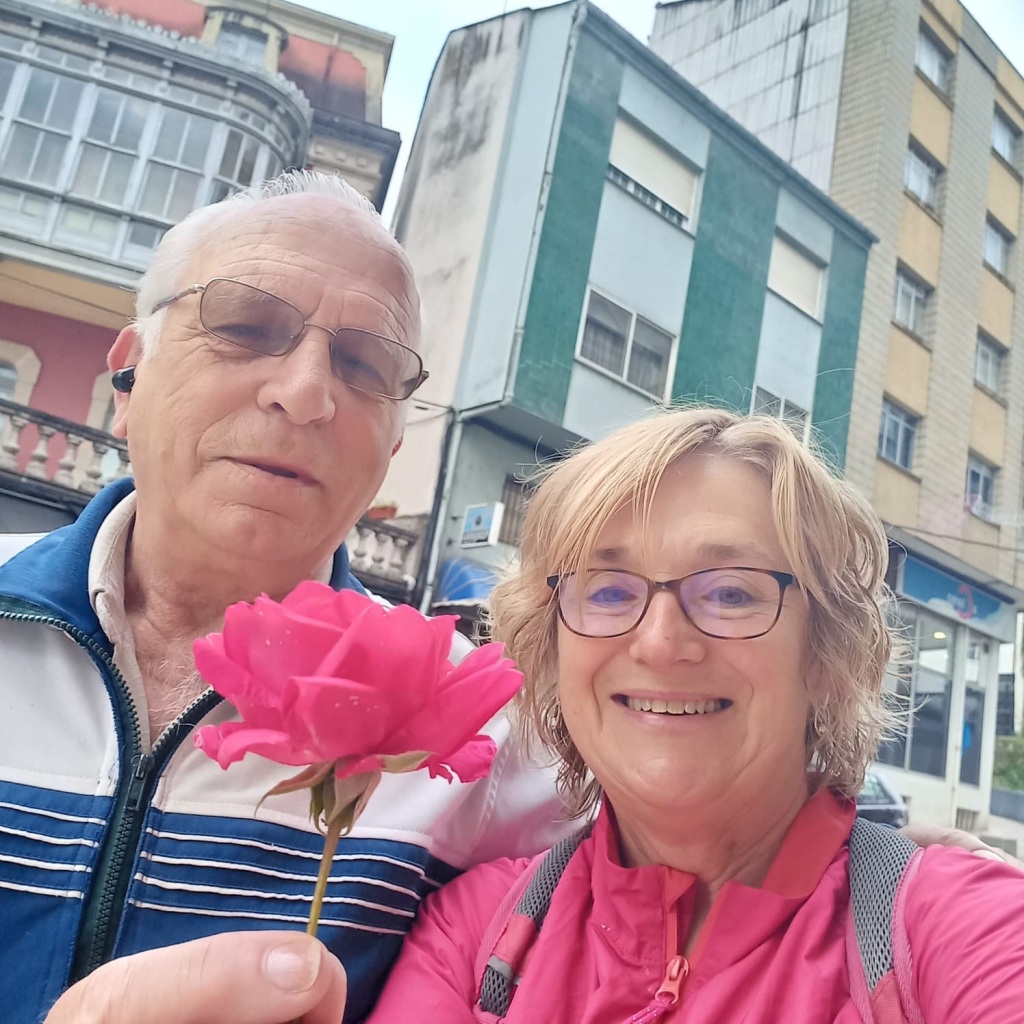
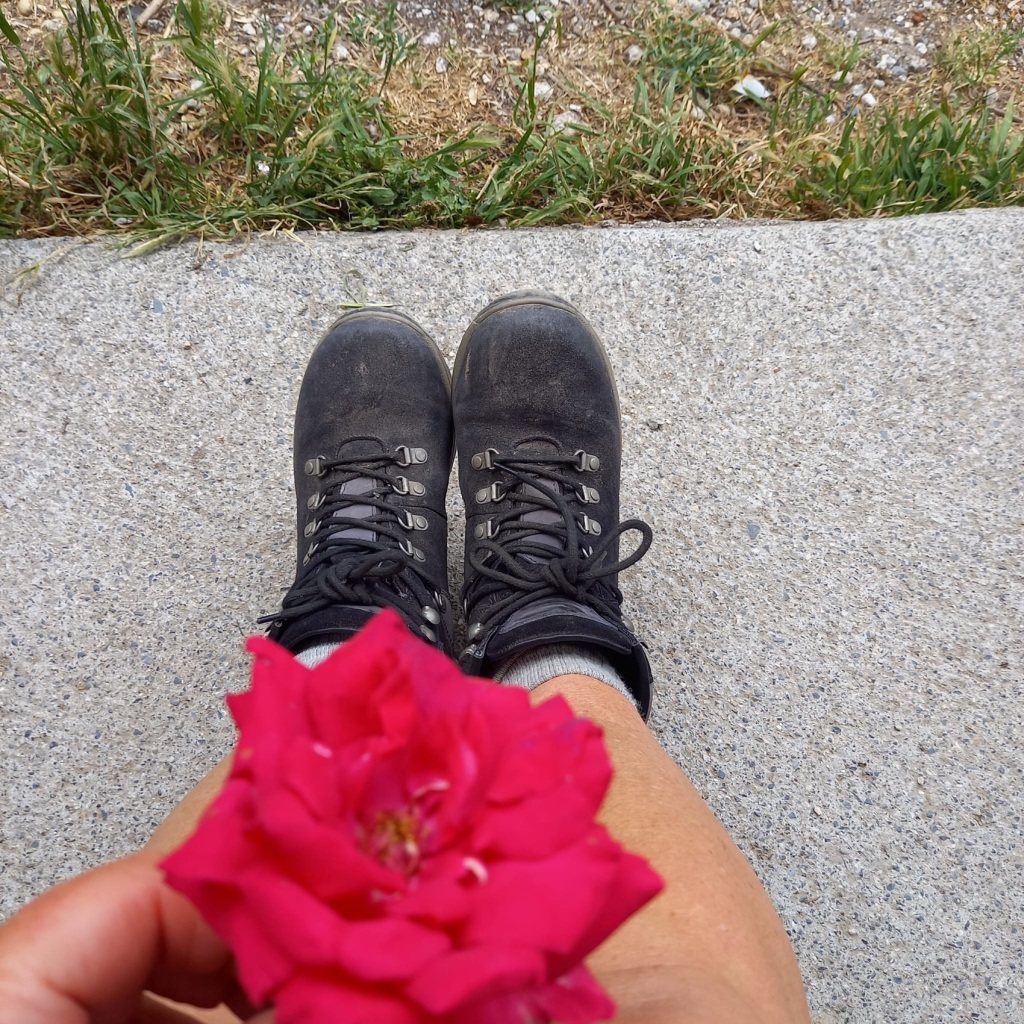
“Do you know the origin of that word ‘saunter?’ It’s a beautiful word. Away back in the Middle Ages people used to go on pilgrimages to the Holy Land, and when people in the villages through which they passed asked where they were going, they would reply, “A la sainte terre,’ ‘To the Holy Land.’ And so they became known as sainte-terre-ers or saunterers. Now these mountains are our Holy Land, and we ought to saunter through them reverently, not ‘hike’ through them.” John Muir. AS IS THE CAMINO!
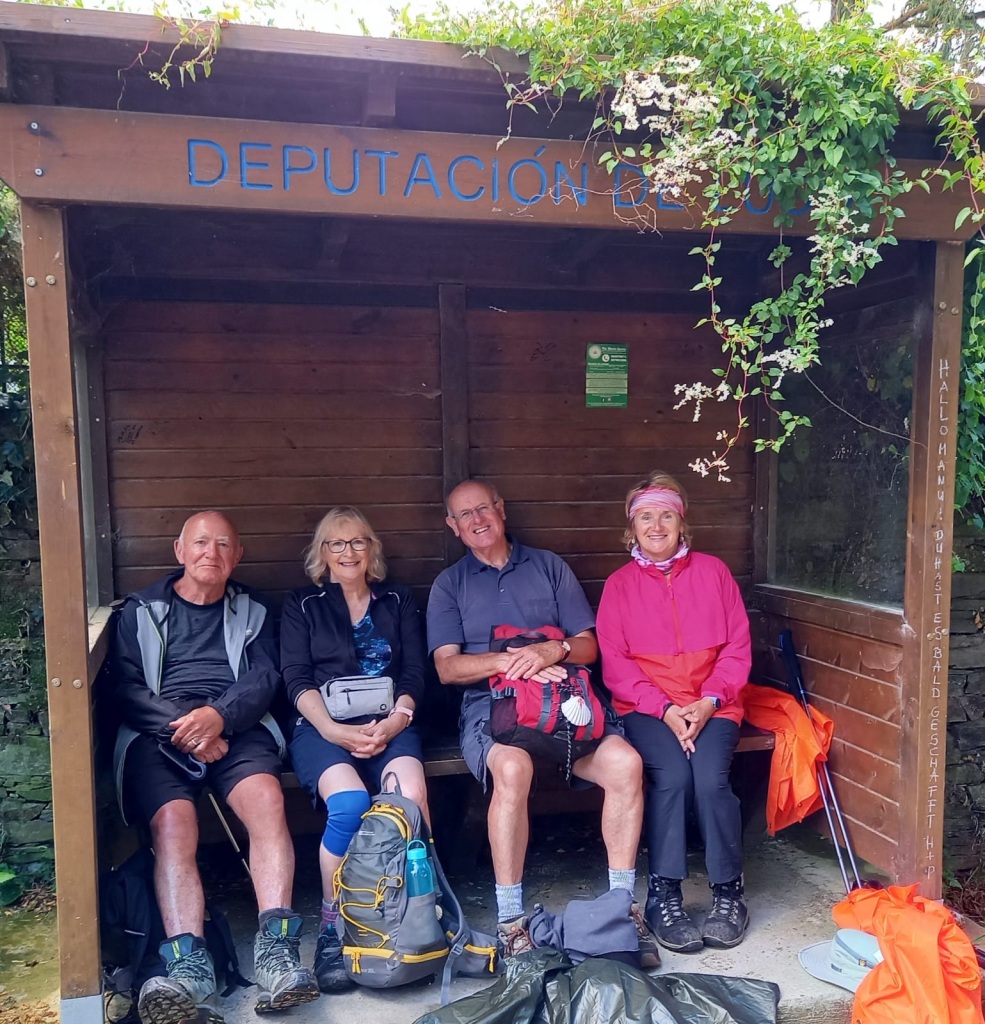
A punctual departure from Astorga, without breakfast, though each one had a snack and a drink of some kind. Christina even had a ready made paper carton of cafe latte!
Clock in hotel foyer.
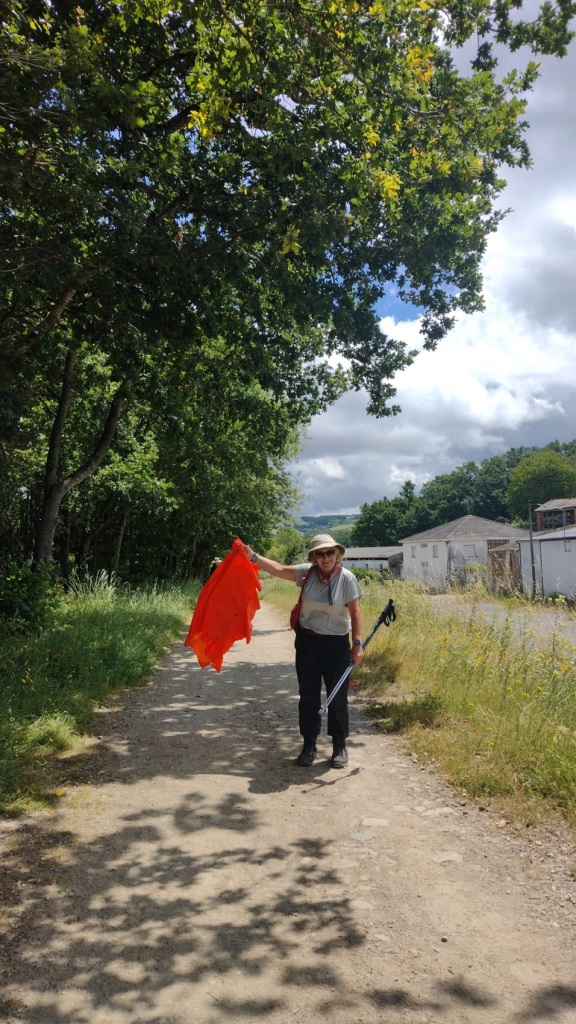
Once again I am indebted to Val & Christina for sharing photos, far superior to mine.
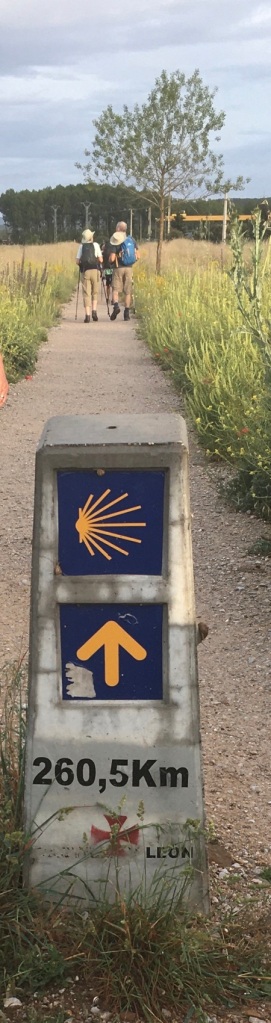
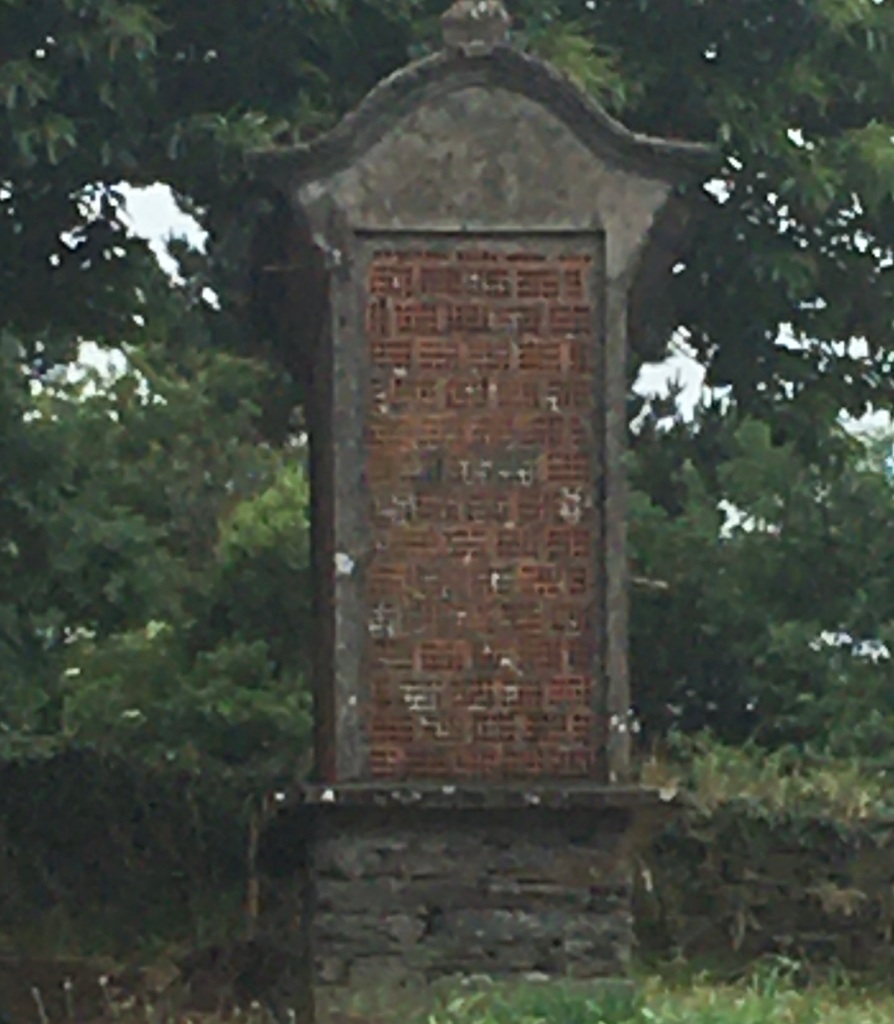
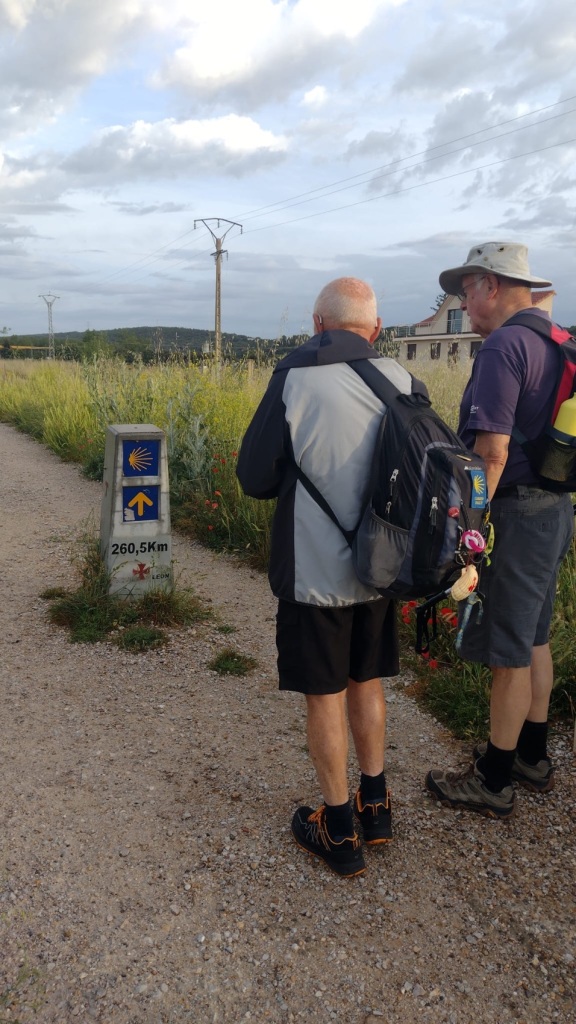
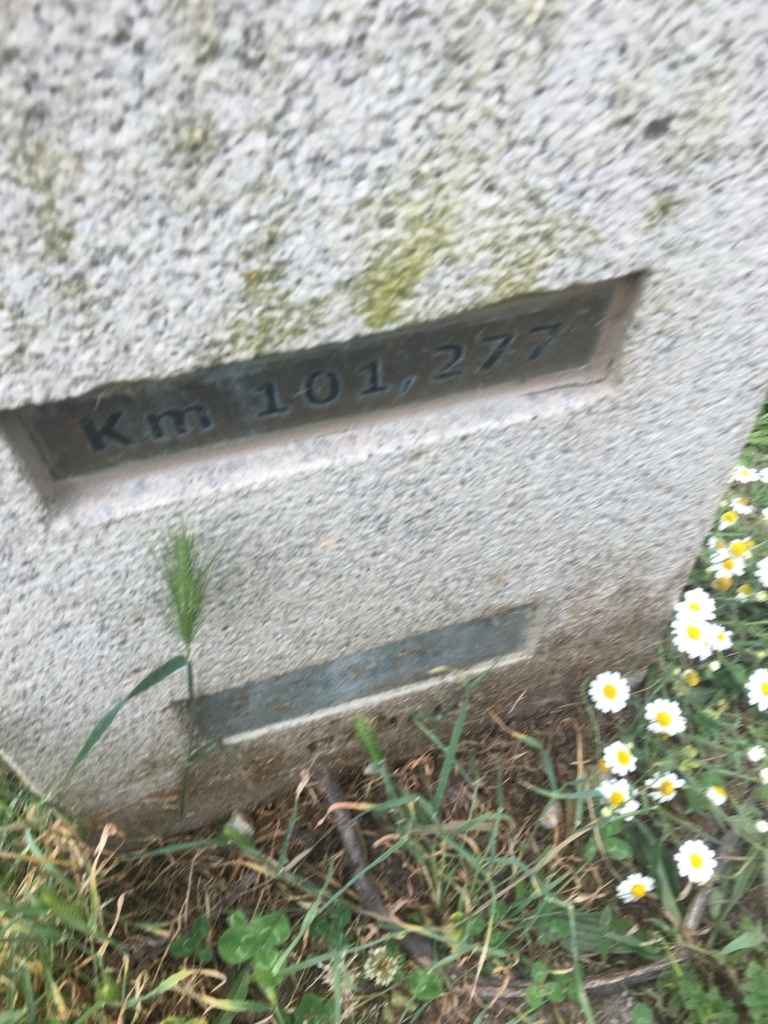
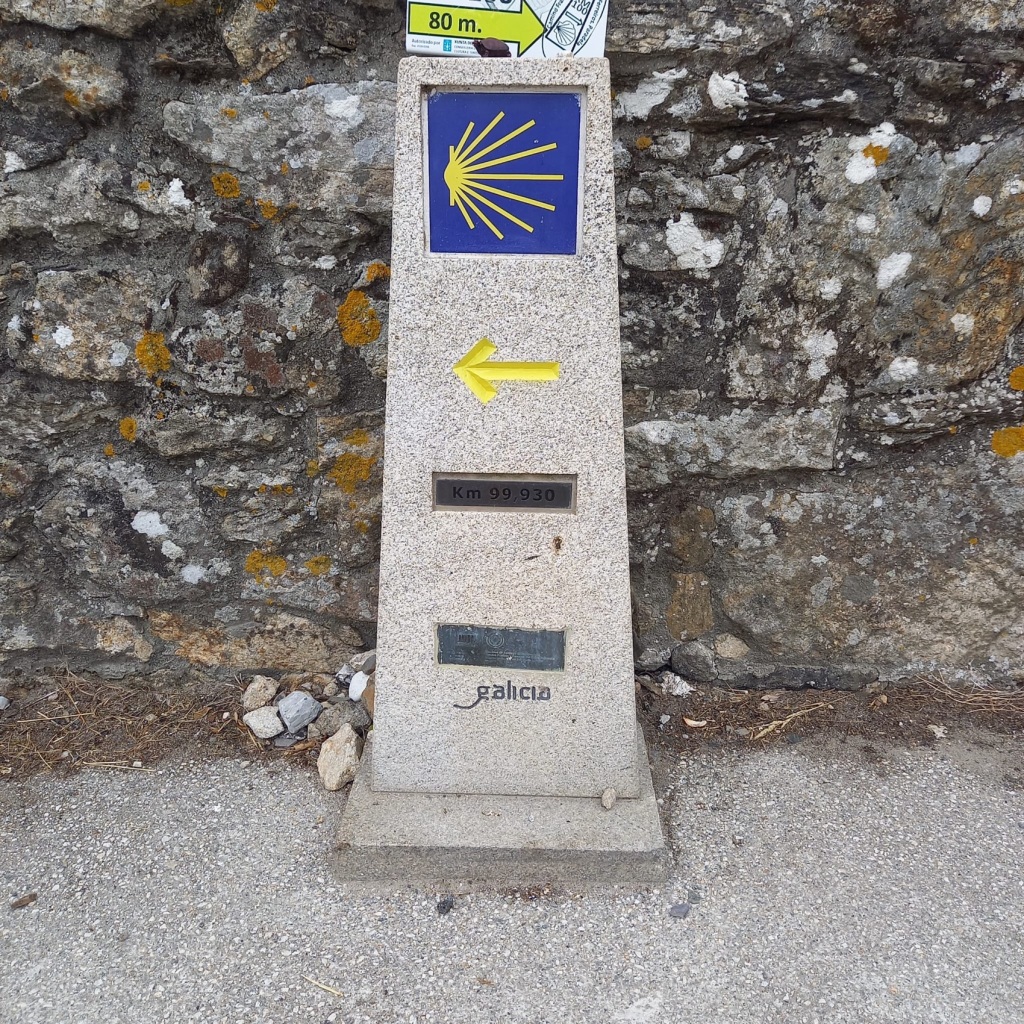
Richard and I admiring the first distance marker post.
We anticipated walking about 5 Km to our breakfast coffee stop.
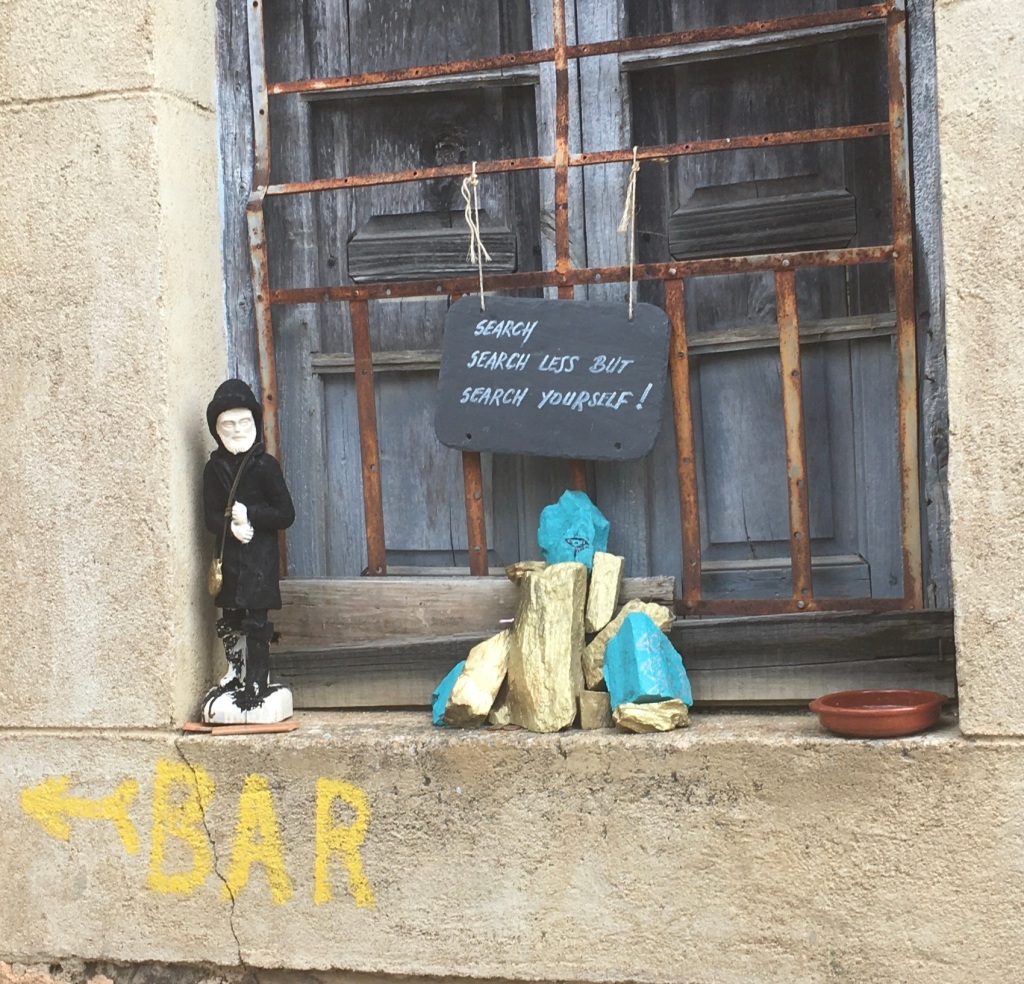
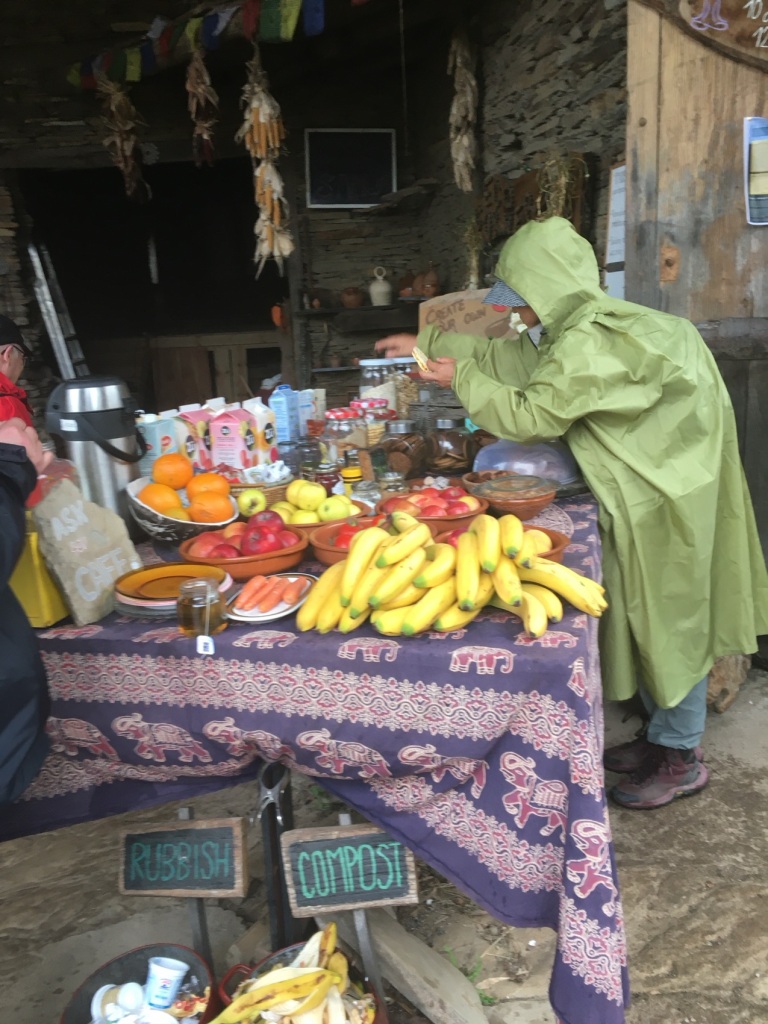
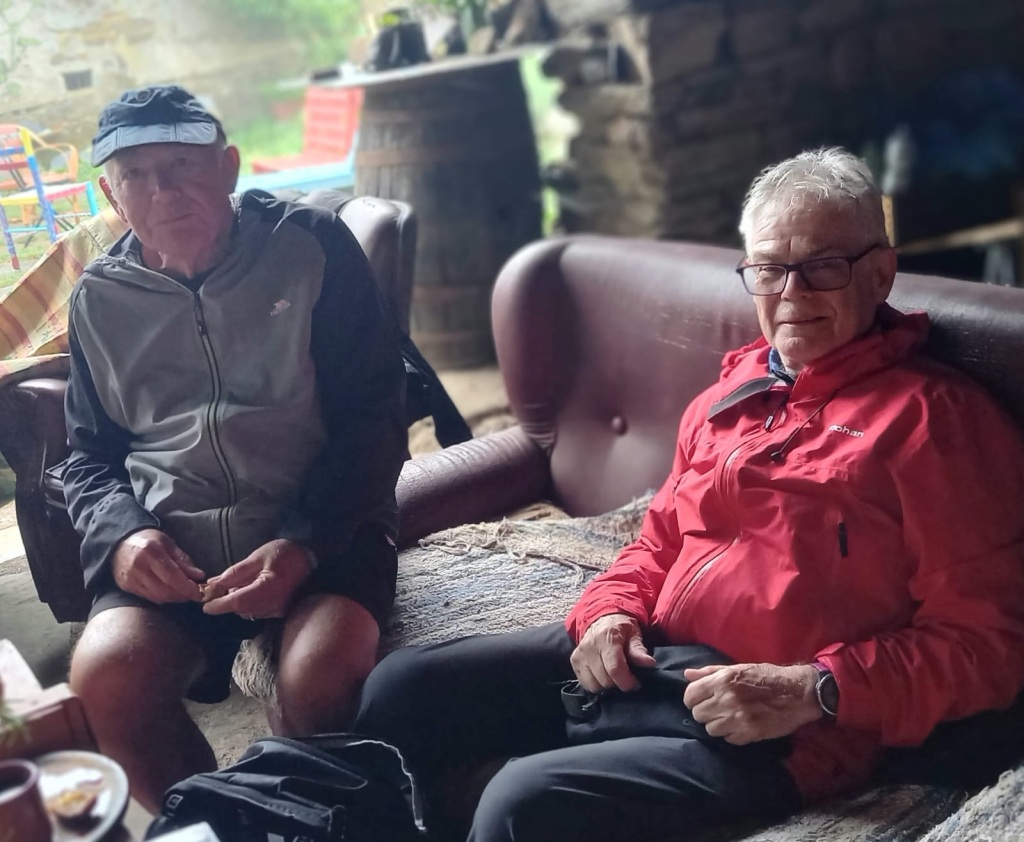
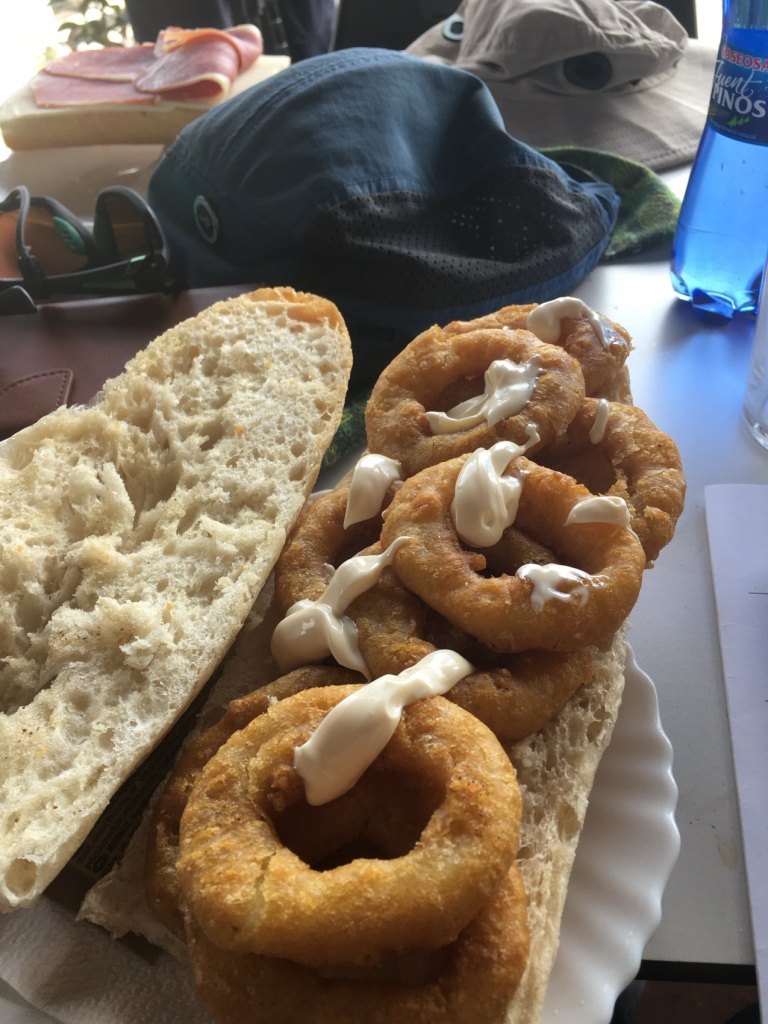
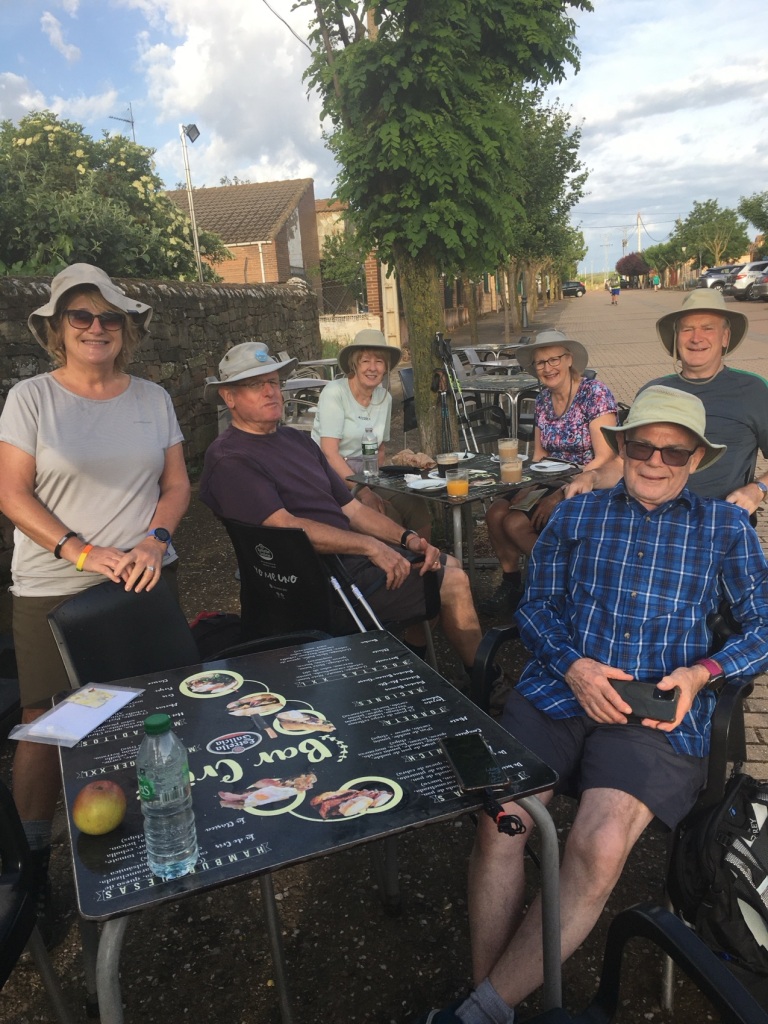
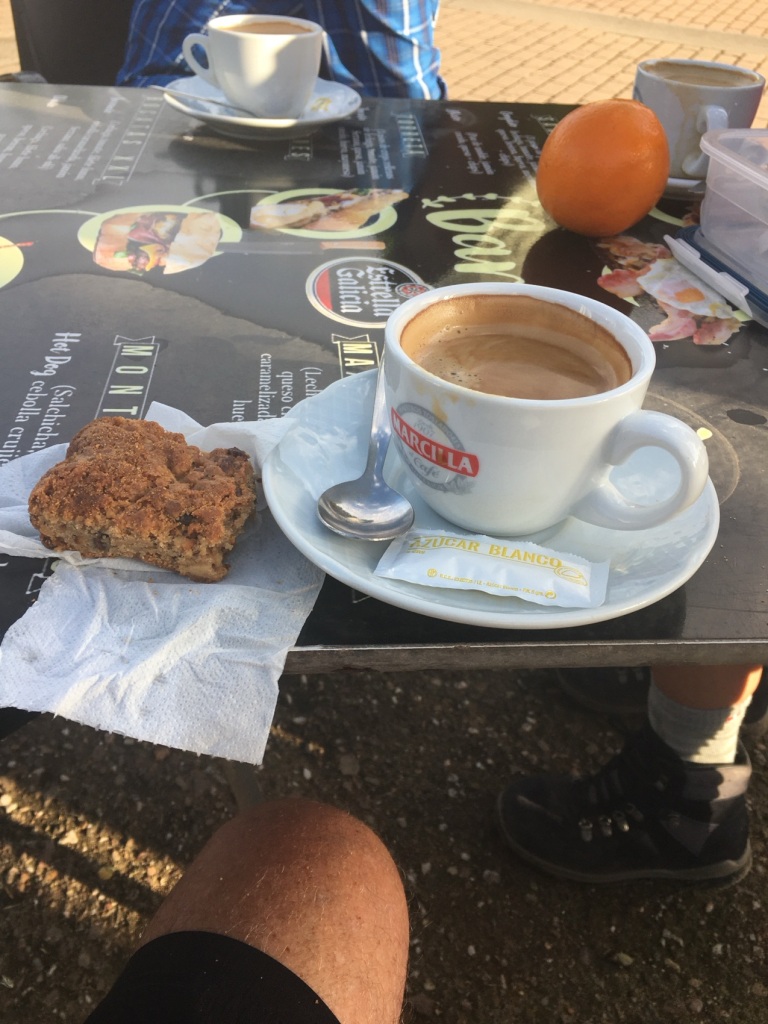
Hats On to the Camigos at MURIAS DE RECHIVALDO.An Americano and one of Hannah’s cookies – hit the spot!
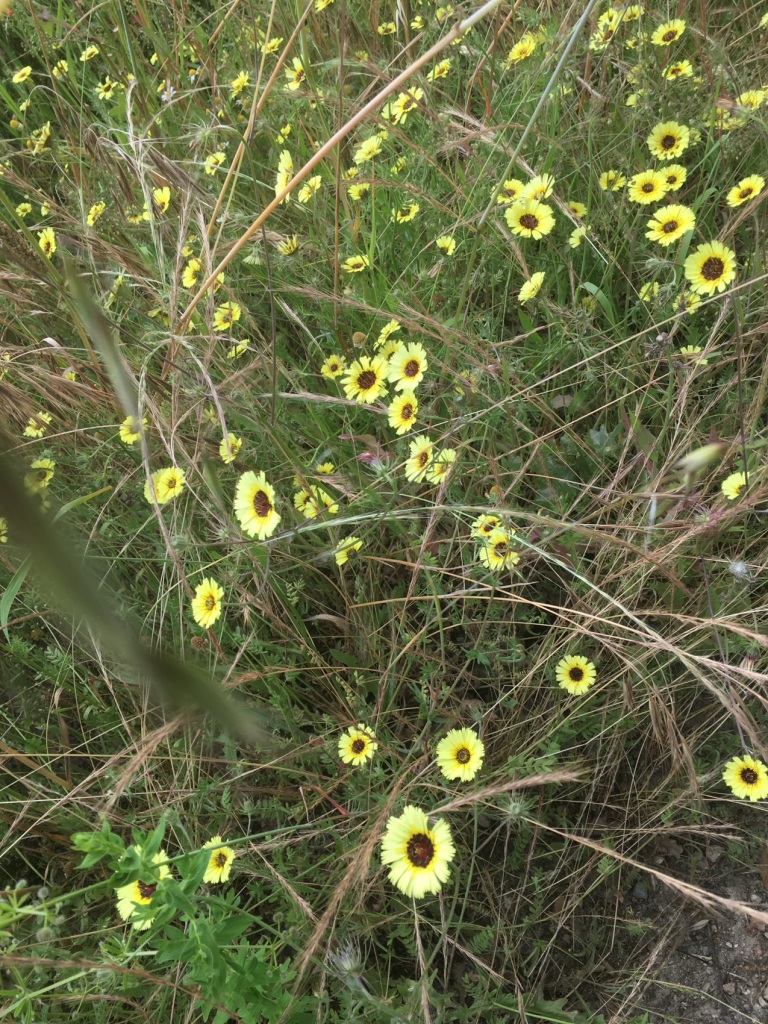
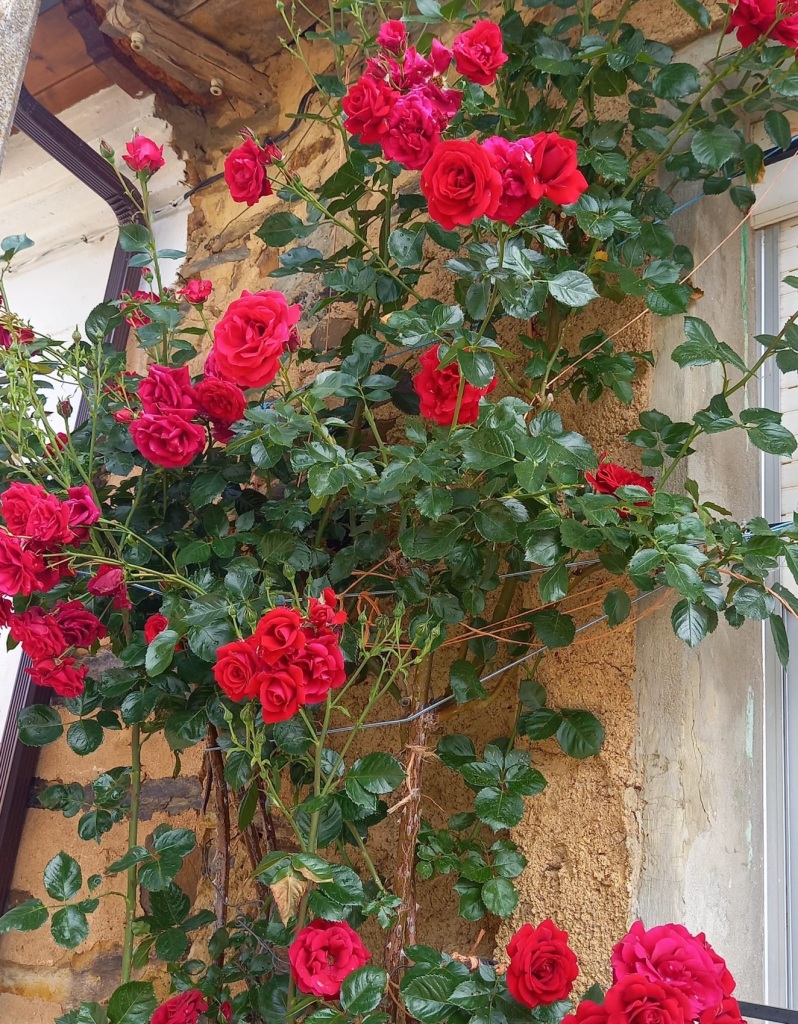
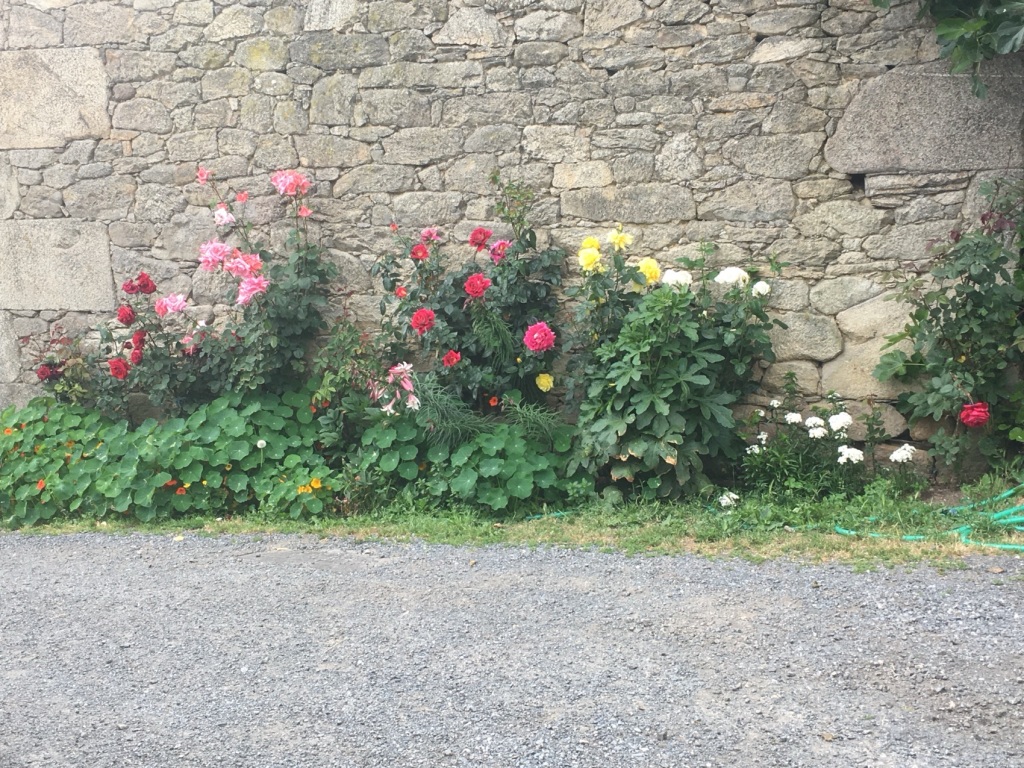
We walked through SANTA CATALINA then EL GANSO, peaceful, pretty villages – red roses do well here.
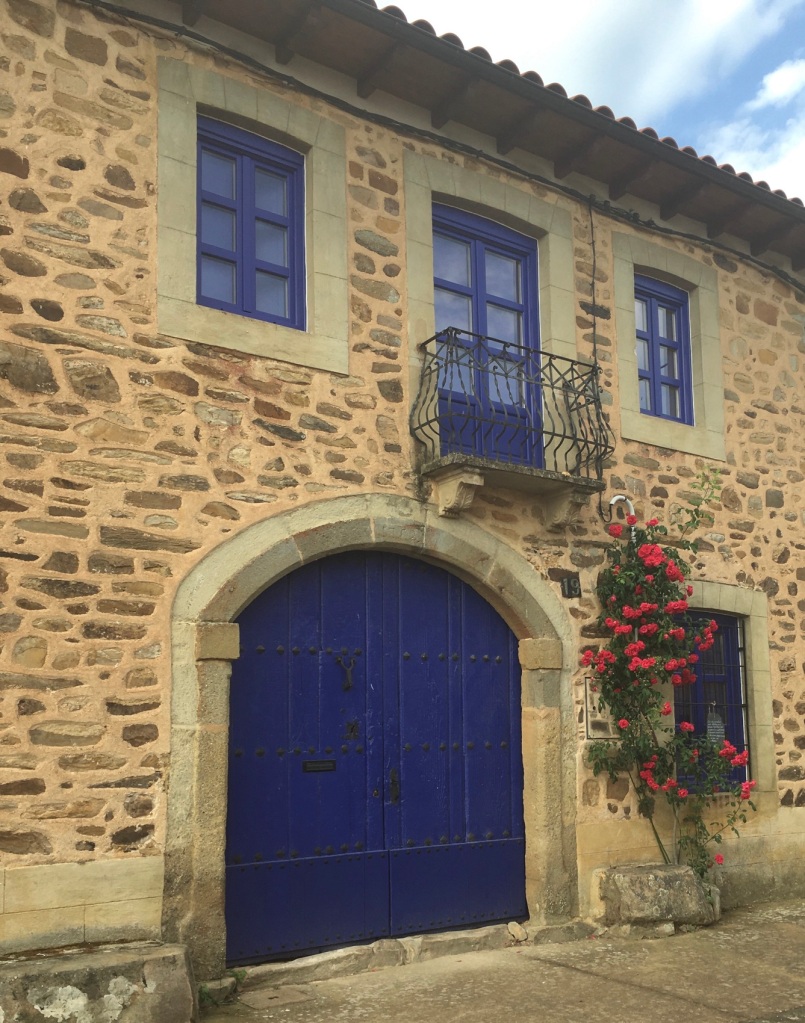
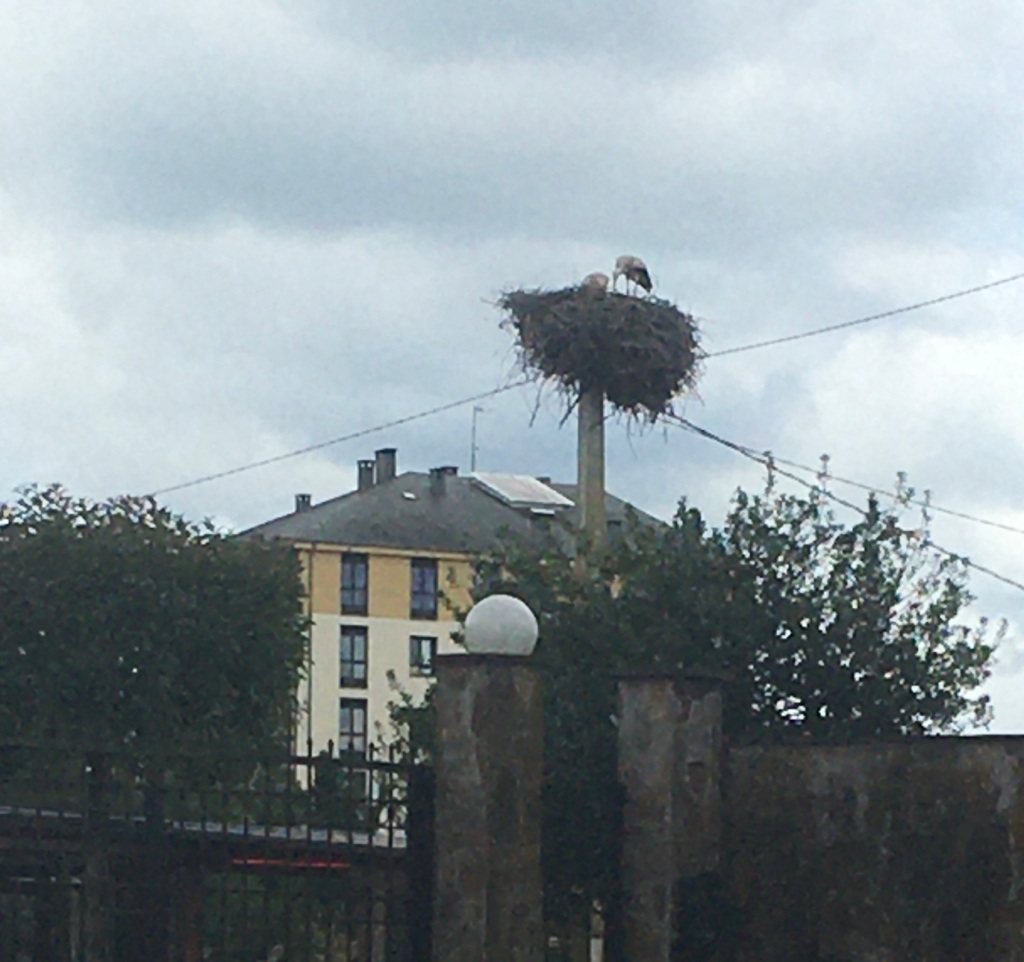
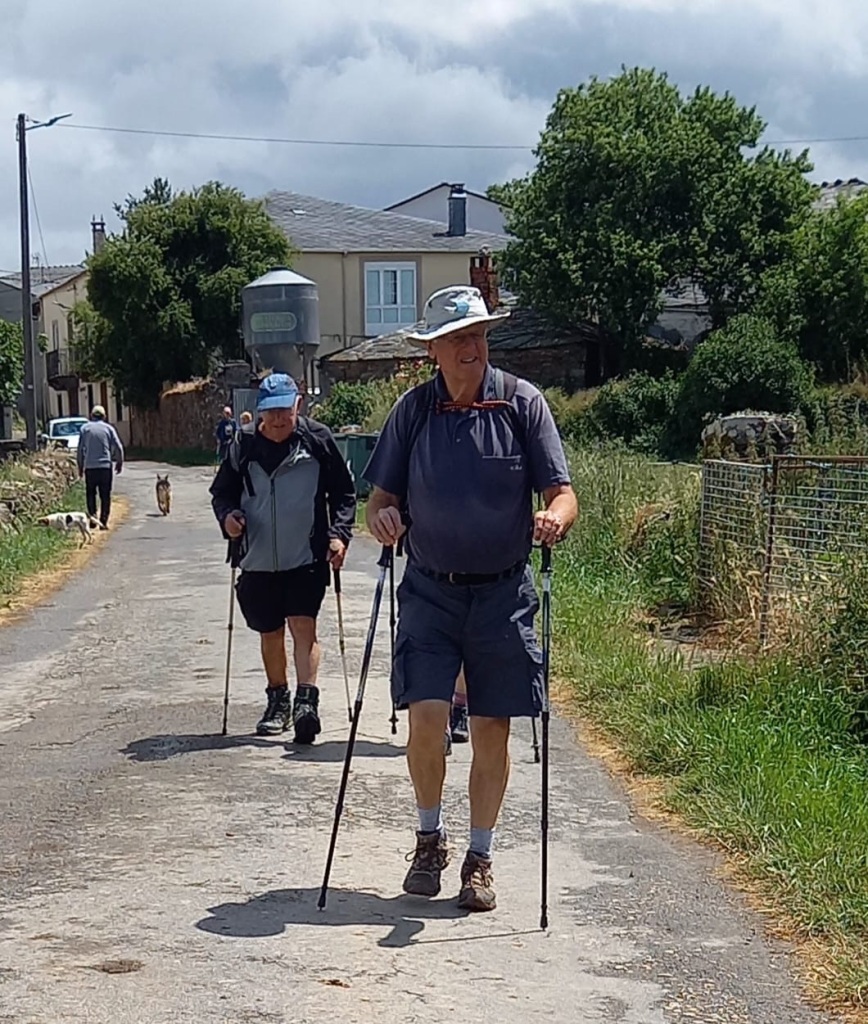
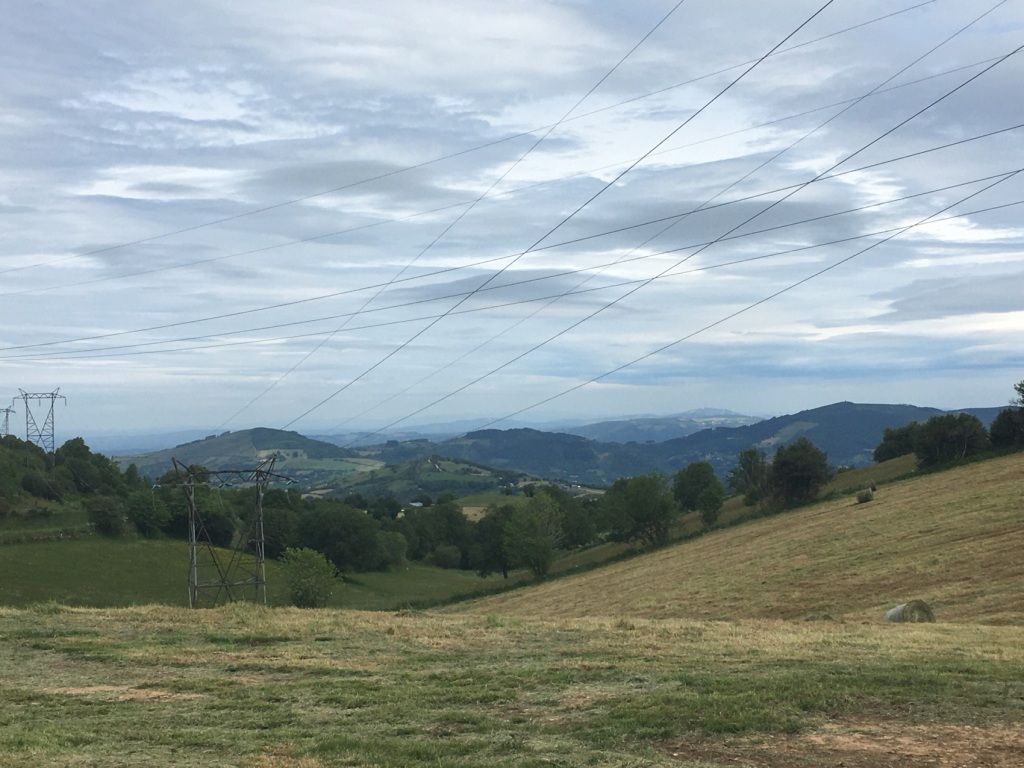
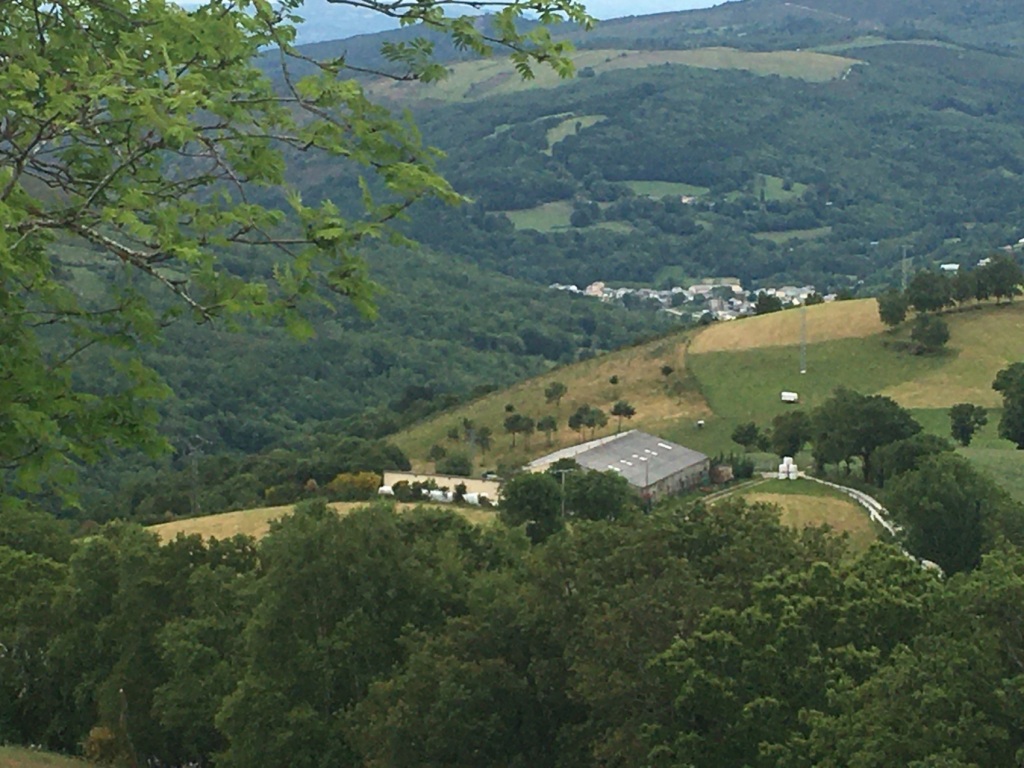
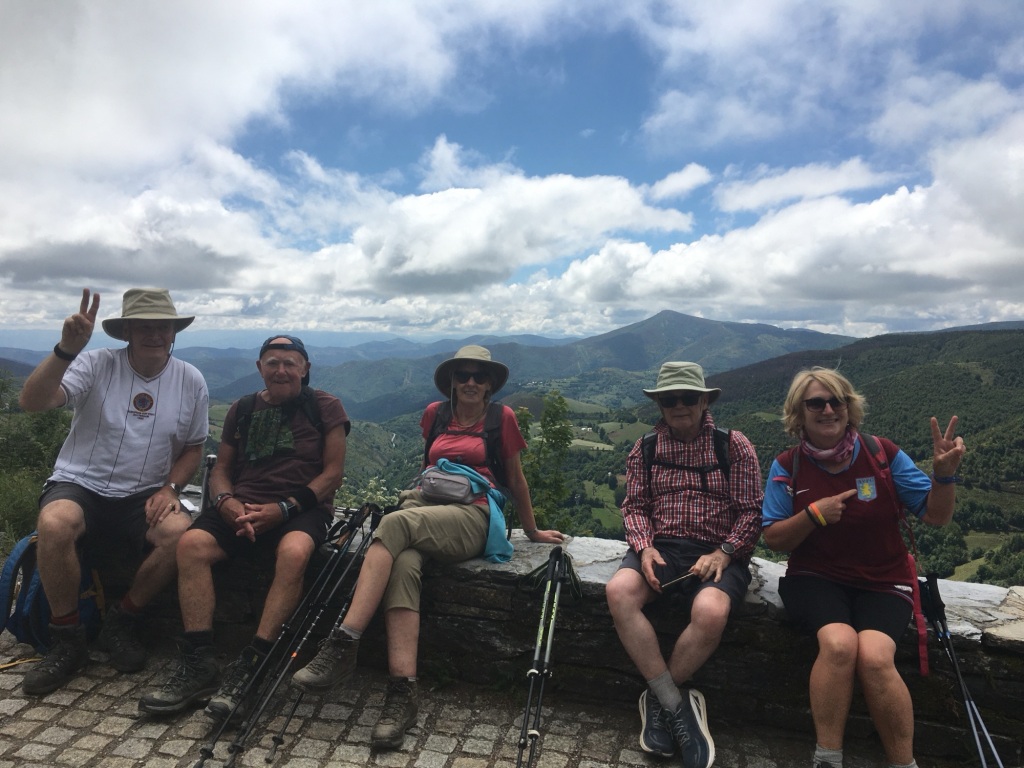
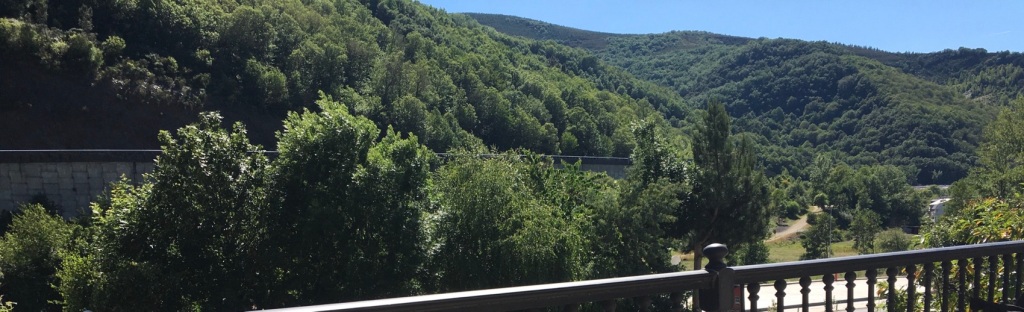
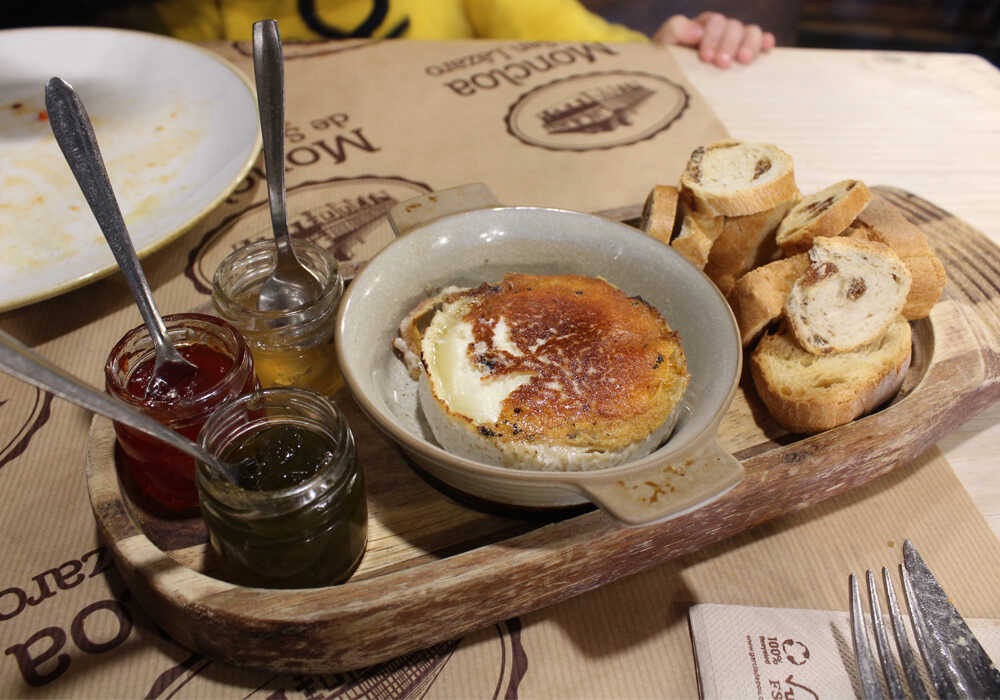
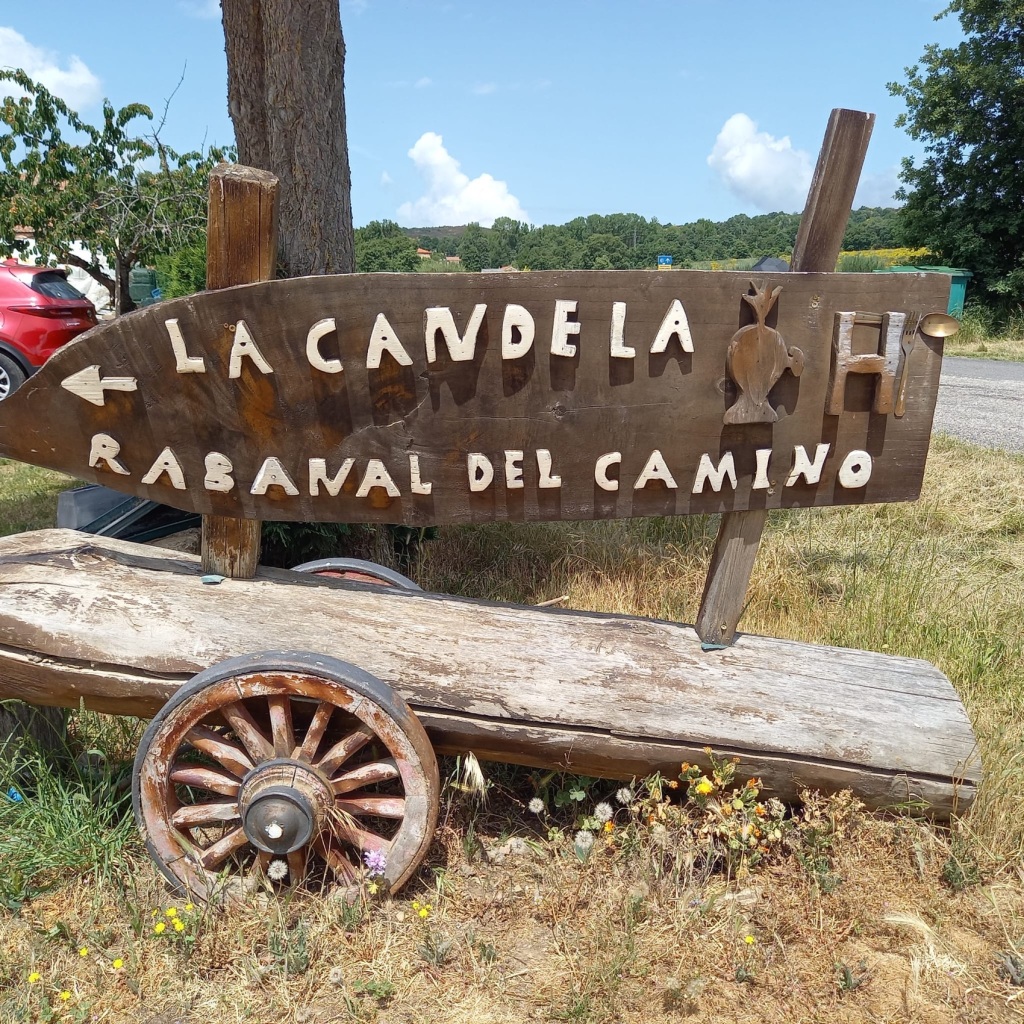
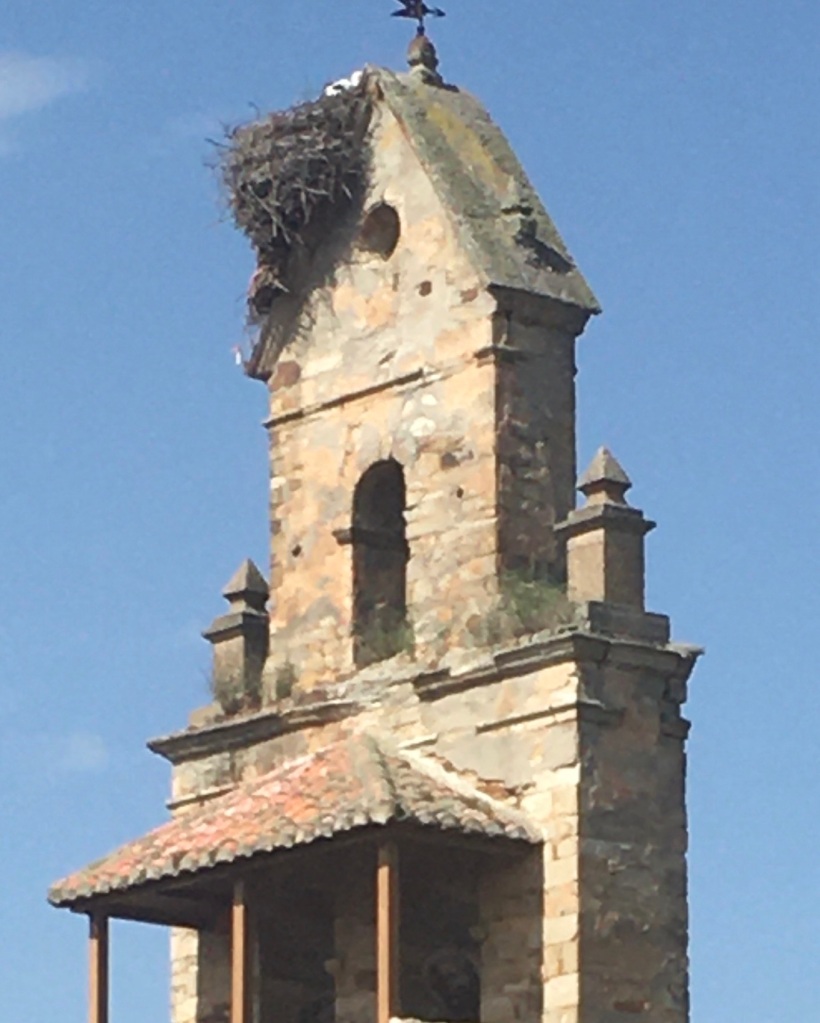
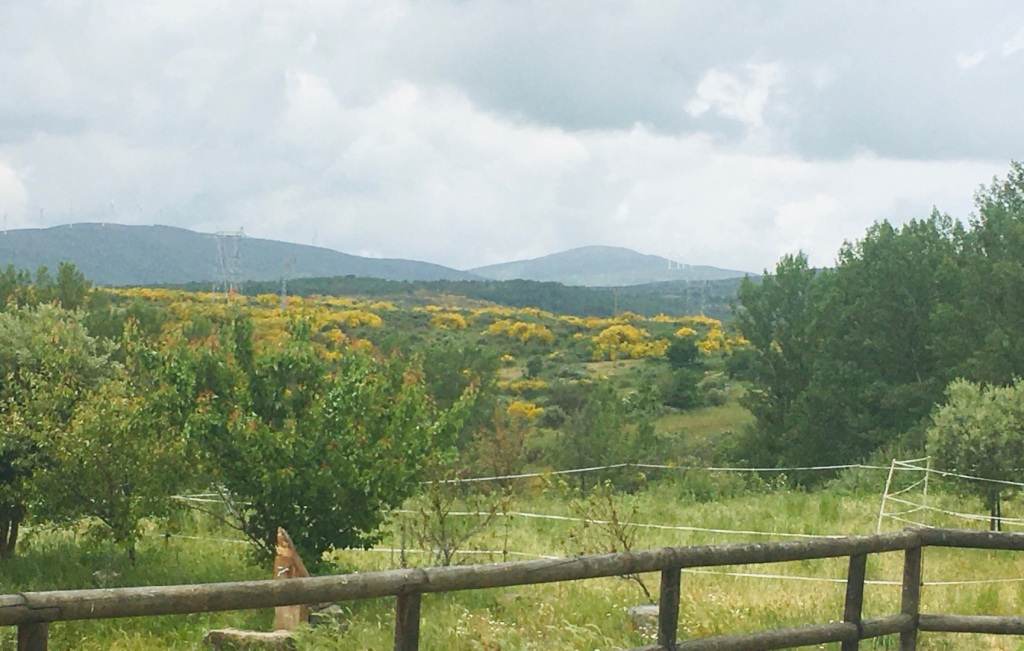
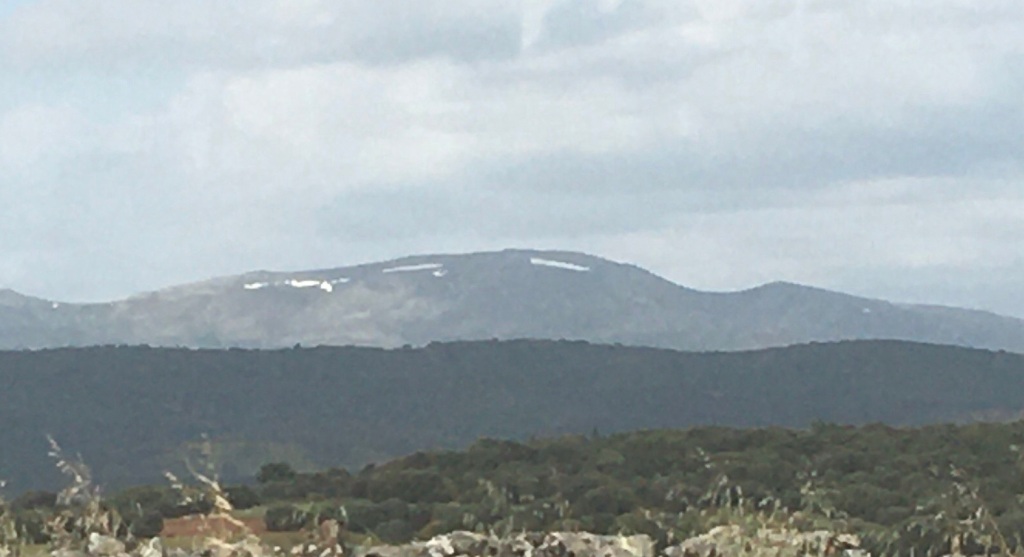
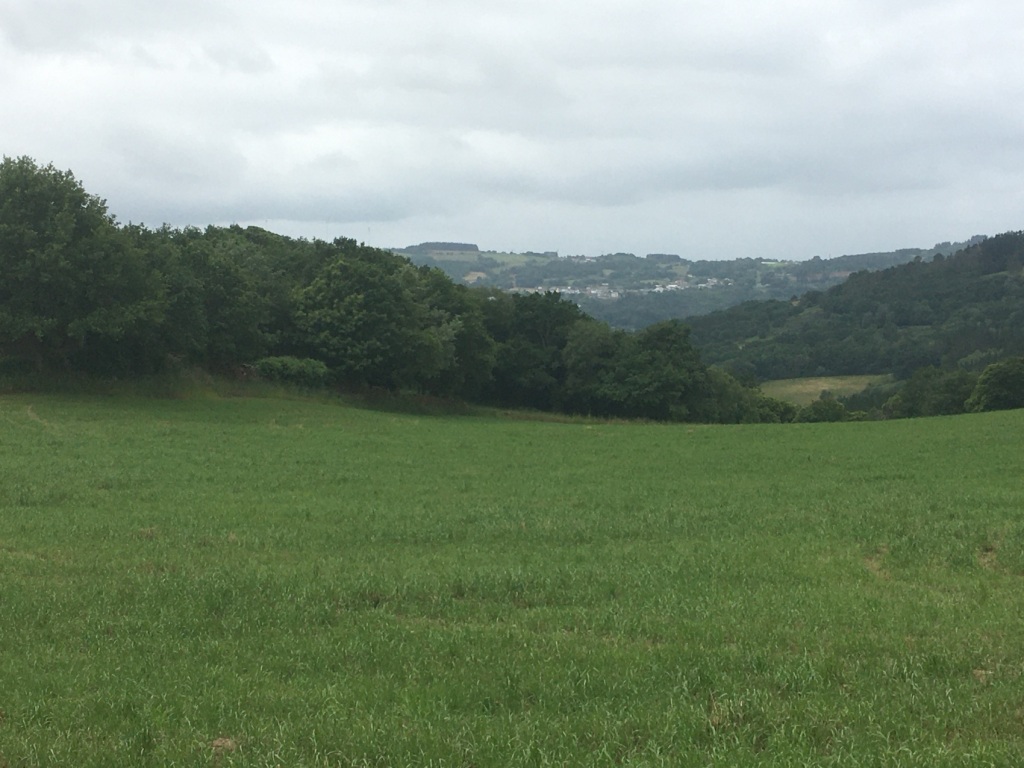
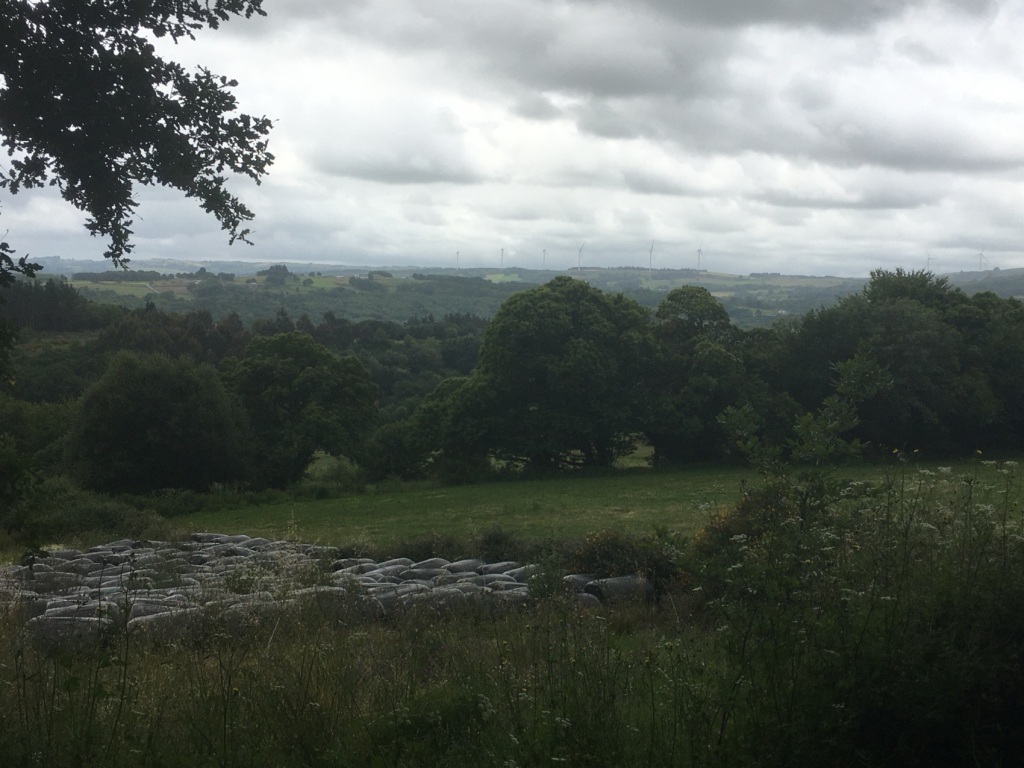
And a Stork’s nest to admire .Some great views as we sauntered along the way.Christina’s cruce.Ray, Richard and MikeNot too much further to go.La Candela – our accommodation – on the edge of the village.
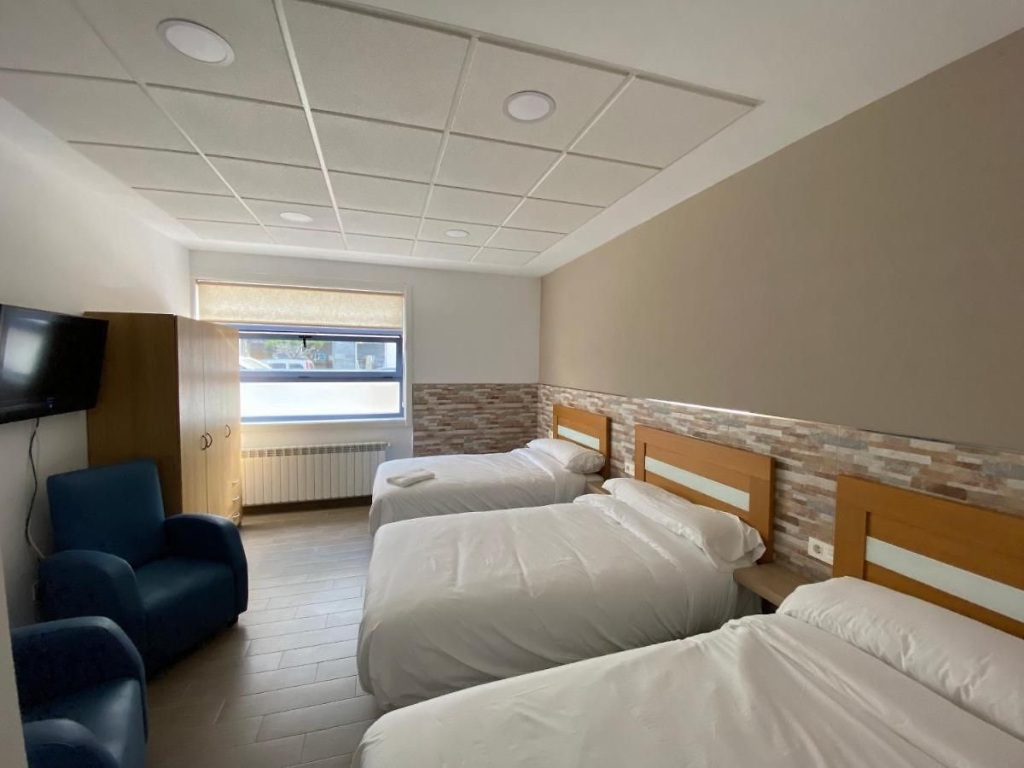
We reached here at 13.00, five hours walking and two 30 minute breaks en route. A good start,blessed with fine weather. We had anticipated rain which came later than expected at 16.45 and expected to continue overnight. The forecast for Sunday is dry with sunny periods – if that turns out to be the case we shall be blessed again as we have a couple of challenging climbs to make.

A good number of photos used in this Blog are both Val and Christina’s – Muchas Gracias – plus some of mine.
Arrival at Birmingham Airport by train with Christina and Tom was straightforward enough and considering the amount of structural work taking place, checking-in and security was quite efficient.
Some of us gathered in the Spoons for coffee and a bite and we whiled away the time with a seminar on cryptic cross words, led by Tom using the Guardian Saturday Quick Cryptic puzzle, with clues.
I still feel quite clueless, despite getting a couple right.
Departure to Madrid was 30 minutes late, but a smooth flight ensued.
Barajas airport seemed quiet and we were through to the taxi rank in record time and taking three taxis for the group we soon arrived at Hotel Clemente to check in to our accommodation at Fly Rooms.
After a quick turn around we met back in the very cool Hotel Clemente bar, for a “ sharpener” .
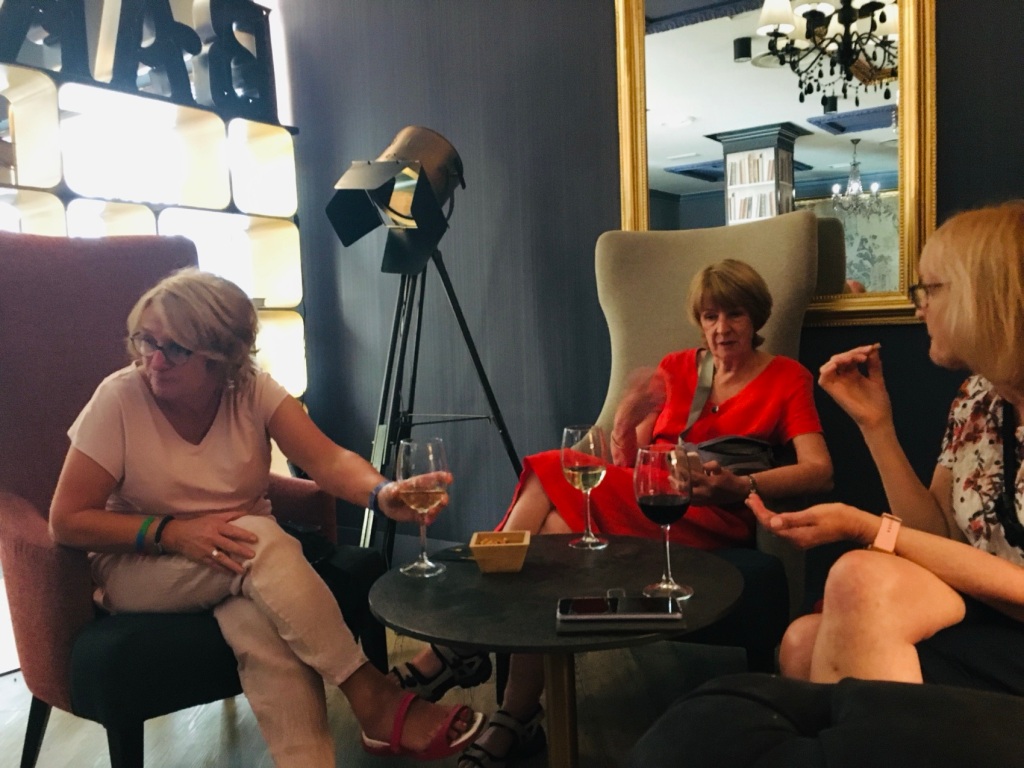
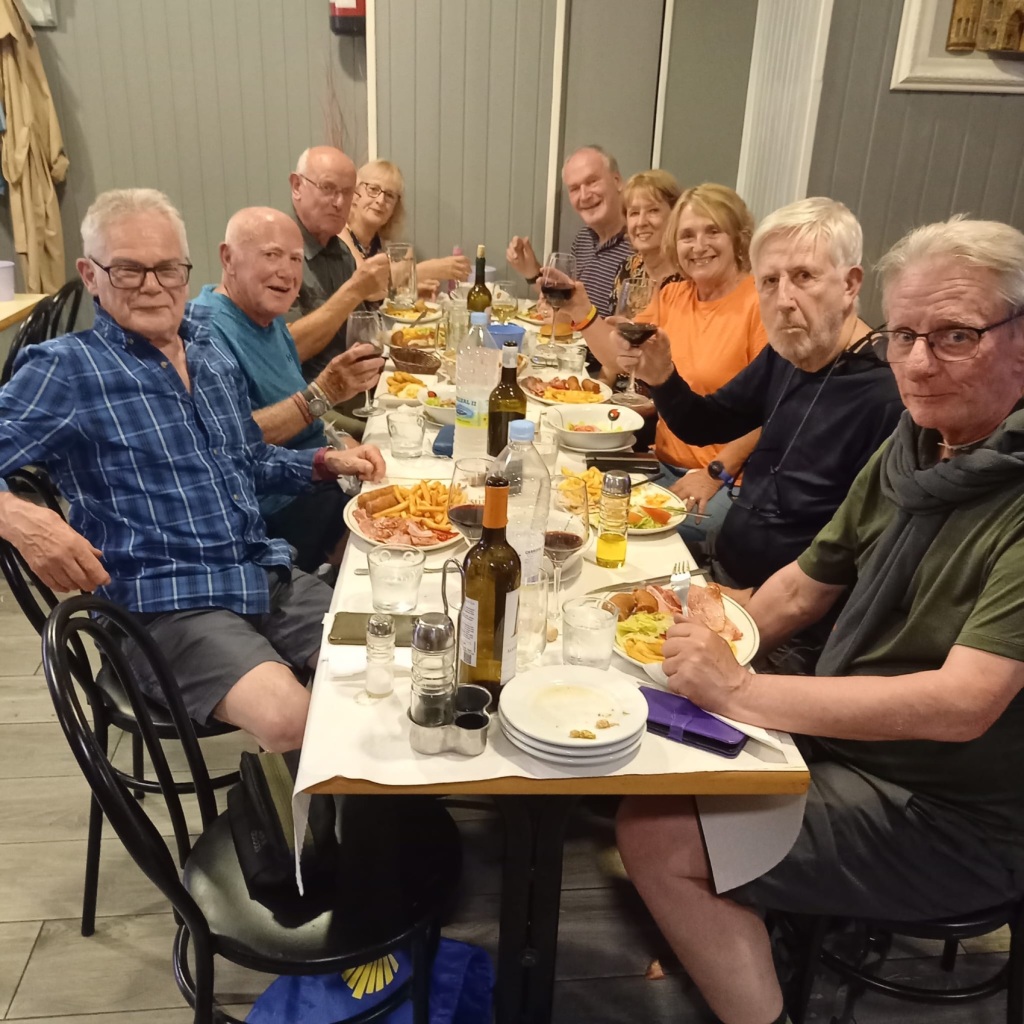
Christina,Myra and Val .Richard,Tom and Mike.
Then, on to a local restaurant, La Vino de PEREA , where we were quickly seated in the shade. Helpful menu + specials in English.
We had a very convivial meal which everyone enjoyed, although I did say that this level of fare was a cut above what we might usually expect, but it was our first night so why not something a little special?
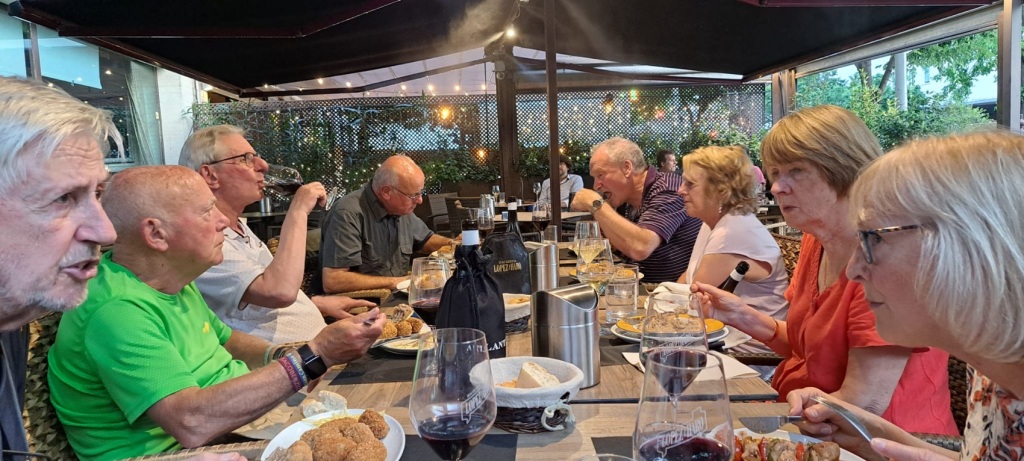
Croquettes filled with creamy finely chopped Oxtail
We were back in Hotel Clemente on Thursday morning for a state of the art breakfast, with a selection of hot dishes as well as fresh fruit,,cereals and cake.
Taxis had been booked for 09.00 for Terminal Four back at the airport and we were there quickly enough. Madrid airport is a huge place but well designed and the road system is exemplary.
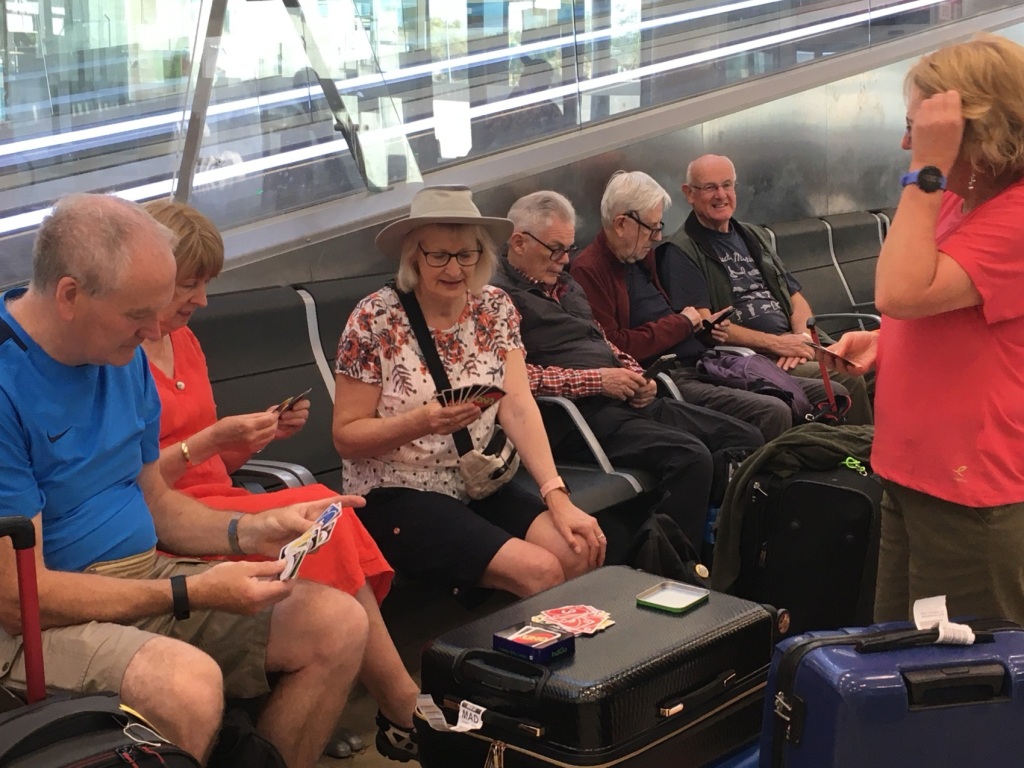
The estacion de autobuses is only a couple of years old and we were soon seated with Christina directing what turned out to be a hilarious game of UNO,using two cases as a card table.
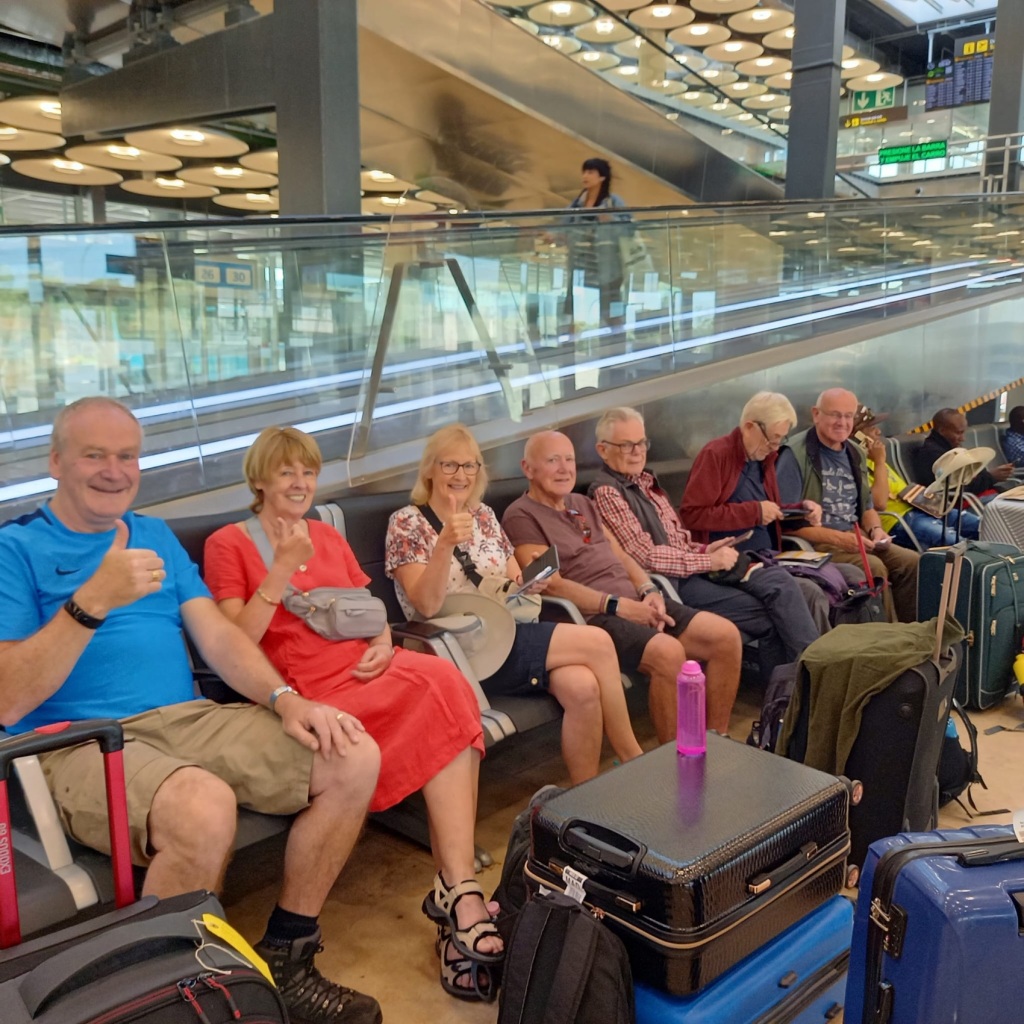
Thumbs up !UNO !
Our ALSA coach was a comfortable twin axle vehicle and we took a route around Madrid, calling at two smaller coach stations before eventually exiting the city .
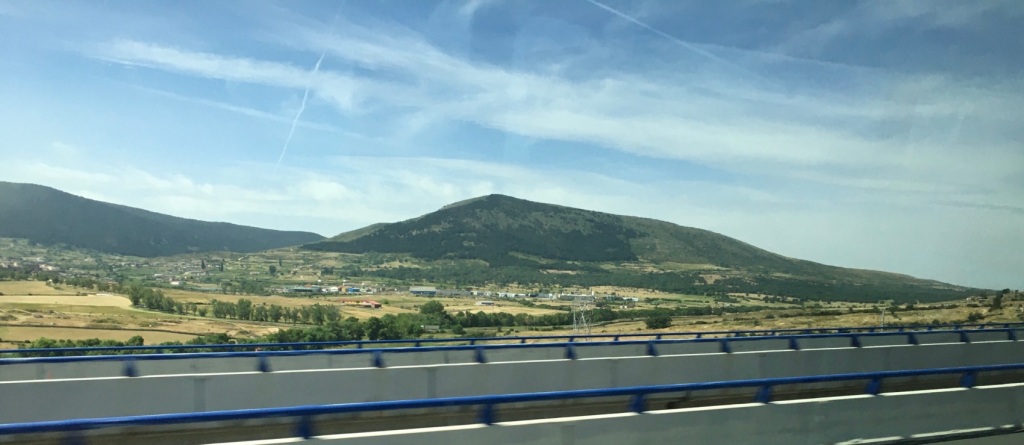
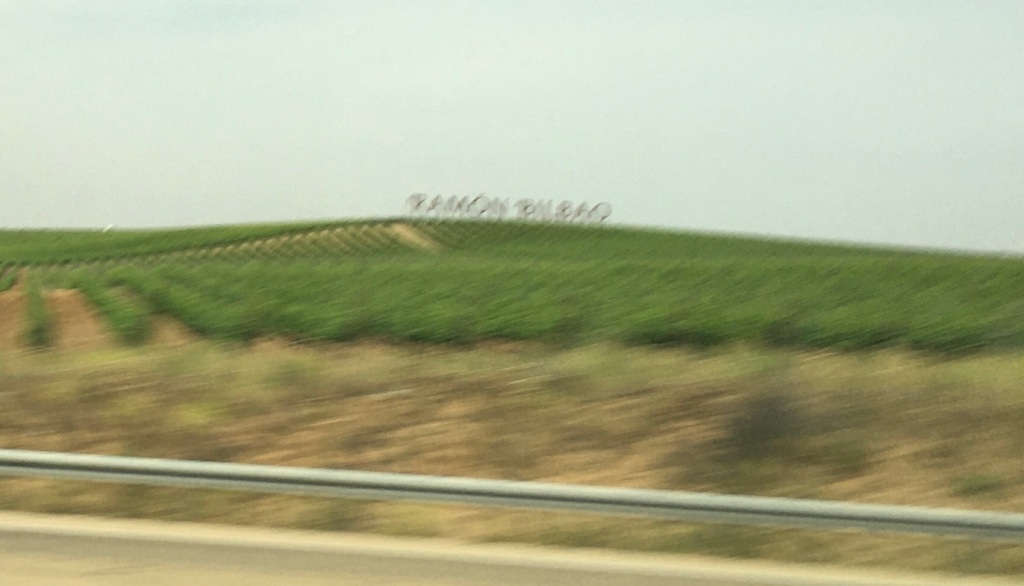
Typical views heading NorthA little blurred as we sped along but you can just about make out RAMON BILBAO, fine local wine.
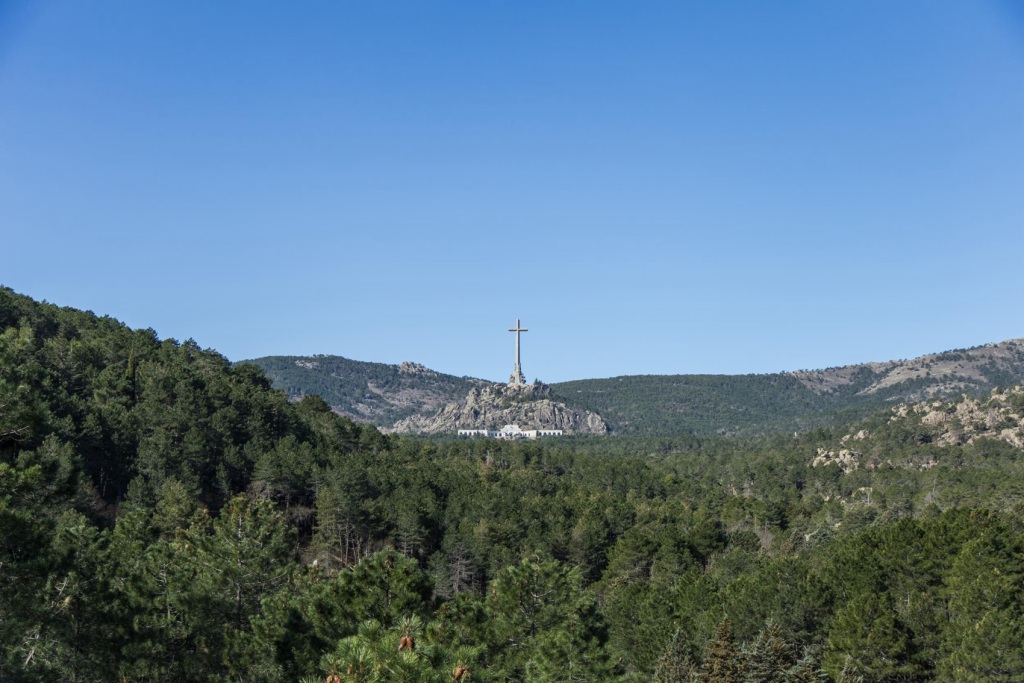
En route, Rob pointed out a tall cross on the hillside to our left – it was overlooking the Valley of the Fallen where Franco was interred. However, the government decided to exhume the body as it was agreed by a majority that the dictator’s remains had no place amongst the fallen of the Spanish civil war.
We arrived mid afternoon in 30* temperatures and made the 11 minute walk to our hotel IMPRENTA MUSICAL ALOJIOMENTO.
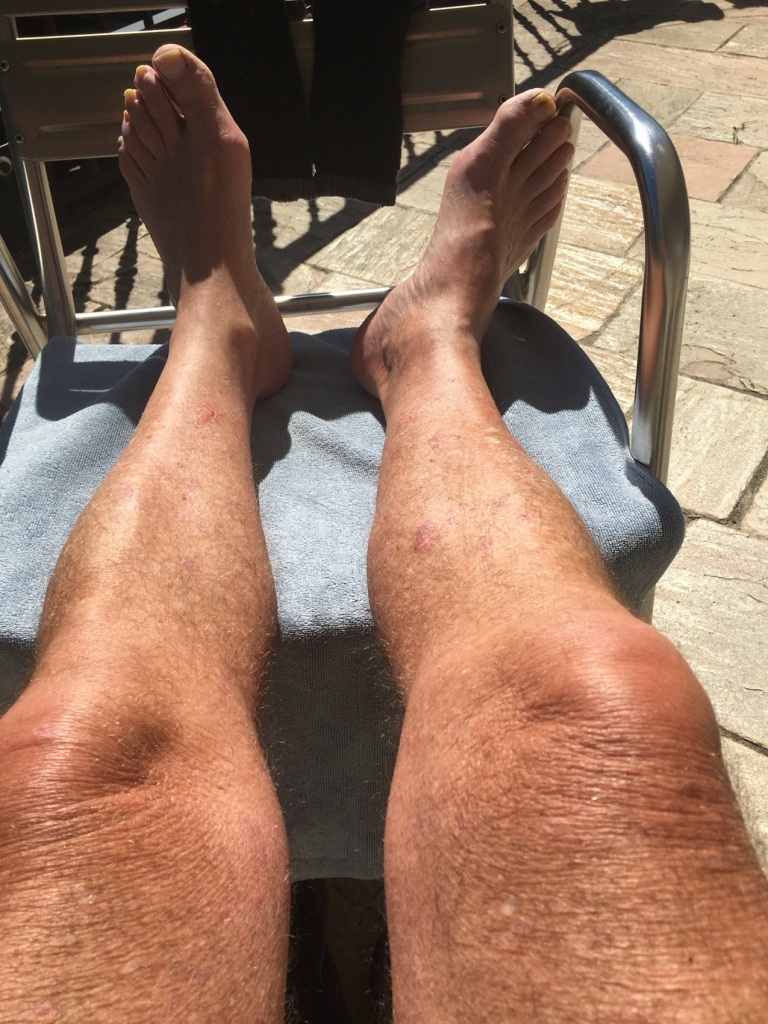
Mike and I decided to take advantage of the balcony and get some washing done.
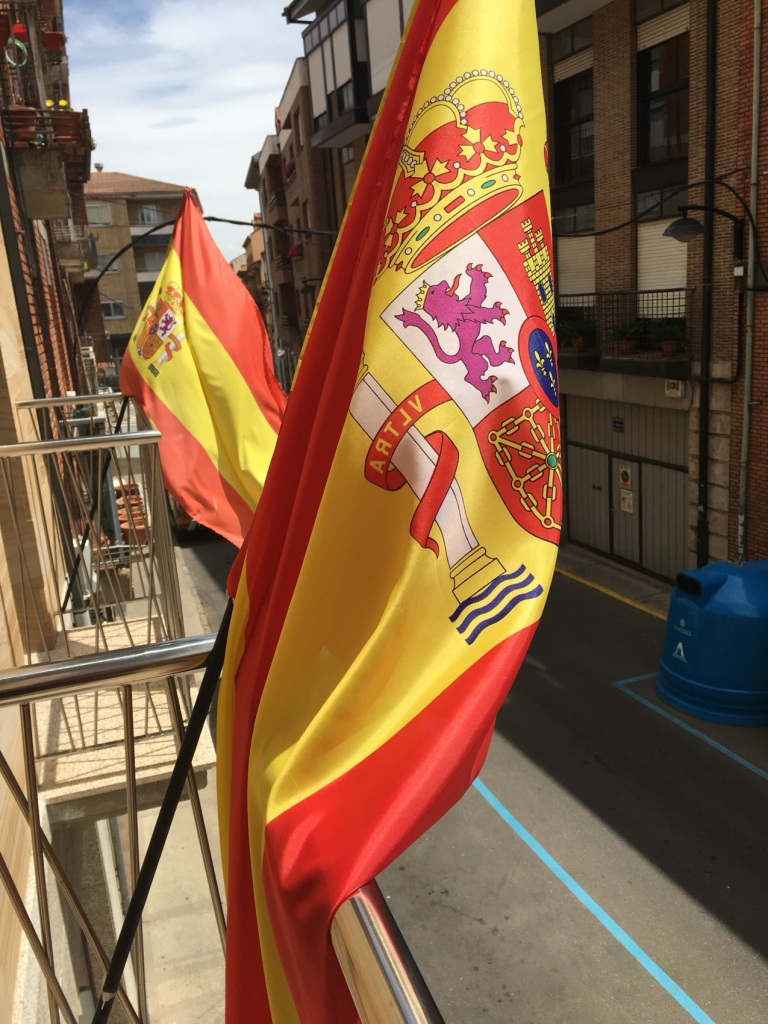
Not often you can fly the flag alongside your socks!
With the best part of a sunny afternoon and early evening to spare we went on a random kind of walkabout of this fascinating city.
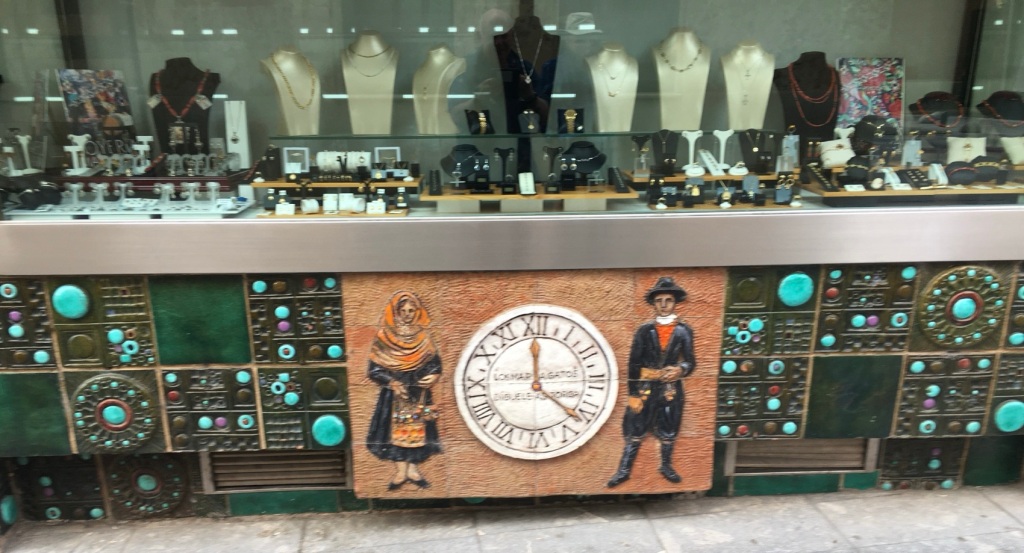
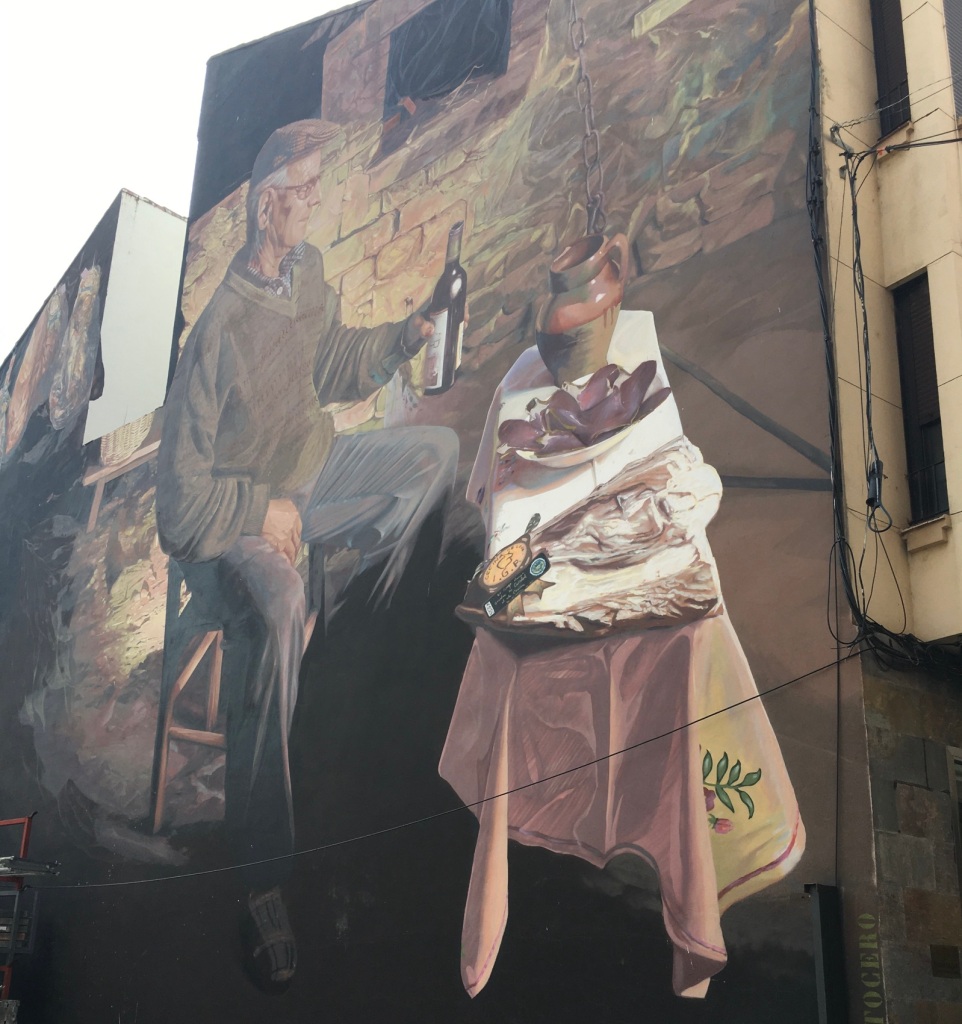
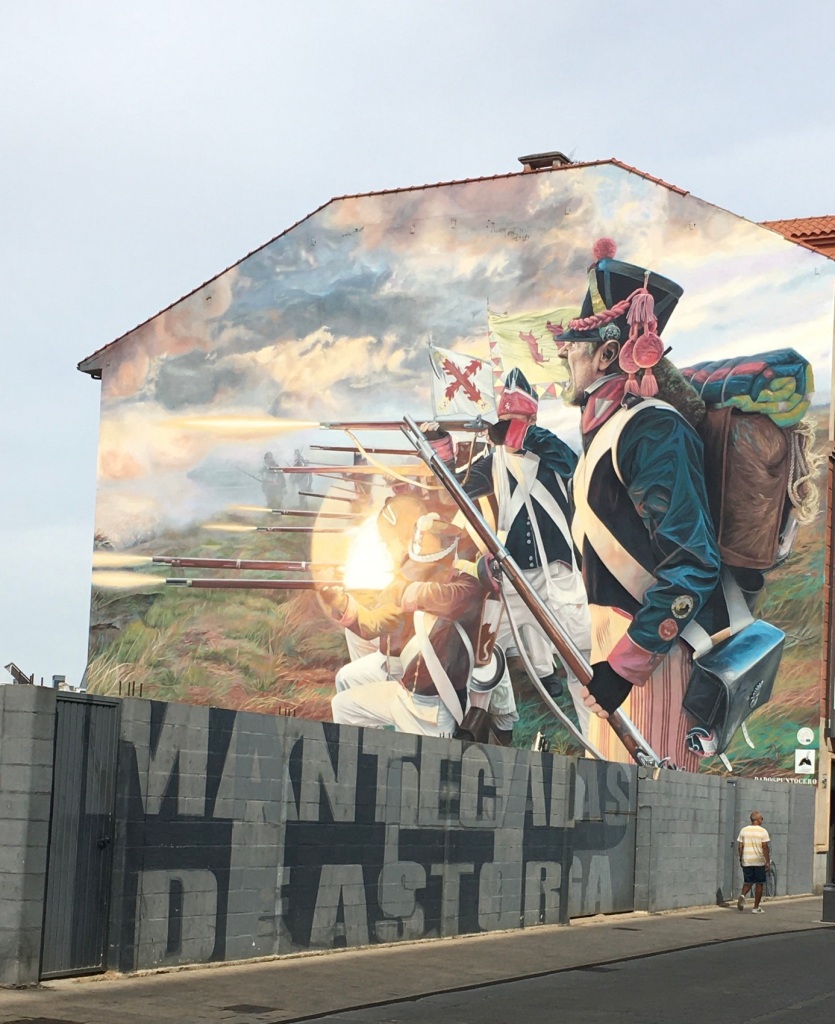
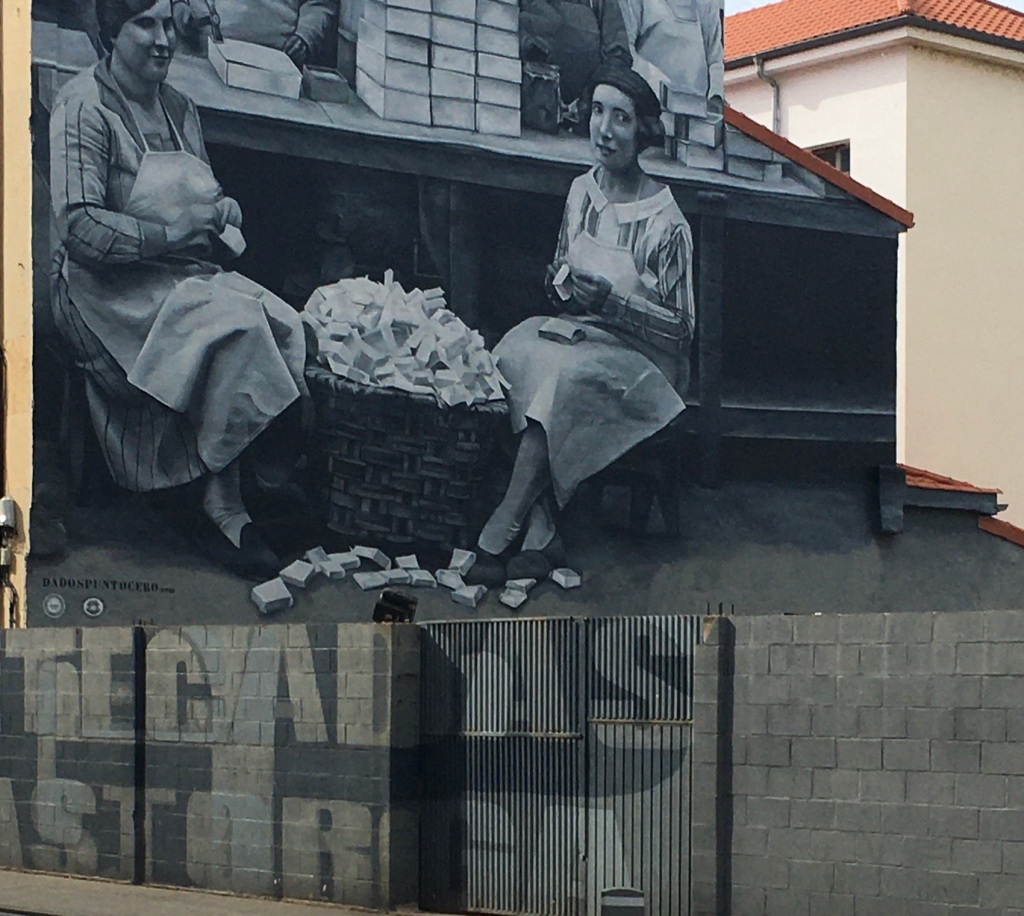
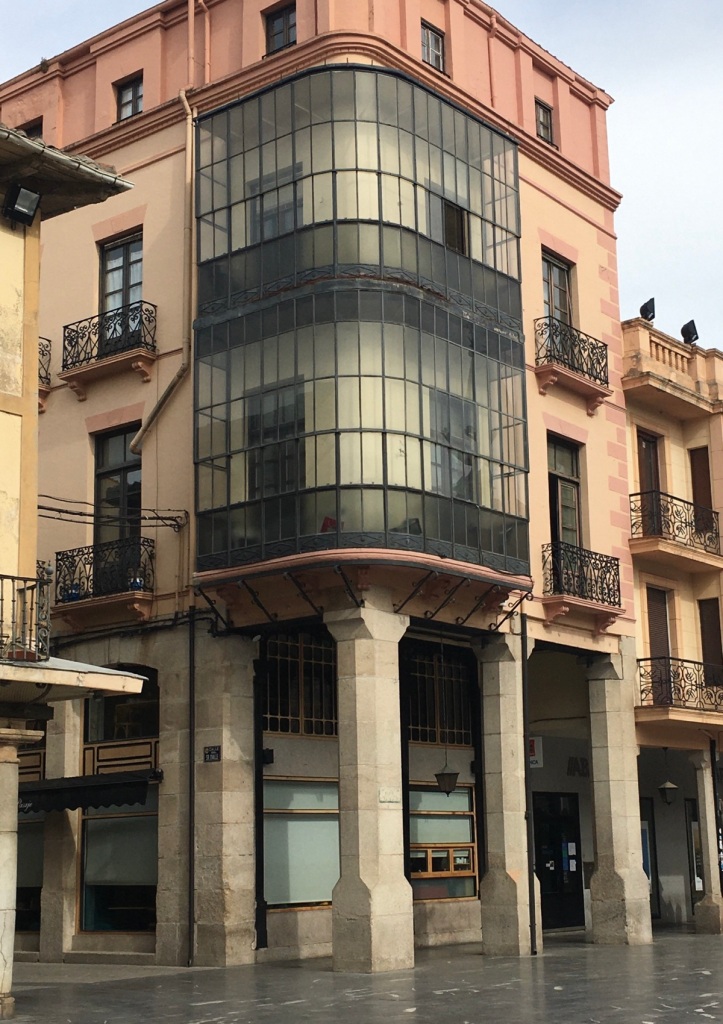
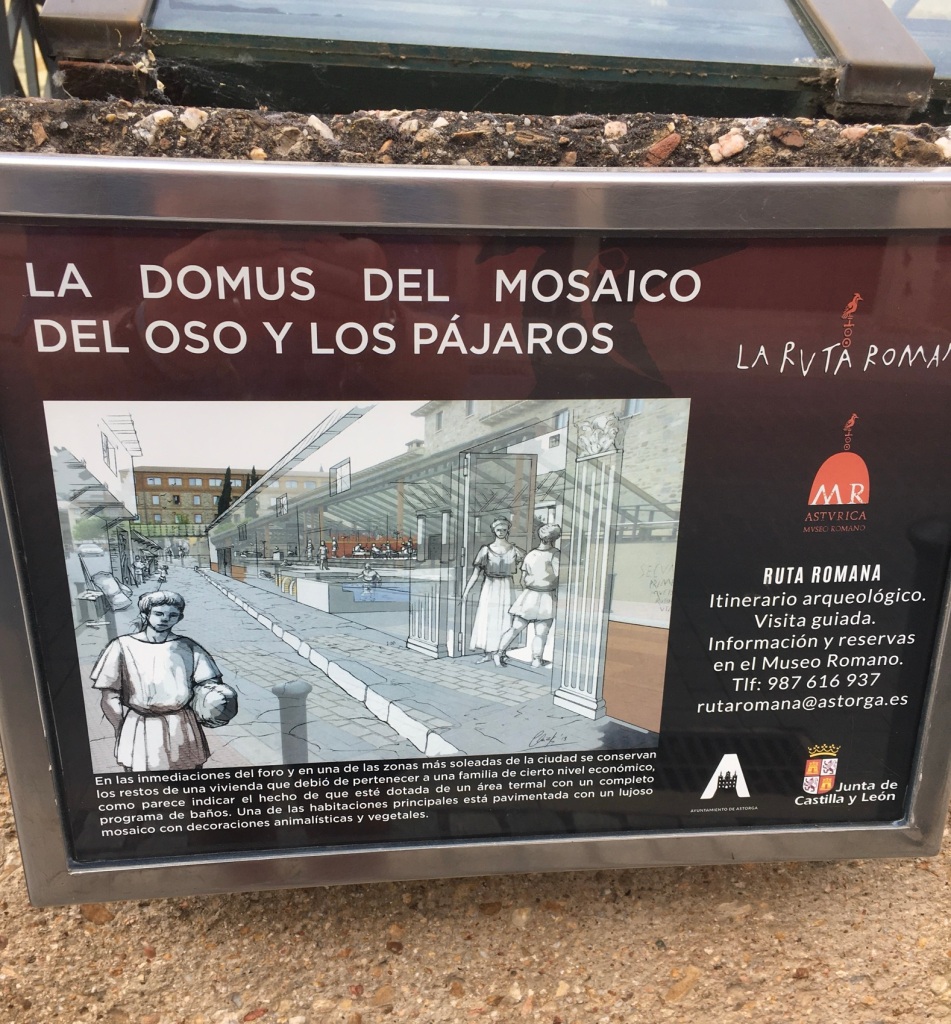
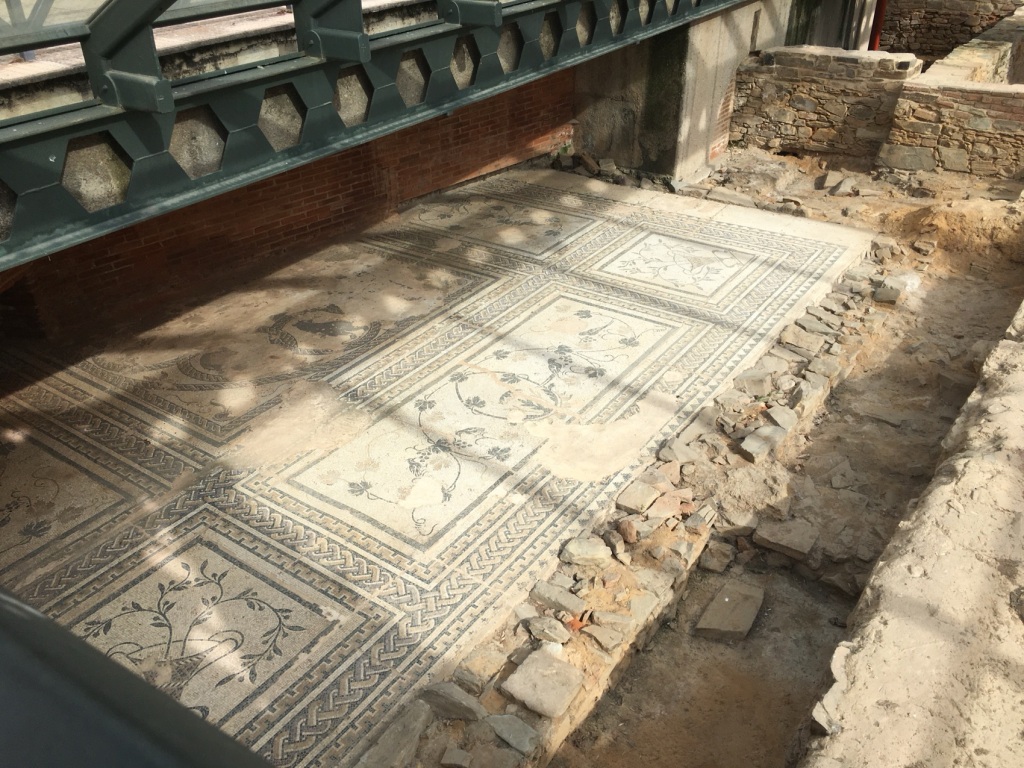
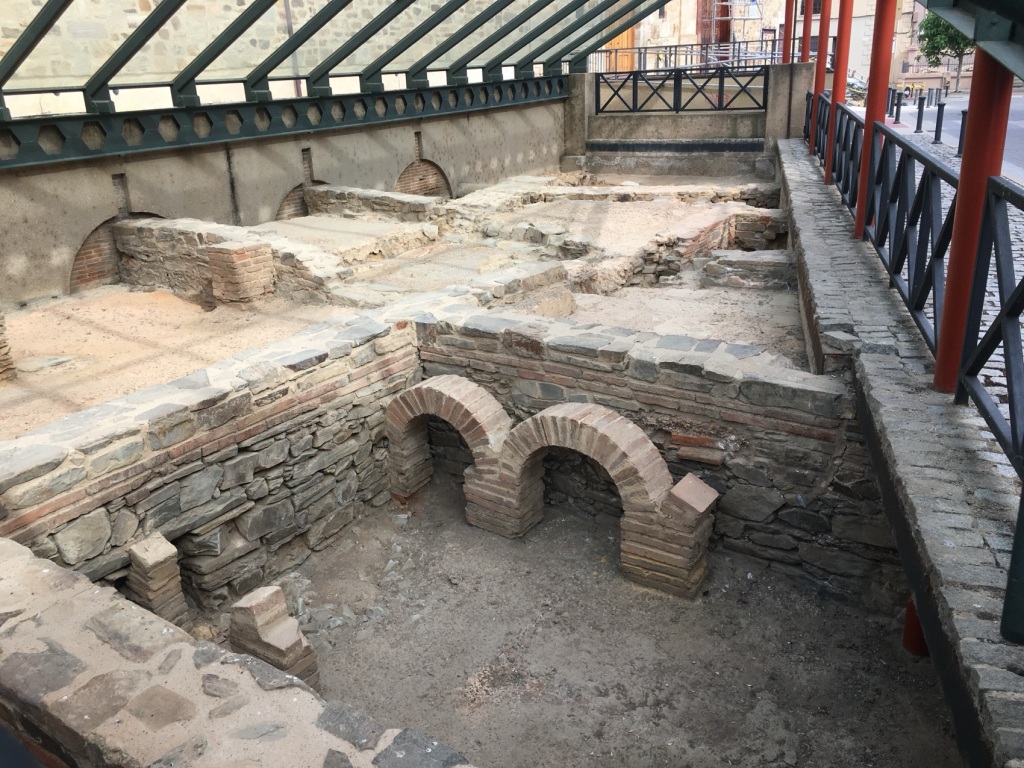
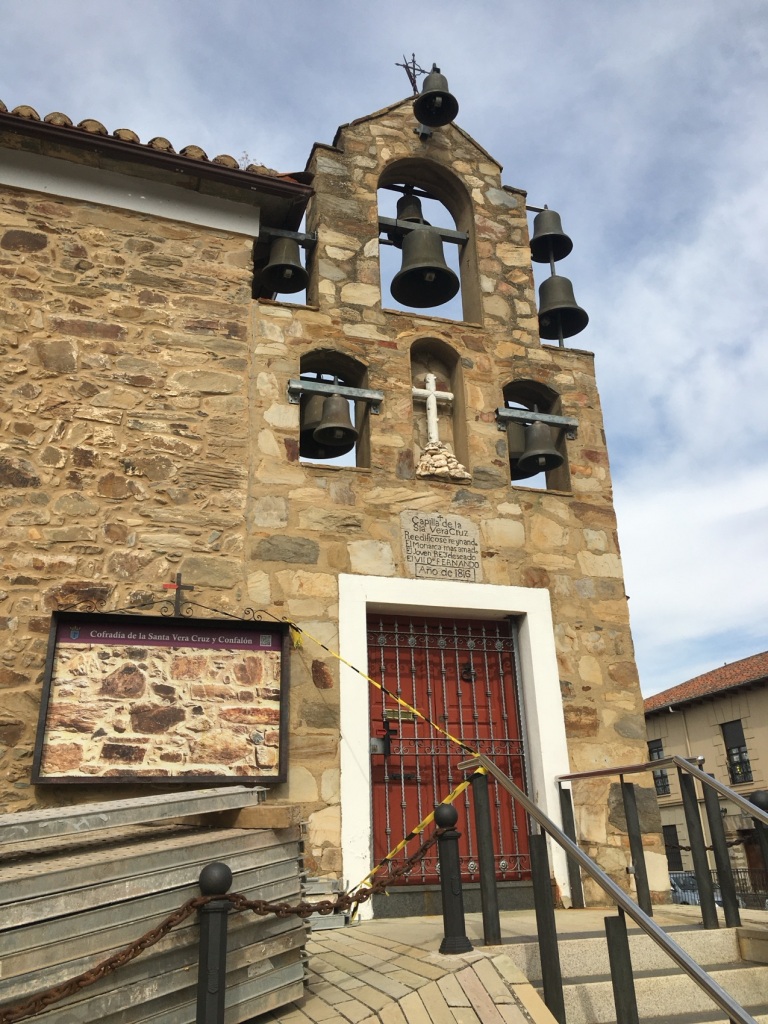
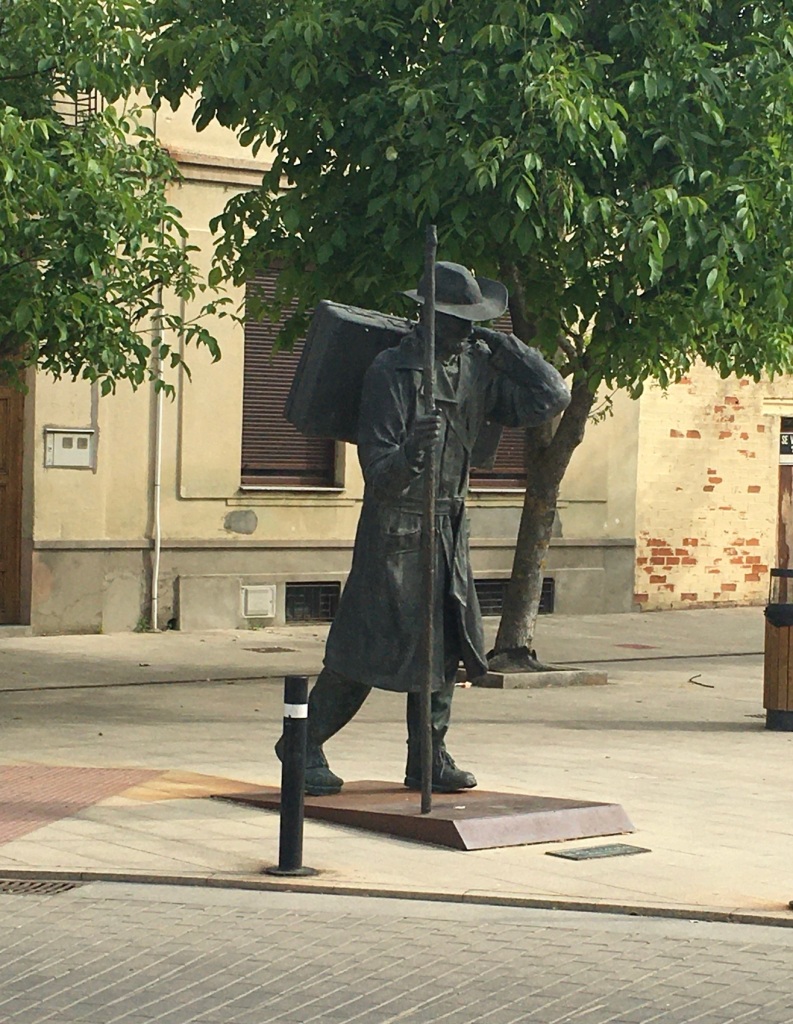
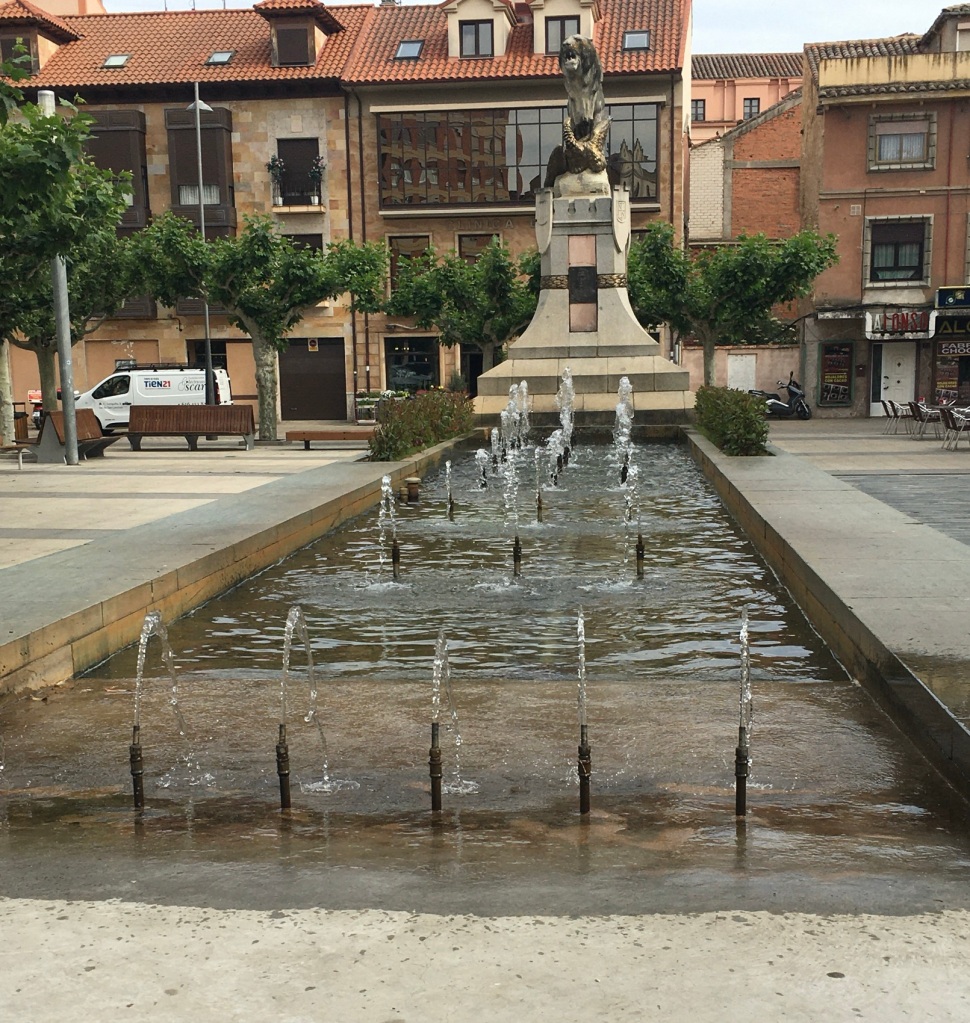
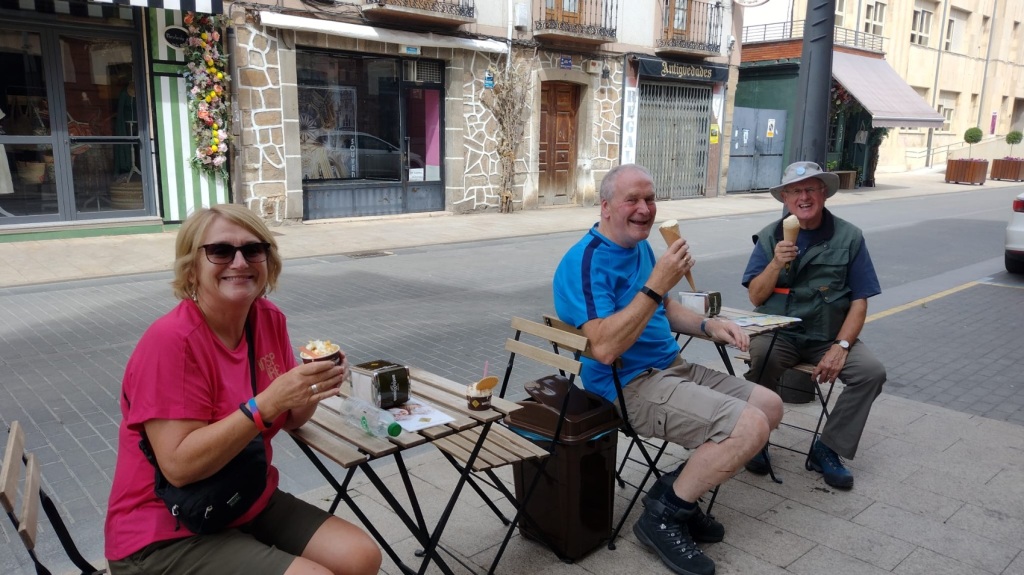
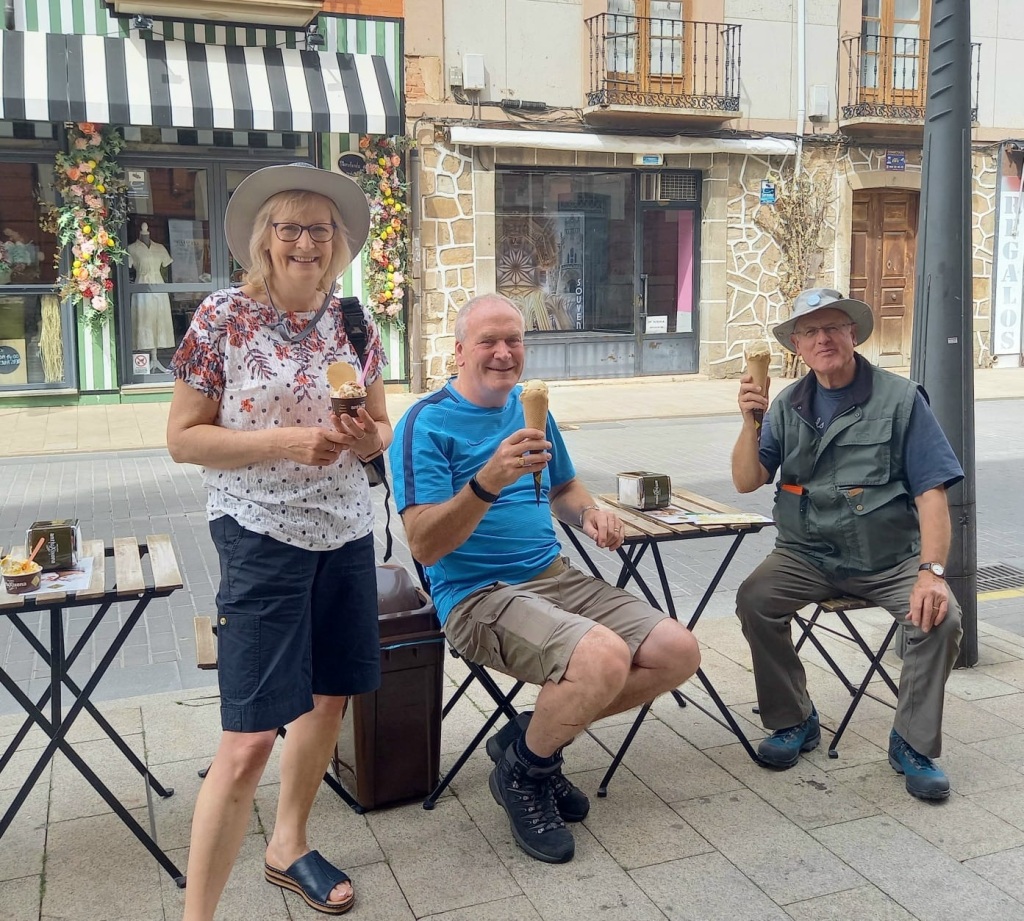
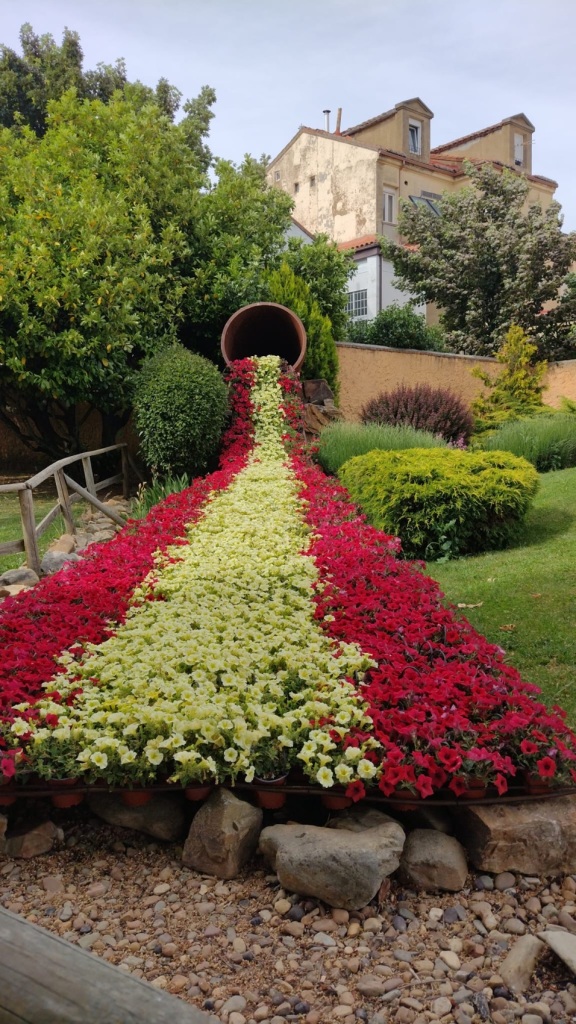
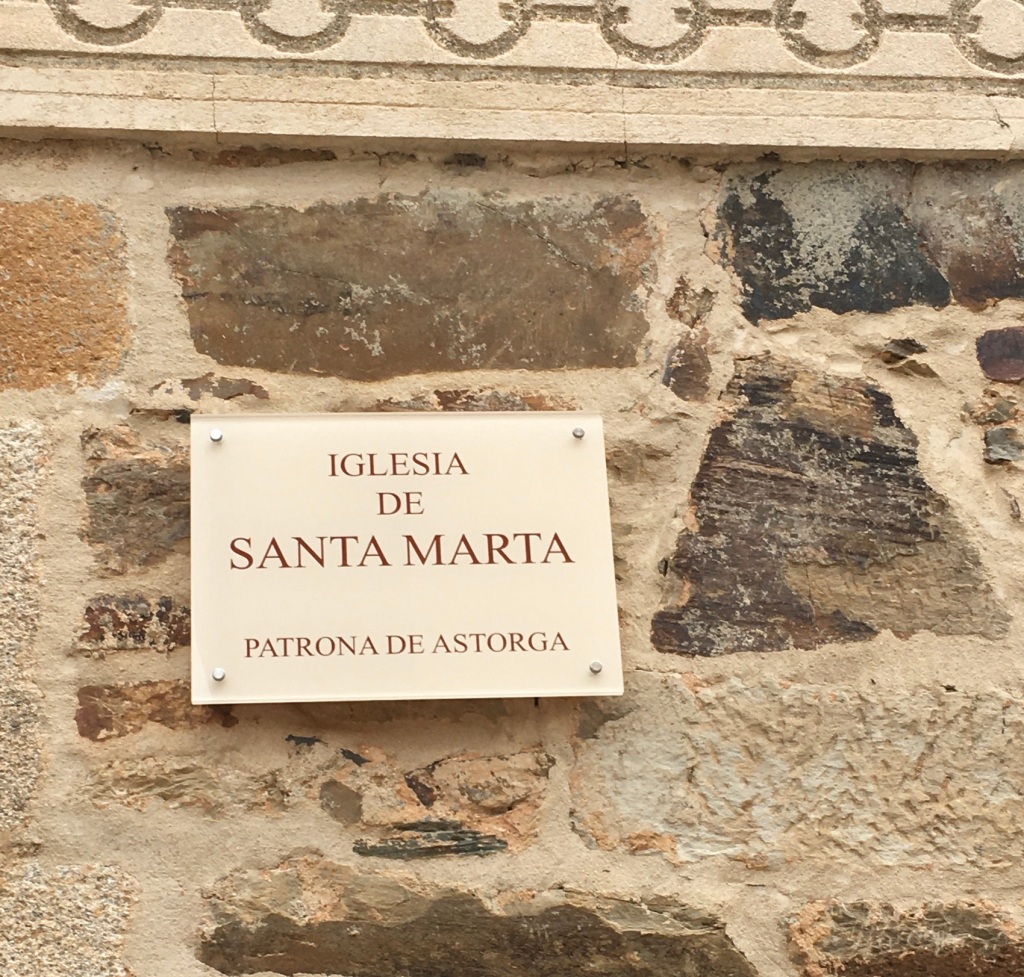
Representative of the Maragota local culture..Magnificent muralsGlass balconiesAstorga has many Roman remainsFine churchesSculpturesAnd fountains Not to mention ice cream Plus floral inventiveness.
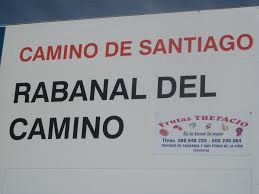
Friday promised mostly sunshine with showers possibly late on. The forecast for Saturday’s first walk was wet and so we have decided to make a 07.00 start to Rabanal del Camino – 20 km. Tomorrow.
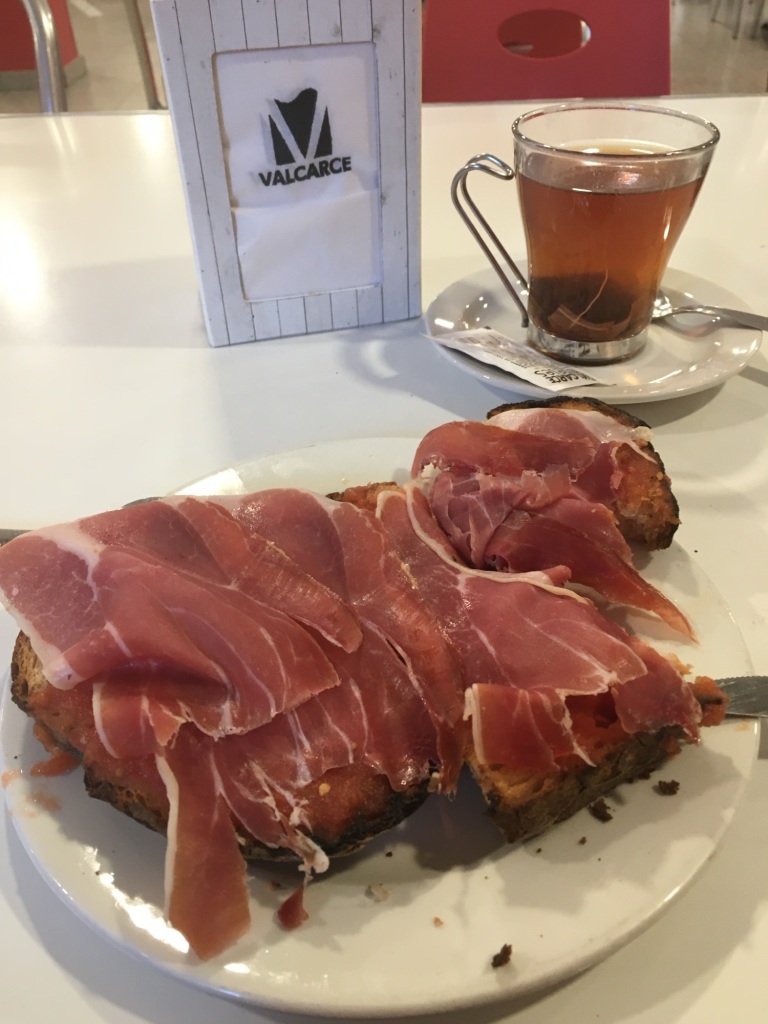
Mike and I enjoyed a late start and a very enjoyable traditional breakfast of tostadas con tomato y hamon, with fresh orange juice and coffee – €4.00!
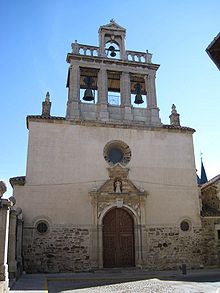
We then walked the Camino out of the city to be sure of our route tomorrow. Passing a church that reminded me of my granddaughter, Martha.
We then passed another very modern church.
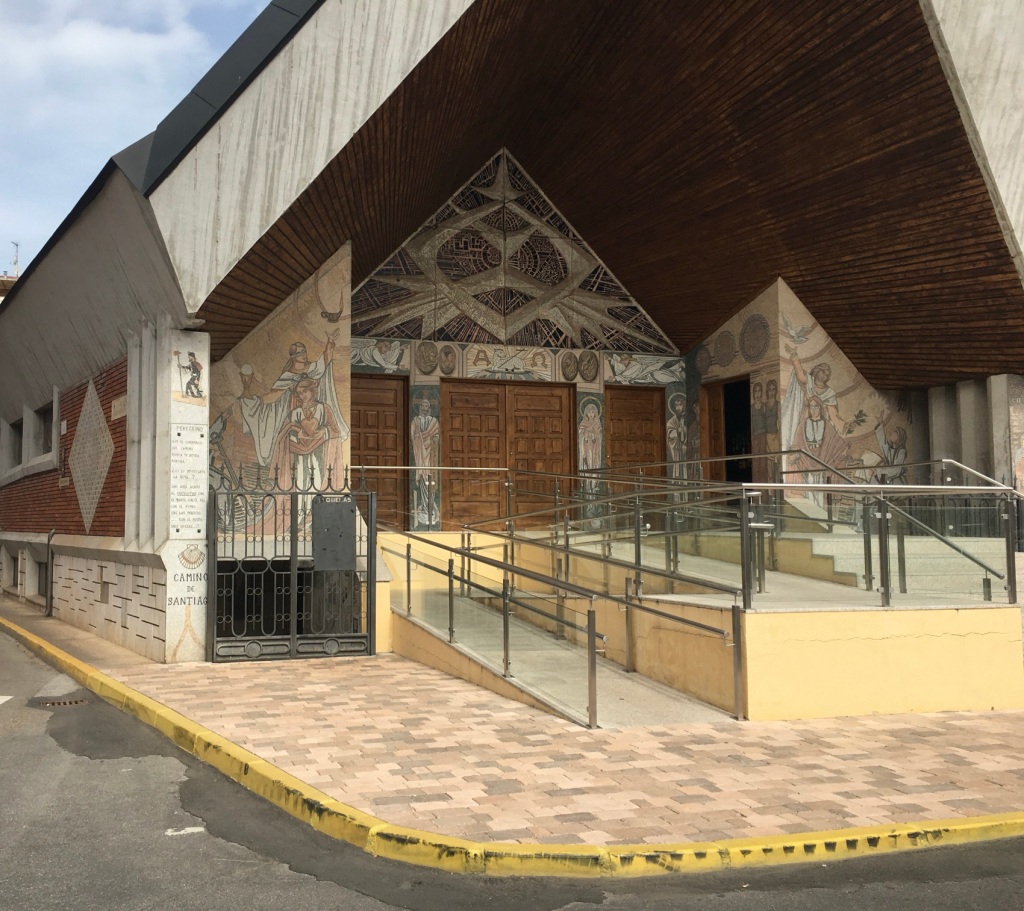
Camino embodied
We were surprised to notice a plaque on the wall of a house dedicated to an English hero.
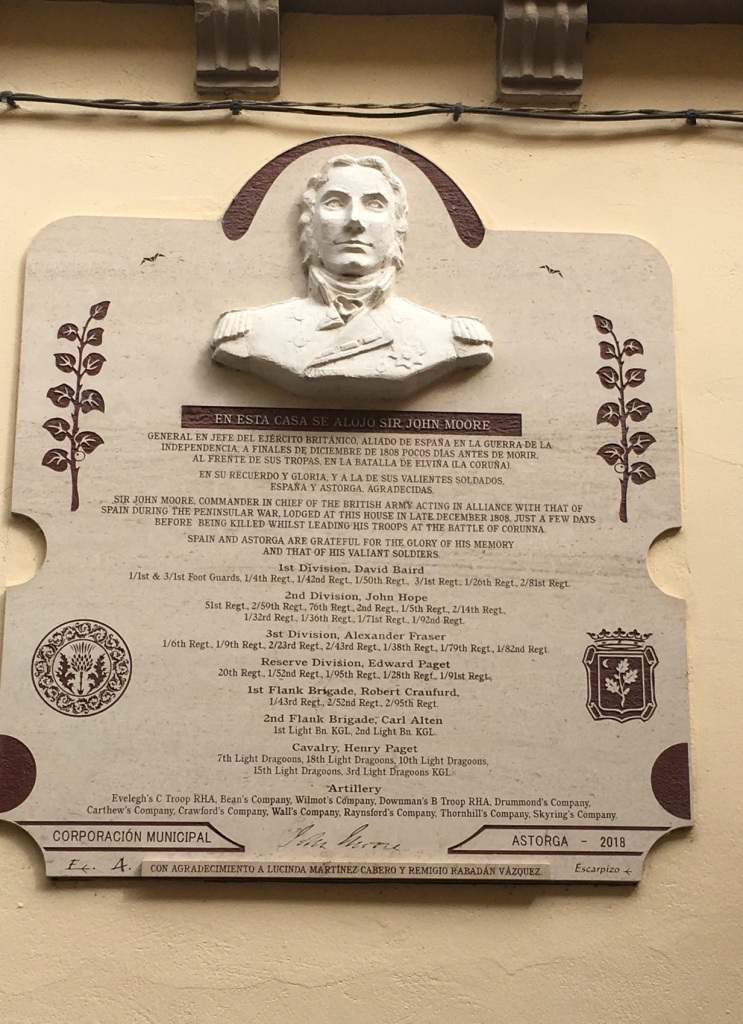
Sir John Moore
We reached the edge of town where the Camino begins for real.
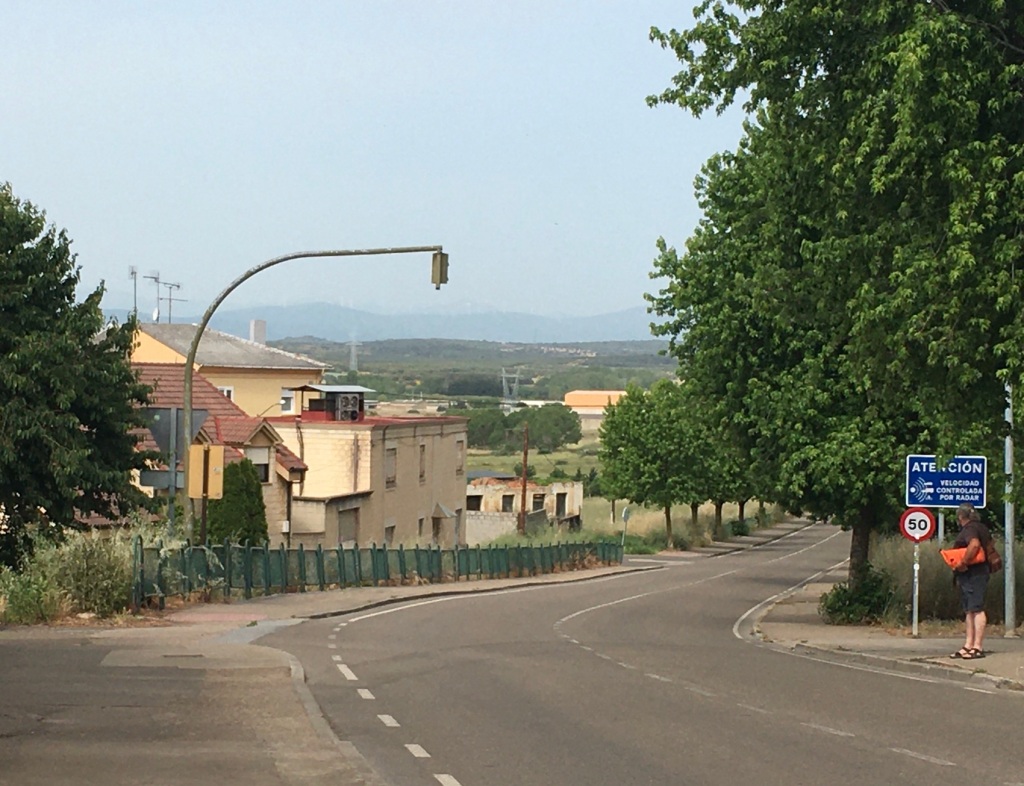
Fairly flat for the first 8 Km then a slight climb to Rabanal.
Retracing our steps we took in some of the buildings for which Astorga is renowned .
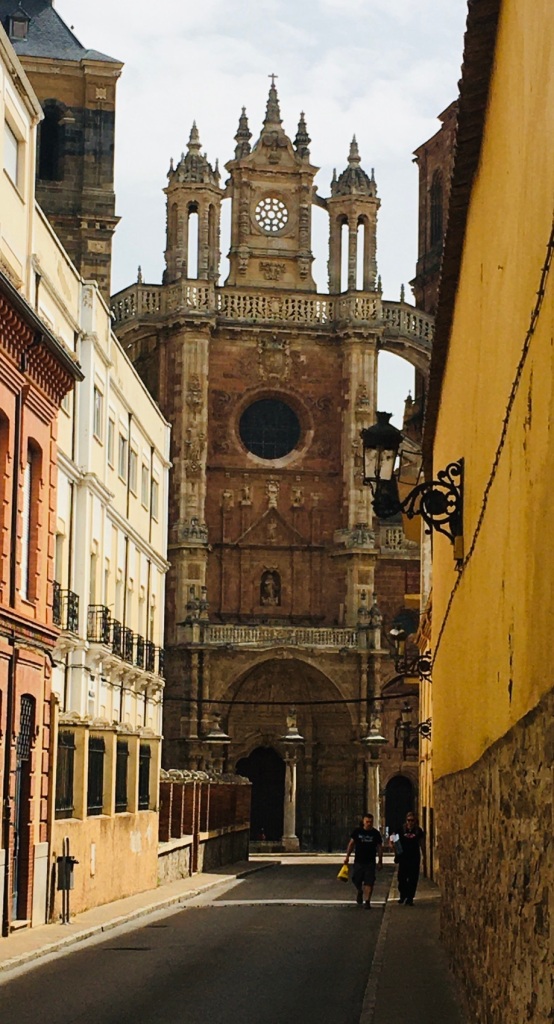
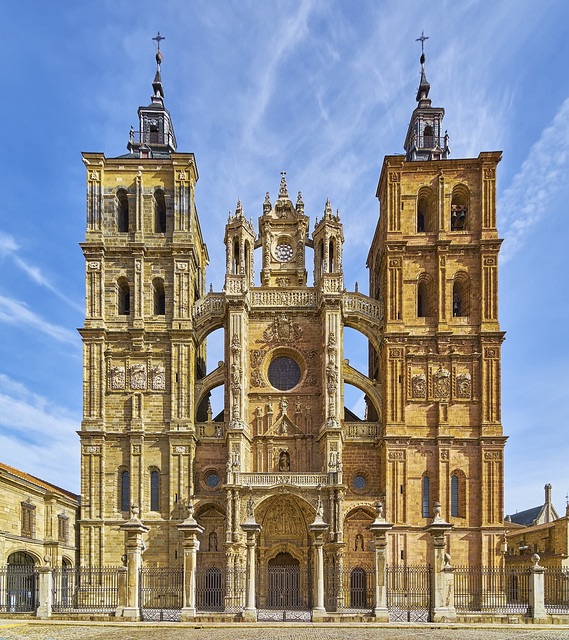
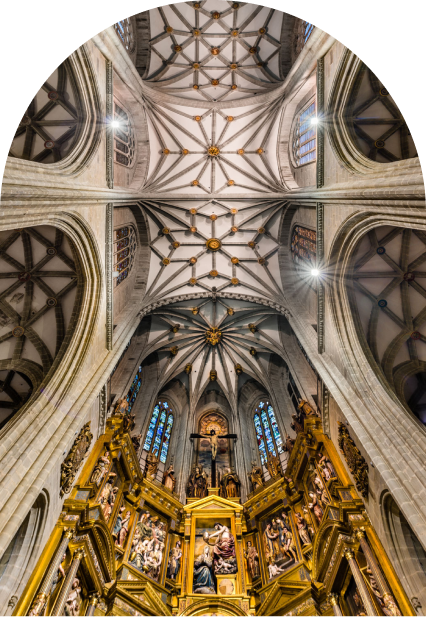
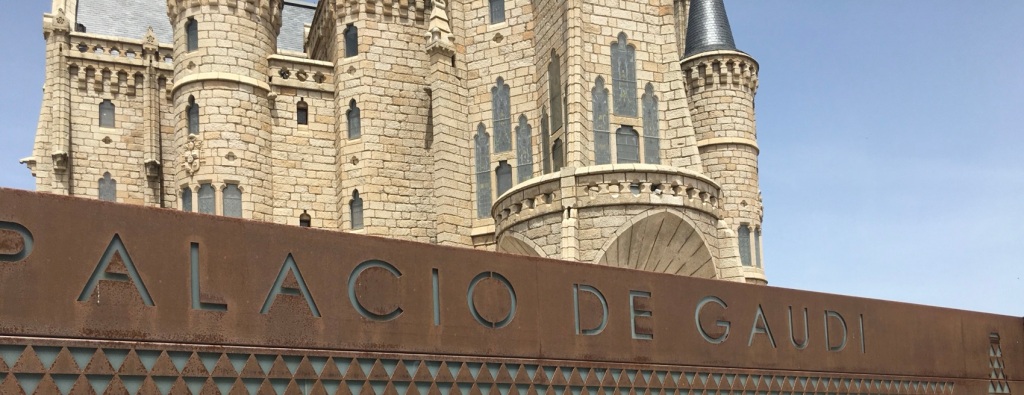
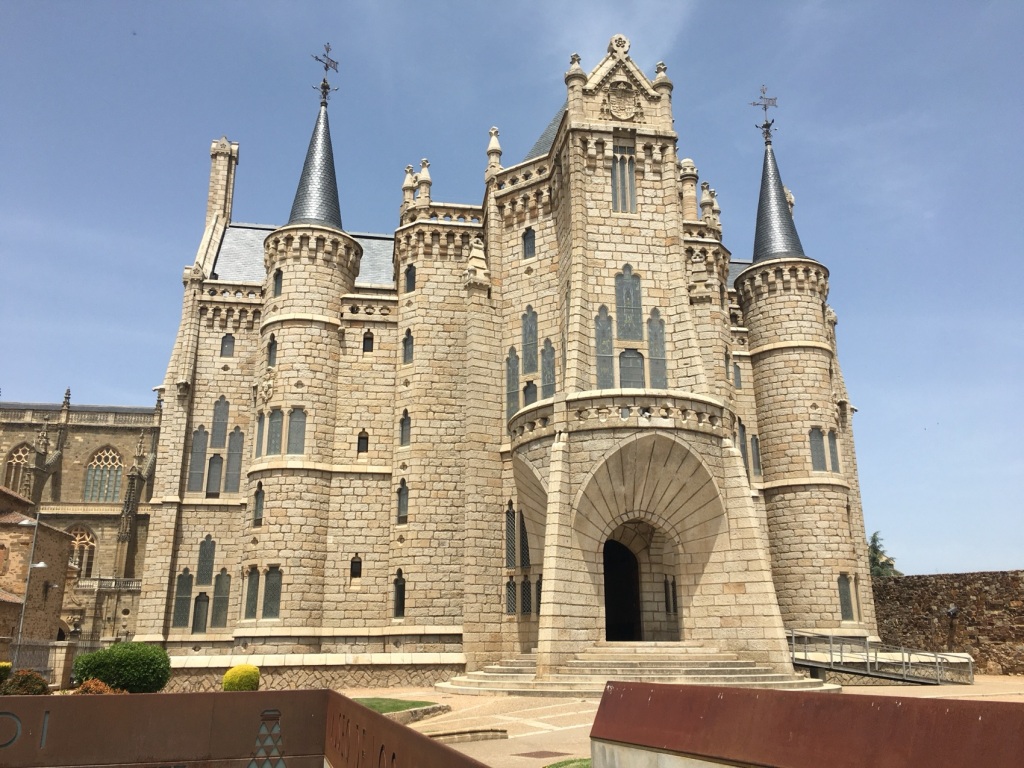
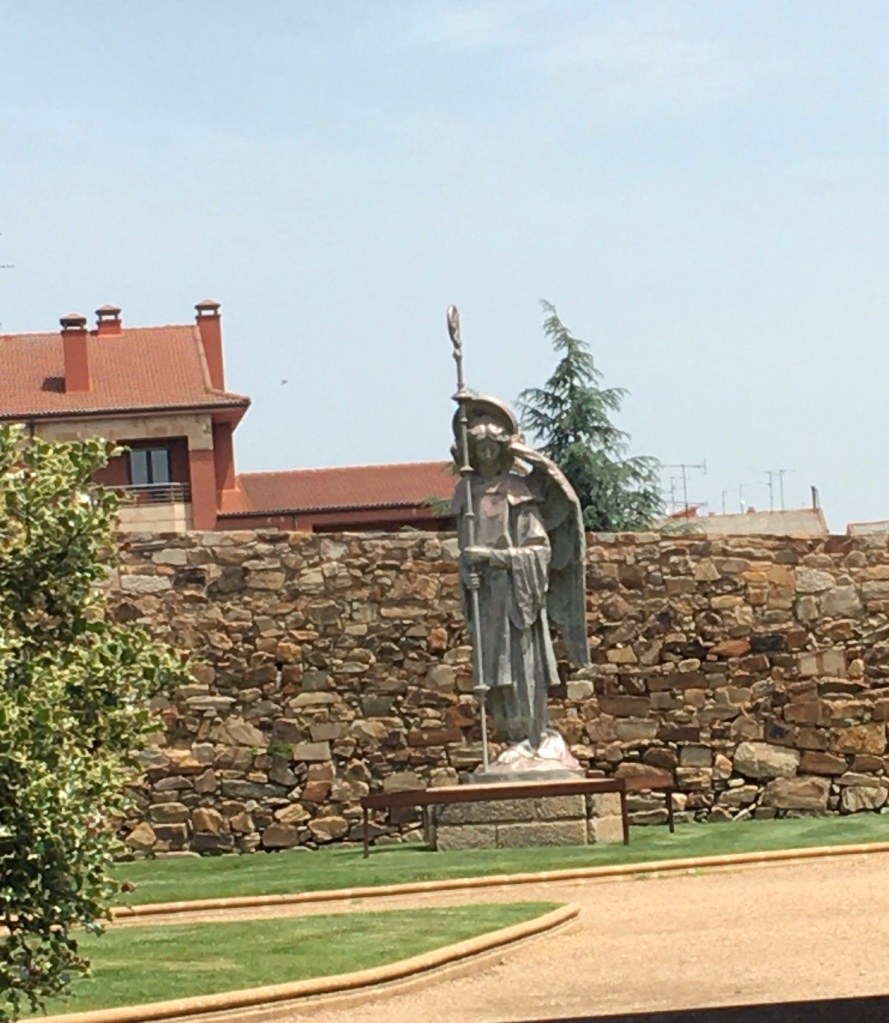
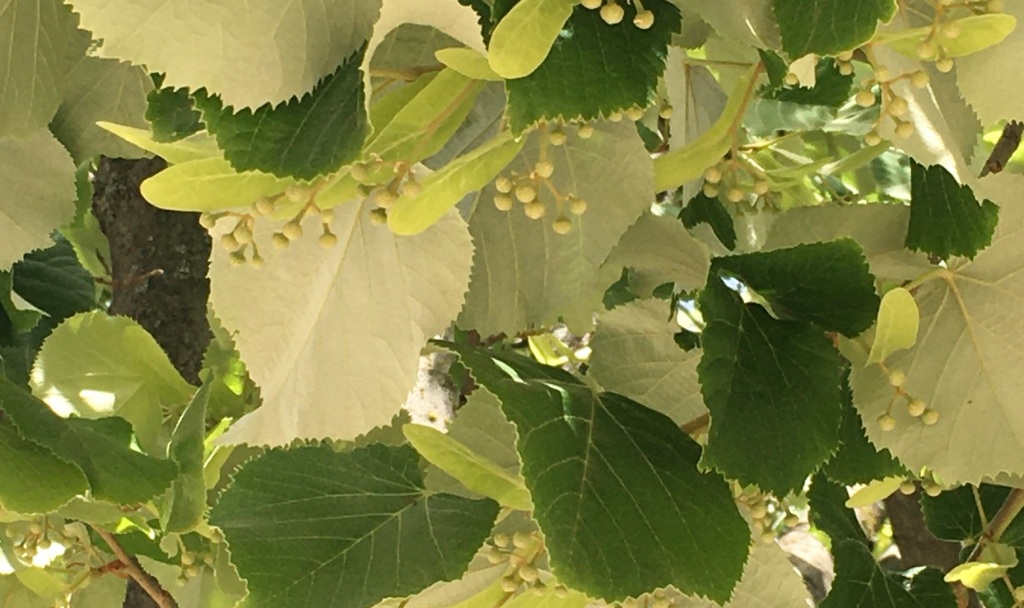
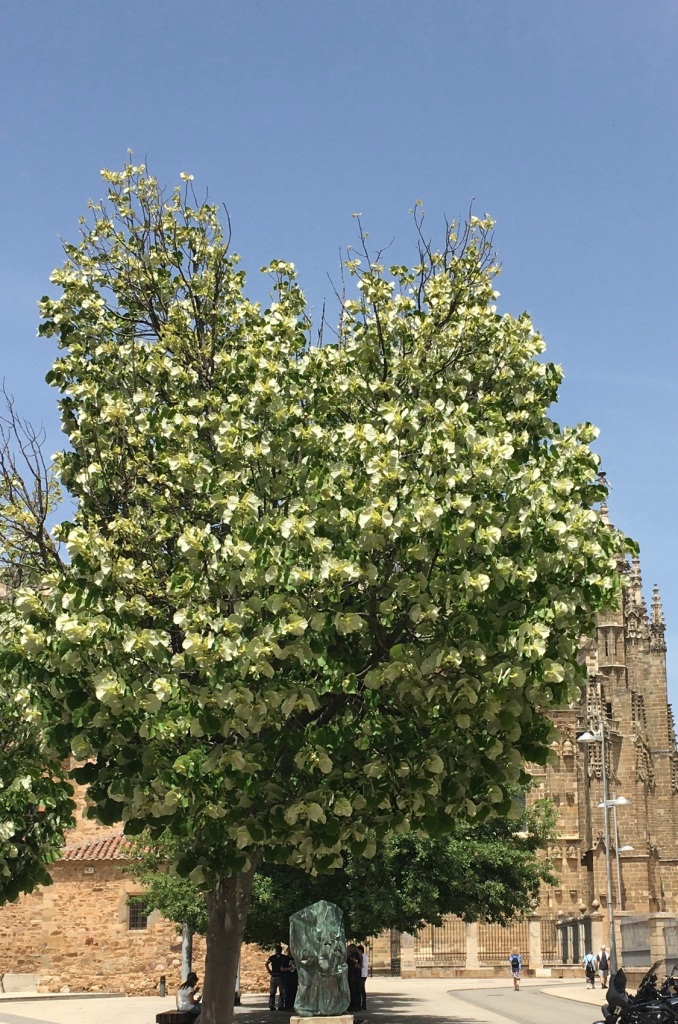
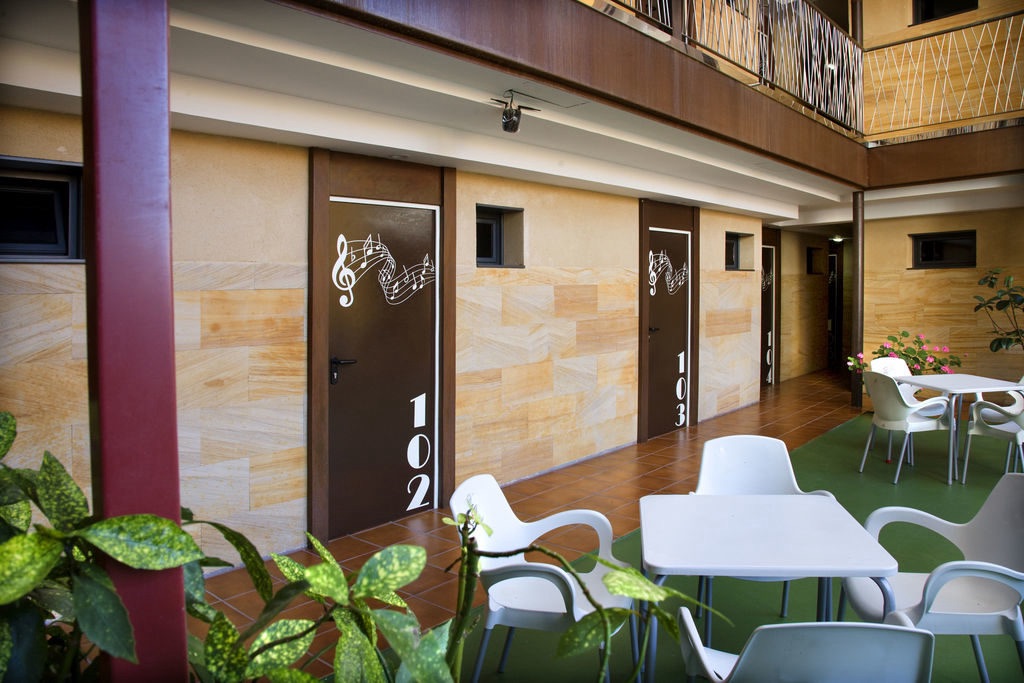
Towards the centrepieceThe Cathedral Soaring upwardsThe GAUDI Episcopal PalaceThe PalaceOn guard in the grounds.Eye catching variegated trees along the squareAfter a restful afternoon and some repacking,it was time for some sunshine on the patio.That’s our room,102
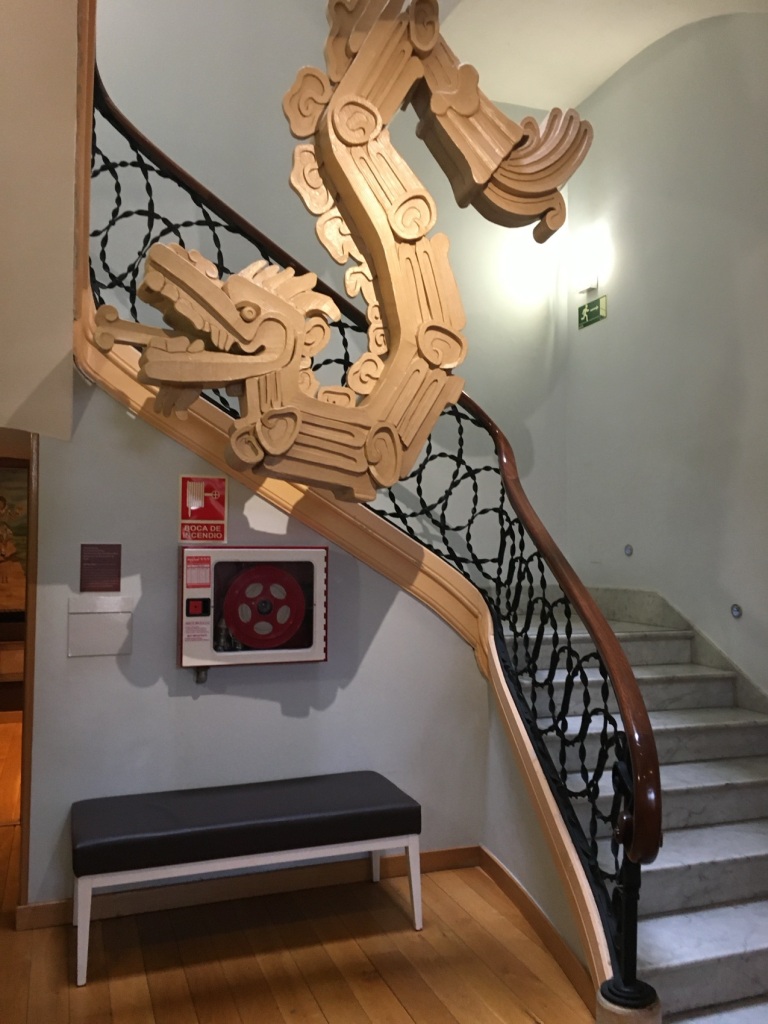
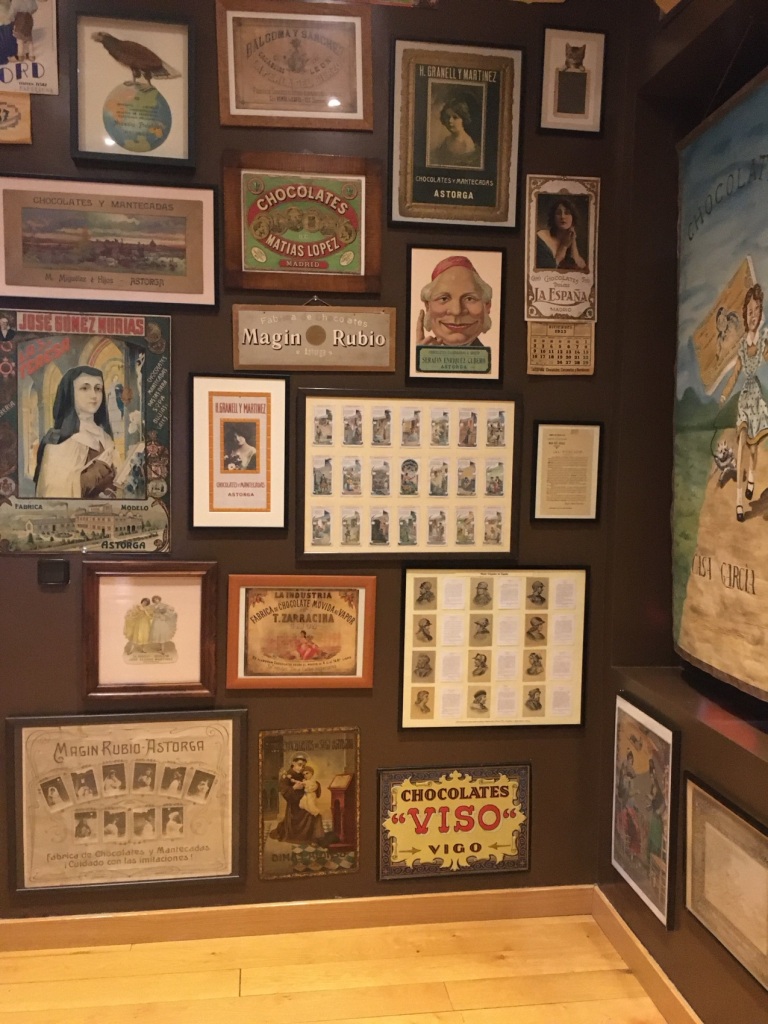
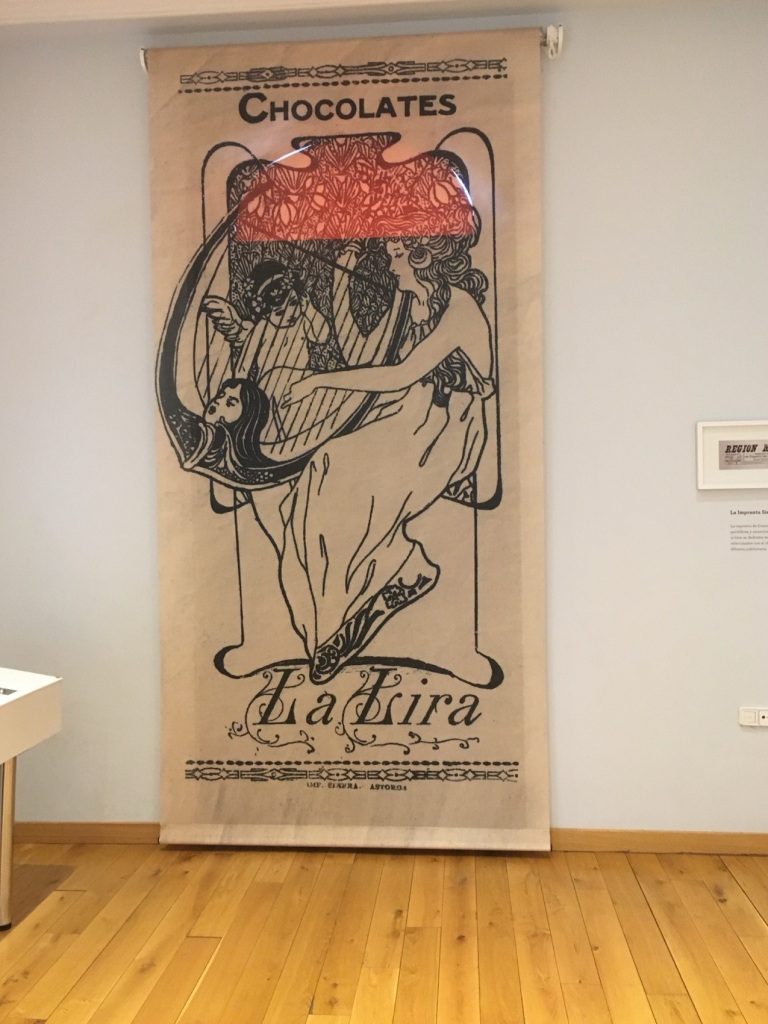
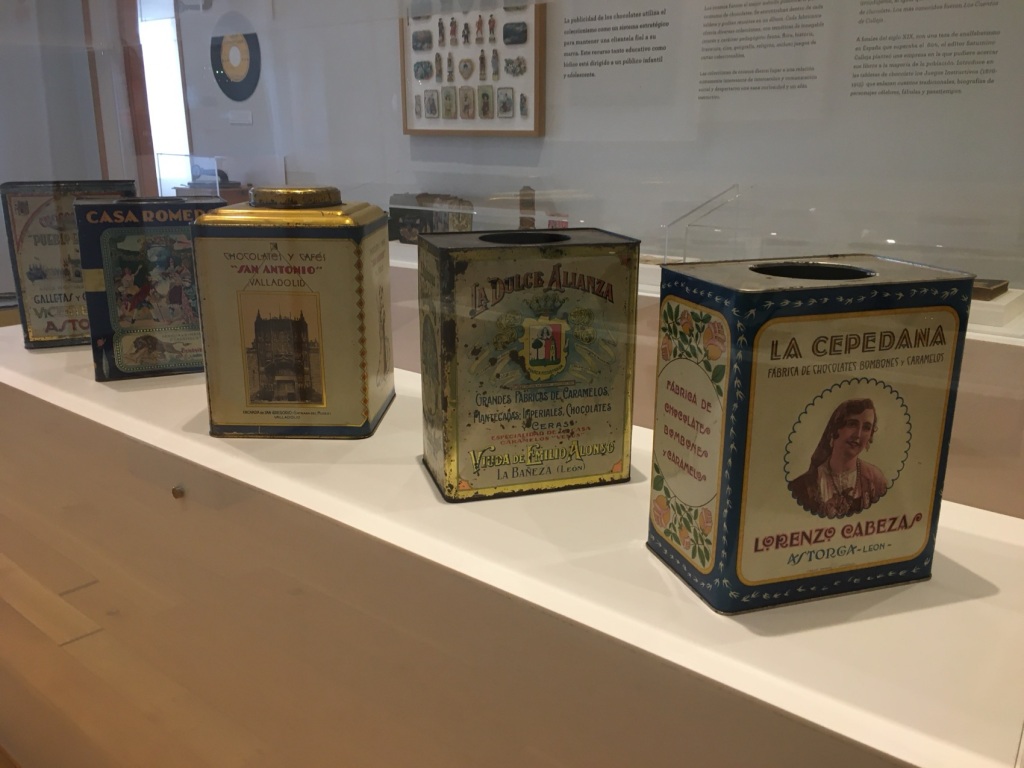
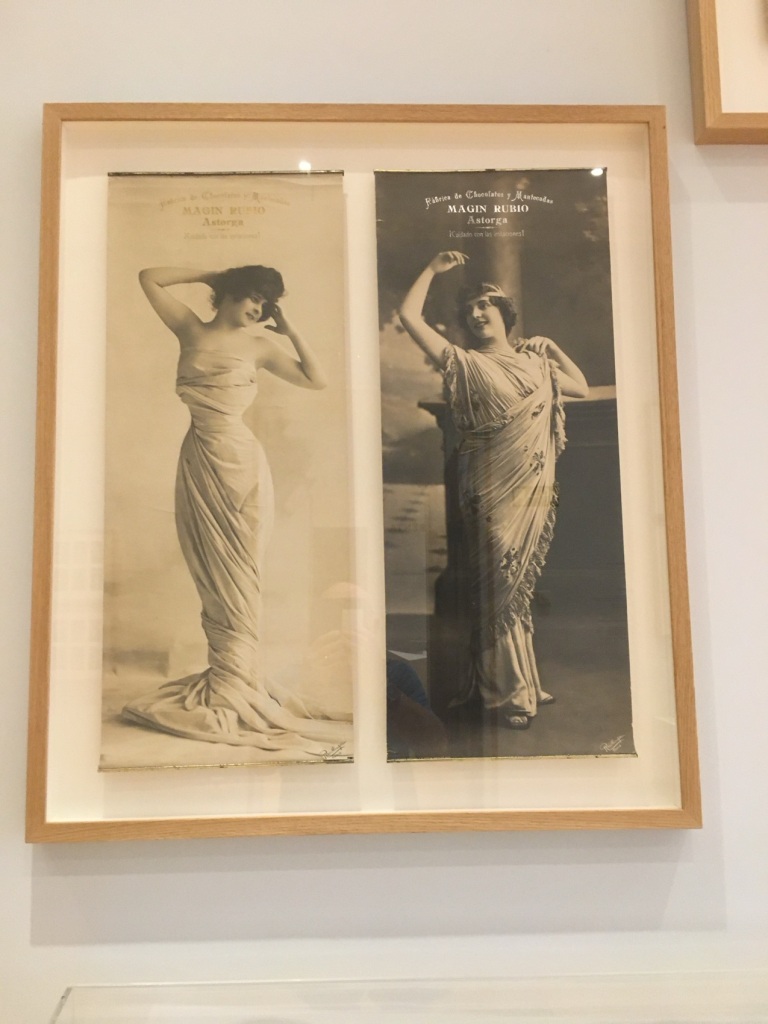
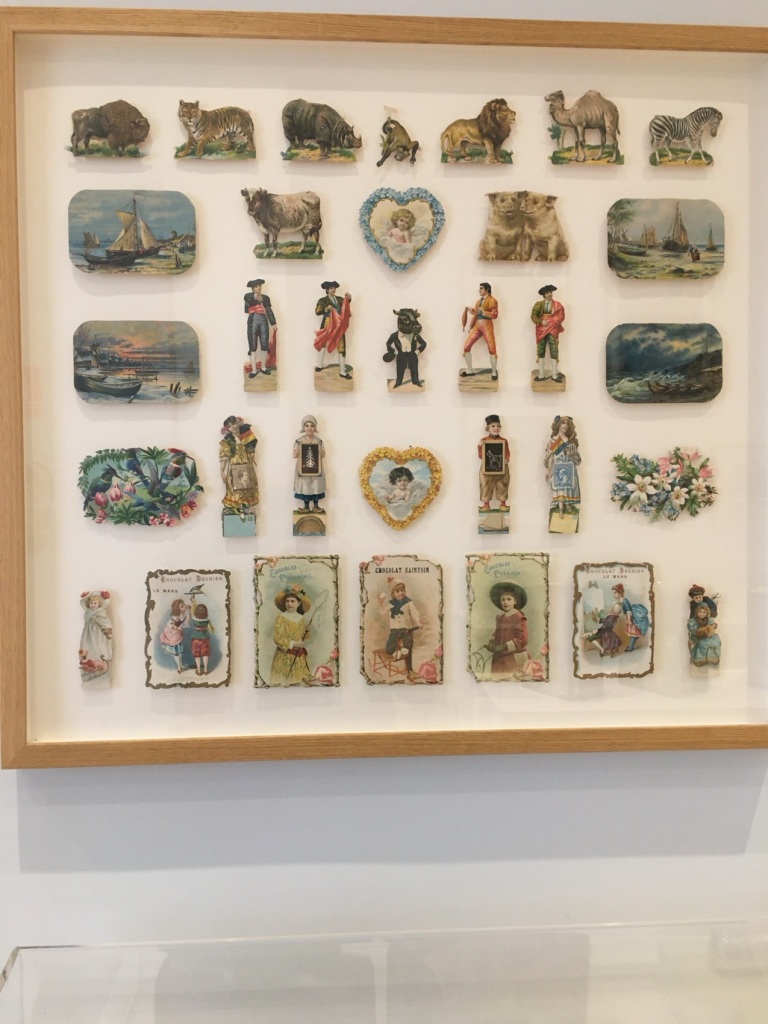
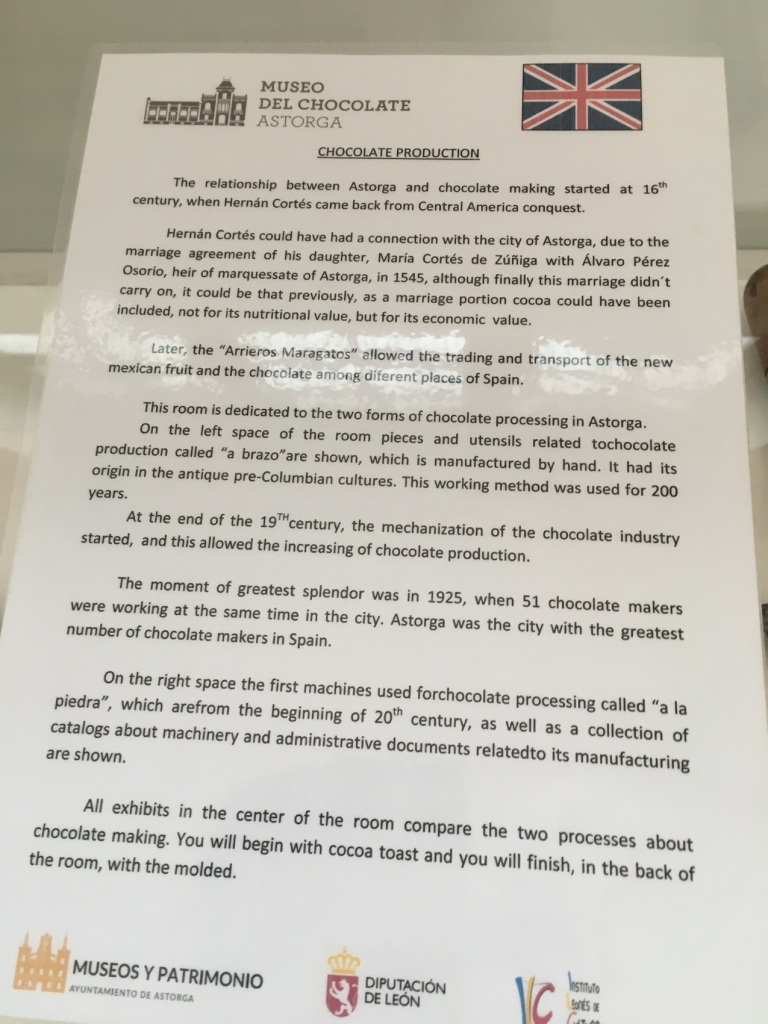
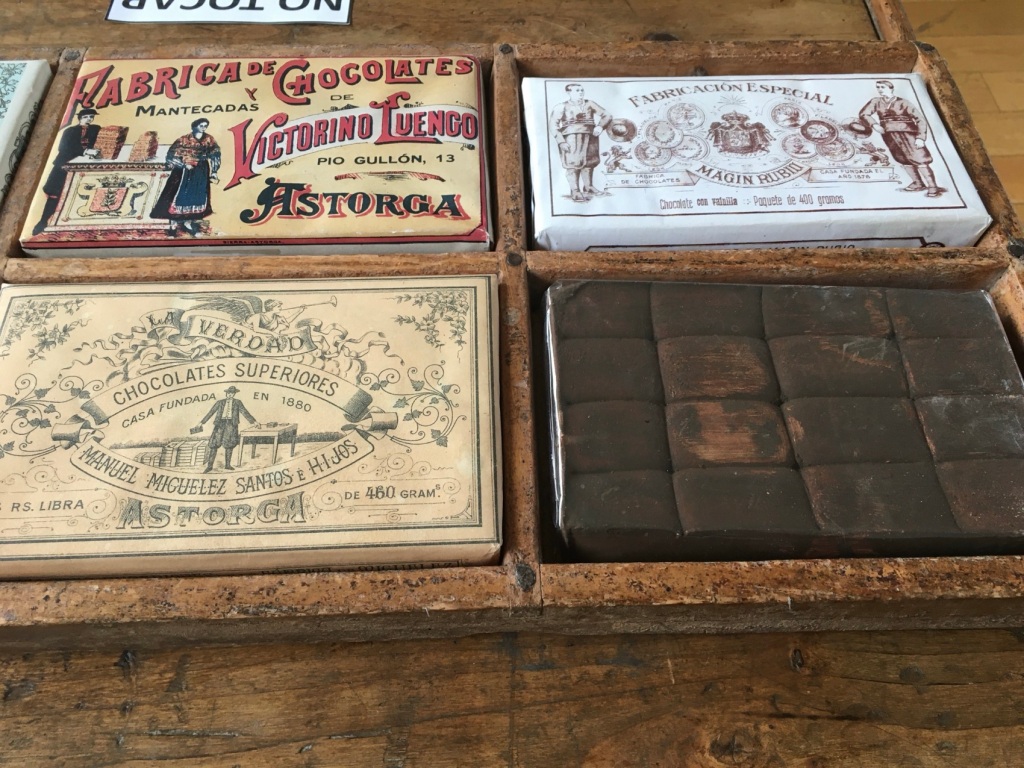
At 16.30 the Chocolate Museo opens . Let’s go, something different. What has chocolate got to do with Astorga; what has chocolate got to do with Cadbury’s Bournville? Both unlikely places.
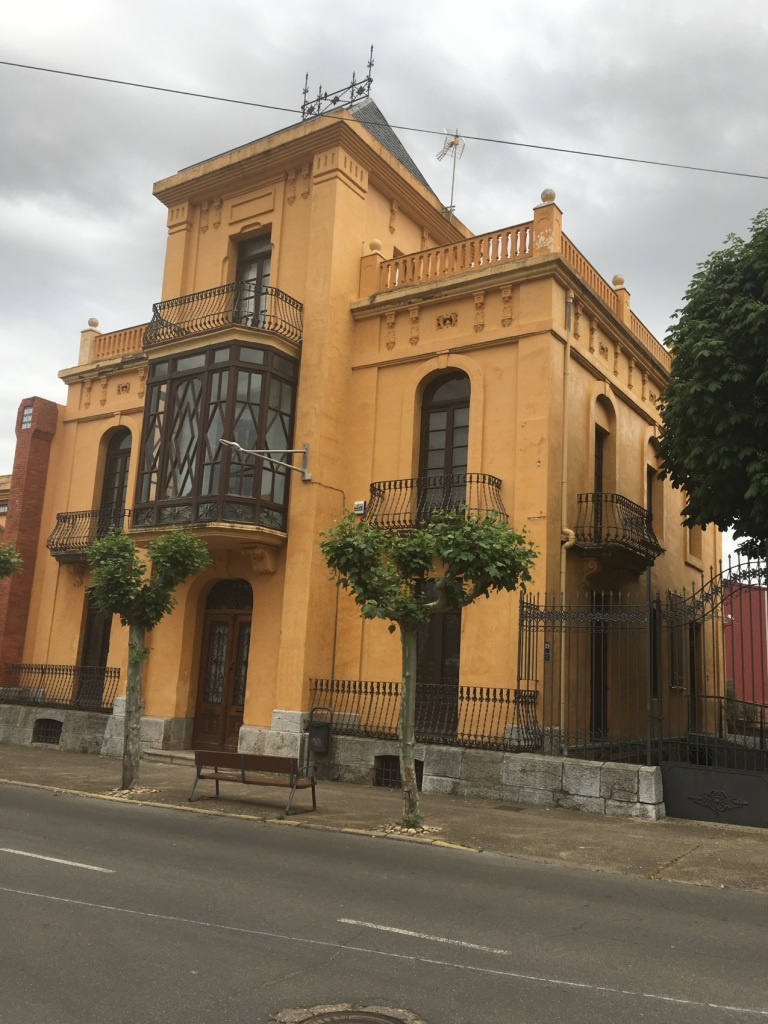
The Chocolate Museo.A Villa put to good use and we got three samples , too.
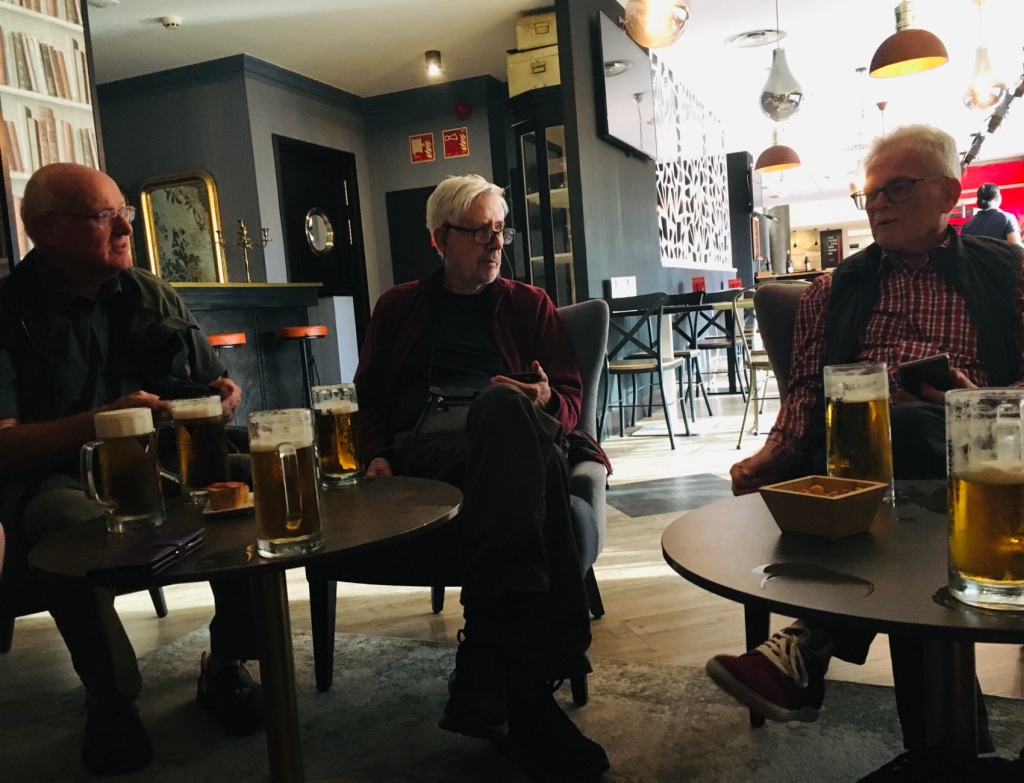
The storm came in about 18.30, so Rob, Tom, Mike and I took shelter in a tiny bar, El Rincon, about 150 M from our hotel. A simple, locals’ favourite. I rang the rest of the group to say we could have a good night here…and we did….super service and incredible value for money . Enjoyable night and it has stopped raining,thundering and lightning as we walked back to the hotel.
“In my soul I am a farmer. I see the worms and the small things on the ground along the way, note the plants that thrive and know this earth is rich and alive.
I could grow things here.
In my heart I am a fisherman. I stand beside the rivers and streams and watch the fish jump.
I could feed myself here.
I know how to grow things. I know how to fish. These are gifts given to me at childhood by my parents.
I may struggle to converse with the people I pass. But Spain… the land, speaks to me in a language I understand.
I could live here and be happy.”
In my soul I am a farmer. I see the worms and the small things on the ground along the way, note the plants that thrive and know this earth is rich and alive.
I could grow things here.
In my heart I am a fisherman. I stand beside the rivers and streams and watch the fish jump.
I could feed myself here.
I know how to grow things. I know how to fish. These are gifts given to me at childhood by my parents.
I may struggle to converse with the people I pass. But Spain… the land, speaks to me in a language I understand.
I could live here and be happy.
In my soul I am a farmer. I see the worms and the small things on the ground along the way, note the plants that thrive and know this earth is rich and alive.
I could grow things here.
In my heart I am a fisherman. I stand beside the rivers and streams and watch the fish jump.
I could feed myself here.
I know how to grow things. I know how to fish. These are gifts given to me at childhood by my parents.
I may struggle to converse with the people I pass. But Spain… the land, speaks to me in a language I understand.
At this point and before we begin our Camino from Astorga on. 20 th June 2024, it is worth remembering a few of the things that differentiate a camino from a holiday. We all undertake our Camino for a vast array of reasons.
DECELERATION – A Camino can be an “ Oasis of deceleration “ Below are some notes I made at a seminar on “ Slowness on the Camino” . At Southwark Cathedral about 5 years ago.
Travel per day – walking is the ultimate slow mode. Natural rhythm
Experience of physical discomfort / pain. Overcoming challenges
Listening to what your body tells you
These inhibit…slows you down, more reflective more likely to engage face to face with others.
Decrease in number and variety of actions per day
Simplicity of experiences
Reduction of consumer choice Eg Menu Del Dia / Pelegrino Eg lunch is not Pret A Manger with 30 different sandwiches/ soups
Walk, Eat, Sleep – a different bed every night and being grateful
You have only to consider what time you start, where you are going to finish
What to have for breakfast
Where/when to have a break
Hostal or hotel
Dinner? Or Tapas trail ?
Let’s go back a few centuries
There are many ‘What a lovely wonderful day that was’ on the Camino but there are also days that are more difficult, ‘Thank Goodness that’s over’. History shows us that such was always the pilgrims’ role.
14th Century Pilgrimage to SdC
Licensees authorizing the owners and captions of ships to carry a fixed number of pilgrims to Spain are still in existence and fill many pages of Thomas Rymer’s book ‘Foedera’. They are written in Latin, the name of the ship in French. The pilgrims must swear before leaving England: they must upon their oath do nothing contrary to the obedience and fealty they owe the king; they must not take out of the realm gold or silver or bullion beyond what is necessary to their journey, and they must not reveal the secrets of the realm. Don’t think for a minute that these ships, one hundred pilgrims and crew on a long journey were large, well-appointed vessels. The pilgrims suffered from overcrowding, seasickness, the fear of storms, disgusting smells, and the derision of the sailors. They very much resembled the jam-packed pilgrim ships on the Red Sea of our recent history which brought crowds of believers to Jeddah, Muslims on their way to Mecca. Our example dates from 1394: “Know you that we have given license to Oto Chambernoun, William Gilbert, and Richard Gilbert, to receive and embark in the harbor of Dartmouth a hundred pilgrims in a certain ship belonging to the same Oto, William, and Richard, called la Charite de Paynton, of which Peter Cok I captain; and to take them to Saint James, there to fulfill their vows, and from thence to bring them back to England, freely and without hindrance, notwithstanding ordinances to the contrary.”
We got it easy.
Sit back and relax for now,: “I’m not telling you it’s going to be easy, I’m telling you it’ll be worth it.” ”
There is a saying in Spanish “cada día tiene su afán” which translates to “Every day has its desire.” I love this saying because so true in life and especially on the Camino. Each day there some new challenge; weather, terrain or aches and pains. But it is important to remember these things are temporary or tomorrow offers something new. 🙏😊
On leaving O Acrivo we very soon walk through Pedrouzo, following the arrows as we go. There is very little to say about this modernised town – no myths nor monuments – generally full of pilgrims like us ,excited and relieved to have got so far.
Amenal is merely a pit- stop but has a popular cafe
Possible fellow travellers
We shall be walking beneath Eucalyptus for some way until we come upon the Lavacolla airport. There are many theories in relation to the origin of the place name Lavacolla. One of the theories claims the name Lavacolla comes from the fact that pilgrims in the Middle Ages used to wash in the stream that crosses Lavacolla to arrive clean in Santiago. This is one of the theories you might hear from the guides of the Cathedral in Santiago de Compostela if you take a rooftop tour of the cathedral. This theory implies the name Lava-colla could come from the words ‘lavar’ (to wash) and ‘cuello’ (neck), meaning ‘to wash the neck’. There is a more earthy interpretation but…You may notice discarded items of clothing by the stream – as we walk around the perimeter of the airport.
Wooden crosses in the airport fence A sure sign that our rural oddysey is behind us.The best campsite for Santiago in my opinion Monument on Monte de Gozo .Monte do Gozo (Hill of joy) is the last hill on the Camino de Santiago before reaching Santiago de Compostela. From this hill the pilgrims can see the three spires of the cathedral for the first time. On top of the hill there is a modern religious sculpture and a park, plus a chapel .Capilla de San Marcos – last place outside of the city to obtain a sello. This was the site of a medieval chapel and marks the original site of the look out point at which pilgrims stood to get their fist glimpse of the cathedral spires – hence Gozo meaning joy . Made of two giant pilgrims pointing the Santiago de Compostela Cathedral. It was built in the 1993 Holy Year and was design by the Galician sculptor Acuña..
The Camino continues and takes us into the suburbs of Santiago, Rua do Peregrino and a flight of steps to join the city’s traffic.
San Lazaro. (Last time I came by here it was open and there were parishioners issuing stamps for your passport and directions to the cathedral . )Witness to the leprosarium that existed here in the XIIth Century sufficiently far enough away from the city walls to exclude contamination
The path enters Santiago on the west side via San Lazaro. The Rua dos Concheiros which flows into rua San Pedro and crosses into the medieval walls of Santiago at Puerta del Camino, leaving a final few hundred Kms to reach Kilometre Zero at the cathedral. John Brierley’s advice is worth regarding on your arrival…..” “Take time to arrive . We each experience different emotions, from euphoria to disappointment, on seeing the cathedral . Whatever your individual reactions, honour and accept them . Gratitude for safe arrival is a frequent response but if you are overwhelmed by the crowds why not return later when you feel more composed …”
I have often sat here and watched the joyful,sometimes tearful arrivals.There is a tradition of having both an individual and a group photo taken on arriving in the Praza ObradoiroSC Ramblers – 2020
Codex Calixtinus: “ Compostella, the most excellent city of the Apostle,complete with all delights , having in its care the valuable body of St. James, on account of which it is recognised as the luckiest and noblest city in Spain”.
There are certain rituals associated with Santiago, no obligation .
There is so much to see in Santiago de Compostela and the link below is helpful in making decisions about what to do. Take your pilgrim passport with you as it enables free entrance into some places. If there is a fee, it is worth asking if there is a discount for “Jubilados “ – Retirees.
The Camino continues out through the old quarter of the town.
The trail passes through numerous hamlets. There’s just a bit of undulation with several shallow river valleys. Most of the trail is off road with shade from the prolific Eucalyptus trees.
Then locals in these parts enjoy telling you without the slightest tone of irony or sarcasm that “ no hay vacas in Galicia “ ( there are no cows in Galicia )….mmm. Another corker is : “No hay burro calvo, ni calabaza con pelo!” (” “There is no bald donkey and no pumpkin with hair.” ) I can clarify: it’s an idiom that basically means “don’t bullshit me” or, more generally, used in situations where something is clearly exaggerated, false, etc. I would add that there might be a second layer of irony to this, in the context of a conversation about Trump, because he’s often made fun of for his orange-colored fake tan, and people have often called him a pumpkin. So he sort of is a pumpkin with hair…
How did we get here ? Let’s leave this diversion and get back on to the Camino .
Striding out we soon reach a tiny place,Preguntono.We go under the N- 547 by a tunnel and reach Taberna Velha and the Wall of Wisdom that has been “modernized” (i.e. laminated) to survive the elements of the Camino. It has inspirational quotes to motivate tired and worn peregrinos as they finish their final kilometers to Santiago de Compostela.In John Brierley’s guide he says,it depends on one’s perspective
After all that philosophy we shall be ready for refreshments and here is just the place.
Casa Calzada – only if you’ve got the bottle for it.
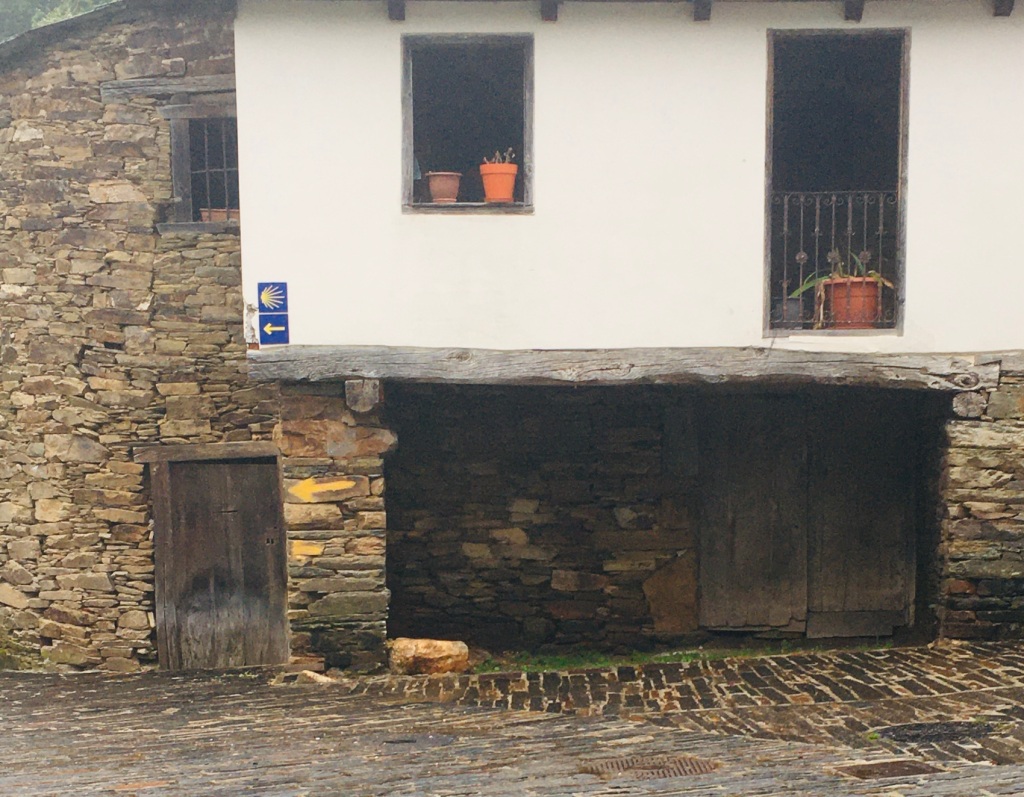
We soon reach A Calle, a typical Camino village
We walk under the Horreos, towards Salceda.A handy bridge.N-547
PLEASE NOTE
The path joins the road at Salceda , and although you don’t walk on the road, you stay quite close. In fact, the path crosses the highway several times between here and Santiago. The speed of the traffic, the curves in the road and the abundance of pilgrims make this the most dangerous stretch along the path. Cross carefully and quickly and always stay under the road when possible.
Son after leaving Salceda we pass a poignant memorial
The monument is of a bronze pair of his shoes and people are known to leave little gifts beside the monument. The plaque at the side says “Guillermo Watt Peregrino, Abrazo a dios a los 69 años a una jornada de Santiago el 25 de Agosto 1993, año santo, vivas en Christo.”He died one day before reaching S de C.
The next place of interest as we near the end of this stage is Santa Irene. At 25 km from Santiago de Compostela, the small and beautiful village of Santa Irene, belonging to the municipality of O Pino.
Here you can find good places to eat and rest. One of the most interesting places in the locality are the hermitage and the fountain, since important curative powers are attributed to it and therefore, it hides several legends.
For many the water emanating from this source is able to kill pests and plagues of crops, so it was used to spray the crops. Also, it is presumed that it cured all the ills of children, who stopped crying when they passed by the image of the Saint. It was previously decorated with the image of the Saint, but this beautiful piece from 1692 was stolen in the eighties.
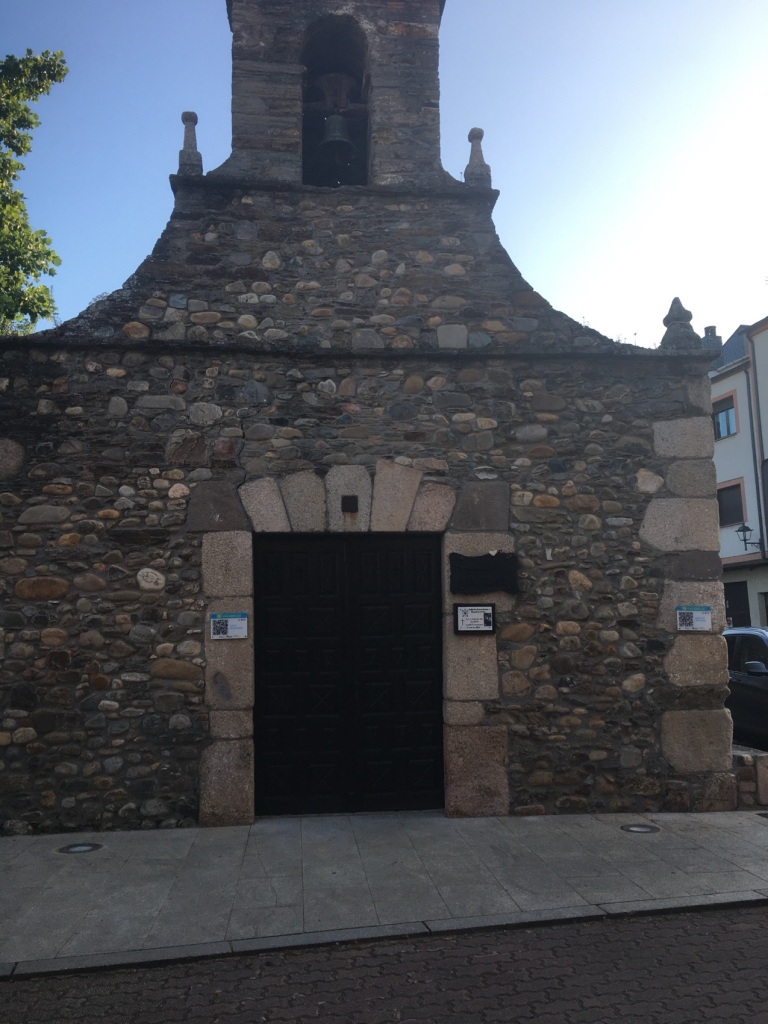
Chapel of Saint Irene Perfectly located at the foot of the Camino de Santiago, you will see this beautiful and well known chapel. This hermitage dedicated to San Pedro was built in the 17th century and has a simple rectangular floor plan built in stone, with lintels and a bell tower. Inside there is a baroque style altarpiece. It is surrounded by a spectacular oak grove, which forms its wooded atrium where the feast of St. Peter is celebrated on June 29th. Fountain of Santa Irene Called by many the Fountain of Eternal Youth where pilgrims come to enjoy the water, this fountain is located right next to the aforementioned chapel. The story goes that the waters of the Fountain of Saint Irene had the power to cure the plagues and the ills of the pilgrims, which is why it became a historical place.Not far away from O Pedrouzo / Arca
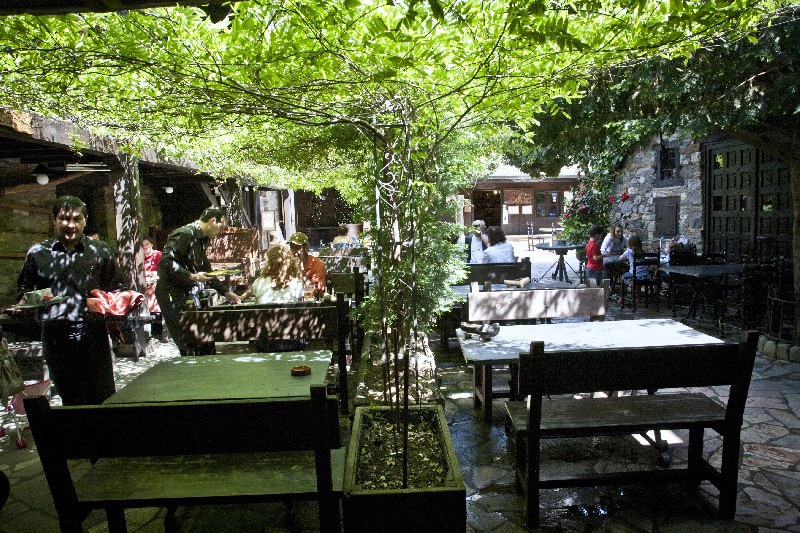
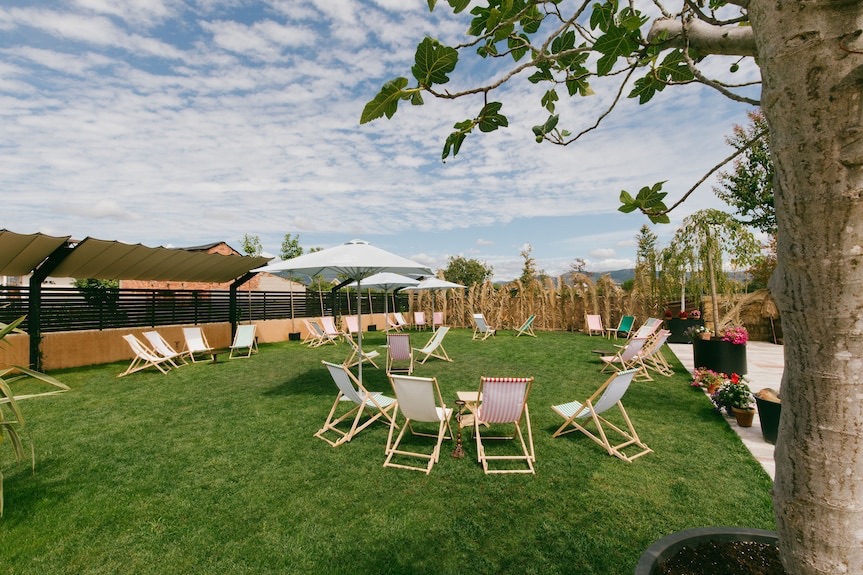
Ten minutes from O Pedrouzo and close to a campsite is our welcome accommodation Alojamientos Rurales O Acrivo Right on the Camino path about 1km from O Pedrouzo. A recent review :- “Well appointed, clean, comfortable little motel type rooms. Laundry facilities were very much appreciated & pool was open, which was fab for tired legs. Restaurant was handy for evening meal & breakfast.” O Pedrouzo is a locality of 540 inhabitants. It is erroneously cited on many occasions as Arca. However, O Pedrouzo is a locality of the parish of Arca and capital of the Concello of O Pino. Let’s hope we get the weather for it!The barThe restaurant terrace
This location should prove to be more peaceful than O Pedrouzo, and we have one more day’s sojourn to go.
Pilgrim Monument Fairly flat terrain – well made paths. The N-547 will be near at times and we shall have it for occasional company and crossings as far as ArzuaLeaving Palas de ReiMuch woodlands from Oak to Eucalyptus to traverse today. The first settlement of any consequence is San Xulian do Camino
Iglesia de San Xulian . Saint Julian is one of the favoured saints of the Camino and is the patron of hospitaliers and hoteliers. However, the legend that surrounds his calling is a dark one.
SAN XULIÁN HAS A SHOCKING STORYTO TELL
According to legend*, when Xulián was a young man, it was prophesiedthat he would one day kill his own parents. To keep the prophecy from coming true, Xulián left town in an effort to stay away from his parents and keep them safe from his own hand. He eventually built a new life for himself away from his parents (likely in Portugal) and married a young woman.
Soon after Xulián’s marriage, his parents set out to locate their lost son’s new home and found his wife there alone. She, unaware of the prophecy, was thrilled to finally meet her mother and father-in-law, welcoming them into the home and even offering hers and Xulián’s bed to the weary travelers while she attended church.
Unfortunately, Xulián soon returned home before his wife and unexpectedly found two people in his bed. Assuming that it was his wife and a secret lover, he murdered both of his sleeping parents in a blind rage.
Immediately realizing his mistake and that the prophecy had come true, Xulián and his wife began a pilgrimage to Rome to seek forgiveness for his sins from the pope. As his penance, Xulián was ordered to devote his life to caring for pilgrims. He did so, and he and his wife were both canonized as saints after their deaths. This story is entirely according to legend and is not officially verified by the Catholic church, but it makes for a good tale, anyway.
Reaching Casanova and it’s solitary Albergue we walk 2.8 km further on to O Coto – a good choice of cafes here – It is here that we cross from the region of Lugo to A Coruna and a village noted in the Codex Calixtinus – Leboreiro – as a good pilgrim stop in the 11-13 th centuries. However, its significance had dimmed over the centuries, but remains a pleasant, peaceful spot.The church of Santa Maria – Rebuilt in the 18th century this church has an interesting legend attributed to its founding. It was said that a nearby fountain was emanting a “heavenly odor” and at night a “shining light”. Villagers, seeing this as a sign from above, proceeded to dig at the source of this divine intervention and found an image of the Virgin Mary there. They immediately placed it on the altar of the church. The one catch was that the image would not stay where it was placed and somehow returned to the fountain. This pattern repeated itself over several days until the villagers carved the tympanum we see here today and dedicated the church to the Virgin Mary. Satisfied, the image of the Virgin remained on the altar and has been in the church ever since. To add to the legend, it was believed by villagers in the 1960’s that the she returned to the fountain every night to comb her hair. And another style of granary used for storing harvested foods. On leaving we cross a single arch bridge over the River SecoFancy a paddle? Possibly a calmer setting than Bruce Springsteen’s “ The River”
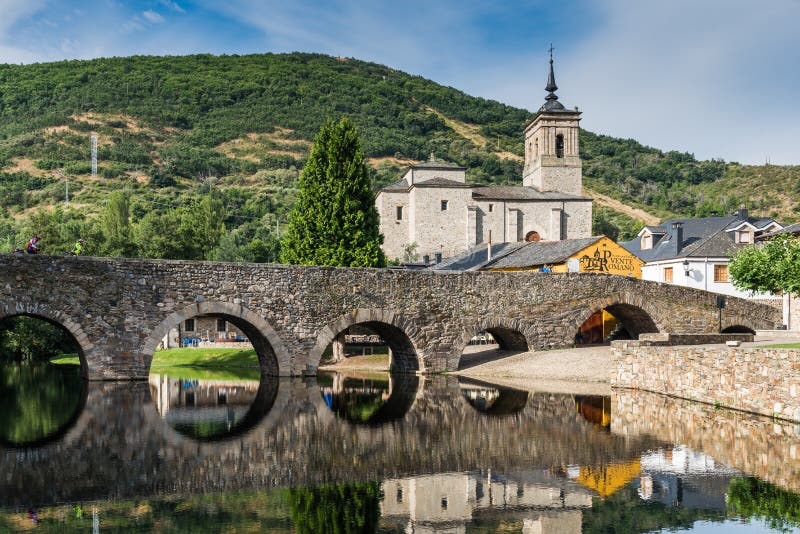
Village with an ancient origin, it was recorded in 12th century documents and it maintains part of its medieval structure. Its medieval bridge is one of the jewels of civil architecture in all Ways of St. James. Without a doubt, whatsoever, it is the most beautiful bridge in the whole Galician route of the French Way. It is mentioned in the monastic cartularies of Sobrado (12th century) and it was partially remodelled in the 18th century San Xoán de Furelos Church, just next to the French Way, preserves part of its Medieval Romanesque architecture, and more specifically, its southern wall. Inside, on the right side, we can find the impressive Neogothic altarpiece of the Santo Cristo, which was created by the sculptor born in Furelos, Manuel Cagide. The Ethnographical Museum of Melide was recently opened, just next to the church and the bridge.Iglesia de San Xoan – during the peak of the pilgrimage in 11-12 th centuries, Furelos and other villages with pilgrim hospitals and churches were protected by The Order of Hospitaliers of San Juan
South of Furelos from the Camino,archaeologists have unearthed much older guardians of the land and people,such as 2000 year old burial grounds called mamoas.
Mamoas – this area is littered with Castries,dolmens and mamoas – many are yet to excavated – the Museo Terra de Melide is a good place for further information.
And finally, Melide.
The northwest region of Spain has been inhabited since the Neolithic period. Melide itself began to grow and become important after the discovery of the tomb of Saint James.
From the 10th Century, Melide grew as the popularity of the Camino de Santiago did. With the increasing number of pilgrims on both the Primitivo and French routes, traders and innkeepers began to set up along these routes.
In the early 14th Century, the Archbishop of Santiago, Berenguel de Landoira stayed in Melide on his way to Santiago to take up his Bishopric. To thank the village for their hospitality, he granted them permission to build a fortress and charge taxes.
In the 15th Century, Melide played a central role in the Irmandiña Revolts against the power of the local barons. It was during these revolts that the walls of the town and the fortress were destroyed. The stone however was later used in the construction of the Convent of Sancti Spiritus.
In the 19th Century, Melide played its role in the fight against Napoleon’s troops during the War of Independence. Despite being outnumbered by the French the troops managed to push the French into a retreat. Less than half of the fighters had firearms, but they were assisted by villagers wielding rudimentary tools and sharpened sticks.
Despite many people leaving the town since the 1950’s Melide is still going strong. Today, tourism from the Camino plays a major role in the economy of the town, alongside more traditional agricultural activities.
Melide, located in the region of Galicia in northwest Spain, is the only town where two Camino routes meet. The Camino Primitivo(Original Way) stops in Melide and the Camino Frances (French Way) passes through.
This town is well equipped and accustomed to helping pilgrims. After all, the Primitivo is the oldest route and the French is the busiest! I have stayed in Melide at least twice . Once 20 years ago on my first Camino and relatively recently , coming in on the Camino Primitivo.
Despite being inland, Melide’s best dish and one you must try when here is ‘Pulpo á Feira’, boiled octopus. To enjoy this dish like a local it should be accompanied with bread, cachelos (boiled potatoes) and red wine.
The wine is served in bowls here ( but not for breakfast!”Our accommodation in Melide – Pension San Anton. A recent review:” I walked the Camino from Sarria (very slowly!) and the PENSION SAN ANTON was one of 10 places I stayed in total, and was most definitely the best value for money. I had a fantastic ensuite room (on the top floor with great views). It was spacious, spotlessly clean, full of light and really comfortable. I’d booked room via website and it’s a bit confusing if you’re staying in Pension or Albergue – as I believe they are the same company and they are right next to each other on Rua S.Antonio. My bag had been dropped off at the Albergue, so I rolled it up the road and fortunately the lift in the Pension took me to directly outside my room. I could rest my weary legs lying on a sun bed by the pool (what a luxury!) and better still, there was a cafe/bar alongside to enjoy a chilled Estrella whilst I did so. It was also the cheapest of all the places I stayed, which made it amazing value.”
EVERY WHERE YOU GO ALWAYS TAKE THE WEATHER WITH YOU
The eucalyptus tree came to Europe and to Galicia in the 19th century when a Galician monk brought some seeds from the faraway land of Australia where he had been a missionary. The species adapted so well to the local climate that it spread rapidly throughout the territory. Since then the Eucalyptus forests have become a subject of controversy- See link below.
A short walk to the bridge over a small tributary of the Belesar dam. We head west through ancient forests and make a slight climb – easy – so we shall be back on higher pasture land interspersed with Pine forests . We shall pass through a number of small hamlets most of which will house a bar or cafe.
Plenty of shade if needed.
After 7 km or so we reach Gonzar and a welcoming sign.
Second breakfast anyone ?Town square.
Very soon we reach Castromayor with its ancient Castro – a 200 metre detour but very worthwhile apparently.
The Castros are homes built by the ancient Celts from the years 600 BC until the 1st century with the arrival of the Roman Empire in Galicia. They are characterized by their circular plan and later their square or rectangular plan, due to the Roman influence. In many of the forts of Galicia that are still preserved thanks to archaeological rehabilitations, visitors can imagine what life and culture were like in the past. The Castromaior fort. In this castro, developed in the Iron Age, it was inhabited between the fourth centuries BC and I AD until three different populations, until its abandonment with the first Roman approaches. Of him they emphasize his big dimensions, since it counts on an area of approximately 5 hectares, and his good state of conservation. Between 2006 and 2010 it was the center of archaeological works in order to discover its entire structure, thereby achieving that in 2010 it obtained the title of Cultural Interest. Thanks to this title and being located a few meters from the route that connects the French Way with Santiago de Compostela, it has become one of the most popular locations on the Camino de Santiago. Lovely song to follow by Joni Mitchell.
Restored in 2004 – Igrexa de Castromaior – 12 th century Romanesque churchHome made dishes a specialty here, including yogurt and smoothies. Enjoy “ Homegrown “ by Neil Young
The year 820 was an important one for Ventas de Naron, and for Christian Spain. For Ventas, it was the site of a battle between the Muslim and Christian forces. The Muslim forces aimed to expand their territory to the north and the Christians, led by the Asturian King Alfonso II the chaste, sent them back. For Christian Spain, it was also the year that the bones of our favorite Apostle were rediscovered. Not long after the very same Alfonso would become the first pilgrim (the primitivo), would verify the relics, would build a church to house them, and would set in motion a course of events that would see the remaining Muslim forces defeated.
Capella a Magdelena, built from the remains of an older hospital overseen by the knights Templar in the 13 th century. Some of the stones retain engraved images of the Templar cross.
We climb the Sierra Ligonde to the highest point of the day (720m), before dropping down into the ancient hamlet of Lameiros.
Ligonde was a place full of historical significance during the medieval period and is actually two hamlets. The first is known as Ligonde Ligonde and is at the top of the hill. The first of the sites here that we saw was the ancient cementerio de peregrinos (pilgrim cemetery). It is located on an old farm named Leira da rúa and its presence would seem to indicate that somewhere near was a pilgrim hospital or hospice.
The Casa de Carnero, founded by the powerful Ulloa family and as the sign below says, the place where Carlos V, on March 24 of 1520 stayed while on his way to be crowned Emperor. Felipe II, his son, also stayed here on May 20, 1554 while on his way to La Coruna sail to England to wed Mary Tudor. In the 16th century this house was given the right of asylum. This meant that anyone accused of a crime or fleeing justice was instantly “freed” upon crossing into the house.
Unusually for a wayside cross, the Ligonde Cruceiro has a Pietà carved on the reverse of the top of the cross. Clad only in a loincloth, the dead body of Jesus lies across the thighs of his seated mother. And, continuing the theme of mortality. “ Losing My Religion “ by REM.
In Ligonde, in addition to its famous cruzeiro, the cross where the hospital supported by the Ulloa family is supposed to have been, there is also an old pilgrim cemetery, which is located on an old farm called Leira da rúa. A plaque helps us stop and contemplate what is today a green meadow, and where hundreds of pilgrims who made the Camino once rested eternally.Pleasant pathways towards Eirexe/ Airexe4.8 km after Eirexe,and seemingly in the middle of nowhere,on the N-547 is Meson Brea,a roadside cafe with a tree covered terrace and pilgrim friendly to boot.Brea is Gallego for” road”and is a very common name for a small village.
On the outskirts of Palas de Rei, we enter Rosario.
O Rosario is a small town of 25 inhabitants, located at a height from which you can see Monte Sacro, a place loaded with pilgrim legends, partly because of its proximity to Santiago. The name of the locality is because the pilgrims stopped to pray the rosary looking at the sacred summit.
One of the main legends of this magical place is collected in the Codex Calixtino. In its pages it says that in the time of Queen Lupa, a mythical character who ruled the county and that was allied with the Romans, a miracle happened.
The disciples of Santiago the Apostle came to her to ask for a cart and some oxen that allowed them to move the body of the Apostle to the graveyard. They say that Queen Lupa sent them up to the sacred peak in search of oxen. Under this request, the idea was hidden that the dragons and oxen that inhabited that mountain would kill them.
When the disciples reached the peak they were, indeed, attacked by the dragon. So, before the imminent fatal outcome, they made the sign of the cross. The gesture provoked the death of the dragon and the oxen that roamed the surroundings became calm. Such a miracle provoked the Queen’s conversion to Christianity and her vassals.
In addition to this legend, there are countless other legends in the area. The majority related to mythological beings of the Galician tradition that lived in the mysterious caves around Mount Sacro.
Money Sacro is approximately 12 km from Santiago de Compostela.
We then enter Palas de Rei.
Palas de Rei, “obligatory rest stop” according to the Codex Calixtinus The name Palas de Rei is supposed to come from Pallatium regis (royal palace) because it was the residence of the Visigothic monarch Witiza at the beginning of the 8th century. The history of this quiet village is undoubtedly closely linked to the French Pilgrim’s Way to Santiago de Compostela. The Codex Calixtinus records that the final stage to the tomb of the apostle starts from this point, 68 kilometres of a journey that Amery Picaud defined as “moderate”. Thus, with the medieval boom in pilgrimages, the locality underwent a significant expansion. The town of Palas de Rei has an outstanding heritage. It was one of the favourite places of residence of the Galician nobility.
A population of 3600 – it is a working farm town. The Camino winds through the town
Iglesia de San Tirso – its most historic icon. Romanesque in origin, from the last third of the 12th century, only the façade retains its original construction; It was renovated in 1955. The temple has a Latin cross plan with a rectangular nave, and with two side chapels, in addition to the pentagonal presbytery. Next to the door, which has a semicircular arch and two archivolts on decorated capitals, there is an image of the Virgin of Socorro. The altarpiece in the main chapel is neoclassical in style.If open, we can obtain this Sello for our pilgrim passports.The visual high point of Palas de Rey is probably a large and partially canopied square from which much of the rest of the town radiates. There is also the typical Galician town hall made up from a mix of granite and whitewashed render. You will see similar civic building in nearly every town in the region.Palas de Rei – Ayuntamiento – Town Hall PENSION SANTIRSO – tonight’s residence. Review below:-
Maravillosa Pensión, y su dueña muy dulce, servicial y encantadora! Hay buena energía y actitud, uno se siente como en casa! Las habitaciones son lindas, modernas, muy cómodas y amplias. Estamos haciendo el camino De Santiago, somos un grupo de 7 personas y estamos contentos y hemos podido descansar! Recomendada para los Peregrinos!
“Wonderful Guesthouse, and its owner very sweet, helpful and charming! There is good energy and attitude, you feel at home! The rooms are nice, modern, very comfortable and spacious. We are doing the Camino De Santiago, we are a group of 7 people and we are happy and we have been able to rest! Recommended for Pilgrims!”
Possible dinner location 5 minutes away. And a final thought….or two.
“The most interesting part of the pilgrimage The Camino de Santiago is indeed a unique and enriching experience, one of the joys of which is interacting with pilgrims from all over the world. The Pilgrimage Route attracts people from different countries, cultures and faith backgrounds, who carry their own stories, beliefs and purposes with them on this historic walking journey. Connecting with other pilgrims on the pilgrimage is a special experience, creating deep emotional connections through sharing the joys, challenges and insights of the journey. During the long walk, pilgrims can encourage and support each other, share experiences and wisdom, and get through the highs and lows of the journey together. Interacting with pilgrims from around the world is also an opportunity for cultural exchange and understanding. By talking with pilgrims from different countries, you can learn about their culture, traditions and lifestyles, broaden your horizons, and enhance mutual understanding and respect. Additionally, interacting with other pilgrims can bring unexpected surprises and inspiration. Sometimes, a simple conversation, a shared laugh or a collaboration can become precious memories during the journey, allowing people to feel the connection and resonance between people. Therefore, communicating with pilgrims from all over the world is one of the most interesting and rewarding parts of the Spanish Pilgrimage Route. May every communication become a valuable asset in your journey and make you feel the connection and warmth between humans. I wish us a fruitful exchange with many pilgrims on the pilgrimage and a smooth and enjoyable journey.”
It will be interesting to compare our thoughts about Sarria as we exit along the Rua Mayor,passing the Convento de la Magdalena, where the camino turns left and we descend the hill before crossing the Rio Celeiro over the Ponte Aspera, following the river,we then cross train tracks and begin the first climb of the day.
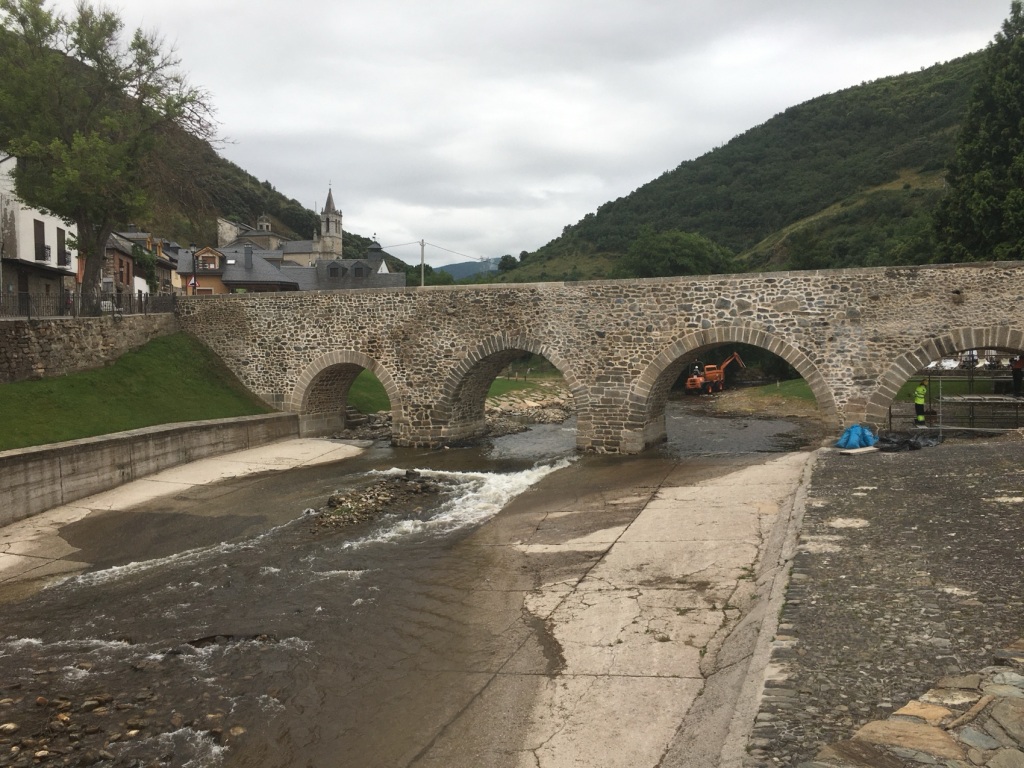
Ponte da Aspera
Ponte da Áspera collects two periods between its stones. It conserves three semicircular arches of Romanesque invoice, built in granite. The rest of the bridge is later, since it was very deteriorated, and dates from the 18th century, in the middle of the Modern Age. This late addition is built in slate.
This bridge that leads to Barbadelo, the next stop on this stage of the Camino de Santiago, is one of the seven emblematic points of the Camino chosen for a rehabilitation project. The vegetation is cleared periodically so as not to leave the image of an abandoned Sarria in the imagination of the pilgrims. A ponte da Áspera hides a lot of history to let it go unnoticed among the brambles and ferns.
Passing through an “ enchanted “ Oak forest and 3.7 km along we reach Barbadelo with its Romanesque church of Santiago de Barbadelo.
Barbadelo is mentioned in the Codex Calixtinus in which the author denounces the commercialisation of the pilgrimage road. (I refer you to the previous Blog). Apparently, today it is no different: from here on out, we may begin to see more panhandlers and scam artists. Not a danger, but best advised to keep walking calmly and don’t get engaged in any conversations. Casa Barbadelo offers refreshments,plus a small shop . Leaving Barbadelo, small farmsteads,sinuous roads and 6 km further along we come to Panaderia Peruscallo – sello available Local delights include Pimientos de PadronUnmissable – legend says every tenth one is hot – well I’ve never had a hot one in twenty years!
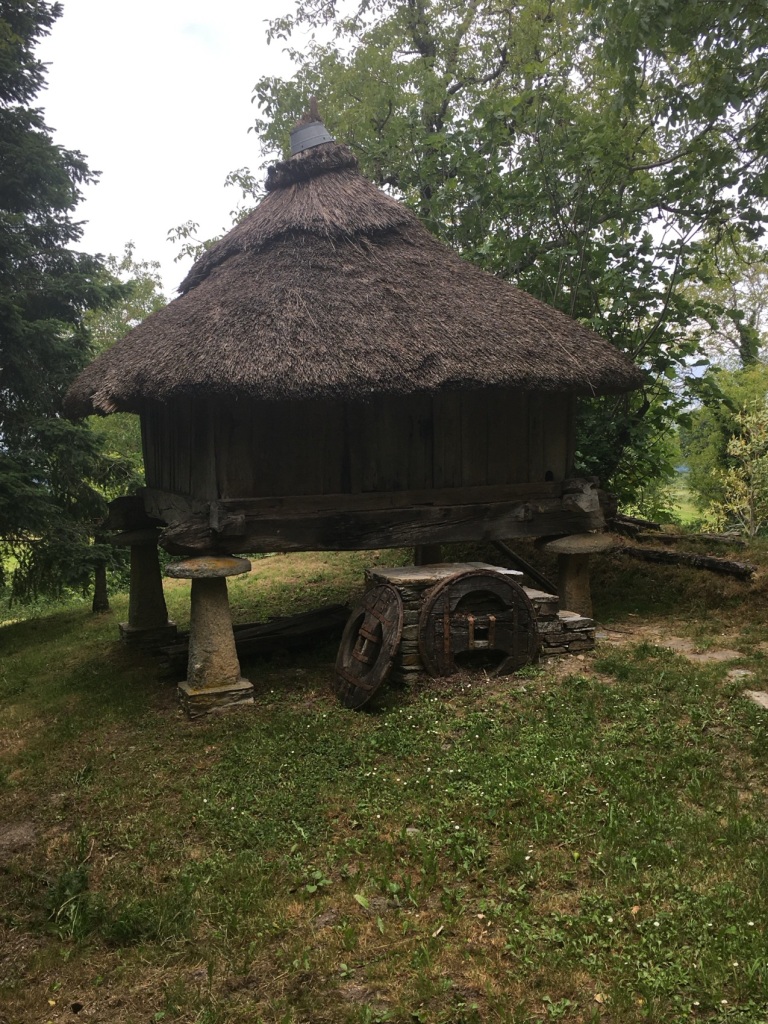
Next village is Morgade with another tempting cafe. We will encounter some large medieval pavements,stones of the millennia – old path . Also, dozens of Horreos, most filled with dried corn for the farm animals.
A romantic image.
Leaving Morgade, we continue through forests and pastures but also through vineyards that are part of Lugos province’s Ribeira Sacra wine region .
“ Bottle of Wine, Fruit of the Vine,When you Gonna Let Me Get Sober?” By Tom Paxton
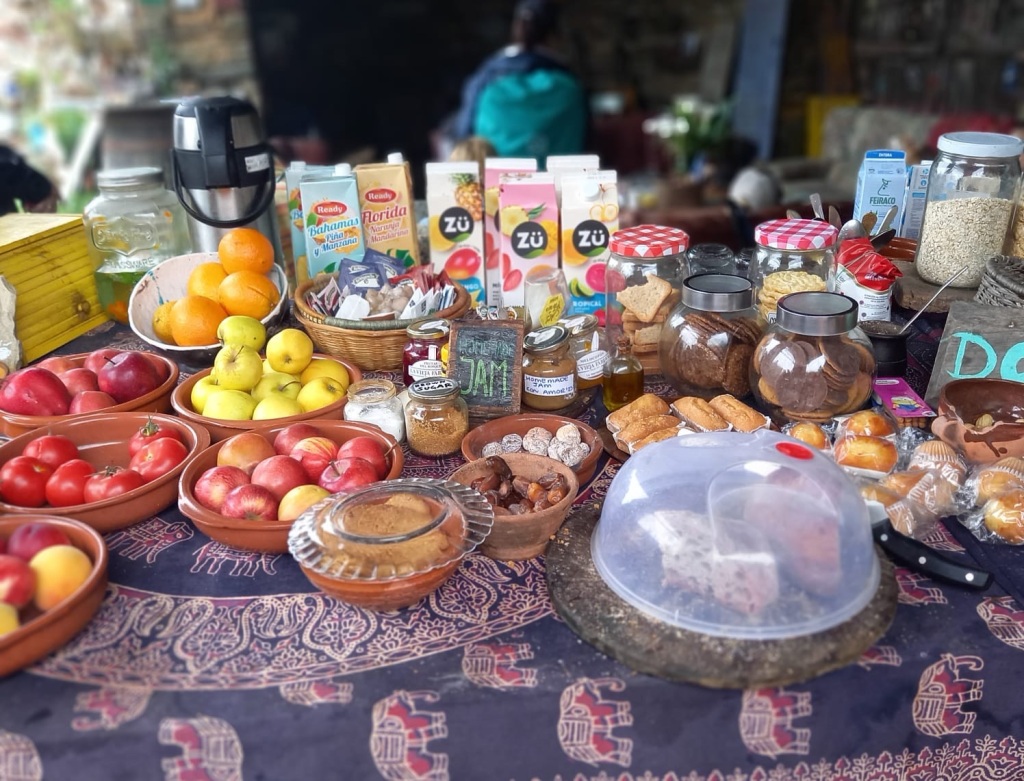
From now on it will not be uncommon to see donativo style tables of local foods – cheese,cakes and donuts – mostly home made. If there is no one in attendance there is usually a jar to make a donation – an honour system.
The path descends to the village of Ferreiros – its pilgrim – friendly history going back to the 12 th century – Ferreiros means blacksmith.
12th century Iglesia de Santa Maria with its baptismal font located outside! The entrance is well worth a look apparently.100 km to go – sadly we shall encounter this kind of infantile defacement.
Moving on we reach the the tiny oasis of Mercadoiro with its albergue and an interesting general store.
Tienda Peter Pank, named after an edgy, rebellious punk- like Spanish comic book character- cowbell anyone?
Onwards through Vilacha, approaching Portomarin
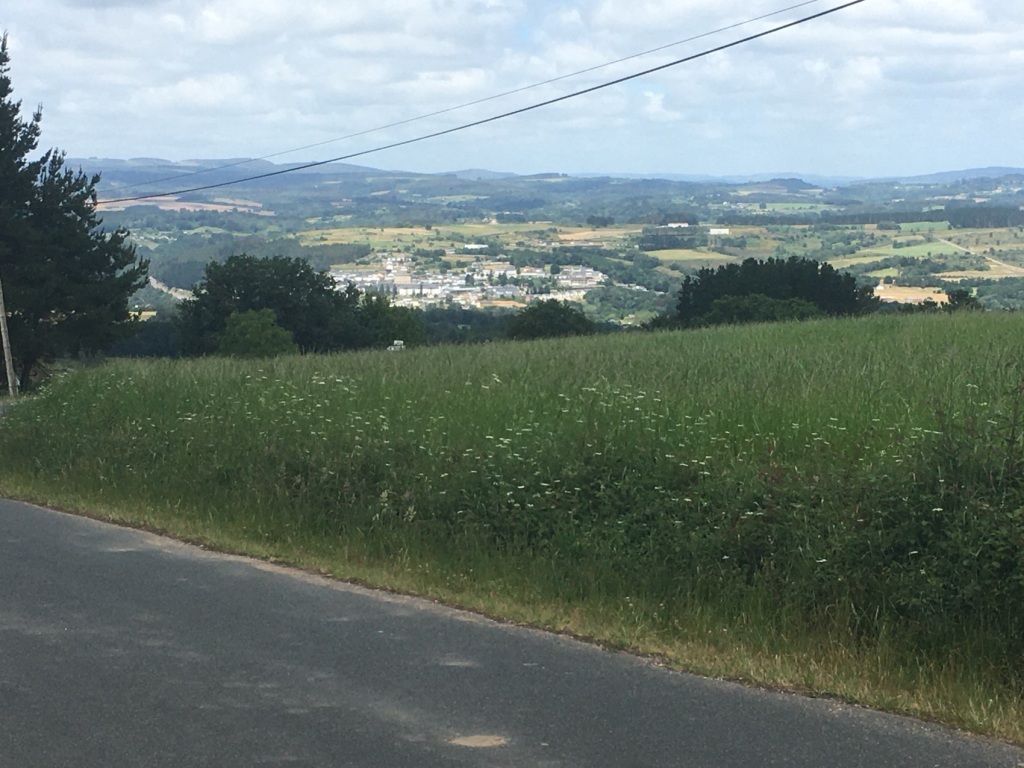
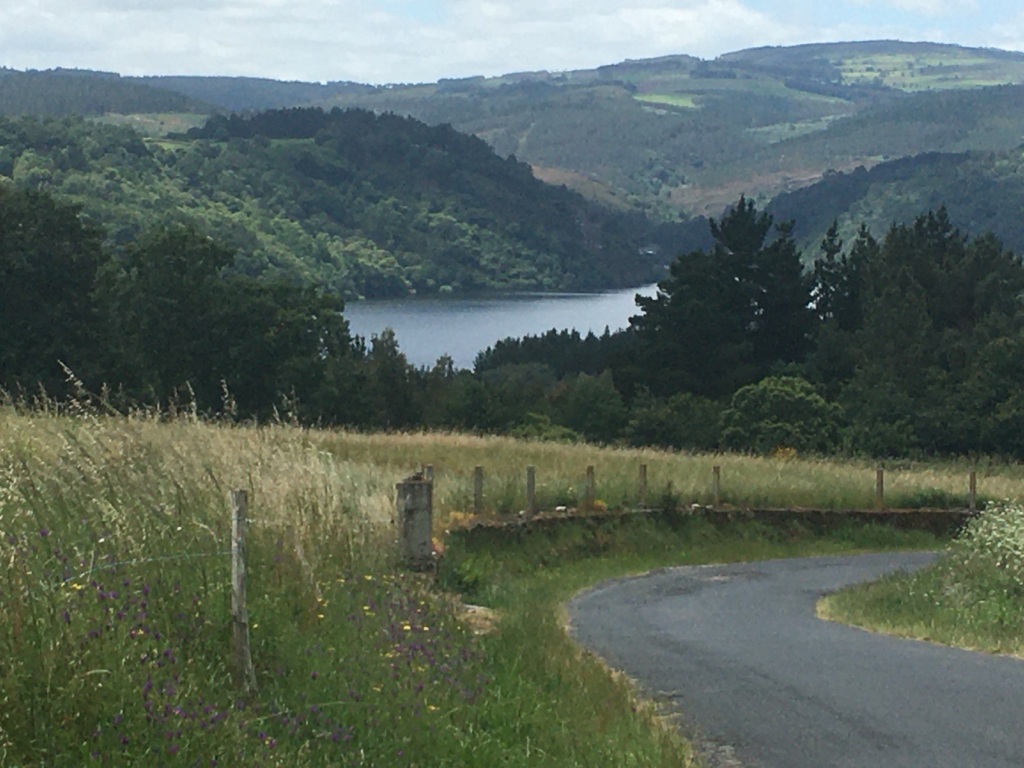
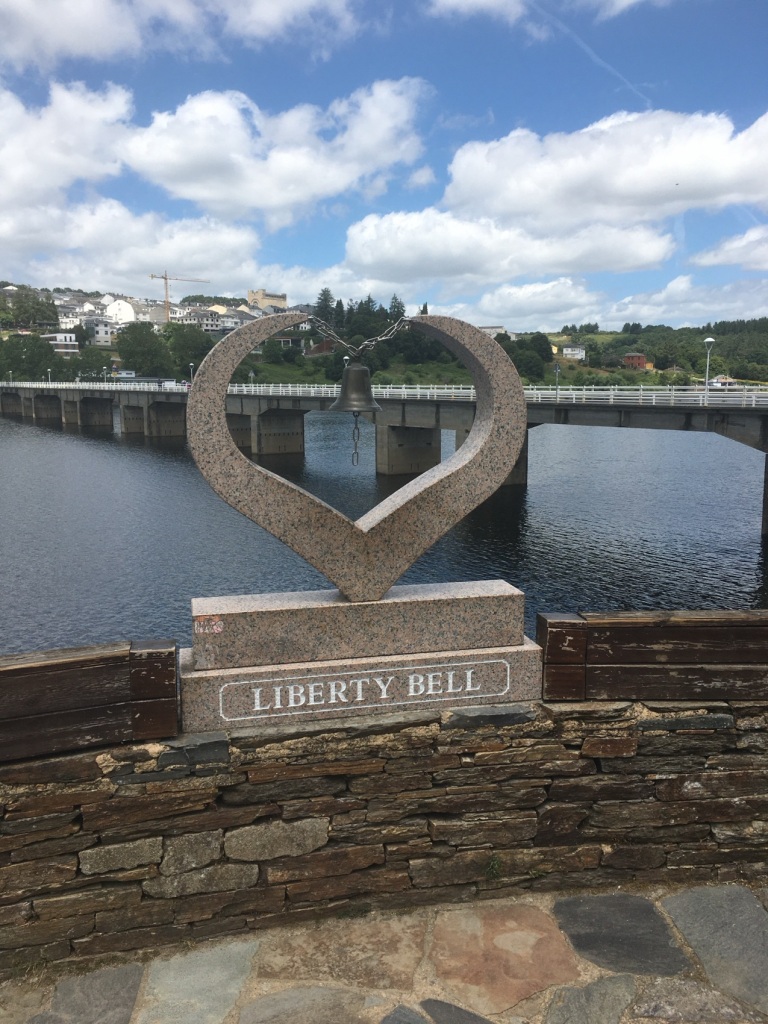
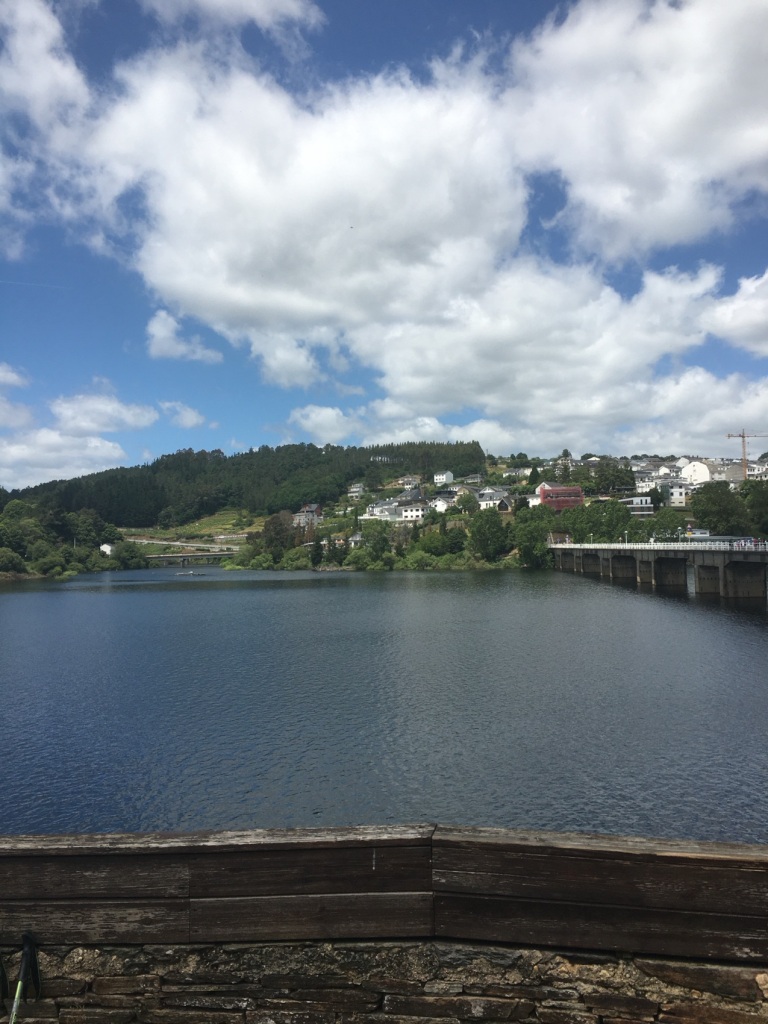
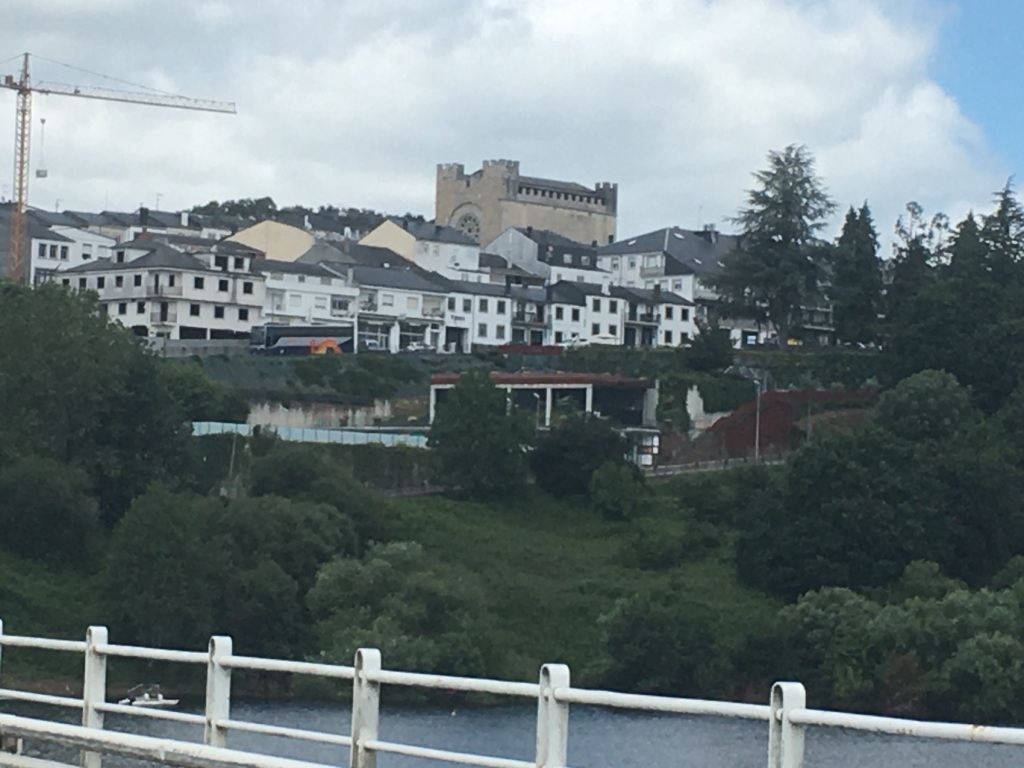
There is a descent into the valley of the River Mino and Portomarin will be in sight.Portomarin holds the distinction of being the newest oldest town along the camino. The town you see today was transplanted from the now flooded valley below. Most of the town is newly built but the church and a few smaller buildings were relocated stone by stone.Iglesia de San Juan – close inspection shows that the stones were numbered to avoid head scratching later. It is ascribed to the workshops of Master Matteo who carved the Portico de Gloria in Santiago.Santiago de Compostela Cathedral
We cross a high modern bridge to enter Portomarin ( pop. 1528 )
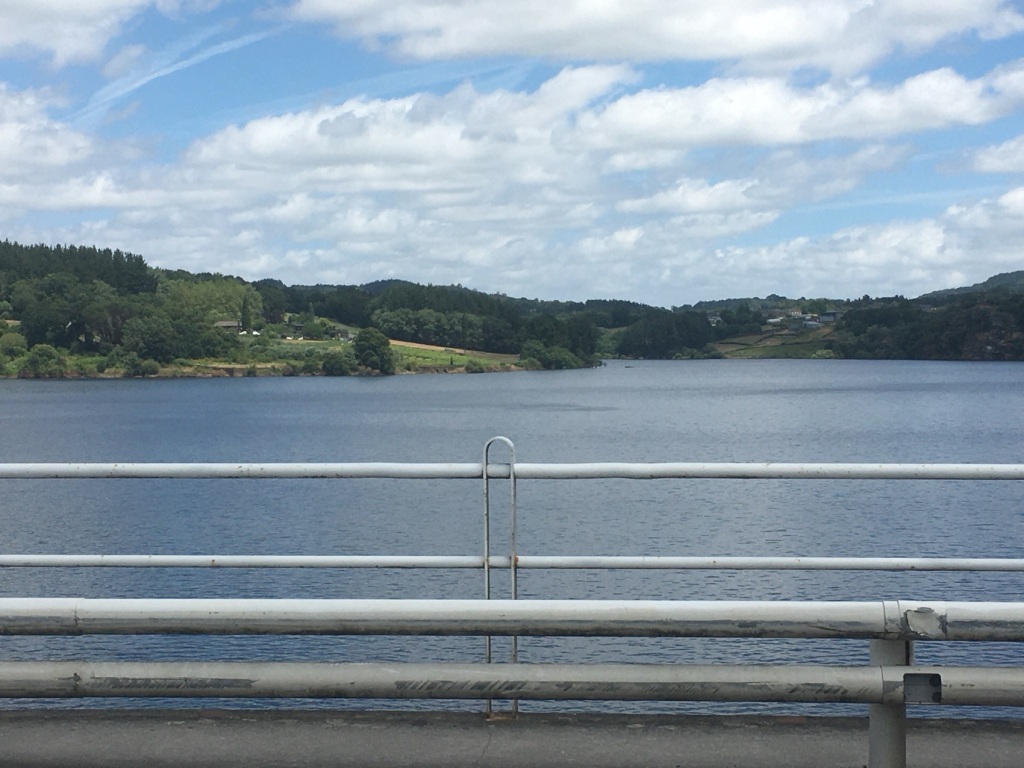
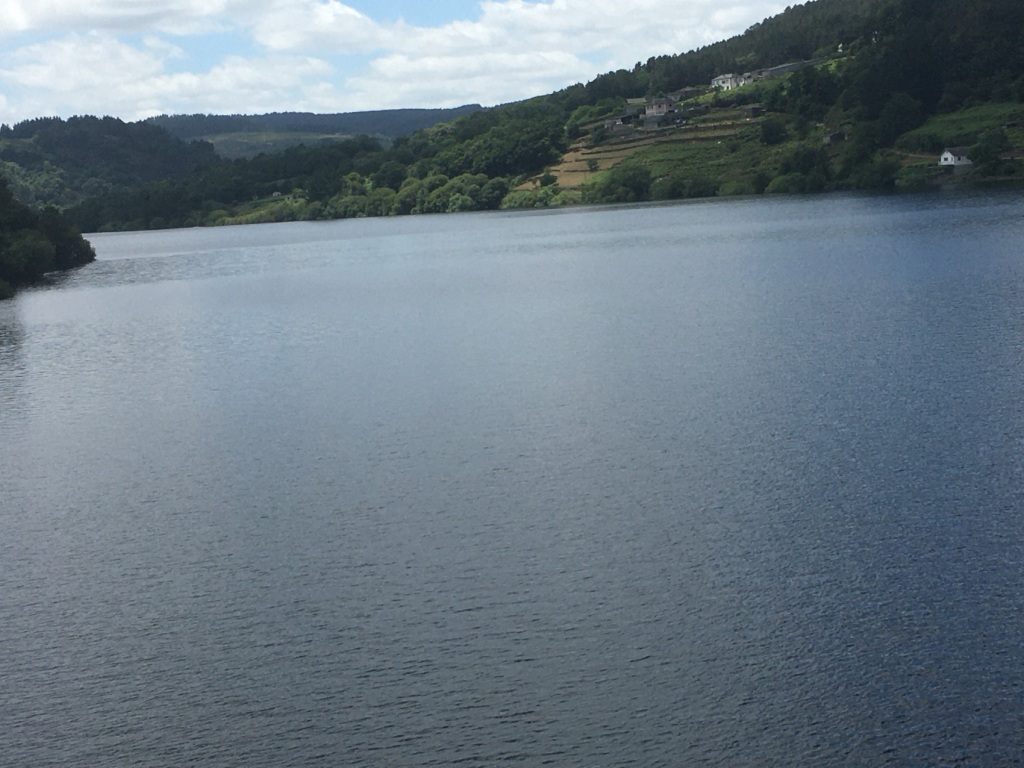
You may be able to see the outlines of some the original village buildings below the waterline .
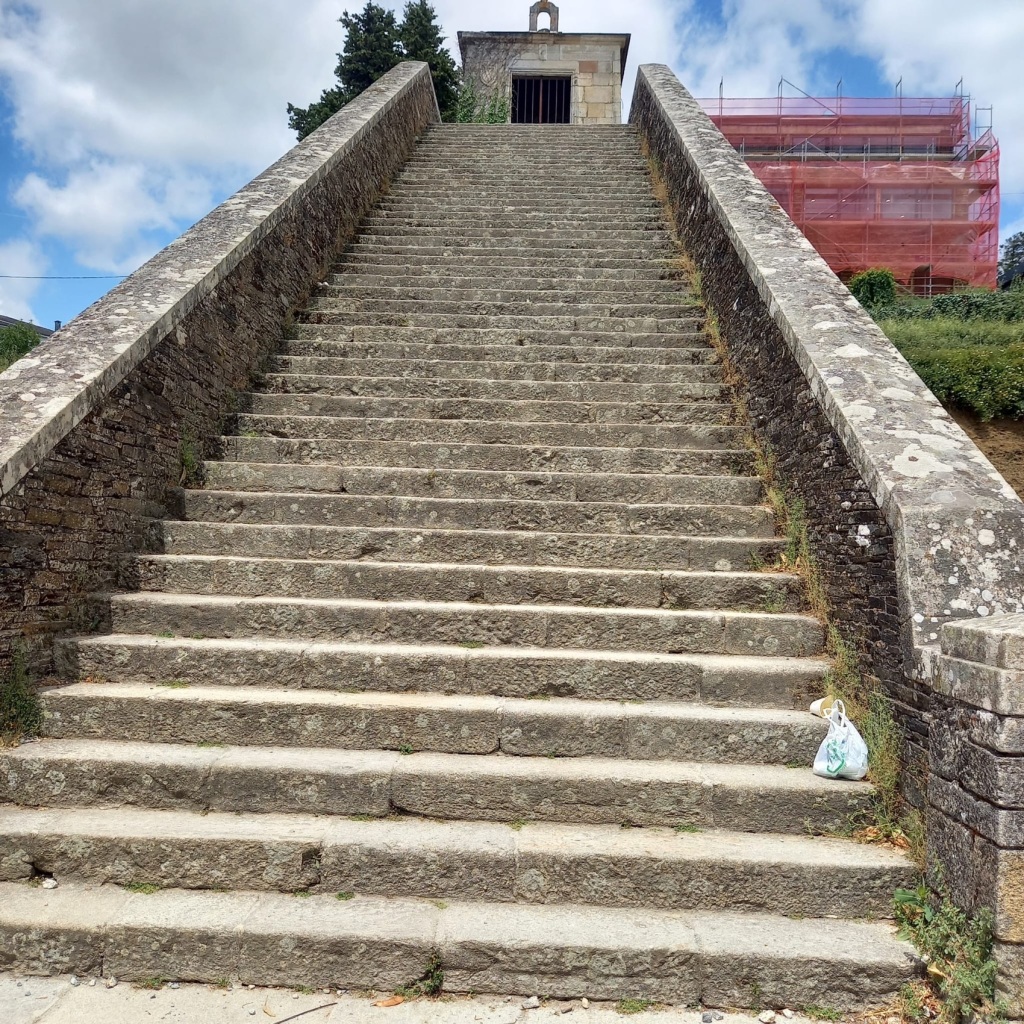
The bridge leads to steep stone stairs – a part of the medieval bridge transplanted higher up. It is pleasant place with its elegant stone colonnades and enticing shops and cafes.Portomarin is our stopover .Our hotel “Comfortable accomodation right in the middle of the town’s major street. There are multiple eateries within a few steps away from the entrance of this inn. The owners are very responsive and always ready to answer any questions you might have via WhatsApp. Highly recommended.” RECENT REVIEW
“ Wherever I Lay My Hat, That’s My Home – Paul Young.
At what is a halfway point for me, at least, I should re-acknowledge some of my sources:
MOON – CAMINO DE SANTIAGO -Beebe Bahrami THE CAMINO FRANCES – Wise Pilgrim Guide Camino de Santiago – Camino Frances – John Brierley The Road to Santiago- Michael Jacobs Camino de Santiago – Village to Village – Dintman & Landis Camino de Santiago- Sergi Ramis
( And the 🛜 which makes us all “thieves of ideas”…& photos )
“Journeys are lived three times: when you plan them, when you live them, and when you remember them… ” Everything is cycles, time moves on. Too fast when you’re having a better time. So much to wish for this trip, so much to plan it, so much organization, make lists, check the Internet, research, send messages, agree, make decisions. And on the other hand, nerves, fear, doubt, distress, excitement, joy, anxiety. This is all part of the journey, there are things that are resolved day by day, there are decisions that are made in the moment. The most important thing is to enjoy everything, live intensely, every moment, every moment.
“ Finished the Camino from SJPDP earlier this month. Like others I could talk about the personal experience I had, but I would rather pay tribute to the local Spanish people who were overwhelmingly polite, welcoming and friendly. Add to that the great food, beer, wine, culture, architecture etc etc- they have so much to proud of. Thank you Spain.” On a forum 26/04/24
But Portomarín is undoubtedly famous for its good eau-de-vie, so much so that its gastronomic festival honours this concoction made using alquitaras, the oldest method of distilling eau-de-vie. You can’t leave this charming village without trying a shot. The most traditional ones are blanca, crema de orujo, coffee liqueur, and aguardiente de hierbas, called “liquid ibuprofeno” by many tavernkeepers as they assure that they cure all the aches and pains of the pilgrim. “ An Orujo …Gracias “.
“Liquid Ibuprofeno ” – Love it…but not after breakfast!
Sarria was founded by the last king of León, King Alfonso IX, who himself died here in 1230 on his pilgrimage to Santiago. It is the biggest town in Galicia on the Camino Francés (save Santiago de Compostela).
The fact that a Compostela is awarded for walking at least the last 100 kilometers makes Sarria a popular starting place, as it is just over the 100 km mark. In fact, more than one-third of all pilgrims walking the Camino Frances start their pilgrimage in Sarria (compared, for example, to Saint-Jean-Pied-de-Port, which is the starting point for only around 8%). Hence the numerous hostels and albergues located here; Sarria holds the record for the most albergues in one town.
EXAMPLES
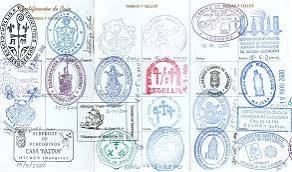
Pelegrinos starting the Camino in Galicia are required to get two stamps a day in their credentials in order to get a Compostela in Santiago.
So far so good ,but the only aspects remaining of historic Sarria are revealed along the final climb up Rua Mayor near the church of San Salvador ,the castle ruins and the raised orchard beyond. Otherwise it is a busy and bustling place.
WHAT TO SEE IN SARRIA
FORTRESS TOWER
Residence of the Merinos and the Major Justice of the Marquisate until the first third of the 18th century.
The Sarria fortress it is an old fortification of medieval origin of which currently only one flank tower remains, popularly known as Battalion Tower.
LA MAGDALENA MONASTERY
Possibly, Sarria’s most important monument, built in the 12th century. Over the years, it served as a wood store, barracks and a prison, until it is given to the Order of Mercy in the 19th century.
CHURCH OF SANTA MARIÑA
The current church has a Gothic appearance with a Latin cross plan, retaining from the previous one only a drawing of the front and a capital.
Rua Mayor
In peak seasons, May,June and September particularly there can be a possibly alarming number of pilgrims in Sarria. This can be disconcerting after the rural idylls walked through before. This is partly responsible for the debate about the 100 km entitlement to a Compostela. There are those who believe the increasing commercialisation of the Camino and the larger numbers making the way can be partly put down to the 100 km stipulation. There is an often expressed view that such numbers and motivations contaminate the spirituality of the Camino.The crowds at these peak times are very much populated with young Spaniards – there is no equivalent to the Duke of Edinburgh award in Spain – a Compostela looks good on your CV.
A proper pilgrim – excellent view from the forum below – Camino de Santiago All Routes | I’ve been following with interest the discussion on carrying bags or not, and whether that makes someone a ‘proper’ Pilgrim | Facebook.
There have been suggestions to the Santiago church authorities to drop the 100 km or change it to 200 km. These suggestions have been rebutted. The Church knows a good money maker as do the Galician authorities and the Camino provides both hospitality and employment.Then comes disparagement : These are not “ true” Pelegrinos , they are Turigrinos. I suspect it is a debate that will resound for years to come. I always think that the late John Brierley, guidebook writer and to some a Camino guru or saint even, offered this opinion and I quote it in full .
“ A reminder for “ seasoned “ pilgrims who commenced in St. Jean Pied de Port or further back in Le Puy, Geneva, Budapest? Beware of signs of irritation at the intrusion of new pilgrims on “ my” Camino – remember that many of the new arrivals may be nervous starting out and the last thing they need is aloofness built on a false sense of superiority. None of us can know the inner motivation or outer circumstances of another. A loving pilgrim welcomes all they meet along the path with an open mind and open heart ….without judgement of any kind”
My own memories of Sarria twenty years ago are few, as it had been a long day’s journey. From being picked up in a crowded minibus under the Aston express way en route to Heathrow. A coach journey to Sarria from Santiago airport and a hotel where I was scolded ( I thought at the time ) for helping myself to a tapa in the hotel bar ! Then leaving the hotel at 6 am in darkness with the group of about 24 or more and crossing the Ponte da Espera.
I caught a fleeting glimpse of a Kingfisher here.
I ought to add that the group leader was a young priest, Fr John Nolan who had begun his priesthood at Holy Family Small Heath where I was HT; he became a kind of school chaplain and will always be remembered for delivering sermons at school masses with the aid of a puppet, which delighted the children and drove the staff up the wall in equal measures! Later, after a period as PP at Our Lady’s, Tile Cross, he was then given the job by the archbishop, of running a diocesan youth centre at Alton Castle,Staffordshire. He contacted me with a request to raise funds for the centre to which I agreed,as did three other fellow HTs. Our group then consisted of youth workers from Alton, some of his former parishioners having a range of ages, plus four HT’s who gave up their summer half term – we were all sponsored . I thoroughly enjoyed my first Camino, stayed in a couple of traditional albergues as well as small hotels, I recall John celebrating mass in a park at one point and I read at a mass in Arzua too,in bare feet! The food and wine were especially memorable.
———————————————————————————————
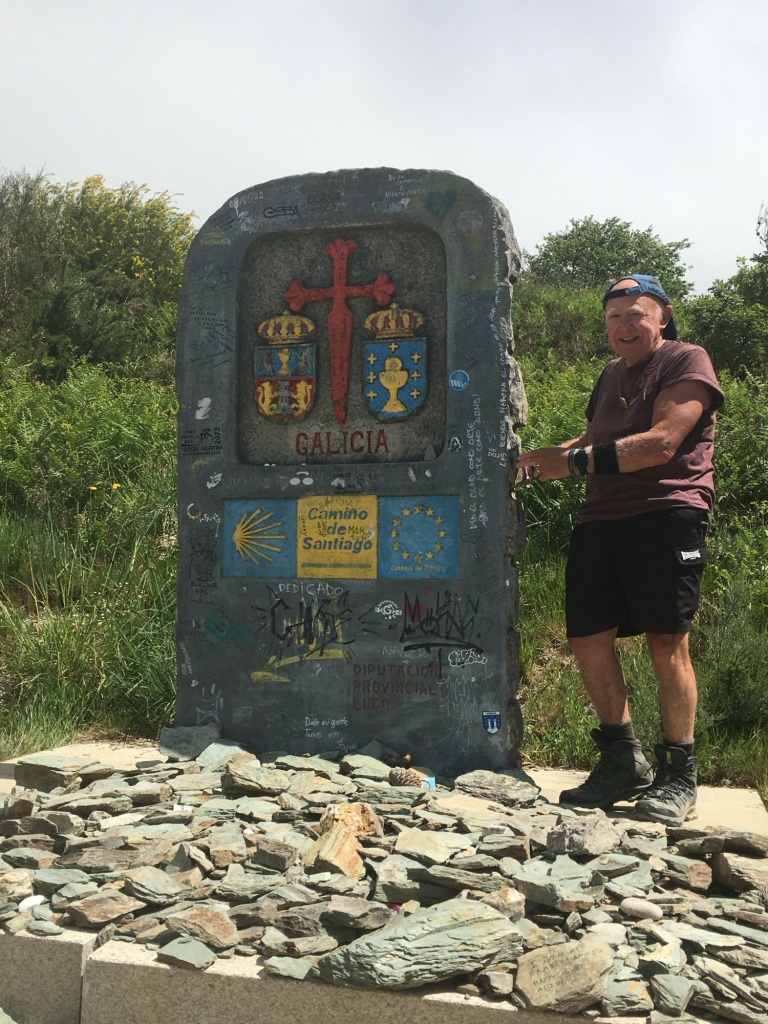
GALICIA
Galicia has a fascinating history and I have taken photocopies from an early travel guide to S de C – “ THE ROAD TO SANTIAGO” by Michael Jacobs – this is more of a scholarly guide than most and his descriptions of its history and character are well worth reading .
.
The seventh largest autonomous region in Spain
JUST TAP ON EACH PAGE TO ENLARGEN IT
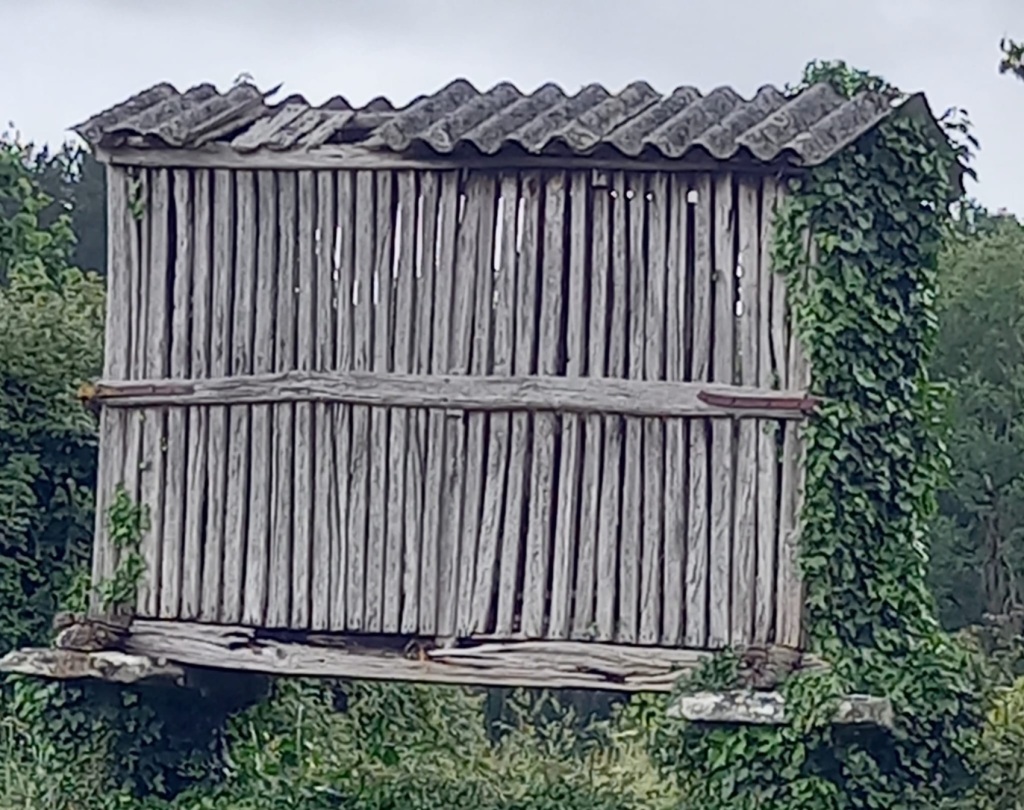
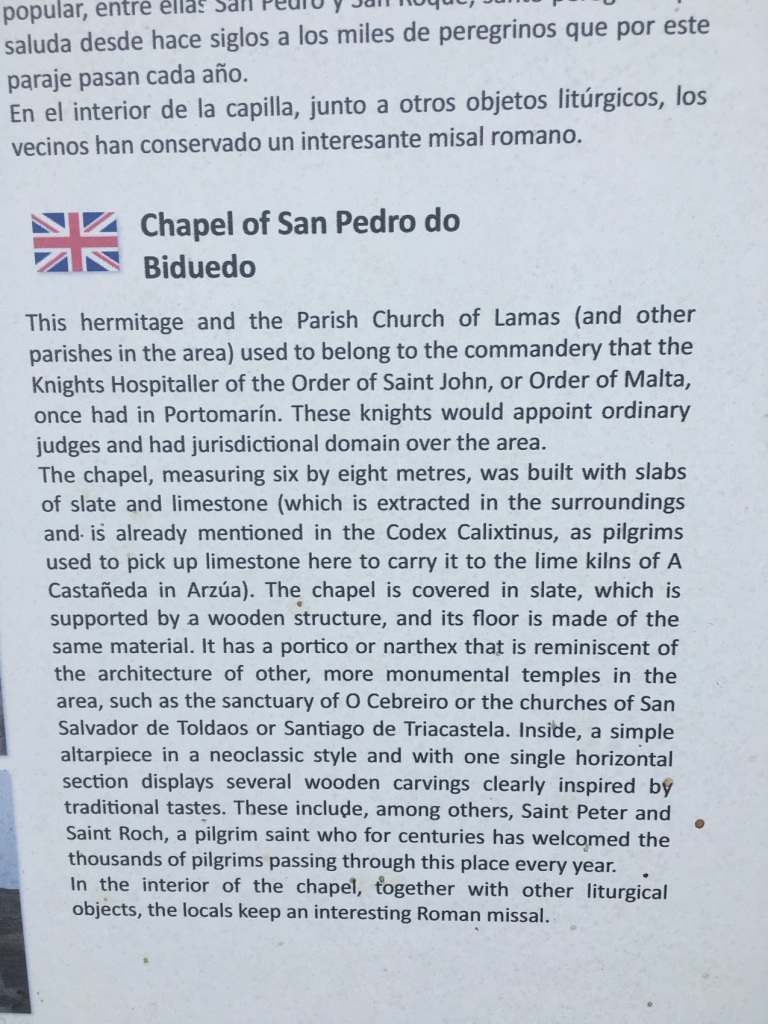
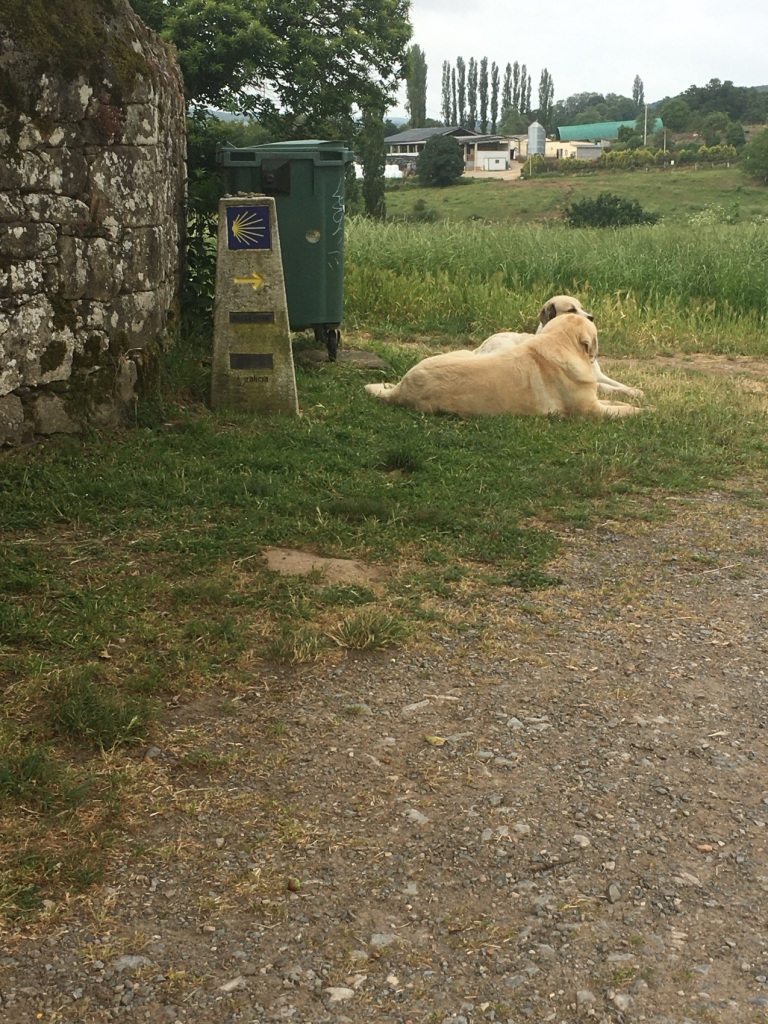
NOTE – Dogs are no longer a problem – they have to be chained by lawA Horreos Great sauntering
Aimery Picaud evoking the landscape which we will enjoy walking westwards, conjured up images of a promised land. For him,Galicia was a place….” abundant in woods,delightful for its rivers, meadows and exceptionally rich orchards, its wonderful fruit and clearest of streams…it abounds in rye bread and cider, cattle and horses and all sorts of seafood; it is rich in silver and gold, textiles and furs,and, above all in Saracen treasures”.
A very French and possibly over idealised picture, but Picaud regarded the Galician culture as comparable to his own..” closest to our French race in their customs”
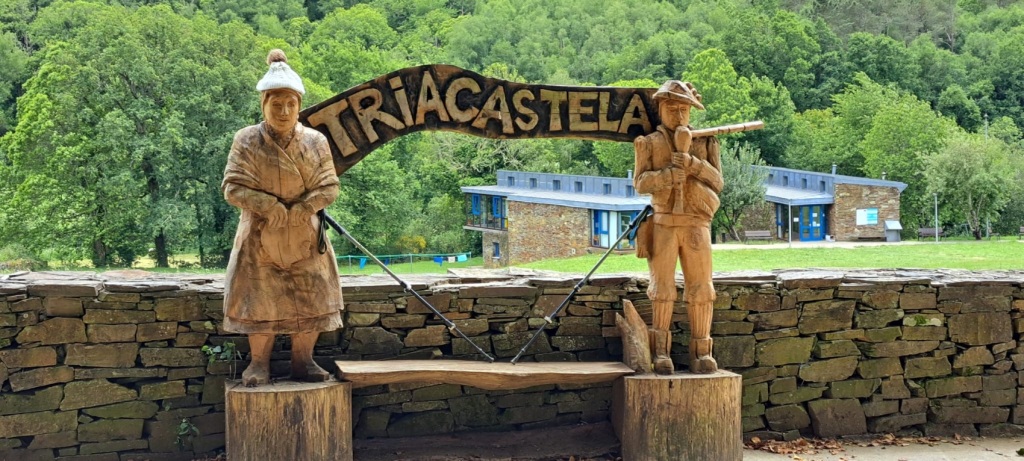
https://www.pilgrim.es/en/plan-your-way/codex-calixtinus/ This is the first and most esteemed guide to the Camino – Picaud is regarded as one of its authors and in the Codex,Triacastela marked the end of stage 11 and signaled the end of the Galician mountains ( though there are still a few smaller ups and downs before reaching S de C ).
The Codex has a colourful history, as does Galicia itself. The link below gives a brief but informative overview of its history.
Leaving Triacastela there are two routes, a longer one via the Samos monastery, the San Xil route we take to the right – the pathways on this section have been much improved, whereas the Samos route does follow the main road in stretches.
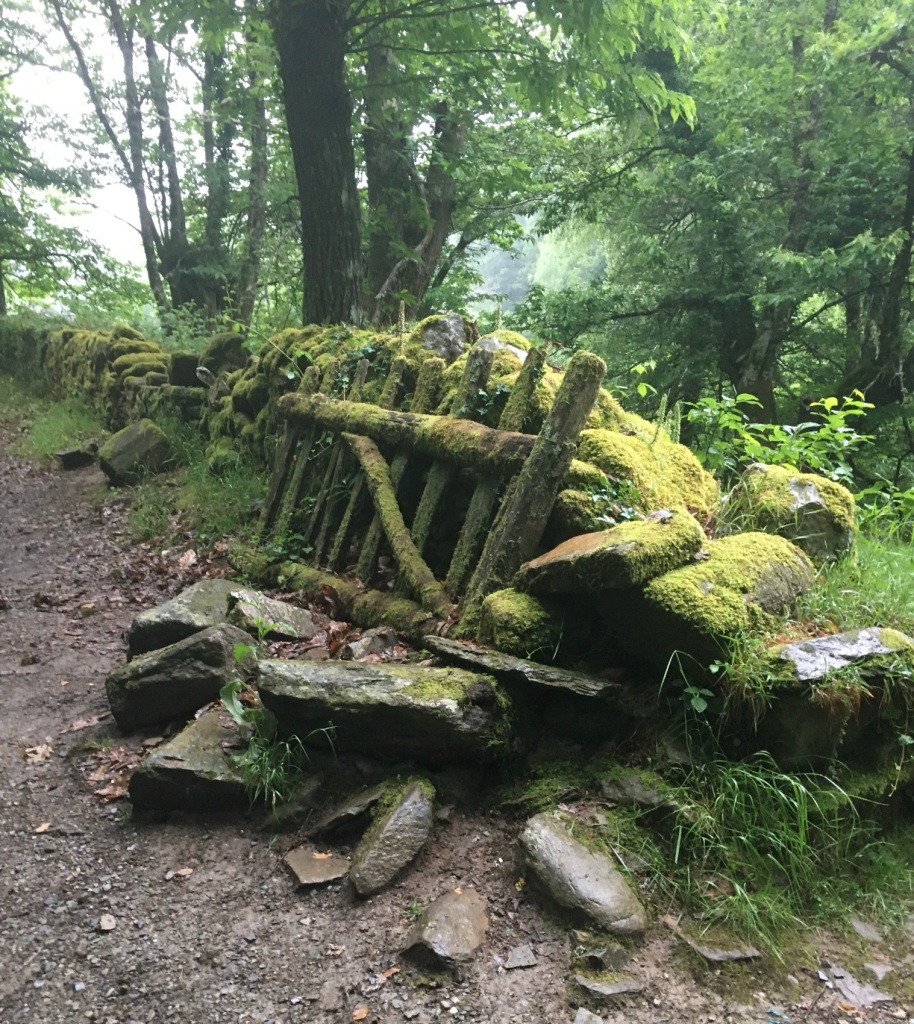
Spoilt for choice as both routes are beautiful. The San Xil route is considered the original medieval Camino. Expect lyrical fairyland – like hamlets with little chapels, one after another strung along the lush valleys of ancient chestnut forests.
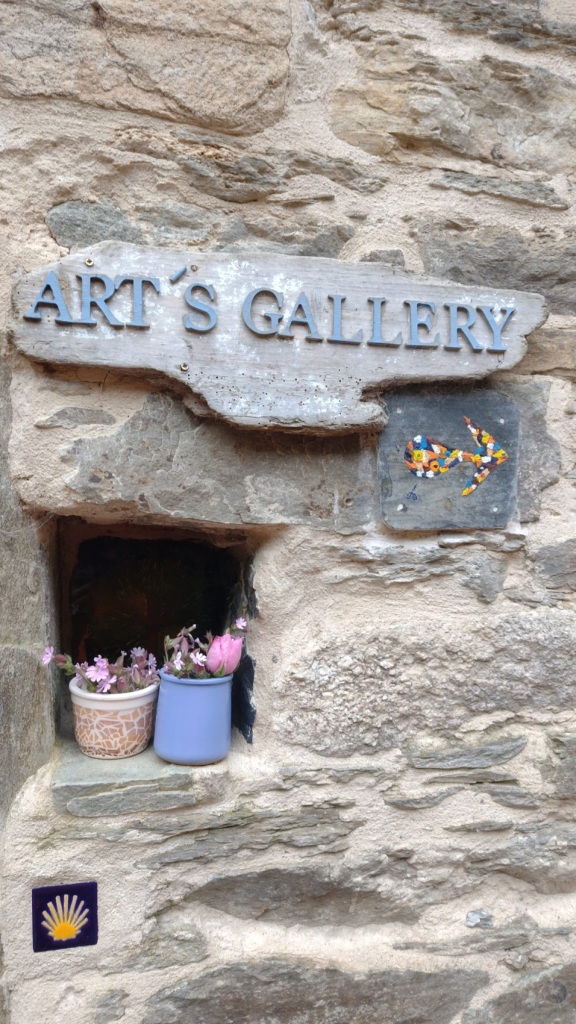
An interesting diversion hereabouts is the art gallery of English painter Arthur Lowe ( not Dad’s Army ! )
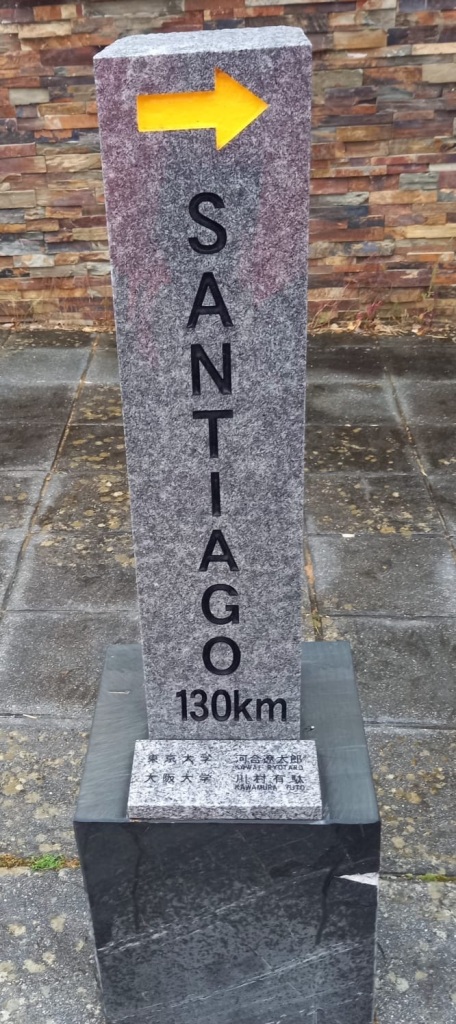
Arthur had walked the Camino several years ago and fell in love with what was then a dilapidated building right on the path about 130km (112 miles) from Santiago de Compostela. He decided to buy it and set about renovating it and now, 10 years on, it’s both his home and an art gallery. The garden is still work in progress but the flowers he has planted, which includes 20 to 30 lavender plants, are already attracting numerous butterflies.
Any pilgrims passing by (who will need to turn right to San Xil at the split in the route in Triacastela) are welcome to enter and marvel at the work he’s done as well as his obvious artistic talent. They may even be lucky enough to get their Camino ‘credentials’, or log book, ‘stamped’ with an Arthur Manton-Lowe original.
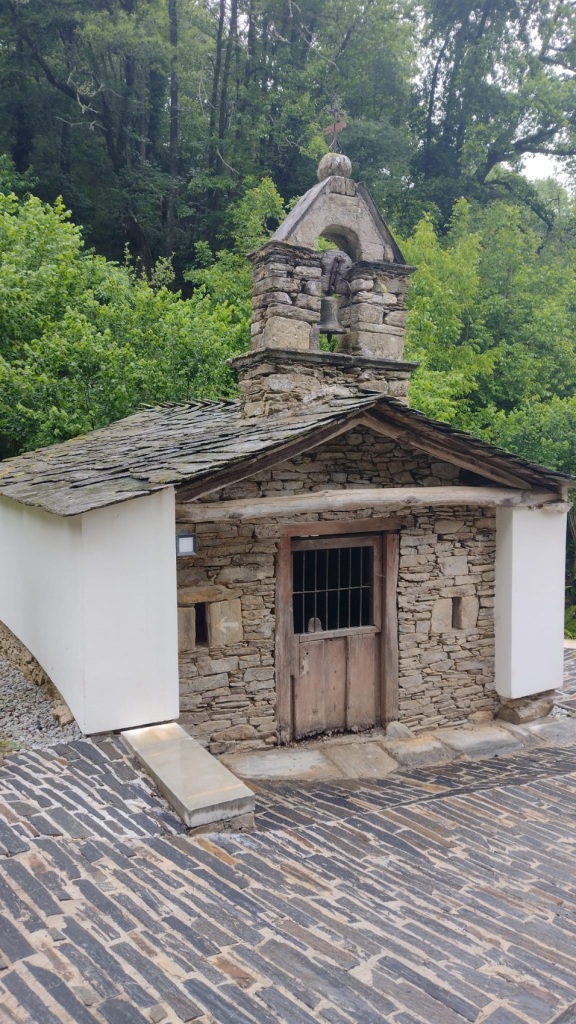
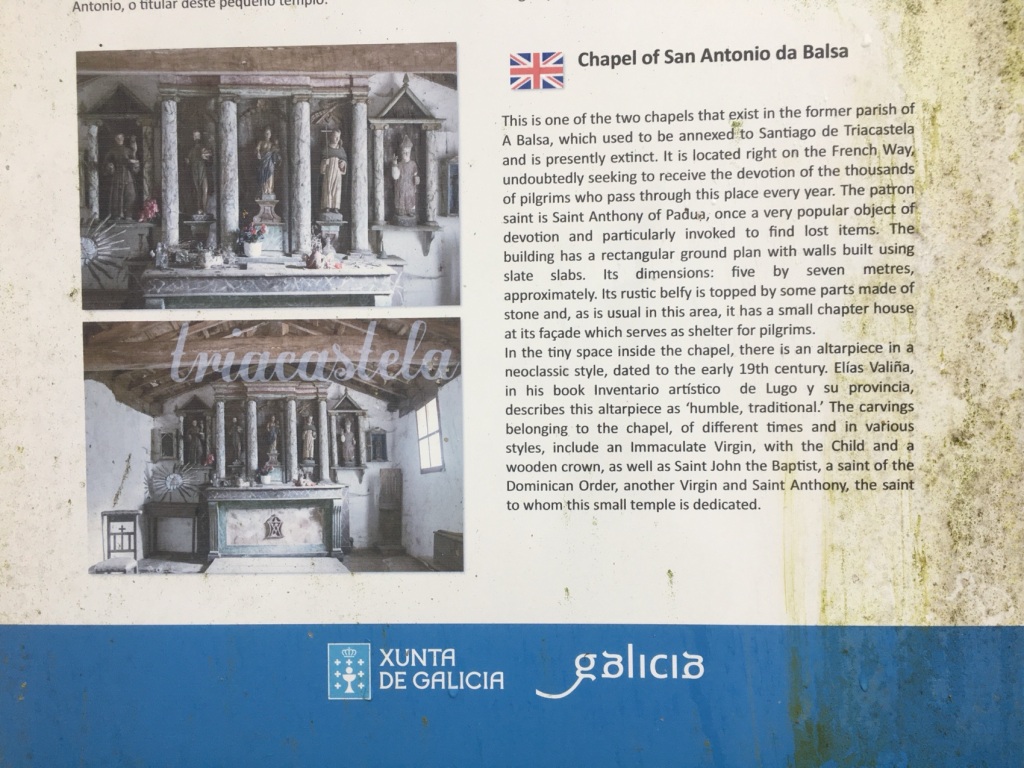
After passing through A Balsa, we encounter a small Ermita and over a small bridge, reaching a large pool of water with a huge seashell
Not sure if this is potable,so best carry water / snack until we reach Furela and refreshment opportunities,9.6 km on.
Then follows a climb up to Alto de Riocabo 910 M, walking along a new high level woodland path above Montan and down through Fontearcuda and then into Furela.
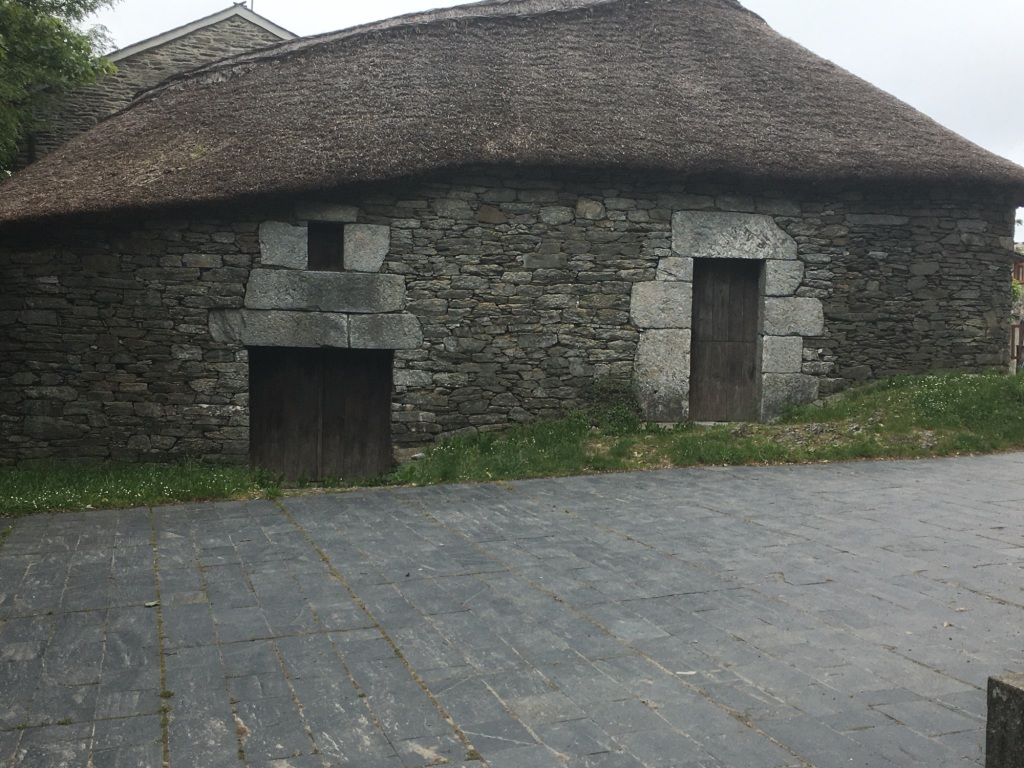
At Fontearcuda, this makeshift hip like barn may be open.If not, we should be ready for coffee and possibly Desayuno 2 by now.At Casa do Franco,Furela.We will have walked past many of these Horreos – grain stores and iconic Galician structures.
Just over 1.7 km we reach Pintin and further refreshment if needed.
Another increasingly familiar sight..Serrano Ham
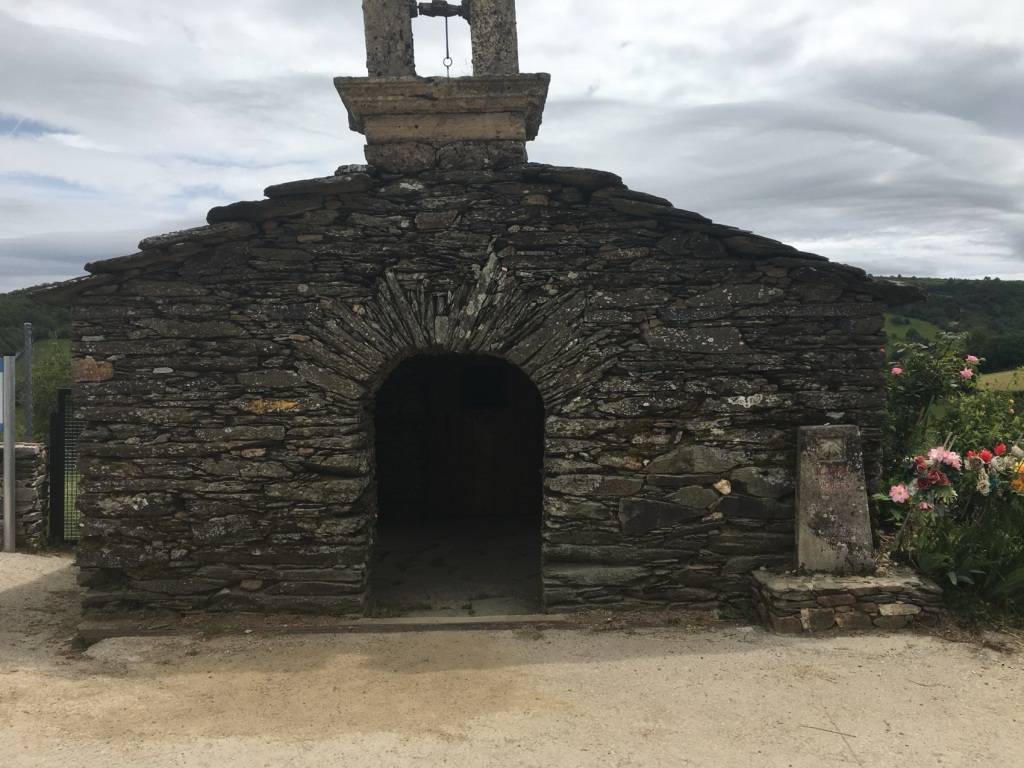
After two more km we enter AGUIADA, the route that detoured from Triacastela to Samos rejoins the main Camino here. With a population of 40, there is little here but the tiny chapel.
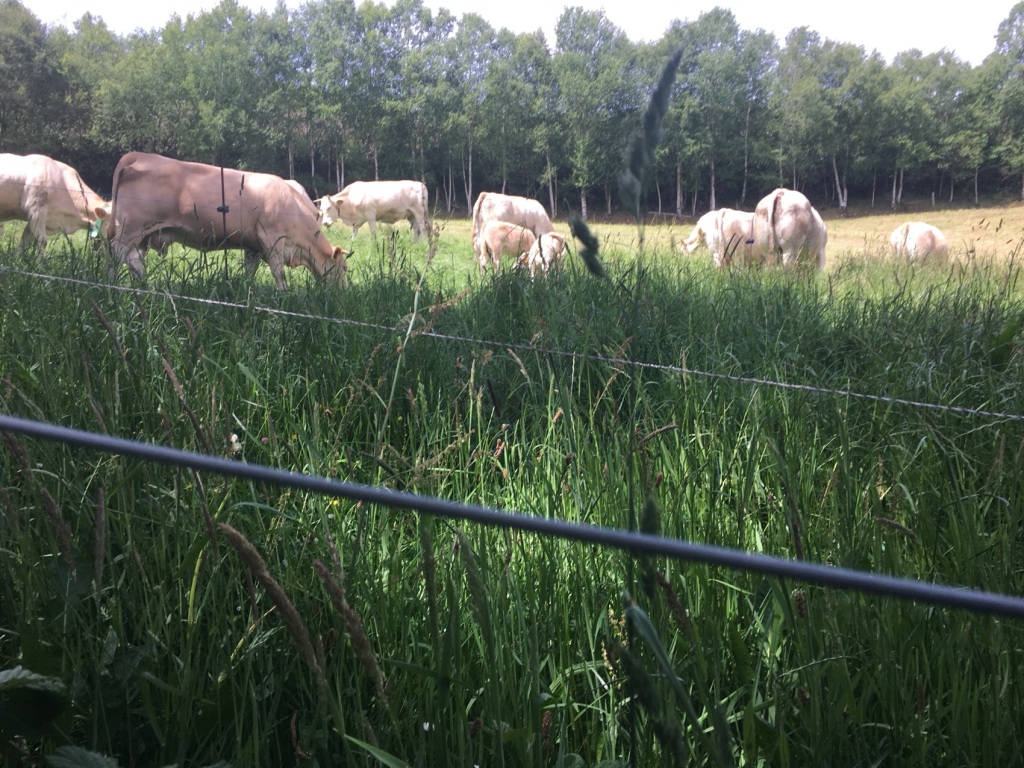
Relief . The chapel flanks a farmer’s field – expect curious cows peering over the fence .
Soon we are passing through San Pedro do Camino and Carballal, still deep in rural country even as Sarria looms 3.8 Km away. Then walking through pine forest we shall become aware of houses and settlements as we near the outskirts of Sarria and the quantity of places to stay and eat increases exponentially compared to our earlier day’s walk. The path then continues through Vigo de Sarria
Welcome Pelegrinos.
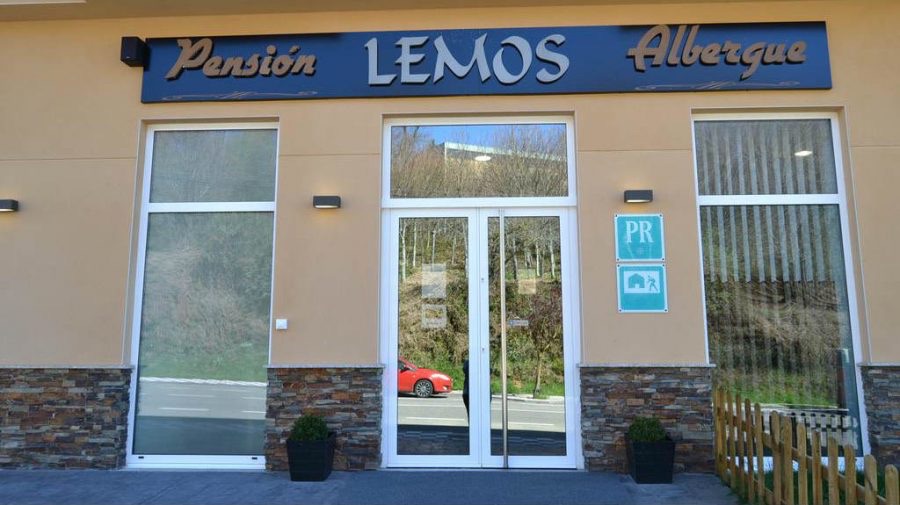
Before crossing the River Sarria we reach our accommodation for the night in Vigo de Sarria .
EL RINCONCITO de dpCristal
A recent revue :”Place is new. Beds are nice. Very clean and efficiently run”.
There is a pleasant tree- lined,riverside promenade after crossing the Rio Sarria.
Memories – almost exactly 20 years ago, I began my first Camino from Sarria – in a large group of 24+ – we were walking to raise funds for the Birmingham Archdiocese Youth hostel, Alton Castle and so we were all sponsored in different ways . I knew relatively little about the Camino, as it was not known about anything like the extent it is today. But I can still recall my feelings of anticipation and curiosity as we left Sarria at 6 am, in the dark, literally ! And now, twenty years on and a few more Caminos walked, I still get just as enthralled.
Artistic impression of the castleApproaching SILVES from the railway station Completely deserted and no signage and not just on Sundays by the look of it.
Fortunately, a fellow tourist assured us we were heading in the right direction. She was an interesting companion as we walked the 1.25 miles down to the city. She was a football fan, 51 years of age and still playing 7-a- side and had been to watch Spain play Holland( womens’ teams ) in Seville earlier in the week. She was from Breda, same town as Liverpool and Holland’s formidable captain,Virgil Van Dijk. That was the third conversation of interest we enjoyed on this short journey from Portimao. First, on the platform at Portimao, with a lady who recognised my scallop shell on the rucksack and we shared Camino experiences. She was Belgian with excellent English, fluent in the vernacular,too. “knackered “ was used quite precisely at least twice! A other Pelegrina chatted to us on the train, briefly and she,too, was an enthusiastic reminiscer.
Looking across the river valleyThe Roman BridgeComplete with a citrus orchard and restaurant That’s our footballer leading the way up a typical narrow street.I really like the lanterns DittoAnd the balconies Locally made – not from China.
Silves is a historic town that was originally the ancient capital of the Algarve. During the Moorish era (9-12th century), Silves was a major stronghold and important trading centre. From the solid red-brick castle, the Moors defended the entire region, while from the harbour, boats sailed down the Arade River to trade with North Africa.
Today, Silves is peaceful and unhurried, but remnants of this illustrious past can be seen scattered throughout the town. This includes the imposing Castelo de Silves, heavily fortified gateways and the Gothic Se cathedral.
We soon came to the Cathedral
Silves was named the bishopric seat soon after the first conquest of the city from the Arabs in 1189, but the Cathedral was only built after 1268, after the city’s definitive conquest during the reign of King Afonso III. It retained the title of cathedral until the 16th century, when the diocese’s headquarters were transferred to Faro as the city was blossoming due to the silting of the Arade River and the growing importance of the Algarve coast. During this period, 26 bishops occupied the Episcopal seat. From the offset the church was dedicated to Saint Mary and, later, to Our Lady of the Conception, represented in the chancel with a Gothic image.
Like most of the buildings in Silves, the cathedral is built in red sandstone, ‘Grés de Silves’, which characterises the city with its tonality and predominance.
An intriguing doorway or window The aforementioned gatewayNearly there Flying the flagThe imposing walls of the castleWalk the ramparts Being a Sunday there was not many shops or cafes open, but we found this shady spot for coffee.Silves is mainly known as one of the most beautiful places in the Algarve and people mainly live from tourism (and fishing and cork). When you walk through the city you see many traces of the past. Every street corner tells a different story.The Portuguese CrossQuiet todayBut expecting a good crowd for lunchWater features and tile work They must have capped the chimney to prevent the Storks from nesting!
SILVES doesn’t have the flashy cliffs, caves, or even a beach at all, but it does have loads of charm and history.
And Praia da Rocha…A great week’s break on the Algarve And the food and wine were good too.