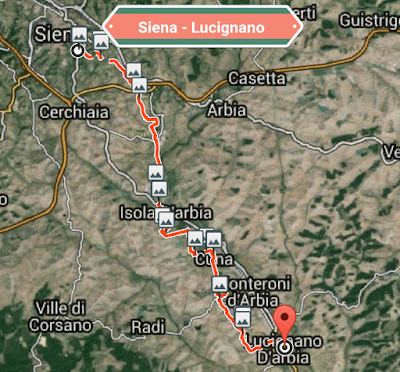
DAY III – Rambler’s’ Break in Ilminster. Sunday AM in Lyme Regis:PM A figure of eight walkabout around Ilminster

14 Oct

LYME REGIS – Situated on the world-famous Jurassic Coast.


The town is regarded as the ‘Pearl of Dorset’ and is renowned for its natural beauty, fossils, literary connections and extraordinarily rich heritage, it is also famous for being the birthplace of Mary Anning, one of history’s most important fossil collectors and palaeontologists.
A memorial to Mary Anning up on the Coastal Path.
09.30 walking down towards The Cobb, in Lyme Regis after a pleasant, meandering drive of 20 miles or so from The Shrubbery.
Open for business
A very quiet scene….by midday the town was very busy.
Beach huts
The sun barely breaking through on a breeze free coastal scene.
The harbour
A walk along the sea wall .
An extension of huge rocks from the end of the wall.
Low key rollers – there were paddle boarders and swimmers on the more protected beach.
A pleasant stroll along the prom with its mixture of cafes and houses brought us to this signpost – much “Literary” history is associated with Lyme Regis.

https://lovelymeregis.co.uk/jane_austen.
Famous adaptation of a famous novel.

Making our way towards the Coastal path we came across another local hero with a sea faring pedigree.

Not many I’m afraid!
Well designed board walk.
Gaining some height above Lyme Regis
On the Coastal path.
Quite wide to start but it soon narrowed down.
We turned around at this point as we had no intention to walk too far – just to get a “ feel” for the path – and anyway it was coffee time.
Some pleasant seawards views .

It was a most enjoyable morning in what is a charming resort – no high rise buildings or “ tat” – Lyme Regis retains a traditional English seaside atmosphere and seems to be doing very well with it remaining so.

Sunday afternoon in Ilminster


Ilminster takes its name from the River Ile and the Minster church dating from 1450.  The town grew up around the church and some of the oldest buildings are close to the churchyard including the former grammar school founded in 1549. 
Sundial on the school wall

In Victorian times the town was an important staging post for travellers with east-west and north-south routes converging there. The town is now by – passed by the A 358 & A 303.

This abandoned church was the Arts Centre. Such a beautiful building too.
I turned right here and came down to the market square.
I then walked uphill passing some independent shops en route.
A great bit of signage.
Looking upwards at the “ hanging gardens” of Ilminster!
Romantically named “ Love Lane”
An unusual placement for this water pump.
At the top of the hill, I turned left again and facing me were two gatehouses, either side of an imposing if somewhat mysterious driveway . This one was up for sale.
It must have led to some sort of grand house I would surmise.

The other one looks as though it’s receiving some much needed TLC !

Moving on,a first glimpse of Ilminster’s pride & joy.
The Minster.
A brief resume of its history.
This stained glass window is of interest because it was created as a memorial to the owner of the Shrubbery – our hotel – formerly a private house.
The Shrubbery Hotel – we enjoyed our stay here – good,home cooked food and a very hardworking,friendly staff.
Ilminster is a sleepy, friendly place – I wish I had the time to follow its Treasure Trail

DAY II On the RAMBLERS’ BREAK IN ILMINSTER + A GOOD 10 MILE WALK

13 Oct
We enjoyed a good evening meal on Friday in the Shrubberies and it was good to have our very own “Beverley Sisters“ back with us.

After breakfast,on Saturday morning, we drove six miles or so to South Petherton, to begin our circular walk through small unspoilt villages, arable fields and orchards.

One of many Market towns hereabouts.

Its 15th century church dominates the skyline.
Mike was leading the walk which he found on the Ramblers’ website – there were ten of us altogether.
A thatched cottage, typical,of the area in Over Station.
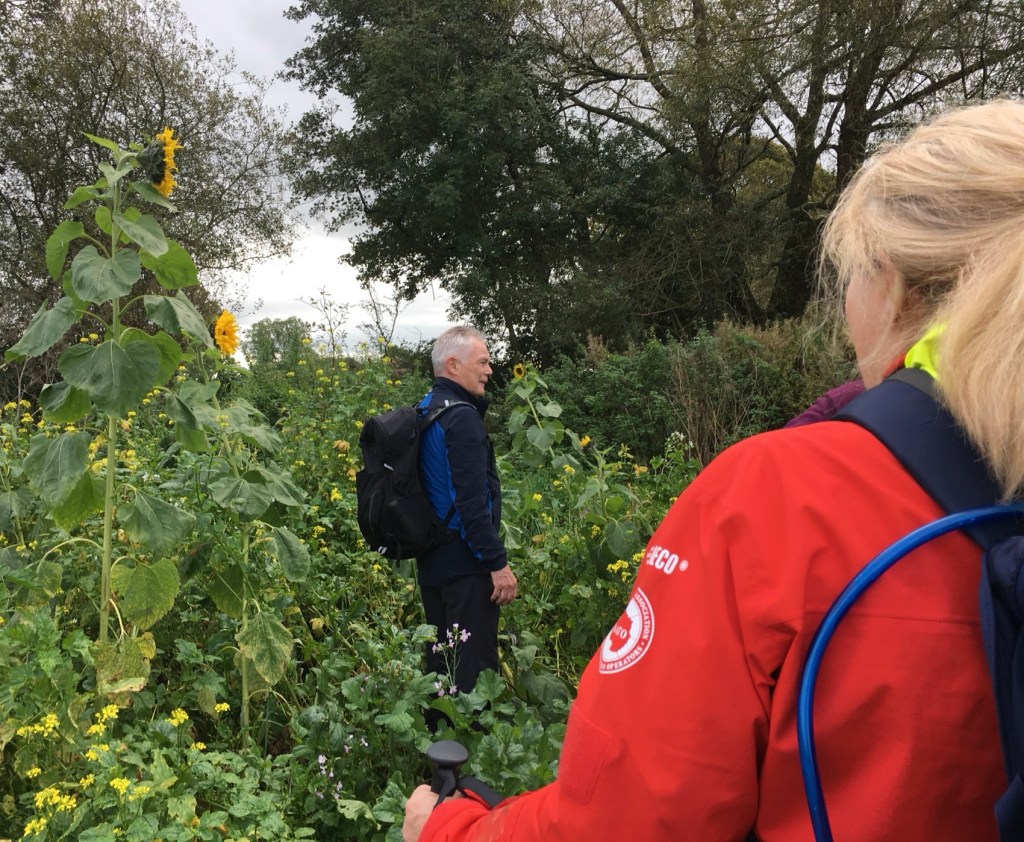
A damp somewhat overgrown mixture of Sunflowers and other vegetation seemed to bar the route, but we made it through. Pat, pictured right, spotted Newts in some of the lightly flooded areas.
Approaching the village of Merriot.
Sunflowers abounded.
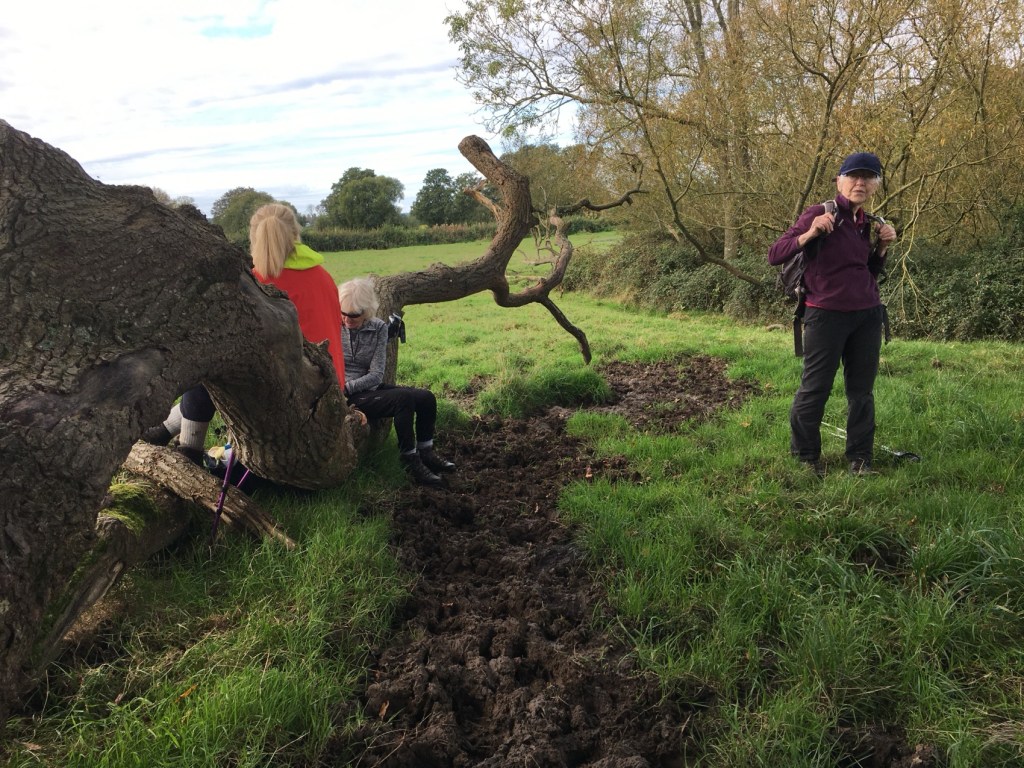
A fallen tree near Stoke- Sub – Hamdon was a good place for a break.
A typical view on our walk.
Higher Street! That’s a first.
An eye catching des-res.

Time to move on from Merriot’s parish church after a lunch stop.

Apple orchards a-plenty and time for some “ foraging”.
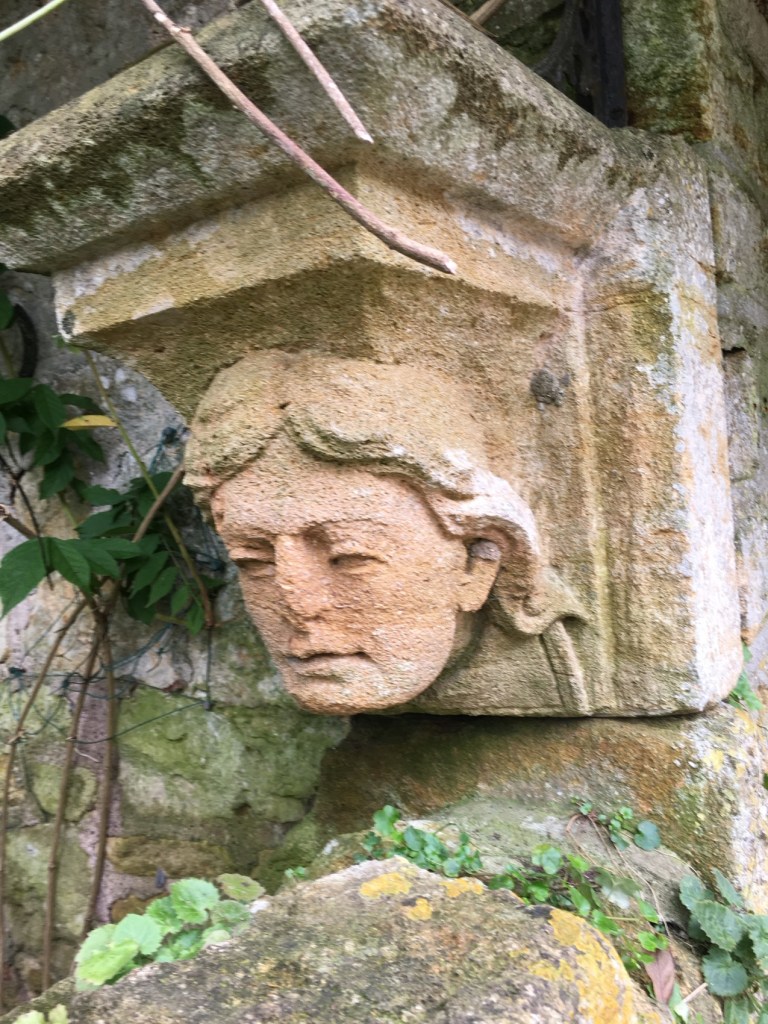
Not on a church but carved on a garden wall, re-entering South Petherton.
The Old Chapel built with the local “ Ham” stone. It was a very enjoyable saunter.

After another welcome dinner at The Shrubbery, I put on a bit of a “ Folderol” for the group and after a long day the “ audience “ did well to keep up the pace!

Some aspect of social history to begin proceedings.something about the origins of the expression “ Not having a pot to p… in”. I watered it down somewhat though.

DAY 1 of A Four day break in Ilminster, taking in Taunton en route.

11 Oct

I have driven past the motorway exit to Taunton many times but never felt tempted to visit Somerset’s county town. However, we decided to break our journey to The Shrubbery Hotel Ilminster, at Taunton. Choosing the Gateway Park and Ride proved to be a good option and avoided the hassle of driving into the town and finding somewhere to park.

A pound each way to and from the town centre.

First port of call was a coffee stop, almost opposite the bus stop – The Bakery, housed in a former Royal Bank of Scotland.

A much needed break after the drive down the M5 which was smooth and uneventful – good coffee,too.

Much of the centre is semi pedestrianised and we were soon struck by a number of interesting buildings.


Taunton was the first place in the UK to be permanently lit by electric street lighting.
Culture on offer, too.

We were only planning on a couple of hours, to include a picnic, ideally in a green spot and by pure chance we happened upon part of the town’s Heritage Trail, by taking a random turn down an alley into Bath Place – a row of original 19th century shop frontages and small mansions.

This opened out on to a main road and Mitre House.
We soon found ourselves following the River Tone after which the town is named.
Our next stop on this section of the Trail was the Castle, which now housed the Somerset County Museum.

“Housed in Taunton’s historic castle, the Museum of Somerset tells the county’s fascinating story from prehistoric times to the present day. Within the 12th century castle walls you’ll find contemporary gallery spaces and great family visitor facilities, all situated within the town centre. With an amazing nine themed galleries, each with its own distinctive character, there’s something for everyone to discover. Our ‘must see’ exhibits include a 200 million year old Plesiosaur fossil (a type of marine reptile); the impressive Low Ham Roman mosaic; the Frome Hoard and a stunning Bronze Age Gold Torc. The museum also houses The Somerset Military Museum.” Maybe next time!

We then came to the Weir which was perfect for an alfresco lunch on a nearby bench.

Some very well,placed riverside retirement flats opposite.
We crossed this lovely bridge and made our way back towards the bus stop.
A proper Cobblers’.
With St James’ church in the background which was not open so I wasn’t able to discover any possible Camino links.

Closer to the town centre – the Taunton Minster’ striking tower.


The foundations of Taunton Minster, St Mary Magdalene church, were probably laid in the early eighth century when Ina, king of the West Saxons established Christianity in Taunton.
The church was first built in stone as part of the reorganisation of Taunton by Henry of Blois, Bishop of Winchester, by 1180.  St Mary’s became the town church in 1308 when Bishop Hazelshaw of Winchester changed its legal standing from a chapel of Taunton Priory to a church with its own ‘living’; the Revd Simon de Lyme became its first incumbent.  This was achieved through a legal process known as the ‘Ordination of the vicarage’.
The church is mainly built of sandstone and has a painted interior, except for the ‘forest’ of pillars which line the four aisles – a rare feature in a parish church. Most of the statues and stained glass date from the Victorian restoration.

Then it was a short wait for the bus back to the ParknRide. What struck me about Taunton during this short saunter, was what an interesting and well kept town it was, with the added attractions of tempting shops, restaurants and pubs.

Not to omit, for me, another of its great attractions – the cricket ground ! Must make an effort to come back next summer when Warwickshire are playing there.

It was a ten mile drive to Ilminster from Taunton and the hotel was easy to locate

A warm welcome with afternoon tea and cakes awaited us and first impressions were most favourable .

A well stocked bar with a good choice of drinks by the look.
The view from our bedroom window – restful as the room.
Feet up time – Sharpeners at 18.00 with dinner to follow. Tomorrow there is a choice of three, local walks and the weather forecast looks fair.

MANON – Capital City of Menorca

27 Sep
There are plenty of “pathless woods” to be seen from the coach window along the Me 1 road to Mahón and although Byron’s poem is not specifically about Menorca, it evokes the island for me.
“ …the deep sea…” and “ the lonely shore”

Mahón, the capital of Menorca has an astonishing history and reading about it gives the visitor an improved understanding of its place in the island’s history and how it became the Capital city,displacing Ciutadella in the process.

MAHÓN’s TOUGH HISTORY

The Mola Fortress

While nowadays, this city is a bustling centre for tourism and trade, this wasn’t always the case. In fact, this city was once riddled with destruction and suffering and was once one of the most important military ports in the entire Mediterranean. Many historians believe the name Menorca,Mahon comes from the Carthaginian general Mago Barca, who was the brother to Hannibal and who is thought to have taken refuge in the city during the year 205 BC.

Born 243bc, died 203 bc

After the fall of the Western Roman Empire, this city became part of the Eastern Roman Empire and an incredibly important port. Port cities were considered highly valuable at the time and they were being used as the main source of trade and transportation. Unfortunately, as a result, it suffered a tremendous number of raids from both Viking and Arab expeditions. This continued for centuries until the city was finally conquered by the Islamic Caliphate of Cordoba in the year 903.

Islamic Moorish rule lasted in Mahon until the year 1287 when it was eventually reconquered by Alfonso III, the King of Aragon. He made the city a part of the Kingdom of Majorca and also part of the Crown of Aragon.

The Crown of Aragon was a composite monarchy, which is to say a group of separate kingdoms all ruled under one king.

This was a win-win situation for everyone involved as joining this composite monarchy provided the city with enormous protection while the city itself offered a brand new trade port for these kingdoms to take advantage of.


In fact, Mahon Harbour was considered one of the most strategically important in all of the western Mediterranean. Because of this, the Crown of Aragon decided that its refortification was necessary and provided the city with the extra protection it needed to stay safe for centuries more.
 However, in the year 1535, Hayreddin Barbarossa led the Ottomans to attack Mahon in what would become known as the Sack of Mahon. The attack was a tremendous loss for Aragon as the Ottomans took over 6,000 captives back to the Algiers as slaves.
Under British Control.

The War of Spanish Succession lasted between the years 1701 and 1714 as a result of King Charles II dying without leaving behind a male heir. This led to a tremendous amount of unrest throughout Europe, with both the French Royal Family and the Austrian Hapsburgs having a claim to the Spanish throne.


However, England wanted to make sure that neither of these kingdoms had access to the riches and power of Spain and made a Union with the Dutch to conquer the important city of Mahon.
Of course, England quickly took note of the potential and profit that this city and the Island as a whole could offer and sought to gain full control which was granted in the year 1713 as a result of the Treaty of Utrecht.
a-painting-by-semiramis-oner-

It was during this time that the city of Mahon has named as the capital which conveniently served as the residence for the Governor of Menorca.

Contemporary photo of his residence

During the year 1756, the island was lost to French control after what would later be known as the Naval Battle of Menorca.However, after the French lost the 7 Years War, the island was returned to the British in the year 1763, but this ownership wouldn’t last long. In the year 1782, the French and Spanish started a combined five-month invasion which took a massive toll on the island and the British eventually surrendered it.In 1783, control of the island was transferred back to Spain according to the Peace of Paris.

However, the British would eventually recapture the important port island in 1798 during the French Revolutionary Wars.

 Luckily, when the French and British decided it was finally time to end all the hostilities between them, they agreed to withdraw their militaries and claims from certain territories including the island of Menorca, which was finally passed back to Spain, where it has stayed ever since.

RECENT HISTORY OF MENORCA

During the 20th century, Spain itself suffered through a terrible civil war. At this time, the entire island remained loyal to the Republic. However, it was captured by the Nationalists in the year 1939.

 Unfortunately, during the battle to capture the Island, Italian and Spanish Nationalist bomber planes bombed the city of Mahon Menorca Spain and destroyed many important historical sites. Luckily, a number of structures remained undamaged or easily repairable making it possible for tourists to still enjoy the wonders of this incredible city to this day.

Original city walls

The history of Mahon has been riddled with conquests, sieges, and battles. However, throughout all that terror this stunning city has also bloomed under the constant cultural influences and changing powers.

Nearing the Fish Market
Seafood tapas
Not just Delicacies !

The city now serves as the seat of the Island Council of Menorca and quite a bit of effort has been made to promote tourism as a primary source of income for the island’s residents helping it to remain one of the richest port cities in all of Spain.

The Capital City of Mahon where people love walking through the historic areas whilst taking in the stunning Mahon Harbour which happens to be one of the deepest natural harbours in the world.

Mahón’s harbour
Looking up from the harbour
Shopping mall with a difference
Mercat del Claustre is as impressive from the exterior as it is inside. Adjoined to a church, it dates back to the 18th century, with many market stalls on the ground floor tucked away in the old monastic cells. The building has an unusual history with many tales to tell, not least during its time as a court and a prison.
Today though, it’s a buzzing, colourful space. Often used for cultural events, and displaying Menorca’s finest fresh vegetables and handicrafts including Avarcas (Menorcan sandals), woven wicker bags and fragrant flowers.


Many delicate facades in Mahón

Window shopping
So many things catch the eye
The only train on the island

It’s set inside the stunning Sant Francesc de Maó convent, and takes you on a journey through Menorca’s different timelines. With sizeable collections of sculptures, antique maps and even Talayotic jewellery, this place gives you a true insight into the turbulent history and culture of this now tranquil Balearic island.
A walk along the harbour is a must and a good place for refreshments.

. https://www.theguardian.com/travel/2021/oct/10/all-back-to-mahon-a-return-to-menorca – good little article.
Sculptures too.
Don’t forget to look up.
A very full day and a very pleasant foray into the Menorca capital city.https://youtu.be/tOxXKehG-5c Enjoyable YouTube clip.

CIUTADELLA OVER A COUPLE OF DAYS

25 Sep

Ciutadella was founded by the Carthaginians and was once Menorca’s capital – its centre of commerce and culture, and was known to the Moors as “Medina Minurqa.”

Looking down at the harbour

“The eternal capital behind the scenes. The quiet and beautiful Ciutadella. A place in which every stone, every street and every mooring in its port harbours a history of battles and conquests.  Many people think that Mahón has always been the capital of Menorca, as it is nowadays. Its primacy, however, is relatively recent: for centuries, until the arrival of the British on the isle – early in 1700 – Ciutadella was the great nucleus from which the entirety of Menorca was governed. Relegated to a secondary place with the arrival of the English, the civitavella of Alphonse III lost its influence.”


Ciutadella gets its name from “citadel” or fortified city because that’s what it once was. It’s said that Ciutadella is a 16th century Spanish city frozen in time.  
As the city expanded some of the old walls came down, but not all of them. The old and very pretty harbour is tucked under the walls of the old city and lined with boats, restaurants and bars. It’s where the boats leave for their round-the-island tours or nearby beaches.
The charming old town has arcades and courtyards with shops and cafes and a beautiful 14th century cathedral. The main town square, Plaça des Born, is the city’s beautiful centerpiece. It’s lined with elegant buildings including the city hall that was once a royal palace.
Impressive balcony
My favourite shrub
These murals are dotted around the backstreets
No truer statement exists!

Ciutadella is a city to explore on foot, especially the historic quarter, where an obelisk dominates the main square.


The Palace of Salort, is also in this quarter, likewise the Palace of Vivó, one of the truly emblematic symbols of the city, with a Neoclassic red façade, ornamented with motives based on traditional Menorca imagery.

The cathedral is built on top of the High Mosque that existed under Arab rule. It is truly monumental, with one nave and six chapels.

If you’re a fan of seafood, traditional cuisine from Menorca, which largely based on seafood, is unlikely to disappoint. 


Menorcan Gin is an industry that started when thousands of British sailors stationed on the island in the 18th and 19th centuries wanted the drink that was fashionable back home. 
Xoriguer is the key ingredient in Menorca’s most popular cocktail drink, called “pomada.”An authentic pomada is made from Gin Xoriguer, lemonade and ice.
And it’s as refreshing as it looks.
They are very proud of their lighthouses .

One day we walked along a road by the sea and were curious about the distinctive villas, some of which were early a 100 years old.

Egyptian style
A more recent addition.
Cooling off after another enjoyable saunter.

CIUTADELLA – an incomparable city to lose yourself in

CALAS,CAMIS VIA CIUTADELLA

23 Sep

MENORCA ,SEPTEMBER 2024, PATRIMONIO MUNDIAL – 11 DAY HOLIDAY

Over the years, everyone who had visited Menorca that I listened to,had only  praise . 

So it is a little surprising that it took so long for me to actually visit this prize of an island.

And,it is a relatively small island.

The transfer from Mahon airport to our base near Cuitadella,bisected the Island and took less than 50 minutes .

From South East to Midwest

Los Lentiscos apartments was chosen because it was budget level, cheerful and near to the many “ Calas “ which are a feature of Western Menorca.

There are no serious rivers in Menorca but there are many coves along the coast of varying size known as “ Calas “

Initial reactions on arrival : Mahon airport is  carefully landscaped,on a  human, welcoming scale ( contrast to Bham ) and competent Jet2 staff were on hand to direct us to the transfer coach. The drive across the island was calm and we were able to notice the changes in landscape from  the Capital, transversing some hillier areas in the  centre of the island, by –  passing interesting towns like Alaior and Ferreries which Barbara and Hannah had visited on an earlier holiday here.

Airport on a human scale

Very quickly, we came to Aveniguda des Delfines , the main road  into the Urbanisation in which our apartments were located – Les Delifines has a particularly naff sculpture placed on an island  en route.

The Main Street

However, happily,  this wasn’t to typify our visit.

Once ensconced  in our two apartments, a walk was needed after being sedentary for so many hours….inevitably this involved finding a supermarket ( easy ) and stocking up the fridge . Apartments suit us as we can choose to eat out  and shop locally and to cook from time to time.

The apartment had a good sized fridge and freezer section,with a two  ring burner and a microwave – just about the minimum for “ home cooking”.

Being on the ground floor turned out to be a bonus as we could walk out from the patio directly to the pool area, bar and reception in no time at all..

Being off season it was relatively uncrowded and very quiet – like a lot of places, not somewhere you would want to be in peak season – affable staff in reception, at the bar and  importantly the  people who make it all work – 

The room cleaners , bar staff , pool maintenance guys and gardeners – ambience.

The evening concluded with a short walk to the Yuca restaurant ( recommended but expensive) for dinner – the Gazpacho was very tasty, the wine good and the agglomeration of meat,potatoes and aubergine was artful and very satisfying.

Delicioso

I had already sensed that being on  an island, inevitably, prices would be higher than  mainland Spain, but the food was good even if some of the portions were  rather small….This was not to be the benchmark as some  later dining out was to prove remarkable.

Plentiful “ Supermarkets “ – but no  fresh,green vegetables; only salad items and a reasonable selection of fruit.

There were some erotic seeds available though….

Not in any of my seed catalogues

Little in the way of natural yogurt, creme fraiche or similar – as I intended to cook on some of the evenings, this was a little frustrating.

Similarly, there was no butchery section as such in any of the various supermarkets visited. – fresh burgers, strips of pork loin and chicken, no fresh fish – it’s enough to make you a vegetarian!

One of the main differences to Spain  was “ Tapas” which we traditionally associate with small portions accompanied by a drink. Here, they are basically a starter to a meal and a good size, too. In one restaurant I ordered “ Patatas Bravas” from the Tapas section and it proved to be more than a big enough portion for three – and very good they were, too.

Even in Cuitadella there was no opportunity to ramble from one bar to another sampling small, delicious items, plentiful as the bars and restaurants are.

CALAS

Menorca, besides its reduced size has more than … 100 coves! say “calas” which is the translation in Spanish and everybody talks about calas here . Due to this insane number of calas, they say that “the best one” doesn’t exist.  The waters in the calas are ALL incredible. They can be blue or turquoise, and have more or less fish. – ideal for children,paddlers and snorkelling.

This was very close by and so tranquil
Slightly wider and very quiet until the sunbed man comes, around 10.15

Despite its popularity it was a calm and quiet spot.

Access to the sea was from purpose built concrete platforms and came with a warning.
Barbara’s viewpoint. All of these Calas were in walking distance.

CAMIS not Caminos – “walks” basically – we walked sections of the Cami de Cavalls.

CAMI DE CAVALLS

More than a mere path: the history of the «Camí de Cavalls»

The Camí de Cavalls has a special significance for the local population, and not simply a historical one. The resurgence of the path is the result of hard work on behalf of many people, who believed it should be available as a public right of way, for cultural and social, as well as historical reasons. Years ago Menorca had a beautiful coastal path that went right round the island, crossing remote bays, gullies, woods and fields. It was known as the Camí de Cavalls (Bridle Path), and used by the British soldiers on horseback to guard the coast when they occupied Menorca. This wonderful circuit has been lovingly restored and signposted so that nowadays everyone can enjoy it. It 

It is 185 miles in length and encircles the entire island in 20 stages .

We walked two of the stages. From the apartment to Punta de Nata was the first

Stone plays a starring role along this section, as the path is particularly rocky. It is relatively easy to cover, however, because the profile is quite flat and only varies when passing small gorges dug into the rocks that lead to the sea.

Marker posts every 100 metres or so.
Floral beauty
A traditional Menorcan gate and this tradition is seen in fencework everywhere.
The lighthouse at Punta Nati from here we walked 3 km to the ronda ( ring road ) and took the 61 bus back home.
Passing farmyards on the way.

A couple of days later we walked another section of the Cami de Cavalls southwards. Taking the 61 into CIUTADELLA and then the 64 bus to the start of the Cami at Cala Blanca, walking from its attractive beach.

This is a very popular resort . The walk was relatively straightforward.
The walkway
Lighthouse in the distance .
We walked further on
Quite a large development here , plenty of restaurants and the like.
Anyone fancy “ wrinkly” potatoes?

Having completed this section it was bacon and cheese bocadillos for lunch with a Tinto Verano, then the number 65 bus back to CIUTADELLA. Both Camis were about 9 miles .

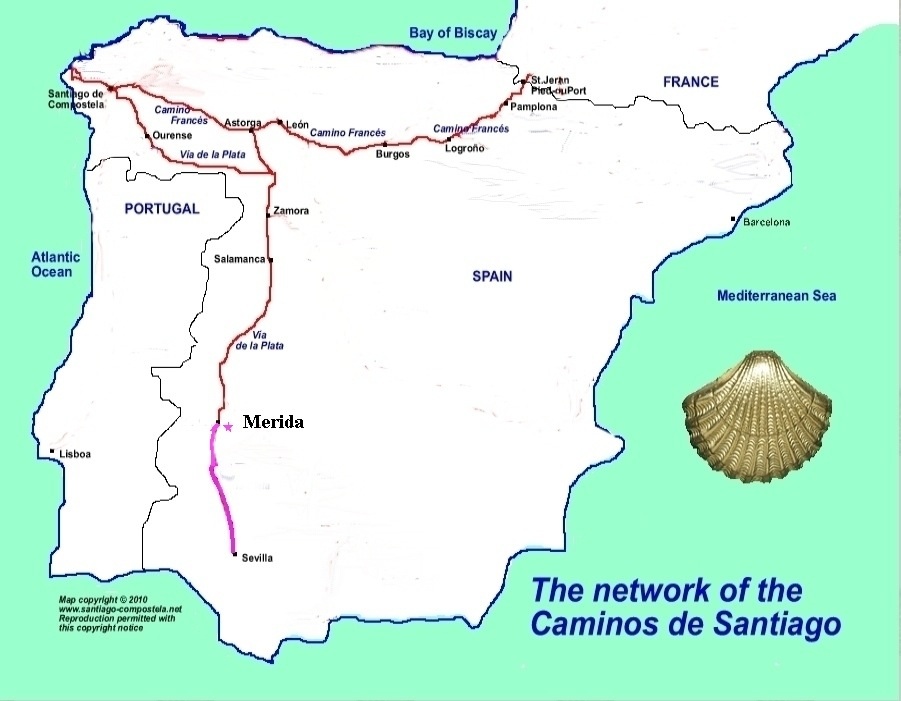
ASSORTED RAMBLERS SAUNTER ALONG THE CAMINO FRANCES – IN 3 STAGES

13 Aug
So true!

The Camino Frances is the most popular of the many Caminos that cross Europe, but principally Spain,Portugal and France. Since Covid, annual numbers are back approaching 350 000 Pelegrinos per annum.

Having walked it,over three years,2022/23/24,I can quite understand why.

The logistics are good – signage, accommodation is plentiful and varied,bars & cafes are usually available along the way – the paths are acceptable for most of the 900 Kilometres plus; inevitably there were a few exceptions, normally descents from mountain tops!

ZUBIRI DESCENT

In early summer 2022, our party was made up of 8 SC Pelegrinos: Sue W. June, Mary,Anita, Tom,Rob,Mike and myself. We flew to Biarritz and got a minibus transfer to St Jean Pied de Port. From there it was our intention to walk to Burgos, in about a fortnight , often in very warm weather. The Pyrenees were magnificent.

One of the highlights came early, the first leg up the Pyrenees to Refuge Orisson. Despite some trepidation, everyone managed the first day’s climb quite comfortably and we spent a relaxing afternoon on the patio-balcony, enjoying the views across the Pyrenees.

Orisson terrace

It is a tradition at Orisson, which is the first night for most Pelegrinos to introduce themselves after the communal meal. We got to know North Americans, Australians, Koreans, Italians, French and some I have forgotten. Mea culpa.

Orisson

For the next few days we would often casually meet up with them in cafes, or at a restaurant in the evening.

Many of them were intending to walk all the way to Santiago de Compostela,taking five or six weeks, and staying overnight in traditional albergues en route – that is some achievement – bear in mind that sleeping arrangements are in bunk beds in dormitories of various sizes, with usually a communal kitchen to prepare your evening meal, lights out by ten and out next morning by 08.00. Very often payment is by donation – usually €10.00.

We were “ Ensuitepilgrims” and unashamedly so!

June captures her mattress – an exceptional night!

All our accommodation was booked in advance six months before departure- after a day’s walk you need the certainty of a room, your own shower and loo, plus sometimes even a balcony.

Boomerang Cottage near Atapuerca was another memorable night.

To obtain your Compostela ( certificate of completion ) it is necessary to get your Pilgrim Passport stamped at least once a day – normally where you stayed the night. These are available in all accommodations,bars, restaurants and churches, if you found one that was open.

I ran out of space eventually and had to use the cover .

We enjoyed some interesting food and….beverages

TINTO VERANO
Slow cooked casserole in Burgos

We stayed in some atmospheric places

BURGOS
We enjoyed a memorable saunter from St Jean Pied de Port to Burgos.

STAGE II BURGOS TO ASTORGA

In 2023, we were fewer in number, Ranjit joined the group which was now minus June,Mary and Anita – six in all. We flew to Madrid and transferred by coach back up to Burgos. The weather was quite cool for the first few days and for the first time in over fifty years visiting Spain, I was glad to have trousers rather than shorts. A large section of this walk to Astorga,over a fortnight again, was across a huge, flat plain called the Meseta. Quite a contrast to the previous year’s walk – it is a unique experience and despite its reputation for flatness, there were always places of interest along the way, as all villages and towns have a story or two in their history of serving and welcoming pilgrims over many centuries.

Storks’ nests to be found on many tall buildings

There were some interesting constructions en route

A house built into a hill
If you are superstitious walk on the right
Tom looking suitably unimpressed!
An iron sculpture
Sue and Rob admiring the Meseta plains, it was surprising how often villages would suddenly emerge..
A classical gateway in a field…
Typica Meseta scene
Burgos university

These was great food and drink to be enjoyed as ever on a Camino.

Morcilla – Rob’s favourite
Best bocadillo ever
Taken by Ranjit

The weather warmed up as we walked further westwards but not approaching the heat of last year .

Leon was a “rest day” – a great place
Rose window Leon Cathedral

We always managed to find a place for a drink stop

A mysterious stone circle
An amazing medieval bridge

As we approached Astorga – our final destination – I looked back over the fortnight and wondered how anyone could find the Meseta section boring; we had a great experience.

This is the best guide book about the Camino Frances and I found it invaluable in planning our journeys.

STAGE III – ASTORGA TO SANTIAGO DE COMPOSTELA

Finally,Summer of’24 and the group underwent a striking change in make up.

Mike, Rob,Tom and myself were joined by our very own Christina and four ramblers from Solihull : Val ( a former, long-standing colleague of mine ) her brother Ray, Myra and Richard. The group met on two occasions prior to the Camino, getting to know one another. So that was five “first time” Pelegrinos which proved to be very refreshing, seeing and enjoying things for the first time, it brought back the essential joy and simplicity of the Camino.

Ryanair changed the flight days which meant leaving two days earlier -this meant an additional day in Astorga – that was no hardship as it is one of the most fascinating ( small ) cities on the Camino, with plenty to enjoy and explore .

We set off eventually, in fine weather , 269 KM to S de C. which would include the two highest climbs of the entire Camino and two careful descents.

260.5 KM to go

We were never without views of mountain ranges for the first few days and they were a splendid backdrop. The new members soon adjusted to the routine of cases at Reception by 08.00 ( to be transported by the ever reliable Spanish post office – the Correos – all booked well ahead. Setting off time was down to individuals, we didn’t process!The signage ( follow the arrows ) was as reliable as ever and as this is the most populous section of the Frances, there were always Pelegrinos not far away.

Vineyard

In the Galician countryside you come across these constructions in every farmyard and in many people’s gardens – I love them.

A Horreos – a grain store – wish I could have bought it home!
A slightly more unusual setting
The flèches – To be found on all sorts of places
A challenge that everyone met
One evening we had a Brazilian dinner with cocktails
This was the location for the thrill from Brazil

Christina, never one to let a challenge go unmet, took a dip in the pool on a very chilly ( to me !) day.

A warmer spot
And she could lay on an Al fresco picnic,too!

Evening routine was a meeting at 19.00 – “ Sharpeners” where over an aperitif the next day’s walk would be discussed,followed by dinner together, which was invariably good fun, once the menu had been explained!

Salud!
Menu del Dia – a Peregrino essential
Sometimes it would be handwritten on a scrap of paper

We traversed some lovely landscapes

The Bierzo region – famous for its fruit,vegetables and wine.

At one hotel we were offered complimentary drinks if we agreed to pose for a photo

Vino Tinto

We did not experience much rain but on one occasion we had to improvise some rainwear from two bin sacks given to us by a friendly girl behind the bar in which we were sheltering.

They did the trick though.

There were so many memorable places and times on this stage – to get the full picture go to “ ensuitepilgrim.blog.wordpress.com” for fuller accounts of all three stages. Just scroll through the Archives on the right.

The Camino is Drink,Eat,Sleep,Walk and repeat – imagine a fortnight’s sauntering and not really knowing anything much about where you would be eating, drinking sleeping every night – that’s probably the best part.

The Cathedral Square – Camino completed.

My grateful thanks to all the Pelegrinos who joined us on all three stages of this Camino – especially their good humour and stamina.

A FREE DAY TO SAUNTER AROUND SANTIAGO DE COMPOSTELA.

22 Jun
I’ve lost count of the number of times I have been to Santiago but I enjoy it just as much,everytime .
And new Camigos
My favourite Camino breakfast – Tostada y Tomate ,a little cheese and ham with the negra. The Camino is coming to terms with a growing taste for tea in Spain. I want that teapot!
First port of call this morning was the Pilgrim Office to obtain the Compostela certificate, the mileage certificate and the essential tube in which to store them – €5.00 for the mileage certificate and the tube ; the Compostela is free. Very efficient process.

Val’s certificates
Both the grounds of the Pilgrim office and Certification process have improved immeasurably in 20 years.
The best signpost walking back to the hotel.

I have walked through 27 of these places over the years – I have been very fortunate – where next? Not sure.

Ecclesiastical architecture at every turn.
Great to see youngsters enjoying the Camino – they were tapping their sticks in tune to the piper just below. I have yet to work out a tune!

The Piper at the Gates of DawnPINK FLOYD

https://music.youtube.com/playlist?list=OLAK5uy_l8UEy84ThXxsnI_WxAg_UW0TXqK6nBMO8&si=FJYRIyu-PRGLZ6VU

A useful pinning

Next stop,was the Asbastos Market

Pleasantly uncrowded but full of tasty and tempting things to eat and drink.
Serrano Hams
Pulpo
Bundles of herbs brought in from the countryside
An enormous loaf
Cerezas
Scalloped Queso
Orujo in several guises plus local wines
Bacalaho
Oysters from the Rias
You would need a tool set to get into these
Fresh fish including. Pesce d’Espada
A tiny square next to the market – perfect for coffee and people watching – Alphonso II was was looking on in the background.
Tapas with coffee- it has to be S de C
Walking back
Over two dozen different fillings in these mini empanadas.

We met up in the cathedral square as arranged for group photos.

The Solihull Rambleros
The first timers – what an achievement!
Sitting in the shade in a beautiful garden.
Birthday drinks on Richard – 🥂 feliz cumpleaños!
Thanks to all the Camigos .

DAY XIV – FROM ARZUA TO SANTIAGO DE COMPOSTELA – THE FINAL SAUNTER

21 Jun
Mural in O Pedrouzo.
Estimated distance today is 21 km – 12.5 miles – By the time we found the hotel in S de C it was 13.5 miles,walked mainly in drizzle.

We left A RUA at 08.10, a fine mizzle was falling. Opposite the exit, on the edge of a farmyard was a nicely situated Horreos.

After an hour’s walking we reached a point 15 KM from Santiago. A bar called 15 Km in fact. We obtained a sello / stamp for our pilgrim passports and after doing so we saw a long line of secondary school children trundling along. We decided to get some coffee and give them time to move on.

An imaginative table napkin of today’s final route.

On any Camino you can expect to come upon unusual statues, shrines and even memorials of a pilgrim who died along the way.

And over the years some pilgrims leave stones for any number of reasons.
The most important signs are the granite distance markers, often placed to guide you on the right path at an intersection.
Hydrangeas thrive in Galicia – I particularly liked this blue / white variety- Horreos as backdrop.
A shot of a well designed kitchen garden / la Huerta

Two hours or so further on we came by a campsite, which I remembered passing five years ago and it looked to be very popular – it was closed and only the cafe seemed to be functioning, with a couple of Camino trinket stalls in the reception car park.

The rain was increasing and so we dived into the cafe and ordered two hot boccadillos with bacon & cheese.
The bread was “ bap” like and made for a really delicious combination. They are no longer boccadillos but Bapadillos – Spanglais. I told one of the ladies serving that they were the best on the Camino for which I got a grateful Gracias and a lovely 😃.
We were not far from Mount Gozo now – Mount of Joy – today it was no joy as Santiago and the cathedral spires lay hidden below the misty rain.

After the descent from Mount Gozo we entered the outskirts of Santiago – I know from past experience that it’s still,a long walk until,you reach the historic centre of the city.

Some parkland as well,as the usual suburban sprawl.
San Lázaro’s church en route to the centre. In the Middle Ages this was the closest lepers could come to,the Cathedral.

San Lázaro is regarded as a humble saint of health and healing who soothes the sick, especially immigrants and people living in poverty. He is also known as the “god of crossroads” who guides people in making difficult decisions.

We eventually reached the historic centre of Santiago and its famous square the Pzaza da Obradoiro

What follows are a series of photos of the group celebrating the completion of their Caminos.
A balletic pose from Christina
Pure joy!
With Christina and Mike
Those boots look big - they have been great !
Mike – relieved and thankful as we all were.
The Silhillians made it too and delighted they were – they have been great first time Pelegrinos – we are all going to get together tomorrow for a group photo in the square – as we all arrived at different times this afternoon .

We received a tip off that some Americans had paid for the Botafumeiro to be swung at the 7.30 pm Pilgrim mass( €500 ) and so some of the group went to enjoy the spectacle.

The Botafumeiro weighs 53 kilograms and measures 1.5 metres. Using a complex system of pulleys, it is swung from the central cupola of the cathedral, from which it hangs, towards the side aisles

One of the most famous symbols of the cathedral is the Botafumeiro, which may be largest censer in the world. It is used at masses celebrated on key dates at the cathedral. It is also used every Friday (except for Good Friday) at the 7.30 p.m. mass, an homage to the pilgrim by the city of Santiago. It may also be used on other occasions upon request from pilgrim groups. The aroma of the incense has a powerful symbolic connection to prayer and spiritual purification: ‘May my prayer be set before you like incense’ (Psalm 141:2).
The Botafumeiro weighs 53 kilograms and measures 1.5 metres. Using a complex system of pulleys, it is swung from the central cupola of the cathedral, from which it hangs, towards the side aisles. It takes eight men, known as tiraboleiros, to move it. It is suspended from a height of 20 metres and can reach speeds up to 68 km/h.
The first written reference to this enormous censer appears in a 14th-century margin note to the Codex Calixtinus, where it is called Turibulum magnum. There have been several censers throughout history and in the early years, the ceremony did not proceed as seamlessly as it does today. For example, in 1610, the pilgrim Diego de Guzmán wrote in his diary of how the censer ‘hit the upper vaults’ as it swung. And on a few other occasions, the rope has even slipped out of the pulley.

Thanks to Christina,Val and Mike for some of the photos

OUR PENULTIMATE SAUNTER – DAY XIII TO A RUA FROM ARZUA – 19 KM

19 Jun
We left at 07.30 and made a short 300 metre stroll to Bar La Galicia for Desayuno .

It was shortly after 08.00 when we began the way proper. As usual, the group divided into a solo, 2 pairs and a foursome – each according to their wishes or needs. These mini groups would often meet up along the way,more usually at refreshment stops.

The stage between Arzúa and O Pedrouzo is of low difficulty, it goes along forest tracks, crossing woods and fields. A day though in which we must take extreme precautions, as we will have to cross the N-547 road several times, with heavy traffic. We will walk on flat and comfortable terrain, finding plenty of bars and places to rest, perfect to take the stage calmly. Santiago is getting closer and closer.

Eucalyptus
After 5 km we reached
Taberna Velha, and we walked past “ The Wall of Wisdom “
And many similar “ Bon mots”
After about 3 hours walking I stopped at Bar O Lino and caught up with Christina
Pineapple cake and Americano – €3.80 – perfecto.
Guess who’s flower of the day?
Richard gets a warm welcome.
The Guardia Civil on horseback – modern day KnightsTemplars – looking after Pelegrinos.
His poncho looks a bit tatty.
Shortly after leaving the bar it began to rain and this time we had all remembered our ponchos.
Don’t let the grass grow under your feet!

Steady rain for the rest of the saunter through woods and criss crossing the N 547 – a camera is fiddly work whilst wearing a poncho and the dreary weather, although it did not inspire much in the way of taking photos,did not detract from the enjoyment of the Camino; plus the growing realisation that 12 miles no longer meant so much of a challenge!

The rain began to ease as we neared our accommodation for today – Alojiamentos Rurales O Acrivo – after a quick check- in Mike and I made our way to our room.
An altogether welcoming place in delightful grounds and…it stopped raining.

( Thanks to Christina for some of the photos)

The forecast for our last day’s saunter tomorrow- Thursday – is looking brighter and drier for Santiago de Compostela.z