“Only Those Who Have Walked the Camino Know What It Means” Sergio Fonseca.

13 Apr

That quotation is taken from an ingenious, little guide book called:

The Portuguese Way to SANTIAGO de Compostela….My Way.

That description could equally be applied to organising a Camino for 25 people!

Sergio goes  on to say, “ You will probably go through some tough times and may even feel the urge to give up but the “Way” will give you the help you need”.

I know he means and though preparations have been plentiful, whilst they have not been” tough”; at times they have been problematic, for example, when Iberia Express, the airline we are using, sends a “ revised” flight schedule, which allows  10 minutes to change flights in Madrid….people are being paid to do this🤬?

That meant 20 plus people having to contact Iberia Express by phone, to change to an earlier flight from Santiago – some of them felt as though they were dealing with the representatives of Alice in Wonderland.

As many feel when they are walking the Camino, it is not just a “simple” route, taking you to Santiago, if not life-changing, but testing at times.

This Blog is a collection of further “ Updates” to our “ Rambleros” and I have enjoyed this” journey” so far – not saying the actual Camino, in June, will feel like a walk in the park, by comparison – but like them I am looking forward to it .

Update V

Give me my scallop-shell of quiet, My staff of faith to walk upon, My scrip of joy, immortal diet, My bottle of Salvation, My gown of glory (hope’s true gage), And then I’ll take my Pilgrimage.” ~  Sir Walter Raleigh, The Passionate Man’s Pilgrimage, 1603

IBERIACONECTA

Iberia Flight Changes – click red website link and accept the changes.
Make note of slight time differences.

This link is to a very relevant poster.

MORE ON FOOD


https://www.theguardian.com/travel/2018/feb/04/galicia-seafood-fish-spain-foodie-markets


https://www.facebook.com/spanishforcamino/posts/1870139663020540. More on menus, etc.


TAPAS

There is a saying in Spain that life is what happens between meals. But – lesson five – tapas isn’t a meal. It’s a ritual. In a way, it’s life itself.

Ask 10 Spaniards about the origins of tapas and you’re likely to get 10 different replies. Tapas originated from a government edict that food had to be served with alcohol to stop people getting drunk. Tapas comes from the practice of putting a slice of bread over the top of a wine glass to prevent flies getting in. Tapas comes from the Moorish love of grazing on small morsels. Tapas comes from the 13th-century King Alfonso, an invalid able to consume only small amounts of food.
The one thing everyone does seem to agree on is that the origin of tapas is best discussed over tapas – which proves that Spain, as well as being devoted to its collective stomach, is a country with its priorities in order.

They’re not exactly backing themselves into a corner with the tapas thing, either. From an unadorned plate of jamon Iberico, to chipirones (fried baby squid), the Catalan pan con tomate (tomato-rubbed bread), the vinegar hit of anchoas (anchovies with garlic and parsley) and the ubiquitous deep-fried fun of the croquettas, there is a universe of flavour to explore across the Iberian Peninsula, bursting with history and regionality and just plain old good times.

Good tapas can be hard to find.
True, the point of tapas is not to linger. The modus operandi is to eat something, drink something, and move on to the next joint, which minimises the damage made by a poor decision. But choosing from the staggering number of restaurants and bars can send the most optimistic character into an existential crisis

A nightly hours-long procession of tasting and tippling that whets the appetite for dinner (note: the Spanish generally manage to say this with a straight face).

https://caminoways.com/10-most-delicious-galician-dishes

VEGETARIAN CHOICES

Remember to ask for vegetarian meals as vegetarian food is not common in Spain, the following may assist

English

“ Do you have vegetarian meals as Ido not eat meat or fish”

Spanish

“¿Tienes comidas vegetarianas como yo no como carne o pescado”

Indian, Middle Eastern and Asian Restaurants generally have decent Veggie options and University towns also.

Also, a few good phrases to know are:

“Tienes un menu vegeteriano?” Do you have a vegetarian menu?

‘No como carne, pollo, cerdo o mariscos’. “I do not eat meat, chicken, pork or seafood. “

‘Tienes arroz y frijoles?’ “Do you have rice and beans? “

In Santiago, A Tulla Ruela de Entrerruas, (Several delicious veggie items), off of Rua du Vilar near Tourist Info. Office)
Rest. Cedros, Rua do Vilar 81(?)

In each of us dwells a wanderer, a gypsy, a pilgrim. What matters most on your journey is how deeply you see, how attentively you hear, how richly the encounters are felt in your heart.” ~ Phil Coustineau,

from his book, “The Art of Pilgrimage.”

One of our group was telling me on a recent ramble, how she had “upped her game” – some longer walks and Pilates. This poem is most appropriate- though I hope none of us get too “ solemn” about it.

The Wanderer

She is a solemn wanderer,
A daughter of the road
The crunch of moving gravel
Is like balm upon her soul.

Each rambling, easy footstep,
Within each languid stride,
Keeps the poison thoughts
From taking root inside her mind.

Each footstep is a triumph
That pushes her along
Each gasping breath that fuels her
Is a lyric to her song.

At times she is a vagrant
When there is no place to go
When nothing feels familiar but
The stone that coats the road.

At times she is a traveler
That thirsts for foreign lands
Her mind drifts off to mountain sides,
Or golden sprawling sands.

And most times she’s a dreamer
Thinking of the day
She’ll let her restless, resolute legs
Take her far away.

In all, she is a wanderer,
A daughter of the road
Putting space between her thoughts
Upon the open road.
#sarahspang

This link put me in mind of John and his band of footpath volunteers.
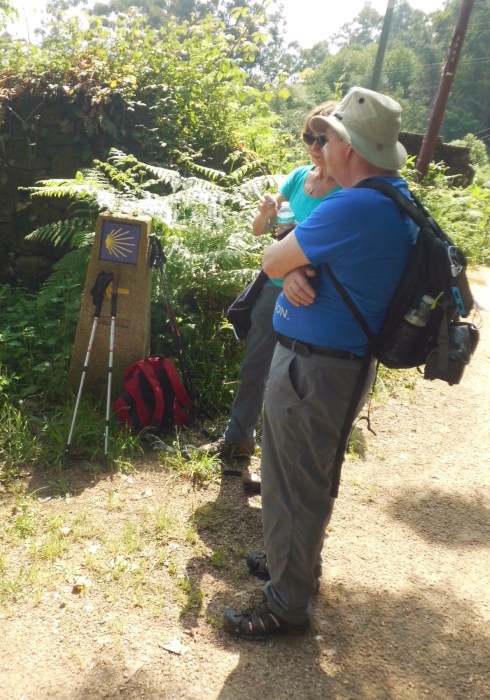
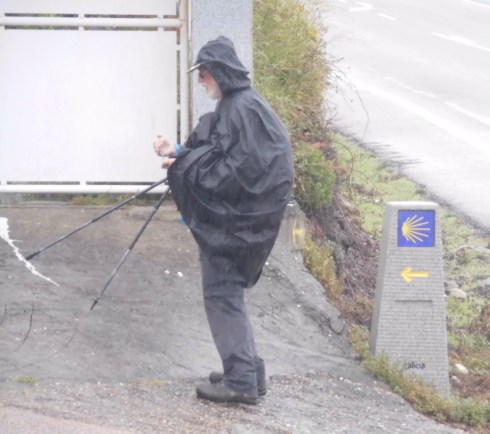
These yellow arrows and waymarks are essential on the Camino.

https://www.facebook.com/permalink.php?story_fbid=1503667109754638&id=382356341885726 volunteers who keep the signage up to date.

Finally, thanks to everyone that has forwarded their £ 57.00 and a reminder that it would be really helpful to have all payments in by 28 February.

As the weather improves, look forward to meeting up with you on future Rambles and as ever, don’t hesitate to get in touch.

Ultreia is another pilgrim salute, like the more popular ‘Buen Camino!’. While ‘Buen Camino’ literally means ‘have a good journey, a good Camino’, the meaning of ‘Ultreia!’ … It is also believed Medieval pilgrims used to greet each other with ‘Ultreia, Suseia, Santiago’, meaning something like ‘beyond,upwards, Santiago’.

Ultreia, Suseia, Santiago’,

John

Update VI

Thanks to you all for the £ 57.00 transfers.
Payment for the coach transfer and excursion has been made.
Receipt below.

Please ensure you read the last section of this Update and return the
Proforma, as requested


Many say “Buen Camino” but what is “Ultreia”?

These days, “buen camino” is the most frequent pilgrim greeting along the Camino de Santiago in Spain, but some think”ultreïa” is more traditional.

Medieval pilgrim #1: Ultreïa!

Medieval pilgrim #2: Et suseïa!

The usual English translation of “ultreïa” is onward, but that doesn’t seem to get at the heart of it. Keep going and walk further aren’t as elegant, but they show the encouragement that’s an integral part of the word.
Ultreïa (English) – A song we might be lucky enough to hear, en route.

“Every morning we take the Camino,
Every morning we go farther,
Day after day the route calls us,
It’s the voice of [Santiago de] Compostela!

Chorus:
Onward! Onward! And upward!
God assist us!

Way of earth and way of faith,
Ancient road of Europe,
The Milky Way of Charlemagne,
It’s the Chemin of all the Santiago pilgrims!

And over there at the end of the continent,
Santiago waits for us,
His smile always fixed
On the sun that dies at Finisterre.”

So now you have an alternate greeting

“Ultreia”

Souvenir sorted!

This new 2 Euro coin that was recently released,is dedicated to #SantiagodeCompostela #SpanishDoor

More about FOOD on the Camino

Some suggested foods to carry on the camino for lunches and snacks:
• Trail mix with nuts, seeds, and dried fruit
• Fresh fruit (apples carry well, bananas are good for muscle cramps with their potassium)
• Fresh vegetables (cucumbers and tomatoes travel well)
• Bread: fresh Spanish baguettes are delicious and inexpensive.
• Ham: Spain has so many delicious varieties
• Cheese: also many varieties are available. Ask for a small quantity from the deli (50-100 grams) to avoid wasting extra that you cannot refrigerate.

Pilgrimage: The Road to Santiago begins on BBC Two on Friday, 9pm

Thanks to Rosie for reminding me about this new bbc tv series.

Article, below, I copied from “The Observer”. 11th March.

“Faith, friendship and curses as seven celebrity pilgrims trek to Santiago
Three-part TV show to be broadcast as thousands find their spiritual sides on tough Spanish route and new pathways in Britain

The celebrity pilgrims at the beginning of their journey. Neil Morrissey, Ed Byrne, Debbie McGee, Raphael Rowe, JJ Chalmers, Kate Bottley and Heather Small. Photograph by Brigid McFall/BBC
Harriet Sherwood
Religion correspondent

“There were no road-to-Damascus experiences and very little piety. Instead, when seven people in the public eye walked the Camino de Santiago, the ancient pilgrimage route across northern Spain, there were many arguments and much snoring and swearing.
The group – a priest, an atheist and assorted believers and non-believers – discussed the values shaping their lives while retracing the steps of medieval peregrinos. Along the way, they forged friendships and encountered some of the thousands of people who walk the Camino each year, part of a resurgence in pilgrimages.
Pilgrimage: The Road to Santiago, which starts on BBC Two on Friday, followed the modern-day pilgrims along part of the 500-mile route from Saint-Jean-Pied-de-Port in the French Pyrenees to Santiago de Compostela, almost at the tip of Galicia in Spain. The group was made up of Kate Bottley, Anglican vicar and Gogglebox star; actor Neil Morrissey; M People singer Heather Small; comedian Ed Byrne; performer Debbie McGee; journalist Raphael Rowe, who spent 12 years in prison for a crime he did not commit; and TV presenter JJ Chalmers, who survived a bomb blast serving in Afghanistan.
As they walked, they questioned their own and each other’s beliefs. “It was eye-opening,” said Rowe, a non-believer who described himself as an “ignorantist”. “It made me think differently about myself, about other people, about religion and faith. I learnt more about religion [on the camino] than I ever have in my life.”
His fear that he might “catch religion” proved unfounded, he said. However, by the end of the journey his “trust in people’s honesty and motivations” had been restored.

Small said the experience strengthened her faith, despite an uncomfortable moment when the group stopped at a monastery and the singer was grilled unsympathetically.
“Along the way you meet people who are genuinely interested in who you are. But then we went into the monastery, and the man there was not interested in me per se – what he saw was my colour, only my colour,” she said. “When you’re being treated as ‘other’, you always know.”
Small walked out of the monastery, followed by the rest of the group. Their appalled reaction to the incident “showed me we’d really made a bond”, she said.
Bottley had expected the camino to be a spiritual experience but found it a physical challenge. “I hated it with a passion,” she said. The group carried their own gear and slept in basic pilgrims’ hostels. They walked in extreme heat and driving rain.
“It was the hardest thing physically I have ever done, and I’ve given birth twice. The physical act of putting one foot in front of the other, day in, day out,” said Bottley. She had never sworn so much, she added.
The vicar also felt under pressure to defend and explain her faith. “The religious debate was exhausting. I felt I came out to bat a lot. There were a couple of moments when I feared my theological rigour wasn’t enough to carry the debate.”
Pilgrimage was popular in medieval times, when bands of travellers criss-crossed Europe in search of spiritual enlightenment. For many, it was a holiday and a chance to meet new people and hear their stories. The Canterbury Tales, the epic yarn written by Geoffrey Chaucer in the late 14th century, described a group of 30 pilgrims walking from London to Thomas Becket’s shrine in Canterbury cathedral, with each telling the others a story along the way.
But in 1538 the English pilgrimage movement ended. Henry VIII and Thomas Cromwell moved against the pre-Reformation church, destroying monasteries, abolishing saints’ days, banning relics and smashing Becket’s shrine. Pilgrimages disappeared for more than 300 years.
Now the camino has spearheaded a pilgrimage revival. In 1984 just over 400 people completed the final section of the camino, a 62-mile stretch which entitles pilgrims to a compostela, a certificate written in Latin and issued by the cathedral of St James in Santiago. By 2016 the number had topped 278,000, including 6,000 from the UK.
New pilgrimage routes have opened across the UK. The Old Way, a medieval 220-mile route from Southampton to Canterbury, is being revived by the British Pilgrimage Trust. The 92-mile Two Saints Way from Chester to Lichfield aims to “set the modern pilgrim on a contemporary quest for ancient wisdom”.
In Scotland, a number of pilgrim trails have been developed, including a route in honour of St Magnus in Orkney and the 72-mile Forth to Farne Way, a stunning coastal walk from North Berwick to Lindisfarne.
Many walking these ancient ways are religious; but many more describe themselves as spiritual. A surprising number seek only to escape the pressures of 21st-century life with a simple existence of walking, eating and sleeping.
All members of the group in The Road to Santiago said they were enriched by the experience, in particular the strength of the bond created between them. They have stayed in contact since completing the camino.
“Did anyone have a road-to-Damascus experience? “No,” said Bottley. “But the camino has a way of showing the best of yourself – and the worst of yourself.”
Pilgrimage: The Road to Santiago begins on BBC Two on Friday, 9pm

BILBAO Will post a Blog on this trip on ensuitepilgrimblog.wordpress.com

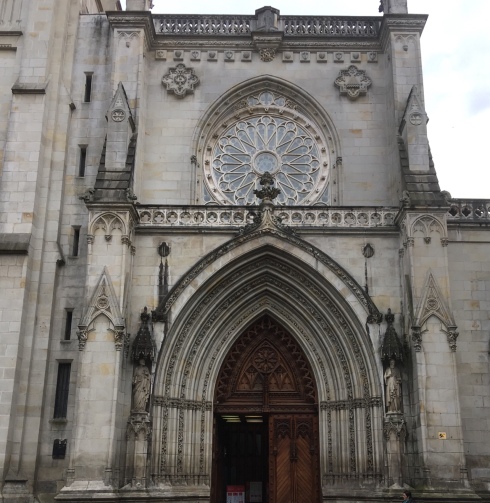
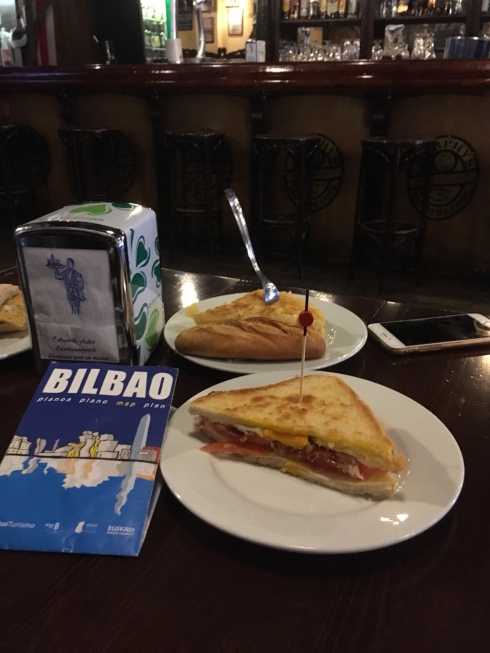
Just returned from a short, city break in Bilbao – the Cathedral is dedicated to St James – photos of signage, etc on Pilgrim route, Via Del Norte, which goes through Bilbao to S de C, mostly along the Roman Via Agrippa.
I walked a section of it a few years ago, from Luarca.


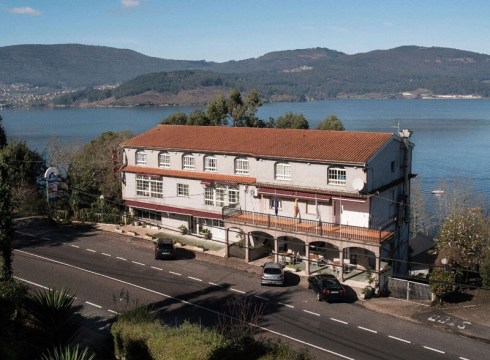
We are staying and having dinner at Santo Apostolo on Wednesday,6th June – This booking has been made by direct contact with the hotel.( very pilgrim friendly; stayed there recently ).
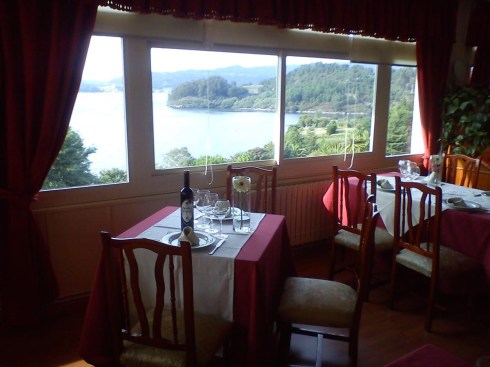
The hotel provides a good value Pilgrim Menu – assorted starters , including empanadas, salad and croquettes, but they need to know the numbers for the main course,which is a choice between :-
“Seafood rice”or “roasted ham”; Both Spanish favourites.
I know we have at least one Vegetarian in our group, so I shall request an option.
If there are other vegetarians amongst you,please indicate, below on the proforma which you all need to copy, paste and return to me ASAP, please, just enter the digit 1, against your choice.

NB EVERYONE SHOULD COMPLETE AND RETURN THIS

Name. ____________________________________

Seafood Rice ___

Roasted Ham___

Vegetarian ___

Here’s to the arrival of Spring, to accompany our Rambles.

Regards and best,

John.

Update VII

“ Miles Away, But Closer Every Day” – with no thanks to Iberia Express!

CHANGE TO FLIGHT DETAILS

Thanks and well done to you all for reacting to the flight change alert. Hopefully, the only glitch we have to overcome ! 😇
Thanks to Rob Halley for making me aware of it.
We shall need to take the 07.00 Airport bus from Praza de Galicia, in S de C @ 07.00. A ten minute walk, on 13 th June.
An 800 metre walk, so suggest we leave San Martin de Pinario no later than 06.40. And for an unhindered departure, check out the night before.
Breakfast after check-in, at the airport?

Medication and First Aid

Caterina has suggested that anyone with any “ condition”, makes her aware,by contacting her on “ccattel@gmail.com”.
This would be totally confidential between you and Caterina.
More on First Aid, in the next update.

Short, evocative video of the Camino.

What it’s really like.

“There is a pleasure in the pathless woods,
There is a rapture on the lonely shore,
There is society, where none intrudes,
By the deep sea, and music in its roar:
I love not man the less, but Nature more”
-George Gordon Byron
Always walk your own Way!
TIP
Make a photo copy of your passport main page, as ID may be required in some hotels – I have found my “ copy” to be acceptable 99% of the time ) – this means that you have the security of keeping your passport in your own, safe place. Generally , the hotel receptionist will accept just the passport of the the person making the booking i.e me….if not
then we have to go along with however many they request.

DINNERTIME
I am proposing that we book these meals ahead, in our hotels, where applicable. In a couple of places the hotel will be the only feasible venue; in the others,I have checked on their websites and “ reviews” of their provision – they all provide good, Galician Fayre.
A lot of pride is taken in their regional cooking.
I think this would save the bother of having to check out local restaurants, and/or assessing the viability of catering for 25 people.
Not something one wants to do after a day on the Camino.
Plus, the prices are very good value, ranging from €13 – €15.00, which usually includes a starter, main, dessert and drink.

I shall send out a Proforma for meal choices, separately, later this month, as the hotels need to know these, in advance of our arrival.
( Need Hannah’s expertise here! )

If, for whatever reason, anyone would prefer not to be included, please let me know ASAP.

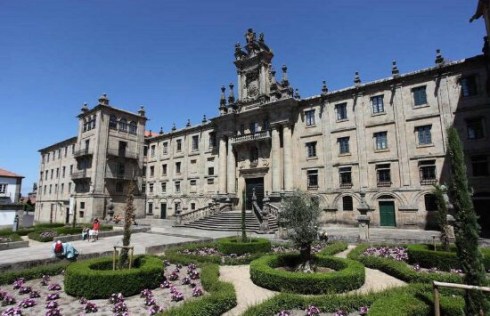
Hopefully, we shall have arrived at our hotels, in plenty of time for recuperation,a walkabout,locally, as Vigo, Pontevedra, Caldas de Reis and Padron are all very interesting and totally different places.

When we reach Santiago, I am thinking of a group meal the first night,
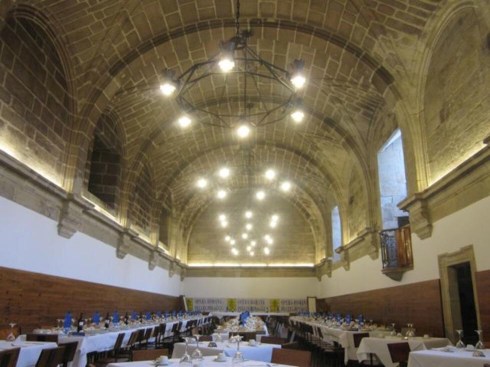
in the atmospheric refectory in our hotel.
Second night,suggest going out for “tapas” – you can’t easily do that in groups of 25!
Last night, hopefully an early dinner 🥘.!

LUGGAGE TRANSFER WITH THE CORREOS-SPANISH P.OFFICE

Thanks to Penny, my sister, for organising this.
Great price of € 20.00 each for all transfers.
Bags must be at each hotel reception, by 08.00.

At the foot of this update is an attachment – the Correos luggage label . Plus a copy of mine – ignore “ money in envelope”.
Print it off and have it ready to attach to your case/bag on the morning of the 5th June – Please write our booking ref. on the top.
Booking Ref. VIL050618SAN01x25
Swimming Opportunities en Route.

06/06 Santo Apostolo – 10 minute walk to beach

08/06 Balneario Acuna- Pool and Spa opportunities

09/06 Hotel Scala – Swimming Pool.

Now that most of us have watched,or heard of,” Pilgrimage;The Road to Santiago”, BBC 2,there is still time to send to me your reasons, expectations and hopes for your camino – anonymity guaranteed – Go on, express yourself!

Benefits of Nordic Walking..( or any walking with poles )

Badges and Patches

Pipes being played near Cathedral, where we are staying – hope the weather’s better!

Walking Poles
A study by academics at Northumbria University has shown for the first time that trekking-poles help hikers maintain muscle function while significantly reducing soreness in the days following a hike.
In the study, 37 physically active men and women were split into two groups of equal fitness and asked to hike up and down Snowdon, the highest mountain in England and Wales.
One group was issued with and trained in the use of trekking poles while the other group made the climb unaided. Each group ate the same evening meal on the night before; they ate the same breakfast, carried similar weight in day packs and took the same scheduled rests during both the ascent and descent.
The participants’ heart rates and their personal perceived exertion ratings were recorded during the hike. Then, at the end of the hike, and at 24-, 48- and 72-hour intervals afterwards, muscle damage and function were assessed through a variety of tests.
The results showed that there was significantly less muscle soreness in the group using trekking poles. This group demonstrated a reduced loss of strength and a faster recovery immediately after the trek compared to the control group. Self-rated soreness peaked at 24-hours in both groups but was significantly lower in the trekking-pole group, both at this point and at the 48-hour point. In addition, levels of the enzyme creatine kinase (which indicates muscle damage) were much higher at the 24-hour point in the non-pole group, while the trekking-pole group’s levels were close to the pre-trekking levels. This shows that the muscle damage they were experiencing was negligible.
Pole manufacturers have suggested that trekking poles can reduce forces on lower-limb joints by as much as 25 %. However, the existing research has been restricted to the laboratory or to non-mountainous outdoor settings, such as running tracks, and has only focussed on biomechanical investigations into stress on the ankle, knee and hip. This is the first documented study into the effectiveness of trekking poles in the environments for which they were designed.
“The results present strong evidence that trekking poles reduce, almost to the point of complete disappearance, the extent of muscle damage during a day’s mountain trek,” says Dr Glyn Howatson, who conducted the study.
“Preventing muscle damage and soreness is likely to improve motivation and so keep people enjoying the benefits of exercise for longer. Perhaps even more advantageously, the combined benefits of using trekking poles in reducing load to the lower limbs, increasing stability and reducing muscle damage could also help avoid injury on subsequent days trekking. It is often the reduced reaction time and position sense, associated with damaged muscles that cause the falls and trips that can lead to further injury in mountainous or uneven terrain.
“These findings have particularly strong application for exercisers wishing to engage in consecutive days’ activity”.

Nb This is using TWO poles.

Book Recommendation

This is free on Kindle, for the next couple of days; walked with the author, last year – lovely guy.

“I think I may have missed the boat, for this..”?
Fitness Special—Hike Forever: Age 50-65 – Backpacker

This is a beautiful film

https://vimeo.com/177867577

The first 156 Km of the Portuguese Camino, from Porto.
I have walked this and it brought back some great memories.

—————————————————————————————

Less than two months to departure time.
Hope everyone is looking forward to it.

As always, get in touch on any matter, large or small; or
anything I may not have covered.

Ultreia!

Regards and best,

John

Correos Luggage Transfer Label


The Bilbao Effect – The Guggenheim Museum. When he got to Bilbao a month before it opened, says Frank Gehry, “I went over the hill and saw it shining there. I thought: ‘What the fuck have I done to these people?’”

12 Mar

BILBAO

After a straightforward journey – train to Bristol and bus transfer to the airport, we arrived in Bilbao,10 minutes early.

It felt good to be leaving “RIP-Off Little Britain” behind and bask in 21*.

Airport bus to Plaza Moyua.

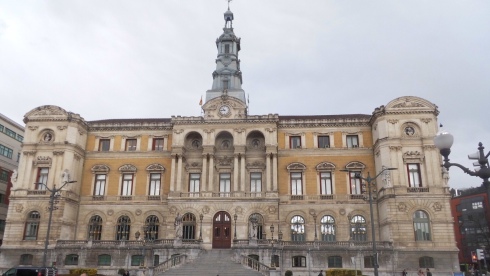
Having collected keys from the Apartment Agency, we were taken there by a helpful employee;our balcony overlooked the river and the Paseo Arenal, which years ago had been part of the docklands.

What was most noticeable, were the hills and mountains that encircle the city. Skyscrapers adjacent to meadows;also, the tranquility of such a large metropolis , fourth biggest in Spain. The plan was to enjoy a drink, some pinxtos and later, a meal.

We were very impressed with enormous turn out for a walk to mark International Womens’ Day, with participants of all ages and both sexes, sporting purple ribbons – apparently 6 million women staged a strike across Spain.This finished with a rally at the Ayuniamento.

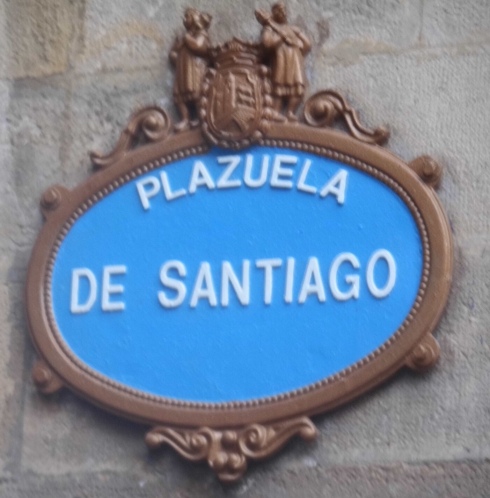
The drink was enjoyed in the Cathedral square – Santiago’s church and a sign to remind you that it sits on the Camino Del Norte.

We were to encounter more signage, later in the week.

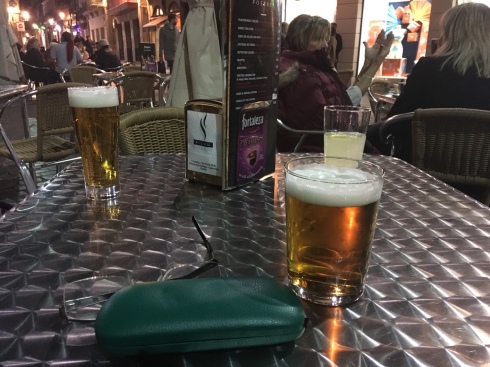
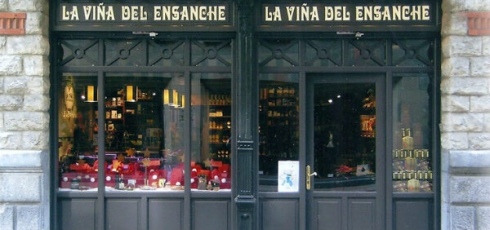
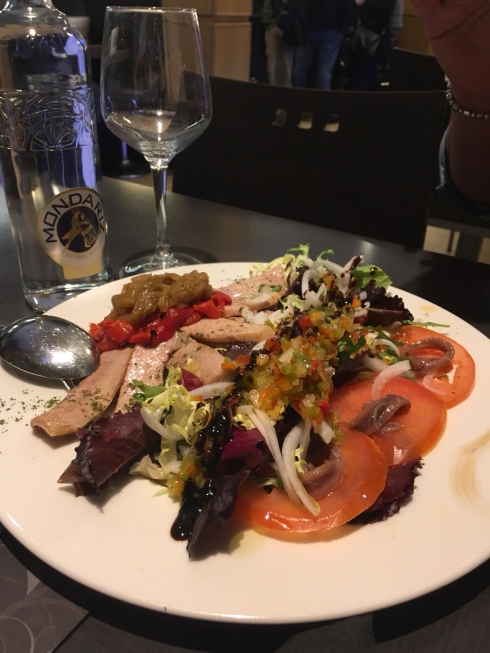
Dinner was found in LA VINA DEL ENSANCHE and we enjoyed the atmosphere and the best Patatas Bravas ever.

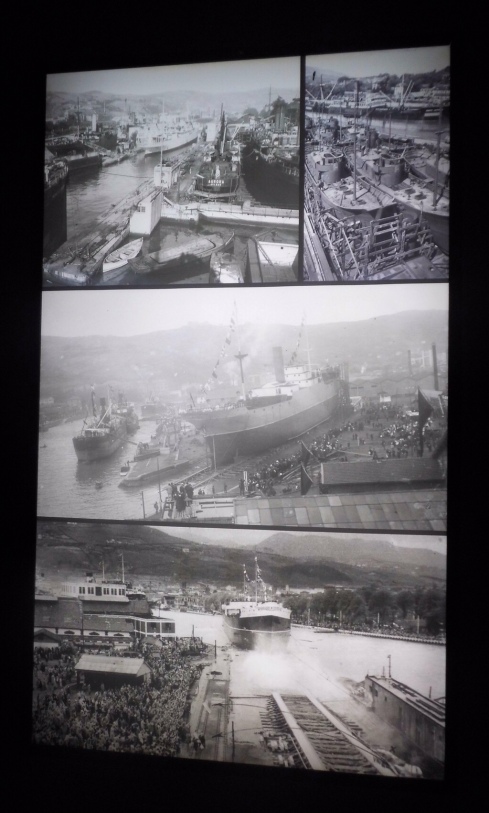
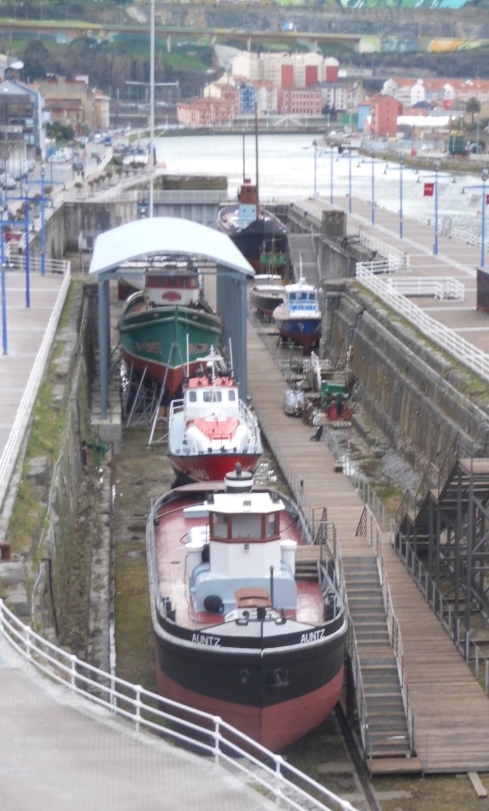
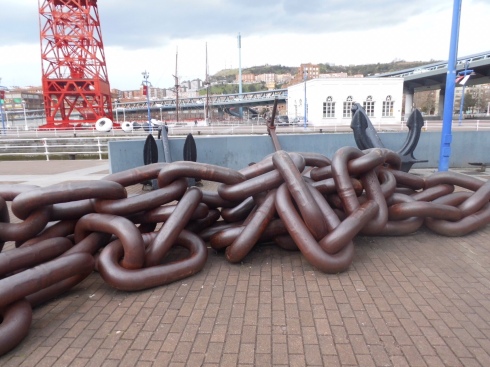
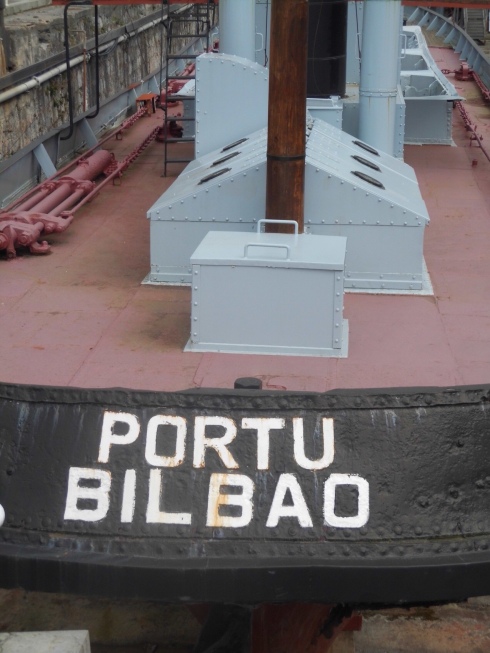
Friday, after a late start, saw us walk across the city to the Maritime Museum which, although it was partly closed for renovation, gave an insight into the city’s shipbuilding and sea-faring past.

A tragic image of females working on the docks, not so long ago, captured on a container.

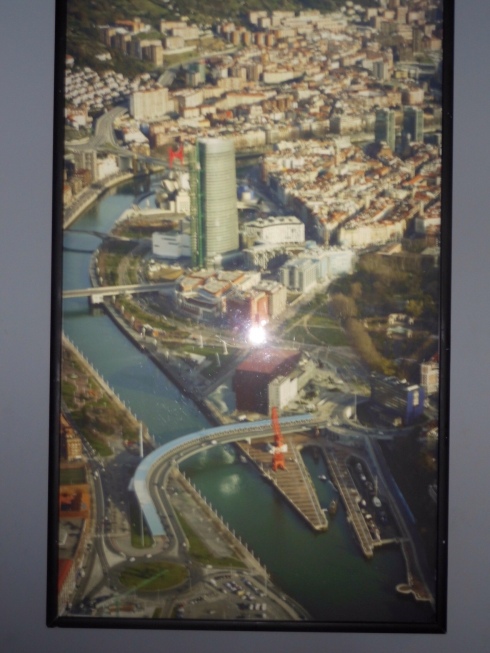
Since the 80s, and especially post the terrible floods of ‘83, the city fathers demolished much of the dockyards and obsolete industries, moving them downstream, nearer the estuary; the beginnings of re- fashioning the city’s image.

Three photos alongside each other captured this transformation, which was later epitomised by the Guggenheim Museum.

Taking a walk across the Park, we then entered the Museum of Fine Arts, which featured collections by Goya and Eduardo Arroyo.

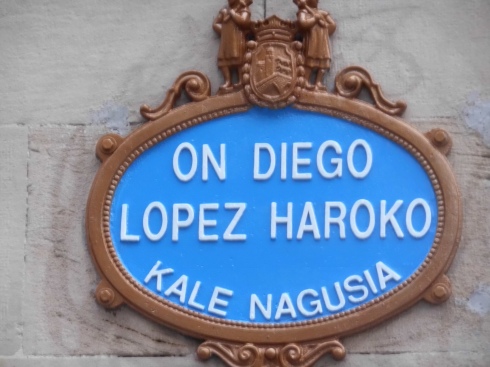
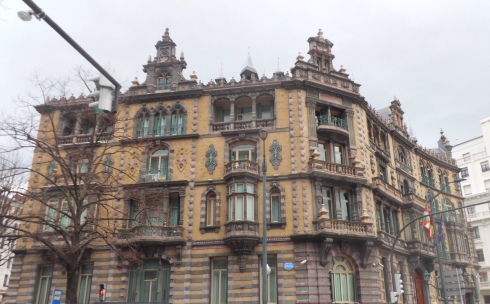
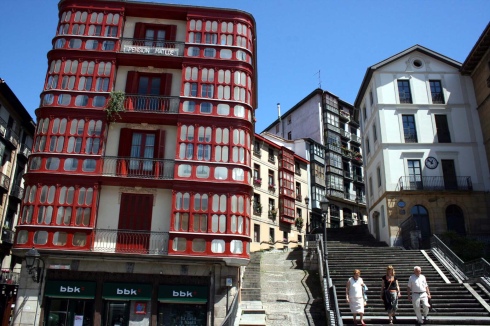
As we walked about,we were struck by the number of fine buildings, not all civic and loved the street signs, found, helpfully, on every corner.

Bridges feature greatly across the River Nervion.

We enjoyed a fine meal in the Old Town, after drinks in the Archeological Museum square, with blossoms to enjoy.

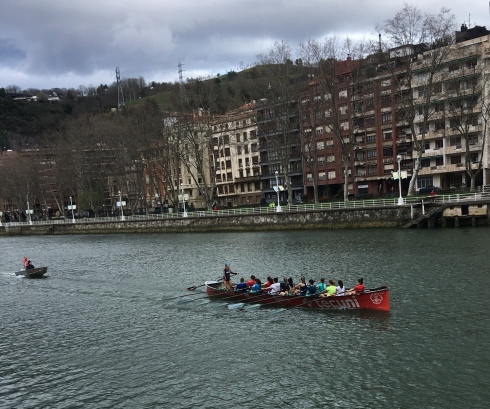
Saturday, we were already booked into the Guggenheim, for 10 am, when it opened. An enjoyable 10 minute walk alongside the river,impressed by the rowers, then crossing on the Zubiziri Bridge.

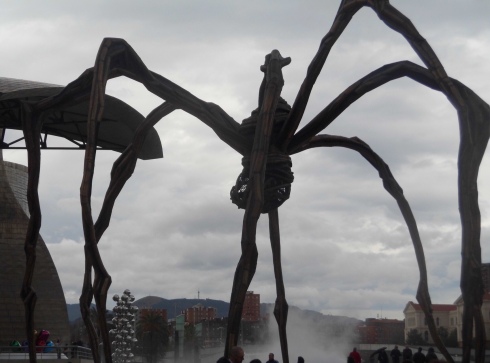
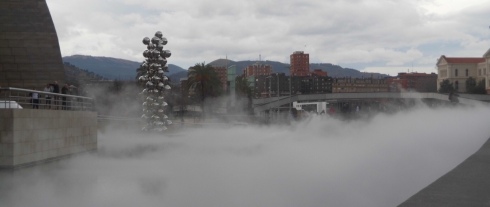
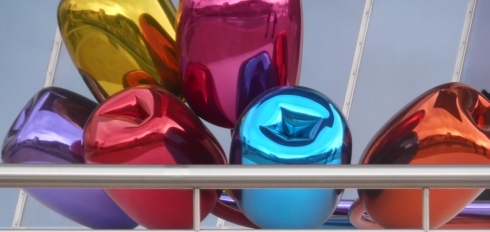
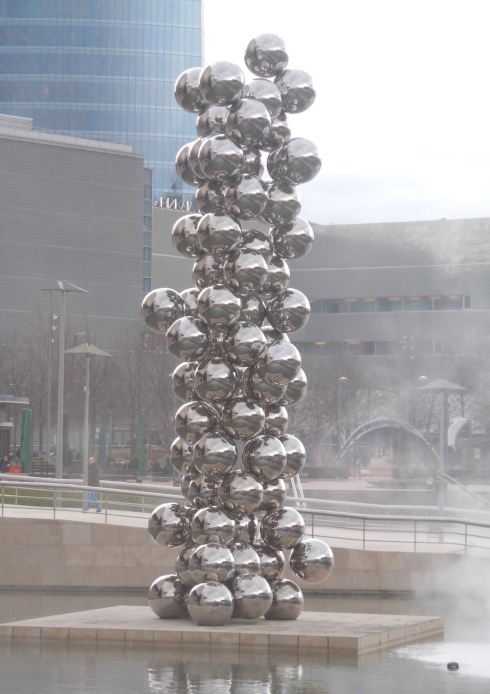
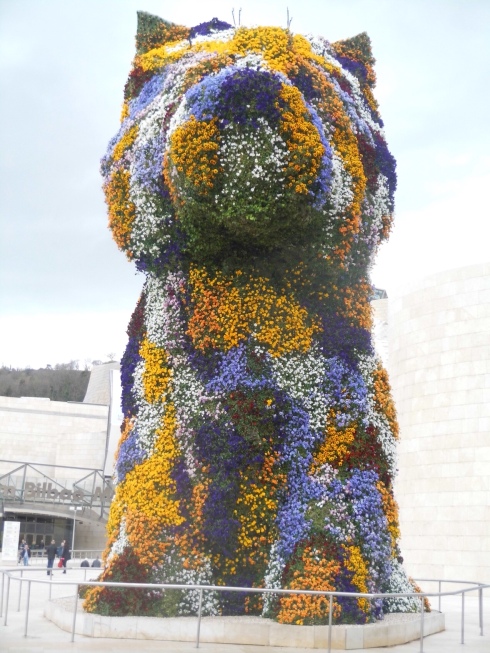
We encountered the Spider,The Mist effect, deliberately produced through a 1000 pipes ,the Tulips of and course the building itself.

I had read that some people found the collections inside this breathtaking structure, less than accessible.

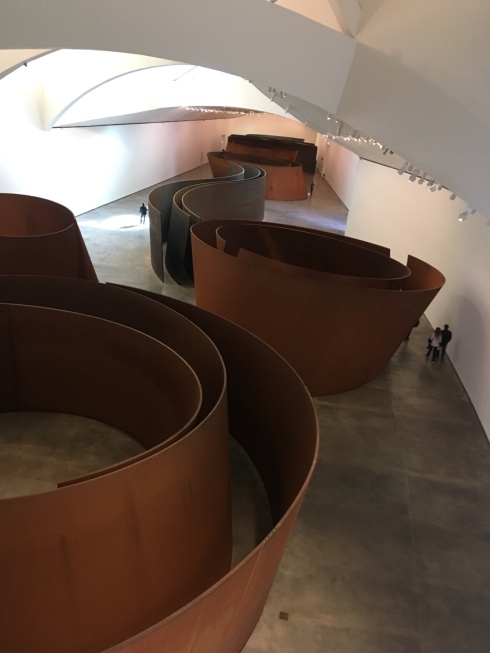
I did find it difficult,at times, to comprehend some of The explanations, but I was still fascinated by Richard Serra’s

” The Matter of Time”

And, the overall emphasis given to the variety of works of art and the imaginative way they were installed, made the biggest impression on me.

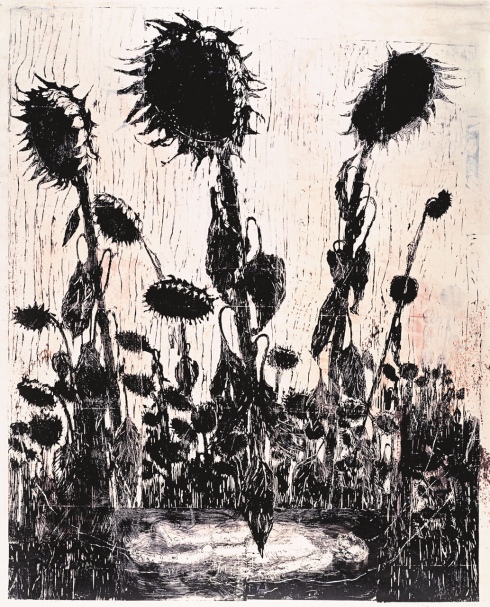
Anselm Keifer was a new name, to me; bought a print of his “Sunflowers”- Van Gogh, it ain’t.

The only collection I found disappointing, was on the third floor, by Henri Michaux.

I found its monotony wearisome.
Having taken a rejuvenating coffee in the Museum bar, it was time to go up and admire the “Puppy”.

We took a break from cultural things to have lunch in Molly Malones’ bar, whist watching Man Utd v Liverpool ; bad result for us…..

I had picked up a leaflet, previously, in the Maritime Museum, describing the Bizkaia Bridge as a “ Must See”, when visiting Bilbao. We took the Metro towards The Estuary, mainly underground,

( € 3.60 return – Real value,public transport).

We approached thisWorld Heritage Site with some trepidation- were we going to walk across that?

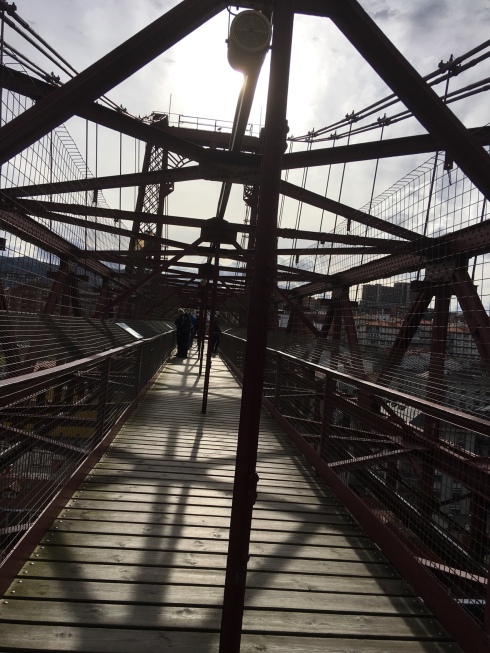
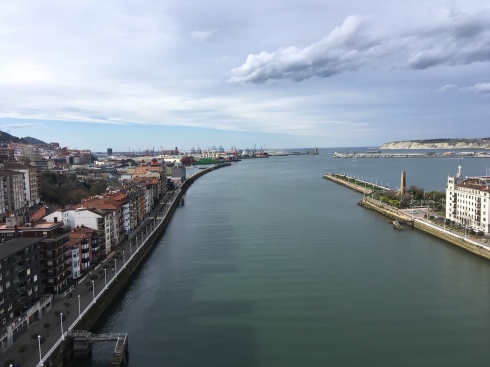
We were not disappointed, as we took the lift up to the walkway, spanning the river – viewpoints and helpful information boards – then after descending, we crossed to Portugalete, on the “ Gondola”.

Industrial history always fascinates me and this was a highlight.

Camino Del Norte signs in Portugalete and a lift up the hill – would delight every weary Pilgrim….and us!

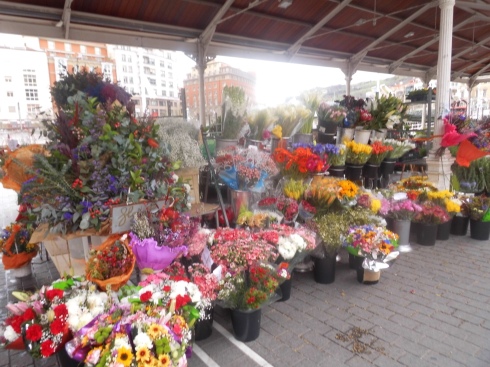
Sunday morning and we walked along the river, past the flowers market, to our penultimate activity.

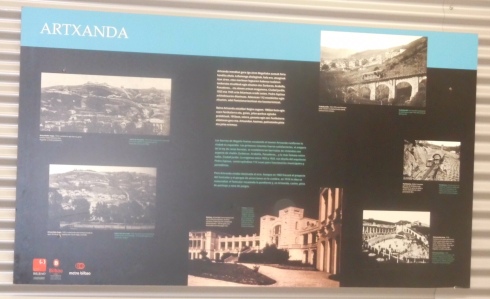
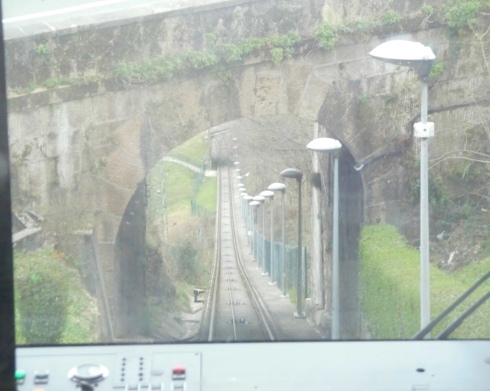
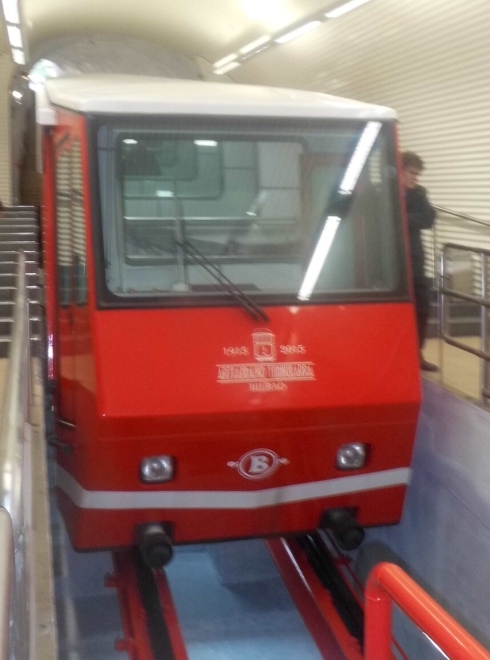
The Artxanda Funicular- it is one of the must-do activities in the wonderful city of Bilbao. This classic cable car takes you up Mount Artxanda for breathtaking viewpoints overlooking the city. It was really windy up there….

There have been some difficult periods during the 100-year+ history of the funicular (1915-2016); it has been forced to close on multiple occasions. It was first damaged by bombings during the Spanish Civil War. In 1978, there was an accident in which a wagon fell down, interrupting the funicular’s services until it was fully renovated in 1983. Then, the same year, Bilbao was hit by terrible floods, which also affected the cable car.

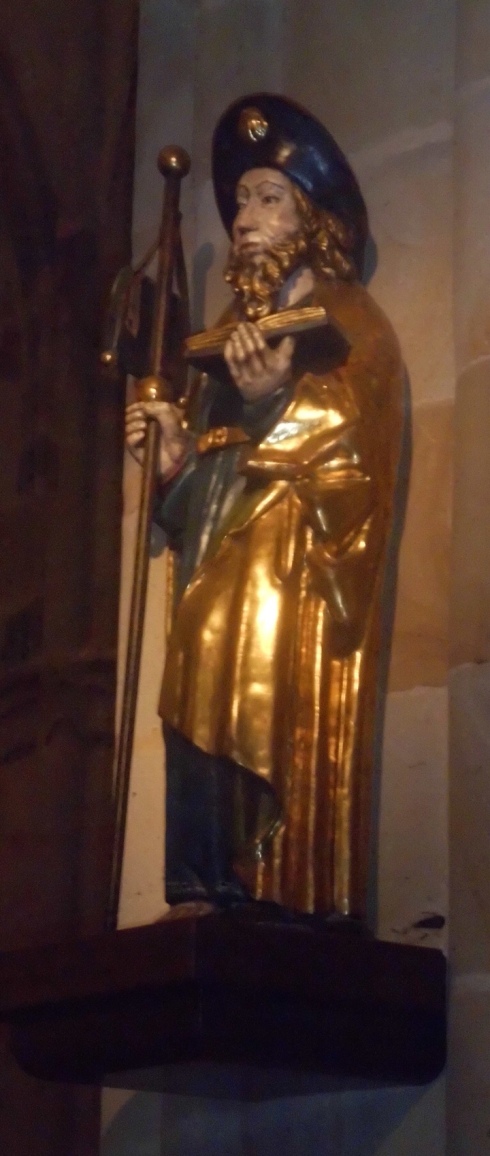
After descending,we walked back to The Casco Viejo, to the Cathedral and took the audio guide; this church is dedicated to St James and the Camino Del Norte passes by.

This was to be the last visit on this city break; time to make for the airport bus and home.
Wore and broke in my new Hoka Trailshoes – Hannah said we walked about 35 miles during this break – hope to use them on next Camino.

This final section, is based on the book, featured within it.

Much is made of the so-called ‘Bilbao effect’, the idea that attracting a world-class cultural institution – in Bilbao’s case, a branch of New York’s Guggenheim art museum – will put your city on the map, and in turn attract more investment, brands, tourism and cultural energy. This was the first time, however, that I’d heard someone say they wanted to copy Bilbao’s building exactly, swapping metal sheet for metal sheet.

So, of course, was Bilbao 18 years ago when it rose to fame almost overnight. The fourth-largest city in Spain had lost its former glory as a manufacturing centre: its factories shuttered, its port decrepit. But after Spain joined the EU in 1986, Basque Country authorities embarked on an ambitious redevelopment programme for their biggest city.

They drafted in expensive architects to design an airport (Santiago Calatrava), a metro system (Norman Foster), and a footbridge (Calatrava again), and in 1991 landed their biggest fish – the Solomon R Guggenheim Foundation, which decided to bring a new branch of the legendary Guggenheim Museum to the city, and hired star California

architect Frank Gehry to build it.

The building was an instant hit. Critics agreed Gehry’s deconstructed meringue of sweeping metal, which opened in 1997, was a work of “mercurial brilliance”. The collection inside, featuring art by Willem De Kooning, Mark Rothko, Anselm Kiefer and Richard Serra, was world-class. The construction even came in on budget, at $89m.

What’s more, Bilbao now had a landmark. Visitor spending in the city jumped, recouping the building cost within three years. Five years after construction, Bilbao estimated that its economic impact on the local economy was worth €168m, and poured an additional €27m into Basque government tax coffers – the equivalent of adding 4,415 jobs. More than one million people annually now visit the museum, which became the centrepiece of the Bilbao Art District: a cluster composed of the maritime museum, the fine arts museum and the Sala Rekalde art centre.
Basque Brilliance !

Fully recommend a visit here – four days would be ideal – then head out to enjoy the magnificent coastline and beaches of the Basque Country and nearby Asturias. Not to forget the Picos de Europa.
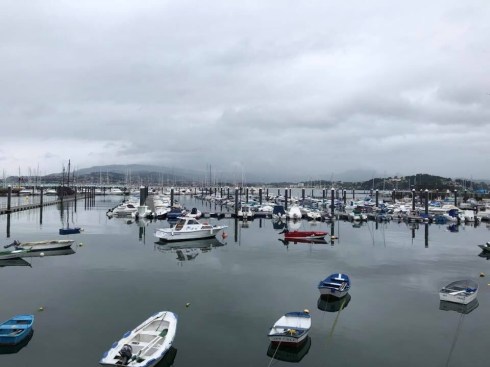
Did you know that Bilbao is the fourth largest city in Spain, after Madrid, Barcelona, and Valencia?

Oh to be back in Spain, now that Spring is not here…

Planning a Communal Camino for the “ Rambleros”.

24 Jan

“It seems thus possible to give a preliminary definition of walking as a space of enunciation.”

Michel de Certeau, The Practice of Everyday Life

Late January,2018; first Blog of the year.

Since last September,I have been preparing and planning a Camino, for a group of 25 Pelegrinos, for many of them it is a ” First”.

Our group consists predominantly of Ramblers, from Sutton Coldfield, nr Birmingham, of which I am a member,plus assorted relatives and friends , from as far afield as Rome and the East coast of Ireland.

The idea was hatched on a ramble, last summer, when I fell into step with Colin, our group’s ” Chair”; he is always looking for ways to expand the repertoire of walks for the group. You rarely emerge from a conversation with him, unscathed! In the nicest sense of having your arm twisted, a little, often, to take responsibility for” leading” one of the weekly, Sunday walks.

The suggestion for a Camino was not a bolt out of the blue, as earlier in the year, at one of the monthly ” socials”, a local couple had given a presentation about their experiences on the Camino Frances.

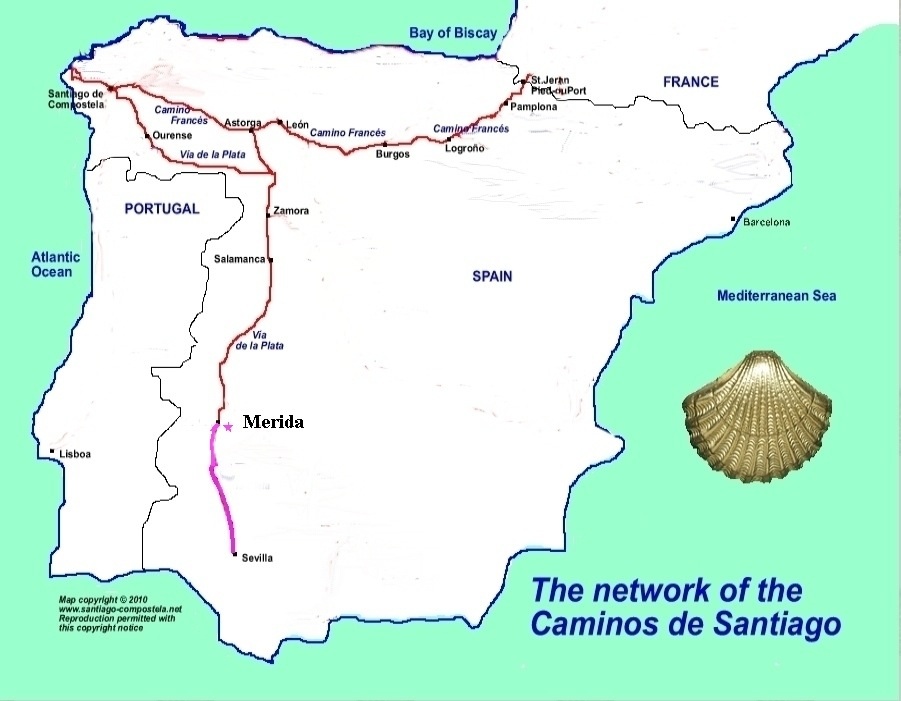
I arranged a couple of meetings at my house for anyone interested and explained, importantly, that we should not be walking the Frances, but the last 110 km of the Portuguese Camino de Costa – it’s more interesting than the last 100 or so Km of the Frances and far less crowded.

Expecting a return of half a dozen or so in the group, to my astonishment it reached 25….The most I have organised a Camino for in the past , was four, including myself.

Logistics was a term I was going to become very familiar with, as plans and bookings were made.

In the best traditions of Spanglish, I named our group ” Rambleros” and the group have received regular updates about all aspects ( I hope ) of our Camino, which will take place in early June, this year. Apart from practical tips and details of accommodation, I have informed the group of some of the problematic aspects – room sharing and transportation, for example – and have tried to evoke the differences between a Camino and a package holiday, in the hope that the only surprises we experience are memorable and pleasant .

The updates are sent as a group e-mail and I have attached some of them, below; I should be more than grateful for anyone to contact me with further suggestions for enlightenment.

RAMBLEROS ‘UPDATE II

Perfect saying for the Camino and airport transfers:-

” start doing what is necessary, then what is possible, and suddenly you will be doing the impossible.” Francis of Assisi

Three more additions to the Rambleros:-

Luisa Mostile – friend of Caterina

Brid Condon – family friend.

June Wright – friend of you all !

Bewilderingly, what I thought would be a straightforward affair, booking a transfer from S de C Airport to Viladesuso, Hotel Costa Verde , turned out to be a mixture of no replies and, in some cases , silly prices!

Eg .One, so called reputable taxi firm, Quoted € 989.00. One way? Yes!

Suntransfers looked promising, then let me down.

Finally , I have a booking for the transfer , which is 117 km, approx.

€ 335.00 ie € 16.00 per head . A very good deal, I think.

(The alternative would have been a transfer by airport bus to S de C bus station, € 3.00, ( good value ). Then bus to Vigo. Then taxis to Viladesuso. Not sure what that might amount to. Nor time spent.

Bearing in mind, we don’t land till 17.00; out of the airport by 18.00, it would make a long day….longer.

Transfer should only take 90 mins.)

The same company is providing me with a favourable quotation for the proposed excursion to The Costa Del Morte, from S de C.

Cost approximately € 30.00 for whole day excursion , Tuesday 12th June.

A wild and beautiful stretch of coastline , with a history of shipwrecks.

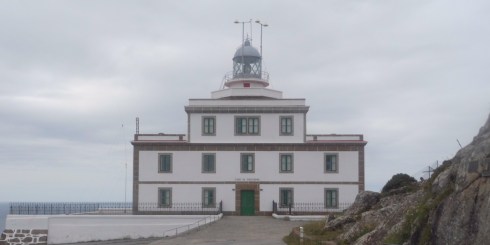
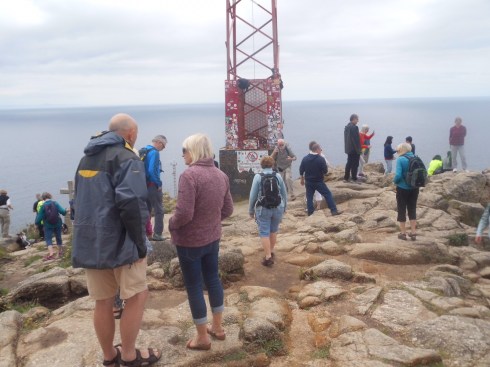
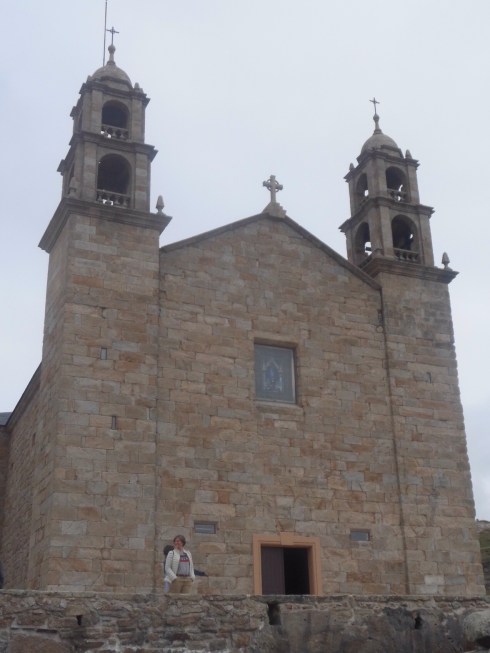
This also takes in two iconic places in the history of the Camino – Muxia and Finisterre and would come with the services of a guide.

Muxia https://www.google.co.uk/url?sa=t&source=web&cd=31&ved=0ahUKEwjBktSW7_nWAhUQb1AKHfd6AkMQFgizATAe&url=https%3A%2F%2Fcaminoways.com%2Fcamino-culture-muxia-virgin-of-the-boat&usg=AOvVaw0dtap5pjkjmUb4Mk2ugDRH

Finisterre https://www.google.co.uk/url? sa=t&source=web&cd=24&ved=0ahUKEwj06cK77fnWAhXH5xoKHdA6A_sQFgiTATAX&url=http%3A%2F%2Fwww.turismo.gal%2Fque-facer%2Ftop-ten-dez-lugares-unicos%2Fcabo-fisterra%3FlangId%3Den_US&usg=AOvVaw0WHcH5x1urdbikI

NB

Spanish meal times would then kick in…

BE AWARE

In Spanish Spain, lunch can be taken from 13.00, till 16.00 .

Dinner is 20.30 , if you are lucky. 21.00 is the norm.

I would hope that in the interests of mutual enjoyment and sharing of “ thoughts for the day” 🤗, we might have a communal,evening meal .

It may be possible to arrange earlier starts, in some venues.

Of course, some might want a late lunch – no Es una problema.

If we arrive at planned destinations, at the times I hope, then we should have time for a “ Siesta” , if required ,and chance for a local, self- guided walk about, ( recommended ) , if wanted.

THEN

Ideally :- “ Sharpeners “ @ 19.30

Briefing for next day’s walk.

Dinner

This is not mandatory! Just a suggestion.

If we can be on the Camino for 08.30,at the latest, most mornings, then it should allow for the actuality of the above, suggested, scenario.

I shall give more practical details of each

day’s walk, later, but a great lunchtime filler is a Bocadillo – a fresh, large bread roll with a choice of fillings – Jamon y Queso – ham and cheese being a personal favourite, but cafes are very flexible and non-meat alternatives are usually available.

😓Please send me your full name and Mobile Phone Number, if you have not done so, already.

Thanks,

John

PS

“it is fresh on my mind I walked some way with a couple of people who were part of a commercial tour group. I won’t share the name of it because I can’t verify the information. They pay 3600€ for 12 days including all meals, hotel stays, a support van with snacks, some special tours. The price includes luggage transport. They get to enter the Pilgrim office through a special door for their Compostela and a special place to sit on close to the altar. (I have some problem with these last 2). The people I talked to thought they were getting value. It is 300€ a day though. Judge for yourself. I think it helped some people walk who couldn’t do so otherwise but what a lot of money!”

Writer , Edward Abbey (Desert Solitaire, The Monkey Wrench Gang) inadvertently described the Camino many years ago:

“There are some good things to be said about walking. Not many, but some. Walking takes longer, for example, than any other known form of locomotion except crawling. Thus it stretches time and prolongs life. Life is already too short to waste on speed. I have a friend who’s always in a hurry; he never gets anywhere. Walking makes the world much bigger and thus more interesting. You have time to observe the details. The utopian technologists foresee a future for us in which distance is annihilated. … To be everywhere at once is to be nowhere forever, if you ask me.”
I shall be sending a separate update, shortly, with details of hotels,,average room costs and daily distances .

Meanwhile, contact me any time you have a query and enjoy your Rambles.

Pps Don’t forget to send me your full name and mobile number, I’ve only received three to date!

Regards and Best,

John

Rambleros” Update III

“Paths are the habits of a landscape. They are acts of consensual making. It’s hard to create a footpath on your own…Paths connect. This is their first duty and their chief reason for being. They relate places in a literal sense, and by extension they relate people.

Paths are consensual, too, because without common care and common practice they disappear: overgrown by vegetation, ploughed up or built over (through they may persist in the memorious substance of land law). Like sea channels that require regular dredging to stay open, paths NEED walking.”

― Robert Macfarlane, The Old Ways: A Journey on Foot

TWO WELCOME ADDITIONS TO OUR GROUP

Roger Gallier

Anita Wilkins

We are now 25 in all …..

DISTANCES AND UNDULATIONS ( none very steep )

Some slight variations, eg getting to Hotel , but near enough.

DAY I Viladesuso – Baiona. 12 KM

Hotel Restaurante Costa Verde – Monday 04/06

One Climb of 120 M

Baiona – Vigo by bus ( after afternoon in Baiona )

Day 2 Vigo – Redondela 17 KM

Hotel Atlantic – Tuesday 05/06

One, Gradual climb of 160 M

Day 3 Redondela – Pontevedra 18 KM

Hostal Santo Apostolo – Wednesday 06/06

Two, gradual climbs – 153 M and 145 M

Day 4 Pontevedra- Caldas de Rei. 23 KM

Hotel Rias Bajas – Thursday 07/06

One ,gradual climb – 135 M

Day 5 Caldas de Rei – Padron 18 KM

Hotel Balneario Acuna – Friday, 08/06

One gentle climb – 160 M

Day 6 Padron – Santiago de C. 24 Km ***

Hotel Scala – Saturday, 09/06

One steepish , but gradual climb 260 M towards the end.

( *** can be shortened by taking local bus for last 6 KM )

Day 7 Santiago de Compostela

10 – 13 th June Hospederia SAN Martin Pinario

———————————————————————————-

AVERAGE COSTS PER NIGHT, PER ROOM

Hotel Costa Verde – Breakfast included

Double € 50.00.

Single. € 40.00. As above

Hotel Atlantico

Double € 43.20

Single. € 36.00

Hotel Santo Apostol

Double € 50.00 T B C

Single. € 30.00 T B C

Hotel Rias Bajas’,

Double. € 68.00

Single. € 59.00

Hotel Balneario Acuna – Breakfast included

Triple € 118.05 x 2

Double € 65.00 x 4 and € 83.00 ( special offer ) x 4 includes thermal bath

Hotel Scala

Triple. x 1 €.70.00

Double x 6. €. 55.00

Double x 1. €.45.00

Single x 3. € 45.00

Single. x 2. € 40.00

Hospederia SAN Martin Pinario NB 3 x Nights’ accommodation.

Booking was complex, here, and because of late additions to the party, I had to shuffle Barbara and my rooms:-

1 night @ €118.

2 nights @ € 209 in total € 327.00

Triple x. 2. € 297.00

Double x 4 € 191.97 ( I had to pay for these in advance )

Double x 1. € 237.00

Single. x 4. € 198.00

Estimating”Watertight “ Averages is difficult because in three hotels, there are triple room shares for “ Singletons” which are cheaper than double and single rooms.

So, the following figures should be taken as reasonable guides, only.

Single Room average cost is € 44.00. Per night **

Double room average cost is € 60.00 Per night ie € 30.00 per person

** As indicated, when sharing a triple, this should reduce the cost.

BREAKFAST

We have breakfast, prepaid, in two hotels.

Breakfast can be obtained in all the hotels, or often, more cheaply, at a nearby cafe – the choice is yours.

Recommend taking breakfast at Santo Apostol – very reasonable when I was there, this September.

Just a couple of things.

0. If you have not forwarded your full name and mobile number, please do.

2 a. I was on the train to London recently and was writing a Blog** about the multifarious reasons people have for beginning a Camino. I should be ever so interested in learning of our reasons for doing so.

2 b.And it would be really interesting then, to compare our thoughts

AFTER the completion of the Camino.

So, if you would like to send me your thoughts, please do .⌨️ ✒️

I should only summarise them – if possible !

Full confidentiality assured, of course.

**My Blogs can be found on”ensuitepilgrimblog.wordpress.com”.

In the world there are 194 countries recognized by the UN .Galicia received pilgrims from 177 nationalities, and pilgrims from 17 countries are missing. I’m sure they’ll visit.

https://www.santiagodecompostela.me/collections/most-popular-camino-items/products/a-pilgrims-guide-to-the-camino-portugues-lisbon-porto-santiago-camino-guides latest Portuguese guide

Understanding Spanish food on the Camino –

Here’s a guide to the most common tapas terms to help you navigate these tasty dishes:

Almendras: fried almonds

Aceitunas : olives

Bacalao: cod

Banderilla: small skewer of spicy, pickled vegetables — it’s named after the spear used by matadors to spike the bull

Bocadillos: sandwiches

Bombas: fried meat and potatoes ball

Champiñones: mushrooms

Croquettas: deep fried balls of dough that are stuffed with anything from ham and cheese, to chorizo or prawns

Empanadillas: fried or baked pastries that are stuffed with meat or seafood

Gambas al ajillo: prawns sautéed in olive oi and garlic

Jamon Serano: air cured ham

Patats bravas: potatoes (baked or fried) topped with a spicy tomato sauce

Pollo: chicken

Pulpo: octopus

Queso: cheese

Racíon, or racíones: larger-size portions of tapas that are meant to be served, possibly , as a main course.

Tortilla: a omelette of many layers of thinly sliced potatoes cooked with eggs and onions

Coffee

My favourite Camino/ coffee song:-

Standard coffee terms are café con leche , coffee with milk,cortado (espresso with a little bit of heated milk), café solo (a shot of espresso), solo doble (double shot of espresso). Americano ,( espresso with added hot water)

For those who like more milk than coffee, ask for a manchado (in Spanish it means “stained”). It’s milder and whiter than cafe con leche.

This is not exhaustive …….

MAPS by an expert.

If you would like some definite mapping of our route,then John Harden, one of our group, has been grappling with a Spanish website, I linked to him and he has made PDFs of relevant sections of the Camino . He is more than happy to put them on a memory stick , to share around .

EXCURSION

I have just received some good news about the proposed excursion to Finisterre and Muxia with the same Pilgrim friendly company arranging our coach transfer, from S de C.

They are offering us the day for € 25.00, per head ! (Average price with other firms is € 35.00 ). The itinerary is quoted, as follows:-

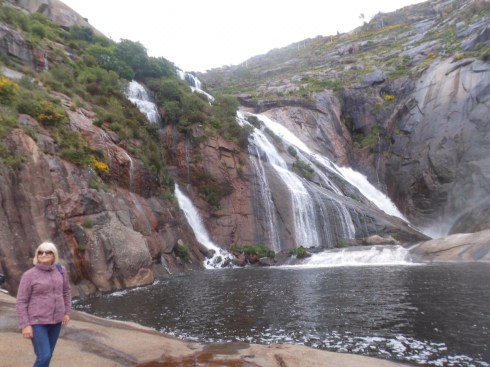
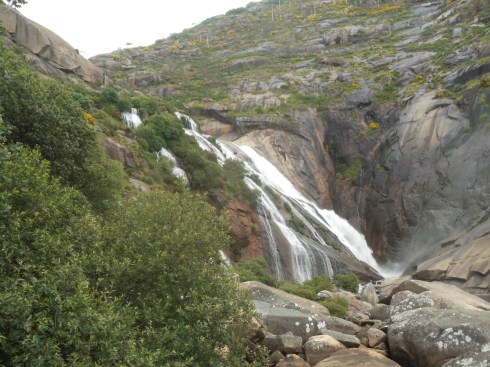
To Pontemaceira – Muros – Cascado de Ezaro ( waterfall ) – Finisterre ( free food ) – Muxia.

The airport transfer to Hotel Costa Verde is € 335.00

The whole day excursion is € 625.00

€ 960.00 in total .

A 30% deposit required by March, next year.

70% remainder, by May.

Can I suggest that I settle the whole total in March, thus saving an additional collecting of money.

Therefore, if you can pay € 38.40 each, for both trips, in February, to me, I can complete payment in March.

I have to say I have been very impressed with this company and have attached their confirmation, below for your information.

This article is is interesting for anyone contemplating a first Camino.

Albeit, about the Camino Frances – it’s not the only one Camino…..

Walk of a lifetime: Why the epic Camino trail across Spain is a route to true happiness | Daily Mail Online

Caminante, No Hay Camino

by Antonio Machado

Caminante, son tus huellas

amino, y nada más;

nante, no hay camino,

ace camino al andar.

ndar se hace camino,

volver la vista atrás

e la senda que nunca

a de volver a pisar.

nante, no hay camino,

estelas en la mar.

Translated as :-

Wanderer, your footprints are

the path, and nothing else;

wanderer, there is no path,

the path is made by walking.

Walking makes the path,

and on glancing back

one sees the path

that will never be trod again.

Wanderer, there is no path—

Just steles in the sea.

CONFIRMACION DE RESERVA – JOHN TWORT.pdf

Apologies for this rather lengthy update.

Next Update will include info. about the Pilgrim passport and training tips ( if required ! ), Spanish alcoholic drinks and those Yellow arrows.

Una feliz Navidad y un año nuevo pacífico, para todos ustedes.

John

Rambleros IV, 2018

un año nuevo feliz y pacífico para todos ustedes ✌️

Pilgrim passport details. I.e Credencial

These go by a number of names :-

Compostela

Pilgrim Passport

Credencial

I shall be ordering these for us, shortly .

Personally , prefer “ Credencial” – it’s the shortest !

Luggage Tranfer Airport Transfer and Excursion

( please disregard any earlier cost estimates)

We shall use the Mi Mochila Con Correos Service for luggage transfers,

as provided by the Spanish Post Office.

As a group we receive a discount, so I am estimating the cost at

€ 25.00 per head, for all the luggage transfers. This is a good deal.

The coach transfer from S de C to Viladesuso, a distance of 144 km. € 335.00 – call it € 14.00 per head.

Our excursion to Finisterre and Muxia will also cost€ 25.00.

Therefore, I hope you will find it helpful to submit payment to me for all three, in one transaction of £57.00, by 28th February.


Polite Reminders

Please ensure your Passport

and European Health Card ( E H I C ) are up to date.

Have you sent me your full name and Mobile number? 📱

On a lighter note, some information on drinks in Spain. 🍷

Spanish Alcoholic drinks

Patxaran (Spanish: pacharán) is a Basque liquor flavored with sloe berries, usually served over ice. Good as an aperitif or digestif.

Anís is similar to other anise-flavored drinks in France and Spain. Common in Galicia.

Cerveza con limón. How good is a cerveza con limón after a long day’s walk? Mahou Limón is the pre-made brand, though it’s better freshly made, or simply ask for una Clara .

You may be asked if you would like it with Gasera / Gaseosa, or Limon.

Spanish vermut, which is served on the rocks or in a martini glass. It’s not a mixer like in other countries.

tinto de verano – red wine over ice mixed with Casera or Gaseosa is a very refreshing drink at the end of a hot day.

A chupito is an after-dinner shot.

In Galicia, at least, a chupito means a shot of arujo, which is like mild grappa. You can have some added to your coffee, or just have a shot after dinner. It can be herb flavoured, or, sometimes coffee flavoured .

Can you recommend a local liqueur to try?

¿Puedes recomendar un licor local para probar?

Wine

A saying in Spain:

Si vas a España y no bebes vino, ¿por qué vas a España?

If you go to Spain and don’t drink wine, why do you go to Spain?

It’s not mandatory though !

vino tinto – red . You will very often be served Rioja; or ask for

A glass or bottle of local red wine.

“un vaso o una botella de vino tinto local, por favor.”

NB The Spanish usually serve red 🍷 quite cold.

If this is not to your liking then ask for one at room temperature.

“un vaso o una botella de rojo local a temperatura ambiente, por favor”

Vino blanco – white. In Galicia, Albariño is ubiquitous and very good.

🍺 Beer

Can always be obtained on draft – cerveza de Barril.

Una Cana – a glass 🥃 or

Una grande – large 🍻

Or in bottles – by all the major breweries , and local “ craft” beers.

Fitness and Bootlace Finesse Links

Lace Tying Techniques – Prevents Blisters With Almost Zero Effort

Walk This Way – Guardian article – And you thought Walking was simple?

https://www.theguardian.com/lifeandstyle/2018/jan/06/walk-yourself-fit-transform-body-joanna-hall?CMP=share_btn_link

MOTIVES FOR WALKING THE CAMINO

Thanks to Rambleros for responding to my request for sharing reasons, hopes etc; all different ! It’s never too late to send me your thoughts.

I came across this “life- changing”Camino experience, the other day.

“Walked the Camino de Santiago from St Jean to Finisterre in October. Life changing! Got home and put house up for sale! Now sold! Going to start walk again in February to find our new home on the Camino. Can’t wait! “

Hope everyone is getting out walking and, as the weather improves , we are all able to put in the extra mile.

Please let me know if there are items of information you feel would be helpful for inclusion in the next Update.

Don’t hesitate to get in touch about any of the above matters, or others.

Saludos y Mejor.

That’s where we are at present.A further Update Is already in the planning stage.

“ They Call Me the Seeker”. – 

9 Nov

Writing this on the train to London.

Youtube https://youtu.be/hiSzo82Gbzc

I sometimes put my I-pod on , when walking,I have accumulated 12000 tracks +
compiled over the years and am continually updating one of my “ Playlists” – Camino. 

I think one of my favourite, ever-present tracks is 

“One More Cup of Coffee” , by Roger McGuin & Calexico.

For me it evokes that motivation I feel , after the first coffee stop and bag break, of the day.


Why do we walk the Camino ?
At the Pilgrim Office in S de C, on application for your Compostela you can cite Religious, Spiritual,or other, when asked to signify your reasons
Within any of those headings , lie multiple , contradictory and even unknown motives.
Eg You may think your motivation is Religious, but on analysis, it could be construed as Spiritual, or vice-versa.

There are a few minor reasons for walking the Camino, and one compelling reason. I know the minor reasons, I don’t yet know the compelling reason.”


I am in the process of finalising arrangements for a Camino, next June. A group of 23 Pelegrinos; mainly first timers.

Walking from Viladesuso to Santiago – the distance  qualifies us  for a Compostela.

I wonder what their individual motives are?

And not only that, it would be fascinating to ask them , at the end, how their experience compared with their actual experience.


I hope they get more out of it than that!

What a Difference a Day Makes…..Steam train Ramble

18 Sep

One day on, from  returning from Santiago de Compostela, we are on a Sutton Coldfield Ramblers’ Sunday Excursion to the Cotswolds. Differences in the weather, terrain and company, plus time to put together a blog about the walk in quintessential, English countryside .” From Cheltenham this ramble reaches the highest point on the Common via Southam and Huddlestone’s Table. The coach is in Winchcombe so it’s the Winchcombe Way and the Cotswold Way on good, gently descending paths all afternoon.” It was also billed as a ” GWR” walk – Gloucester and Warwickshire Railway – Or as I read it…Great Western Railway…or” God s Own Railway”! Anyway, for me, the sight of a steam engine in full blow, is always approaching ” heavenly”. The ” sheds”, as we used to call them, are always interesting ; engines,  even diesel locomotives, rolling stock always fill me with curiosity.


09.55. Five minutes to go to departure and you can clearly recognise  who is dressed for the occasion and  will be blowing the whistle. All these railways depend on enthusiastic volunteers – preserving or heritage – many thanks to them.


The train took us along a mainly, single line. I was further able to relive my early, teenagetrain-spotting days, by being able to not only open a window, but to lean out and take photos. Had it been in the train-spotting days, it would have been to take the number of any fast approaching engine, on the other line. Either way, a speck of coal grit, in the eye,  was an inevitable consequence. 


We passed through a couple of Halts and stopped briefly at a station. Floral decoration was a feature and emphasised the pride taken in both the restoration and maintenance of the stations; one of which was now a private house. Would presume the owners are also enthusiasts ; I should love to live there.


What do you think “S W ” is instructing the train driver?


We alighted at Cheltenham Racecourse Station, divided into a choice from two walks; the”a” walk being the longer of the two. Both would finish in Winchcombe.


A sign that always brings ” relief” to Ramblers, anywhere, even on railway stations…..


Colin, our irrepressible chairperson and today’s walk leader, pointed upwards, across a still, somewhat misty landscape, at a flat hill – that’s where we are heading – a bit of a hill – we all knew what that meant.


Not only that, we were to forgo the beloved ” coffee break” and pause for lunch, only when we were atop it, became most had enjoyed refreshments, either at the station cafe, or on the train – bacon rolls were very popular. Given recent amounts of rain, it was unsurprising to have slip and slither occasionally, en route, but the summit was made in good time and the air was clearing, too. 

There was even  time for a swing, along the way.


A famous landmark was reached, where we coincided, with the other group – Belas Kapp Long Barrow – over 5000 years old.


The groups made their way downwards towards Winchcombe, passing the only Five Star Hotel, in Gloucestershire and Sydeley Castle could be espied nearby.


Winchcombe’s famous Abbey, in the foreground and on to Rosie’ s Pattiserie, where a warm welcome awaited. Perfect end to a great day day out; very different to the landscapes, I had enjoyed over the previous fortnight and the rain stayed away, until we we were well on our way, in the coach Höme. 
” I’m Carrying a Heavy Load”…No More…Final Day; Final Thoughts in Santiago.

15 Sep

https://youtu.be/uc4Hz4WXD6M Heavy Load by Free.

A slow burner song, with great bass…like my rucksack burning up my energy, this time;

 but no more. Still got a Camino in me, maybe the last time.
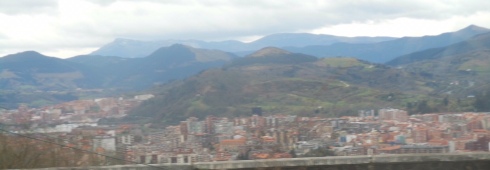

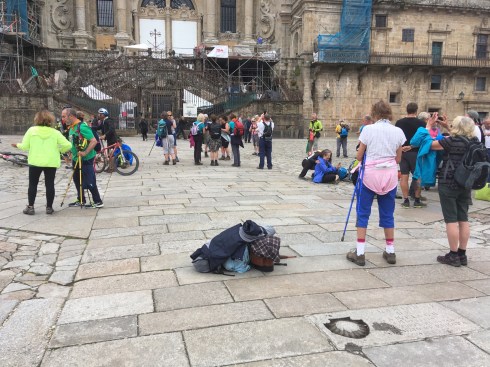
Friday, 15 th September, 2017, spent in leisurely style in the old town. Entering by Porta Camino, close to the Alameda Park, it was very quiet, compared to the crowds of yesterday evening. Shop shutters grunting upwards, street cleaners pushing their wheelie bins and a few bar staff wiping down tables. It was only as we approached the Cathedral that it became more populous, chiefly, as a result of Cruise –  tour parties, lining up to see St James’ famous church….by 10.30, they were omnipresent. They are bussed in from Vigo, an hour or so away up the motorway. Complimentary shells were worn, naively,on their bellies. As they dispersed, the scene resumed some normality,with pelegrinos arriving from all sides of the Praza do Obradoiro – a young group threw themselves down on the ground and did twenty press-ups in unison, bicigrinos lifted their cycles  above their heads, like cup winners and young women performed  a similar feat with their rucksacks.


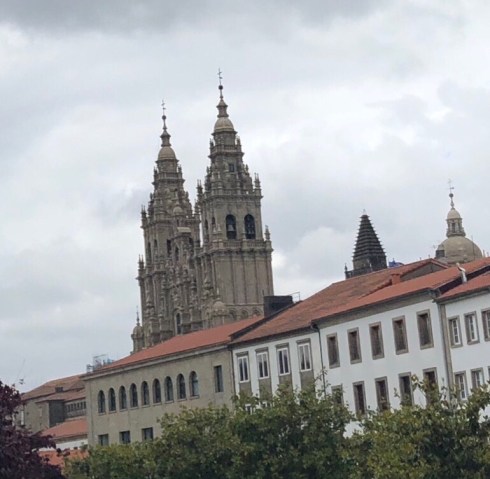
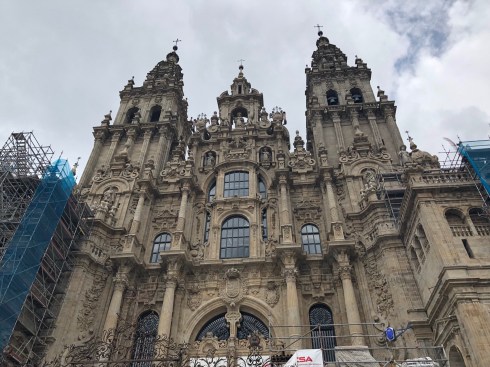
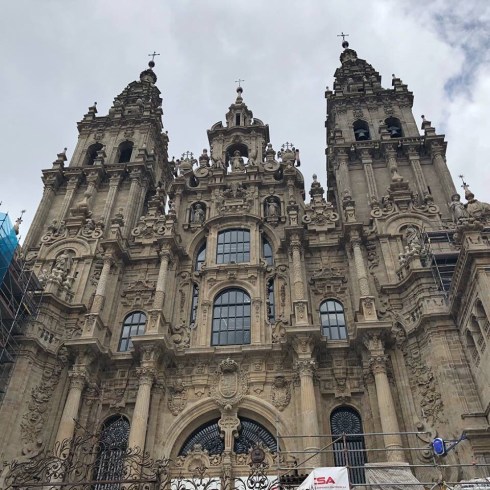
As I contemplated the scaffolding which covers the Cathedral, I wondered why the authorities allowed it to become so weather worn and delapidated, considering the € millions, tourists and pilgrims spend, annually, in the city – it is going to be a very long time before the Cathedral can show its face to the world again. I walked around to the  Hospederia San Martin Pinario, a wonderful place to stay, if like me, you can’ t afford the Parador; sat on the wall , listening to Galician Pipes lamenting their way up, from a nearby gateway and watched an impromptu, rehearsal of a dance routine. This was more typical, in terms of music and spectacle, of the city.


I then reunited with Mac, after some mandatory T-Shirt and bracelet shopping, to wander down the cobbled streets, to a favourite cafe ,The BISTRO – Earl Grey for me and a taste of Mac’s chocolate cake with Grand Marnier – these Caminos are hell, aren’t they?


I hope you like Mac’s bracelets….they were quite an outlay ! Despite the maddening cruise groups, the inevitable crassness of some shops, the city is still a majestic and captivating destination; none better than at the end of a Camino, however long,or short. It is only possible to give a glimpse of the beguiling nature of Santiago. So here is a mere, scintilla , including the famous ” Pilgrim’s Mass”, with its crowd pulling, flying Thurible.. There are far more fulsome and erudite guides to be found on the Net and in a plethora of literature. Actually, I find Wikipedia more than sufficiently informative!


And two posters to close this Blog and this Camino.


In the end, we walked a “Buen Camino”; may you, one day, too.

“You don’t have to know where you’re going to get exactly where you need to go.” ― Marilyn A. Hepburn….But we got to Santiago de Compostela.

14 Sep

This is another, favourite quotation of mine; never a Camino without these experiences…

“The paradox: there can be no pilgrimage without a destination, but the destination is also not the real point of the endeavor. Not the destination, but the willingness to wander in pursuit characterizes pilgrimage. Willingness: to hear the tales along the way, to make the casual choices of travel, to acquiesce even to boredom. That’s pilgrimage — a mind full of journey.”Patricia Hampl Favorite Report

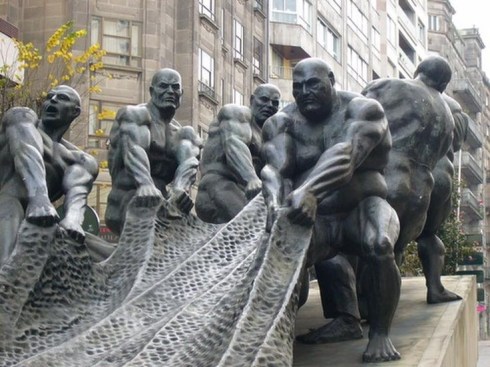
This powerful sculpture is in Padron. There are a number of highly significant sights and scenarios, in this understated place; usually more renowned for its Peppers than its significance in the history of the Camino.


The legendary Padron, the alleged landing  of  St James’ body,   

the hill  where the Apostle preached ….and much more.


The final etape of the Camino ; the final stages, entering the city, are uninspiring, but the rewards are great.


Back to basics, and mea culpa if I repeat myself, Santiago, for all its powerful resonance as a pilgrim city, is still a tourist destination and it is best to be aware of st least two things. Accommodation outside the Old City is better value and so are the restaurants. Our accommodation is a ten minute walk from there, in a state of the art, private Albergue…..not quite “Ensuite”, but for € 16.00 a night, unbeatable value – a single room, each. Just a few photos to give a picture of what an Albergue could be…


We took a quick brunch at a sociable cafe, nearby; Mac ingratiating himself with the staff! Never fails to get a smile…


Then, up to the city, which although I have visited it often, is always as enticing  and buoyant as ever. Whether you want baubles or fountains,  frescoes or colonnades, you will find them, here.


The Cathedral is smothered in scaffolding, which rather detracts from the feelings you may have anticipated before arrival; here are two photos ….before and present day ….we haven’ got an ” after”, yet. Top down, it will be magnificent, I think.


Well, certainly the Top part- restored to a pristine condition . Other pelegrinos lie down and bask in the sunshine, having placed their feet on a famous stone mark. Some of them have been on the Camino for 800 – 1000 KM; six weeks, or more.


We then made our way to the Pilgrim Office, to queue patiently, for our Compostelas – the certicate of completion, in Latin, and if you wish a certificate, in Spanish, marking the distance you have walked. This is a photo of the former.


The queue is well organised and the time goes by chatting to other pelegrinos. There are a number of desks where your Pilgrim credencial or passport is scrutinised; don’t forget to buy your cardboard tube to keep your compostela safe and unruffled. Mac ready to go for it….the Compostela, that is.


Afterwards, we had a beer at a nearby bar, sittiing in the sunshine, chatting to people we had encountered over the last fortnight ; everyone eager to share stories and experiences, in their exhilaration at reaching their journey’s end. 


No apologies for finishing with another favourite, tomorrow,  our last day, here, I hope it is as good.

“Few people know how to take a walk. The qualifications are endurance, plain clothes, old shoes, an eye for nature, good humor, vast curiosity, good speech, good silence and nothing too much….” Ralph Waldo Emerson, Country Life, 1858

A quieter day to Villanova de Arousa

13 Sep

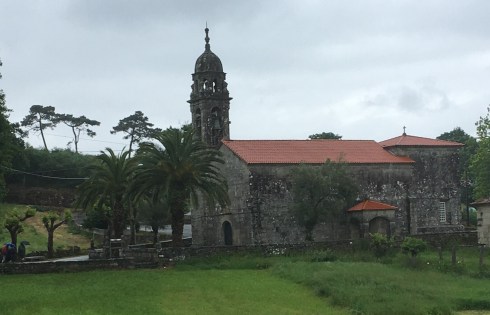
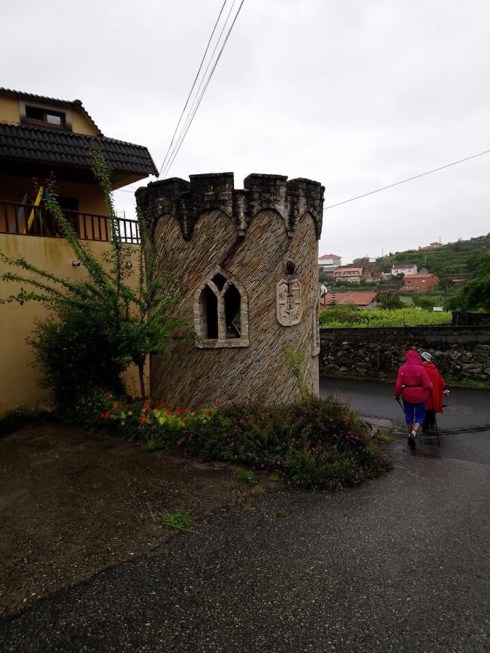
Shortish hop to Villanova; only 10 KM, by quiet back, country lanes. Vines and Maize predominantly….and a good, few dogs, thankfully tethered. We did pass a church, with an interesting altar stone, on the outside – weathered shell motifs. D and Mac were observing this from beyond the church wall….it was a relief to them when we moved on!

There had been some drizzle, this morning, but it was still warm. Pausing at this shell- covered house, we were glad to get out of our ponchos – very clammy.
We passed a quiet evening in the hotel and the next day, made our way down to the port, to board a boat which would take us up the Ria de Arousa to Pontesecures, and a bridge crossing in to Padron. The mayor was there to see us off – he had been with us at the Adega – he has been mayor for twenty years and unlike our mayors, his role is far from nominal, as he is elected and in these parts, that means 100 000 potential voters to be wooed. We didn’t realise, until we disembarked, that he had paid all our fares, for the trip… he gets my vote!

After we had posed for more photos, we set off under the sailsmanship of a man whose principal role was in sub- aqua, it seemed. He proved to be a great guide on the trip, his name, appropriately, was Santiago. I love working harbours and hereabouts the Mussel industry dominates the Ria. 


These are the second biggest Mussel beds in the world, there are nearly three thousand of these platforms, all worked by families – a lot of the harvest is exported to France and Italy. The boats have a small crane, with which to lift the cages of mussels – these are taken from anything like, five hundred ” strings”, dangling down from the platforms.

There are several nature reserves, both on the banks of the river and on islands – the warden of one of major habitats came out  and wished us a good voyage; friendly wave from a fisherman, too.

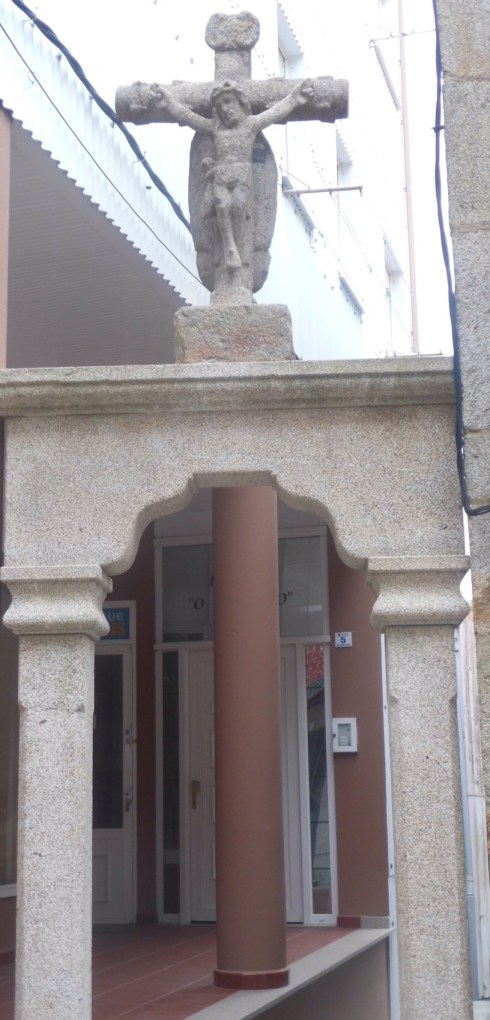
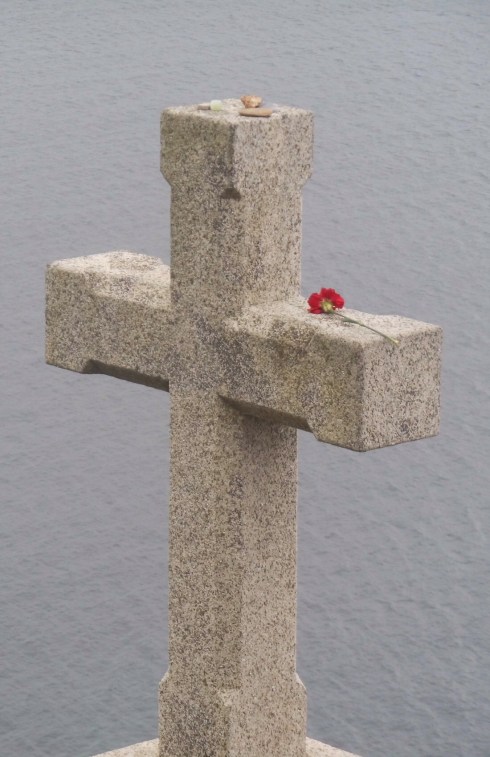
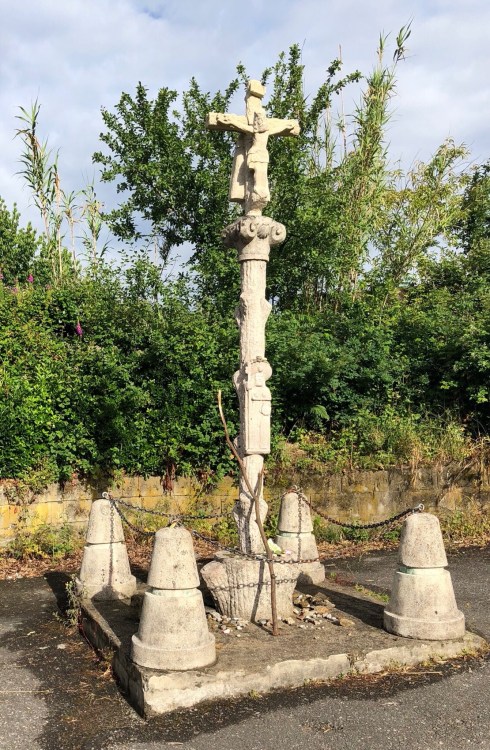
There are numerous stone crosses, situated on both banks, along the way, dating from the early 19 th century; placed to guide pelegrinos towards Padron. In those days, it was the preferred way to travel. We preferred it too…. a 27 km boat journey, rather than a 28 KM walk.
Lots of birdlife, Cormorants and Royal Herons abound. Nearing our destination, as the river narrowed, two more historical points of interest – the remains of an ancient fort, strategically place on the narrowest neck of the river and two replica Viking ships.
More recently, Nestle have set up a big plant, opposite a huge milling foundry.
We docked at Pontesecures – a Roman site at one time – Pontesecures means ” Caesar’s Bridge”, which now carries ” legions” of pelegrinos up from Caldas de Rei, on the orthodox Portuguese routes, into Padron. It was time to say farewell to our navigator and carry on across that very bridge.

This is the end of the Spiritual Variante, which will doubtless grow in popularity, in much the same way as  the Portuguese routes.
A memorable detour.

The Camino Provides….on  the Spiritual Variant…and Surprises.

12 Sep

https://youtu.be/HI8cToXmS1s ” The Pilgrim Song” by Cecilia Samaritan 

Just  when I thought my rucksack carrying days were over, I received an e-Mail from TUITRANS, the company I had used for the previous four days, which dismayed me, as the cost suggested  for the final, four days had gone up by 250%! They don’t have any competition on this section, I.e the Spanish Correos, so their prices are exorbitant. This did not spoil our meal, together with B, of our party, in the majestic Comedor, in the Monastery. We hoped we would meet up with her, for the boat trip, on Wednesday.
Monday commenced in Misty, damp conditions and after breakfast in a nearby bar, Mac and I set off; our first stopping point to be the delightful fishing village of Combarro, just three Km away. I was once more carrying my rucksack and it had not been a problem – four walking days without helped – as we were entering the village, Mac’s phone went and after ignoring two calls, he finally answered. It was our leader,C, telling us wait on the main st. as the Chair of the local Peregrinos’ confraternite had been in touch, and had offered to transfer us by minibus over the mountain, ahead , as sections could be dangerous.


Within minutes we were aboard the minibus after being introduced to Celestinio , the president of The Portuguese Costa confraternite; he guided us around Combarro and I splashed out on the local “pin”.


 He  was to be our host and guide for most of the day…..and night. Someone whose knowledge and enthusiasm for his beloved Camino was inexhaustible

THE CAMINO PROVIDES
We were never more relieved to be aboard, as we climbed up the mountain.I think it would have finished us off. But there we were, being transported over it , rucksacks and all. There was still some cloud over the Ria, as the sun gradually made a bashful appearance. We walked along the top for 600 metres, to another viewpoint.


At that point we were reminded it was time for a coffee, which we enjoyed, along with Empanadas and samples of Galician style stew,at a mountain top golf course….An incongruous, but unique setting.

Looking over the driver’s shoulder, on the way down.


The tour continued with a stop at a Cistercian Monastery, where we were warmly greeted.


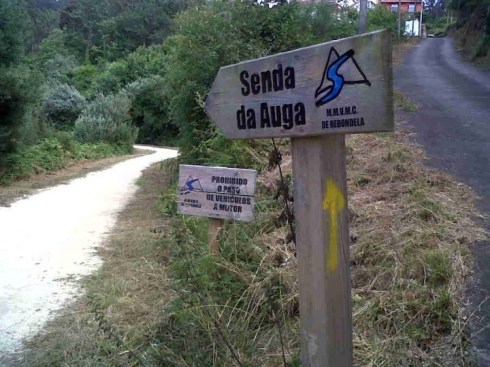
….then a reality check….some walking to do 11 KM along the Rua de Pedras a de Agua, downhill, following a stream and over some stony pathways, reputedly one of the most peaceful and picturesque stages on all the Camino.
 We enjoyed this walk, bypassing the ruins of many small water mills – Muinos- as we went. After a stop for a ” Clara”, we made it to our base for the night  – all five of us at Hostal Santa Baia, very new and most comfortable. We only had an hour or so,to showers etc; before our host and guide would be arriving to collect us and take us to a small reception at a local Adega,renowned for its Albariño wine.We were whisked away and were greeted at the Adega Eidos…the setting alone took my breath away, let alone the stage of the art wine making production, the vineyards and the views. We sampled three distinctive Albariños, together with samples of seafood – the crab pate was muy bien – as were the wines and the hospitality. 


The evening was not yet complete. 

After being given ” Goody Bags” and posing for a group photograph, ( note the caps ) we went on ,with a tour around the Ria and I was impressed with both the beaches and the settings, along this magical coastline. There was plenty of Holiday development, but nothing out of place. We stopped at Lanzarda, which had a Miradour, ancient fort and chapel, set alongside a Necropolis, which ahead been partially explored; apparently it was a huge town in its day, with much yet to be excavated. The sun was setting and Mac spotted Dolphins, frisking about in the Bay.


After a further tour of the coast, including a very exclusive looking resort, Isla de Toxa, we arrived at a restaurant , for dinner, at about 10.30 pm.


We sang ” Happy Birthday” to D, one of our number; the locals applauded.

Back to base for midnight; more shattered than after a 25 KM walk !

THE CAMINO PROVIDED INDEED…
https://youtu.be/p1GkR54wQaM ” Looking Back Over My Shoulder” – Mike and the Mechanics.

Leaving Santa Apostol…” King Harvest Has Surely Come”…to Hospederia Monesterio de Poio, via the ” Variante Espiritual “

10 Sep

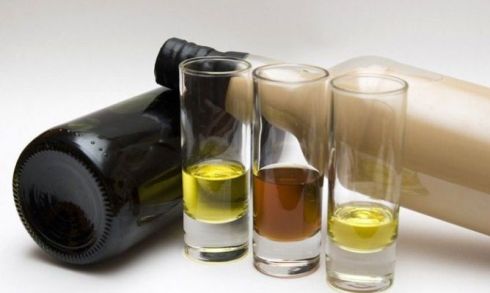
Saturday evening was enjoyably prolonged, after dinner in Santa Apostol,by a conversation with the host , who is a Knight of St James. His English was good and he told us of his devotion and affection for the Coastal Route – not in the least sanctimonious, or pompous – largesse and good humour. He treated us to samples of Orujo, a Galician specialty liqueur, pointing out the differences between the ” herbas”, the “aguardiente” and the ” crema” – didn’t fancy the latter as he said it was akin to Bailey’s !😝


Sunday morning dawned brightly and after a light breakfast, we set off for Pontevedra and the Deviation of the Variante Spirtual. We walked with two ladies from Colorado, USA! We had met them a couple of days, previously; Chris & Kris. Real enthusiasts, they were greatly taken by this little shrine, en route.


We soon reached Arcade, which I remembered from my solo Camino, because it was drizzling that day and I had my photo taken by a couple of Portuguese ladies and I reciprocated – that photo is on the front blog page. I got Mac to take one, in the sunshine, this time. The bridge is famous in Galician and Spanish history of Independence, because Napoleon was defeated here.


After crossing the Sampoio Bridge, we had coffee and complimentary Churros, in the company of two guides from a local company, whose job was to take Turigrinos from place to place, en route. The lady gave Mac some impromptu lessons in Spanish pronunciation, warning him that mispronouncing ” Arousa” – one of our destinations, would lead to a misconception about a Russian woman!


We walked on and before long came to the Capel de Santa Maria and obtained a “sello” for our pilgrim passport – you need at least two per day , in the last 100KM in Galicia – made a change from bars and hotels.


All along the Way, there were fields, gardens rich with grapes, tomatoes, quinces and oranges – ” King Harvest Has Surely Come ” – https://youtu.be/5tWR3F4oQN4 – The Band, from THE GENUINE ROCK OF AGES Album, came to mind.


We were nearing the outskirts of Pontevedra, a city of 80 .000 inhabitants and a famous pilgrimage centre on the route to Santiago – the suburbs are far from endearing and you would not think that its historic centre could be such a contrast – but you could describe the approaches to Santiago, similarly. There were  two images that cheered us up.


And so into Pontevedra, where I had stayed twice before – it is a great city – its most famous Camino church is shaped as a shell. The old streets and remains are really well preserved, as is the bridge which  takes  you Northwards , towards both Santiago and the Variante Spirituale.


We though there was a Camino Exam coming up, at this point…

Revision notes, please!

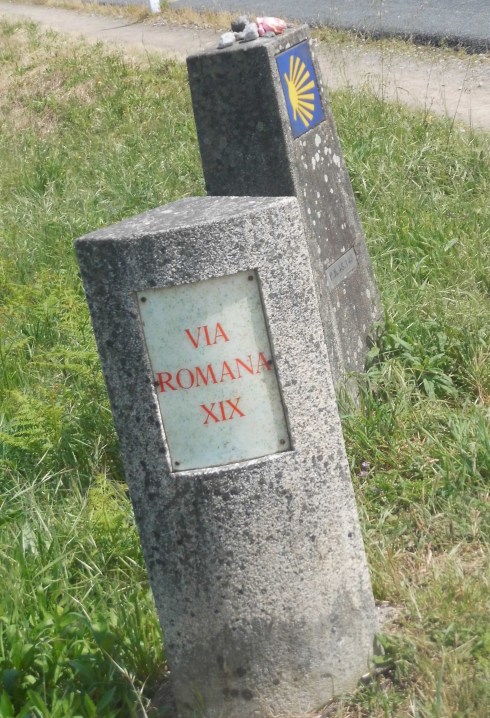
After two KM, the Way goes along a Roman Road, towards the turn left to the Variante Spirituale, with its distinctive waymarks. This Variante has only been supported since 2012.


An easy stroll took us to the Monastery of St John de Poio, with views of the Ria de Pontevedra – the heart of the Rias Baixas. There is a wonderful cloister, ribbed  vaults, and an amazing mosaic, based   on the Camino.


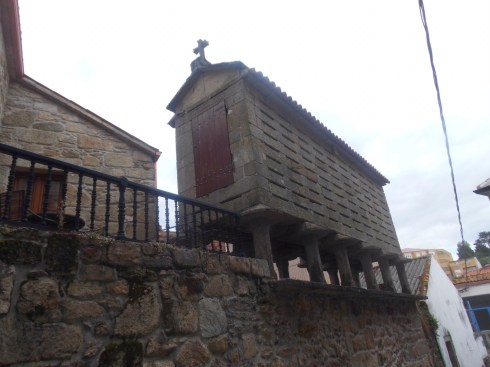
and also, the longest “horreo ” in Galicia , if not Spain – these are grain stores – symbolic of Galicia.


This region makes the best Albariño wine; the Monastery makes its own – € 6.00 a bottle in its bar!


And now for dinner…