Archive | July, 2021

A Unique Life in the Year of My Allotment

27 Jul

“My passion for gardening may strike some as selfish, or merely an act of resignation in the face of overwhelming problems that beset the world. It is neither. I have found that each garden is just what Voltaire proposed in Candide: a microcosm of a just and beautiful society. ”
Andrew Weil

For “ gardening “ add allotment to the quotation above. Both my allotment and our garden were and still are lifesavers in these perilous times,here on “ Plague Island”.

The pond…six months on.

I want to look back on what is almost a year of transformation at the allotment during Covid. Doubtless, having it as a resource,especially during lockdown, has provided an outlet for creativity and hopefully, bountifulness.

The main catalyst for such a momentous year was the acquisition of a greenhouse. Last September, I placed an enquiry on “ Nextdoor “, a local,neighbourhood forum, asking if anyone had a greenhouse they were looking to dispose of, ideally for free! Within 24 hours a lady contacted me to say she had an 8 x 6 foot greenhouse in good condition- needing only to be dismantled and removed.

In its original setting.

Job done with help from a friend,Bob, and my wife,Barbara. I made a donation to a charity of my benefactor as I was given not only the greenhouse, but fixtures and fittings,including a paraffin heater .

It was in October 2020 that the actual erection began. Again with help from another friend,Mick,whose architectural background included that eye for both detail and place.

Thanks to Mick I had a frame in place and what was needed was the installation of the glass panes. I lacked the confidence and know how to attempt this and so a considerable delay ensued. This hiatus led to me having my leg pulled by some of my fellow plotholders until one day,nearing the end of the year, Malcolm our plot treasurer volunteered to give me a hand.

Job done II.

He was well organised and “nifty”,to use an old fashioned phrase – thanks Malcolm. Without my three friends’ assistance I should probably have only managed the kit below.

Recently I sent it to my grandson,Jake.

The greenhouse was in place and even screwed down after the loan of an electric screwdriver from another good neighbour on the plot,Phil.

The stone blocks were recycled from Malcolm’s plot – recycling was to become a main feature of the plot’s development from then onwards.

“Gardens are not made by singing ‘Oh, how beautiful,’ and sitting in the shade. ”
Rudyard Kipling

It was Spring of this year when further transformation and creativity kicked in. With help and encouragement from Phil and the loan of his drill, I started making trellises and raised beds. I made new paths and constructed a pond.

My very own first raised bed which I gave to Hannah.

In March,I had no notion that any of these would happen – my allotment was evolving- I could never claim to have planned it. I think the quotation below is absolutely appropriate.

The recycling element of the plot’s evolution came about mainly through Phil and Malcolm’s example. Phil could not pass a local skip or building site go by without scrutiny for any object that might be reused at the allotment…It’s catching I’m afraid…and I have found all manner of useful bits and pieces. I even came across an unwanted miniature table,left on the drive of a house nearby.

The wooden path edges and clippings are all recycled.

The pond was another “ find”. Opposite my plot adjacent to the railway , is a small copse thick with ivy and overhung by fruit trees. I had noticed that there was a square metal tank; goodness knows what it’s long gone owner’s’ intentions for it were, but I saw a possibility. I went back to the greenhouse and sat with a coffee in hand,sizing up a place for it as a pond. I wanted it to be close at hand. Having made the decision,I dug out a metre square or so of soil to a depth of 25 cm . I then sort of rolled the tank a distance of another 40 metres and with baited breath lowered it into place.

And it didn’t leak!

I edged it on two sides, planted some wildflower seeds I had saved from last Autumn and placed some pots of Chinese origin that a neighbour of Phil’s was looking to dispose of. Then I added a couple plants for oxygenation purposes and a water lily cutting from my garden pond.

Come JUNE and the wildflowers sprung into life.
Apart from the greenhouse, the pond is my second most treasured feature . Jude and Martha ,my grandchildren added some Newts captured from our garden pond. A large frog has been seen since,too!

RECYCLING has been of various kinds. Seed saving, skip perusal, ideas from neighbours and the Web are all in their own way a form of recycling. What follows are a few examples, from an abandoned garden table to wire squash trainers.

Another Chinese pot.
TRELLISES

I almost forgot the earliest form of recycling,in February ,of horse manure from a field behind William Wheat garden centre,near Aldridge. That was after an earlier,not to repeated experience when an earlier request on the Forum took me unknowingly to a semi detached house in Banners’ Gate,behind which were three Shetland ponies, in a small rear garden – imagine what the neighbours have to put up with?I loaded up the boot of the car and made a hasty retreat.

The green house inspired me to sow some flower seeds for the first time. “ When the flower blooms, the bees come uninvited. ”
Ramakrishna.

The curious assortment of upturned bottles is not a bin,but a store of natural plant feed,distilled from Comfrey. You simply stuff Comfrey leaves in to an upturned bottle from which you have removed the base,add water,leave for 3-4 weeks and you gain a feed which is beneficial to all kinds of plants. I alternate the weekly feeding of tomatoes , squashes and peppers with Tomorite.
The Cosmos are in competition with the creeping giants behind. Trompettini,Shark’s Fin Melon and Eden Valley Pumpkins.

Looking back on my fifteen years apprenticeship as a plot holder, I can remember when you were thought to be eccentric if you had a shed! What would the old guard have made of the pergolas,pathways,leisure spaces and feel for design that has been particularly noticeable during Lockdown – the welcome arrival of younger people and families has brought a fresh approach to Sunnybank allotments – what would they have thought of my Potato Tower?

It worked…to my amazement.

You still have to put a shift in now and then – the less attractive side of plot care.

You sometimes have to do this in order to achieve this
Seedbed all ready for planting.

I have learned a lot this year – I certainly won’t try to grow 40 tomato plants, 10 aubergines and 20 various peppers and chillies next year but then Covid may not be as restrictive in 2022. What else could I have done ? Watched Netflix? And the above are all flourishing,not to mention umpteen courgettes, pumpkins,squashes etc.

“Garden as though you will live forever. ” Thomas Moore

I have never been so aware and thankful for my green spaces in these horrendous times – I feel privileged.

The Wear,the Priory,the Camino,the piggery,the riverbanks, streets,chapels and cathedral of Durham city…Finishing with a reflection and a song.

9 Jul
The Wear by the Priory.

The very extensive remains of a 13thC priory, founded on the site of a retired pirate’s hermitage, St Goodrich .Part of it later served as a holiday retreat for the monks of Durham Cathedral. Beautifully sited by the River Wear – a most peaceful retreat – English Heritage should install more information within the remains of the Priory as there is only a very small sketch map outside the adjacent shop.

St Godric died here at the age of 105, having spent most of his monastic life living and sleeping outside.

A short riverside walk through the wood brought us to a piggery.

This reminded me to take home a piece of pork from our nearby butcher,tomorrow morning – requested by Hannah for her birthday dinner on Sunday!

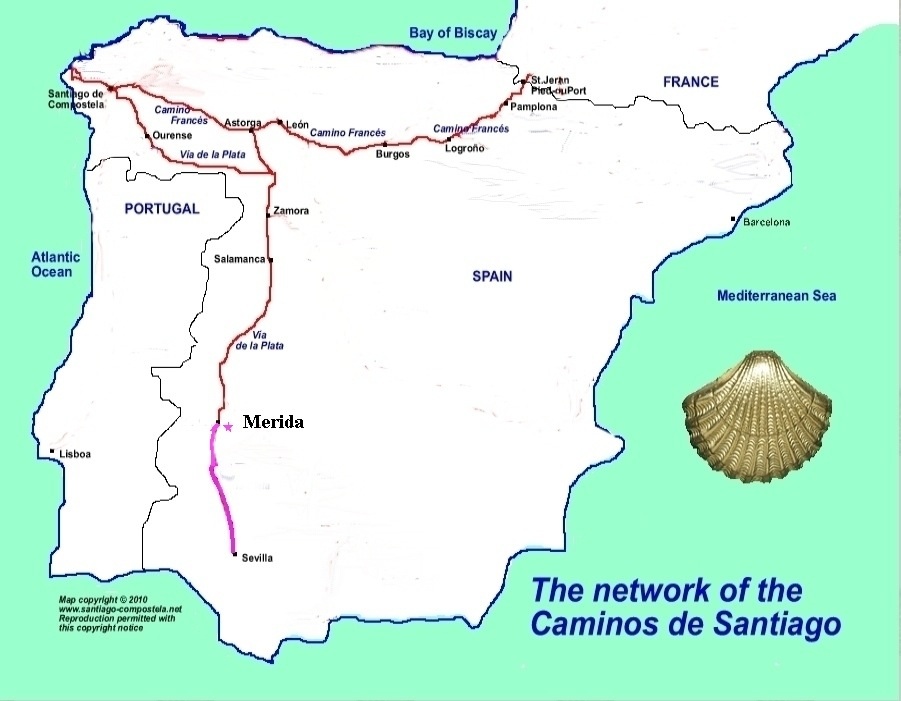
Attached to a flower bed was a Camino sign for the Camino Ingles,which I have walked twice,most recently with Sutton Coldfield Ramblers. If you begin the Camino at A Coruna ,it is under the 100 Km required to obtain your compostela in Santiago- the authorities allow you to make up the distance on designated routes.The priory is situated on such a route and you can obtain a stamp ( sello ), for your pilgrim passport here .

Farewell then to this holy spot and back for a final saunter around “ old Durham town”

A useful, local bus service took us in to Durham for a final visit. The intention being to enjoy the riverside once more and to seek out the quieter backstreets of the old town,principally given over to the University.

Across the river Wear.
This information board was well placed.
Weeping Willow on the opposite bank.
Bridge reflected .

Leaving the river and ascending to the bridge, there is this inscription embedded – quite appropriate if a little melancholy…

Unfortunately we could not make out the author’s name.

Returning to the old streets around the Bailey.

Archways and chapels.

Final view of the Cathedral.

https://music.youtube.com/watch?v=K9xcCH1o7S0&feature=share

“ I’m Gonna Leave Old Durham Town” by Roger Whittaker. Takes me back to my Folk club years. A memorable break in County Durham and a sojourn further north. Hopefully even further northwards next time.

Flowers Over Seaham’s Scars.

8 Jul

The above title was filched from an article in The Independent that recalls the mining heritage of this now award winning coastline.

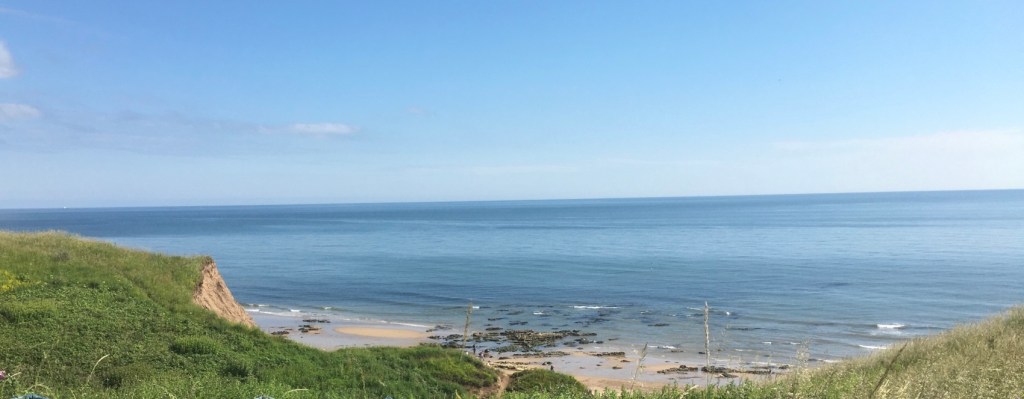
“You were working two, three mile out to sea. You were nearly an hour underground before you got started.” On a sunny day in June when the North Sea merely tickles the shoreline, it is hard to conceive that, just 18 years ago, men were walking – or crawling – along dark, damp galleries hewn beneath the water. “Hutton was the lowest – over 2,000 feet of rock above you, seven fathom of sea water above that.” The quotes are from an unknown miner. His words enlighten the casual traveller who sees little but cliffs ablaze with wildflowers and sands bleached and softened by the sea.

Brilliant Sculpture
From the 1980s…

Eighteen years ago , the Vane Tempest Colliery closed. For more than a century, mining on the coast of County Durham had been a heroic enterprise that had sustained the most densely industrialised location in Europe. Around what became the colliery village of Seaham, plate tectonics had conspired to create a rich source of coal at the point where the North Sea crashes against north-east England. Three pits were created to extract the wealth beneath the surface of the earth – and, when that proved insufficient, the brave souls struck out beneath the surface of the sea.

A two mile stretch of coastline round Seaham has been enriched by the Time & Tide trail, which tells visitors of the courage of the miners and their families. Ten years on, Seaham has been transformed so comprehensively that you need all the help you can get to understand the harshness of life in the mining communities. Seaham Colliery itself experienced seven accidents, including one on 8 September 1880, that claimed 164 lives.

Seaham is generally regarded now as having the best beaches in C. Durham. The harbour/ marina area is worth a visit,too.

Lord Londonderry, a genuine coal baron!saw the potential of Seaham to fuel the Empire’s industry, and set about exploiting it to the full. He was responsible for the arms of stone that jut out from the shore to embrace a scattering of boats. Seaham harbour was created to export the coal, but has aged prematurely to resemble an ancient structure – a relic of industrialisation that nature is now reclaiming.

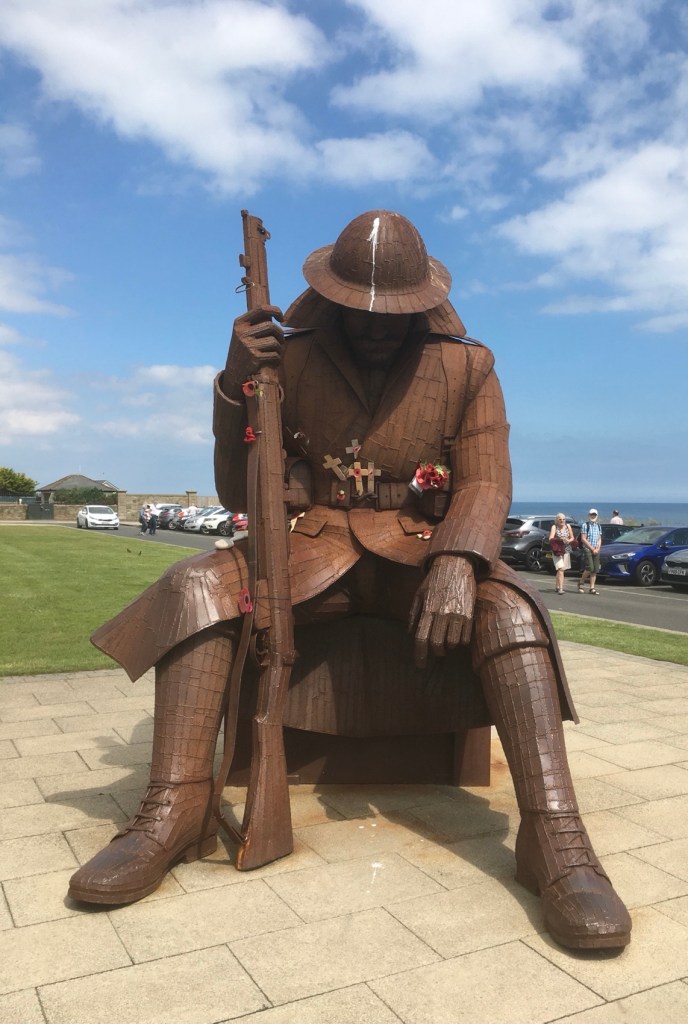
Seaham has military connections as this striking sculpture shows.

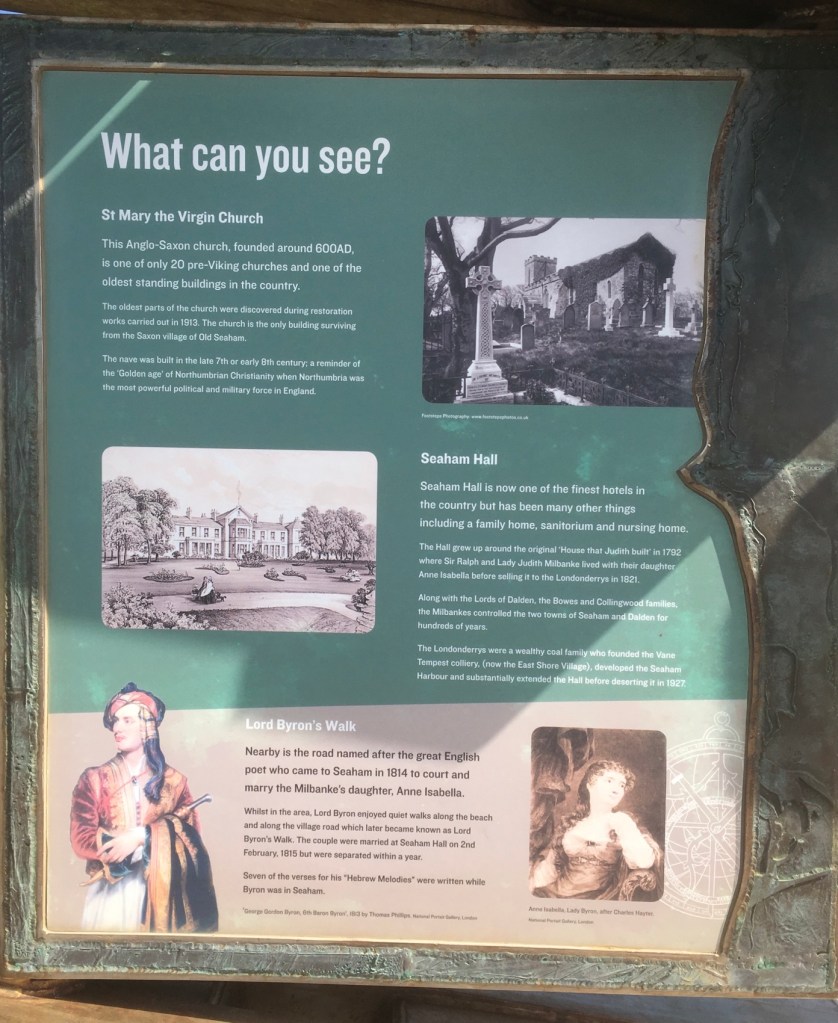
There are about twenty chapels/ churches in England ,from 7/8th centuries that are still in existence and the church of St Mary the Virgin is an example.

On close examination of the walls there are examples of Saxon herringbone brickwork.

Some of the gravestones tell of the sad fates of some of the local people over the years – death in the mines, in railway collisions – I invariably find aspects of local history depicted on them.

A great day by the sea and an inspiring example of a community and coastline’s rebirth – Seaham is a super place to see.

Northwards to Northumberland. Alnwick and Craster-Castles,gardens and a legend.

7 Jul

Fifty miles up from Durham and passing the famous Angel of the North,en route along the great north road.

Not a particularly “ great” drive as there are road widening works for a fair number of miles. However,Alnwick was the first stop and having got to grip with parking arrangements- you have to buy a disc from a local shop for £1.00 and display it on your dashboard .You can keep the disc and parking is free thereafter.

A walkabout and coffee near the market square.

Refreshed and ready for the Gardens and castle – five minute walk away.

The Alnwick Garden is a complex of formal gardens adjacent to Alnwick Castle in the town of Alnwick, Northumberland, England. The gardens have a long history under the dukes of Northumberland, but fell into disrepair until revived at the turn of the 21st century. From The Alnwick Garden:- “”The Alnwick Garden gives pleasure in so many ways to so many people from all walks of life. It has become a contemporary pleasure garden, which brings joy to millions. When I see photographs of it in darkness I feel that I’m watching it sleep, resting in preparation for the people it has to entertain the following day. To me, a garden without people is dead and people have bought The Alnwick Garden to life and restored its soul.” – The Duchess of Northumberland”

Plants that can kill and make you ill!

This was one example.

Or get you high…

Some of the contemporary features .

12 acres of meandering and attractive Gardens are home to the world’s largest Tai Haku Cherry Orchard, a Grand Cascade comprising 120 water jets and the worlds largest Treehouse Restaurant. We were very impressed with the rose collection.

Not all those who wander are lost.
Local Lichfield

Adjacent is the impressive Alnwick Castle,recently famous for its Harry Potter associations.

History on a grand scale. After the Angel of the North this is known as the Windsor of the North

Alnwick Castle is the second largest inhabited castle in the country and has been home to the Duke of Northumberland’s family, the Percys, for over 700 years.

Combining medieval architecture with Italianate State Rooms, Alnwick Castle is regarded as one of the UK’s most significant heritage destinations.

The Castle’s rich history is brimming with drama, intrigue and extraordinary people; from a gunpowder plotter and visionary collectors, to decadent hosts and medieval England’s most celebrated knight: Harry Hotspur.It is certainly an extraordinary building – a bit too much for me.

Picnic lunch and 9 miles to a coastal contrast – Craster.

The name of picturesque Craster is thought to come from ‘craw ceastere’ referring to some kind of fortified place inhabited by crows or someone called Crow.

A family called the Crasters lived in the area for centuries. Craster is famous for its kippers which are smoked on oak chippings to give them the distinctive Northumbrian flavour. The village is a starting point for the short coastal walk we took to the wonderfully situated Dunstanburgh Castle.

Dunstanburgh castle is just visible in the distance .

Dunstanburgh Castle

From Craster, a mile long footpath leads to the extensive coastal ruins of Dunstanburgh Castle, which are situated on a Whin Sill outcrop overlooking the sea.

Whin sill outcrops can be found across the entire length of North East England from Teesdale to the Farne Islands and are formed of a hard grey-black basaltic rock called Dolerite. It serves an role important role in the siting of some of the region’s most spectacular landscape

Said to be on the site of a stronghold of the ancient Britons Dunstanburgh was built in 1313 by Thomas, Earl of Lancaster and was extended in the 1380s by John of Gaunt. Although it is a ruin today it occupies the largest site of any castle in the region and has a very romantic location. As a Lancastrian stronghold, the castle played an important role in the Wars of the Roses.

The sad legend of Sir Guy the Seeker.

Sir Guy the Seeker

According to legend, there is a secret cavern hidden beneath the ruins of Dunstanburgh Castle in which a beautiful young maiden lies sleeping in a deep spell cast upon her by an evil wizard.

The legend claims that on a wild stormy night, many centuries ago, a young knight by the name of Sir Guy the Seeker was looking for shelter at Dunstanburgh when he was approached by the wizard. With a fierce expression and flaming hair, the wizard terrified Sir Guy, but he meant the knight no harm and instead presented him with a challenge:

“Sir Knight ! Sir Knight !

If your heart be right,

And your nerves be firm and true,

Sir Knight ! Sir Knight a beauty bright

In durance waits for you”

Sir Guy accepted the challenge and asked to be taken to the place where the young girl lay sleeping. The wizard escorted Sir Guy along a dark winding stairway. Sir Guy’s heart started beating fast – was he the victim of a trick?

Could Sir Guy trust the wizard to keep his promise that a young maiden lay sleeping and awaiting a rescuer? He followed the wizard with fear.

And now they go both high and low,

Above and undergound,

And in and out, and about and about,

And round, and round, and round.

Eventually after much walking the stairway finally terminated at a great door which was bolted shut with the aid of a hideous venomous snake. Without fear, the wizard removed the snake from the door which opened to reveal a huge but darkened hall.

At the end of the hall lay the beautiful young maiden as the wizard had promised. She was indeed beautiful as she lay sleeping in a tomb of crystal which was guided on either side by two ugly skeleton figures, the one on the right holding a falchion bright, the one on the left holding a horn.

The wizard explained that the young maiden’s fate depended on whether he should choose the horn or the sword. After considering for much time, Sir Guy finally chose to blow the horn, but his choice proved disastrous, he fell into an immediate sleep and awoke to find himself caught once more in the storms outside Dunstanburgh Castle.

As might be expected Sir Guy was to spend the rest of his life searching for the secret cave where the girl lay sleeping. Alas, it was to no avail, the unhappy knight was to die a remorseful man. The words of the old wizard haunted his mind to the very end:

Shame on the coward who sounded a horn

When he might have unsheathed a sword!

Faint Heart Never Won Fair Maid

We enjoyed our first,contrasting experiences of Northumberland and would certainly like to return and explore even further north,next time.

Just got to the car in time before a cloudburst.

CANNY DURHAM

7 Jul

Motorhome has gone ( RIP) and much sorrow – dampness was found during a routine habitation check and the costs were difficult to reconcile with,so farewell.Therefore, an apartment rented for a few days on the outskirts of Durham – a city never visited before and long on the wishlist.

I really love Durham more than any place I’ve ever been; some small towns can be really provincial and strangling, but Durham is the best city in the world. – John Darnielle

After arrival at Cheveley Park,Belmont, a local bus was taken into the city, the intention ? A walkabout to familiarise ourselves and a riverside watering hole. We were not disappointed. The city was sunlit and it’s mainly traffic free streets gave it a “ continental “, to use an old fashioned description. Being of scholarly disposition it was not surprising that we chose The Library for early evening refreshments, a riverside gem and not a book in sight.

I found this website to be very informative:- It provides a concise account of the evolution of the city,going back to Roman times although the Roman name for Durham has never been discovered.

Leaving the Romans aside, the real story of Durham as we know it today begins with St Cuthbert, a seventh century Northumbrian saint who at the age of seventeen entered the monastery of Melrose near the River Tweed to become a monk. His outstanding qualities – a fair and placid manner, a remarkable talent for athletics and a reputed gift for working miracles are certain to have attracted attention and not surprisingly Cuthbert quickly gained promotion. Ultimately he was appointed to the post of Bishop on the island of Lindisfarne just off the Northumberland coast. As a bishop, Cuthbert travelled widely throughout the north and played an important part in encouraging people to follow the Christian faith which had only recently been introduced to Northumbria. Later in his life Cuthbert retired from the post of bishop to pursue life as a hermit on the remote island of Inner Farne, one of a group of small islands to the south east of Lindisfarne.

There it remained for a few years until the monks decided to remove the coffin for inspection. On removal of the body, the monks were astonished to find the corpse in a totally incorrupt state – it had not decayed. This remarkable discovery was seen as a miracle and Cuthbert was proclaimed a saint. When the news of the miracle spread, huge numbers of pilgrims travelled from far and wide to visit Lindisfarne.

Here Cuthbert was visited by many pilgrims but for most of the time he was occupied by prayer having only the sea birds and seals for company. It was here on Inner Farne in the year 687 AD that Cuthbert finally died in the fifty second year of his life. In accordance with an agreement made by Cuthbert during his life, his body was removed from Inner Farne and taken to Lindisfarne for burial. Further details on the website .

This made the monastery on the island extremely wealthy from gifts bestowed by the visitors. Sadly, the increasing wealth of the Lindisfarne monastery ultimately attracted visitors of a most unwelcome kind in the form of the Vikings who came to raid and plunder the island for its riches in 793 AD. As the Viking raids on Lindisfarne continued throughout the following century, the monks of the Holy Island were forced to flee to the mainland.

This niche is found in the Cathedral Wall.

The monks took with them the coffin of St Cuthbert and other valuable relics like the famous Lindisfarne Gospels. For over a century, the monks and their successors carried the coffin around the north of England , settling for a time at Norham-on-Tweed, at Chester-le-Street and at Ripon before settling at Durham in the year 995 AD. The legendary story behind their settlement at Durham is related in the legend of the Dun Cow . There are similarities here with the legends about Santiago and the various sightings of his remains,plus the fact that both Durham and Santiago de Compostella became major pilgrim sites.

Dun was an Anglo-Saxon word meaning ‘hill’, while ‘holm’ meaning island is a word of Scandinavian origin. Dun Holm was later called Duresme by the Normans and was known in Latin as Dunelm. Over the years the name has been simplified to the modern form – Durham.

On learning the name of their destination the monks found that they were now able to move the coffin. Proceeding west through well-wooded countryside they asked a number of local people where they could find Dunholm but unfortunately no-one had heard of such a place. Luckily by chance in an area later known as Mount Joy a milkmaid was overheard asking another milkmaid if she had seen her dun cow – a grey coloured beast that had wandered off on its own. The other maid answered that she had seen the cow roaming about near Dunholm.

When the monks heard mention of Dun Holm they were filled with joy and followed the footsteps of the milk maid as she searched for her cow.

By this stroke of luck or divine providence, they were able to find the site of Dunholm – a wooded ‘hill – island’ peninsula formed by a tight gorge-like meander of the River Wear.

It was on high ground protected on three sides by the steep wooded gorge of the River Wear. The more likely reason for establishing a settlement and a fortress.

The following day’s weather was as forecast – the complete opposite – steady rainfall . Undaunted and prepared, the bus was taken again and we made our way up the hilly streets to the Cathedral.

The Sanctuary Ring.

Most visitors to Durham Cathedral enter from Palace Green via the North Door on which we find the imposing bronze sanctuary ring. This is popularly known as the ‘sanctuary knocker’ but the protruding ring that hangs from the beast’s mouth has always been fixed in place to the door and is intended for grasping rather than for rapping. The whole sanctuary ring is a near perfect replica of the twelfth century original which is now part of the cathedral museum’s treasured collection.

The sanctuary ring features the face of a hideous lion-like beast and represents the ancient privilege of sanctuary that Durham Cathedral once granted to criminal offenders. Criminals could seek refuge at Durham by grasping the knocker and alerting the attentions of watchers who resided in two small chambers overlooking the door.

The aforementioned website gives a really interesting account of the Cathedral as place of sanctuary for criminals in particular.

It is impossible to convey the beauty and history of this magnificent cathedral and there is much more information to be found on the Net. We were greatly impressed by everything we saw and the friendliness of the guides.

Eventually,after an uplifting morning, the Undercroft cathedral cafe provided strong coffee and to one person’s great delight- cheese scones!

After a picnic lunch on the riverside, we continued walking alongside the Wear .

Thankyou Hannah for the photo.

Then, after taking in some of the streets and shops , a taxi ride back home to base, the alternative would have been a 45 minute wait for the bus.

I bought some trainers ( in the sale ) here.

Despite the rain, it had been a great day in canny Durham.