
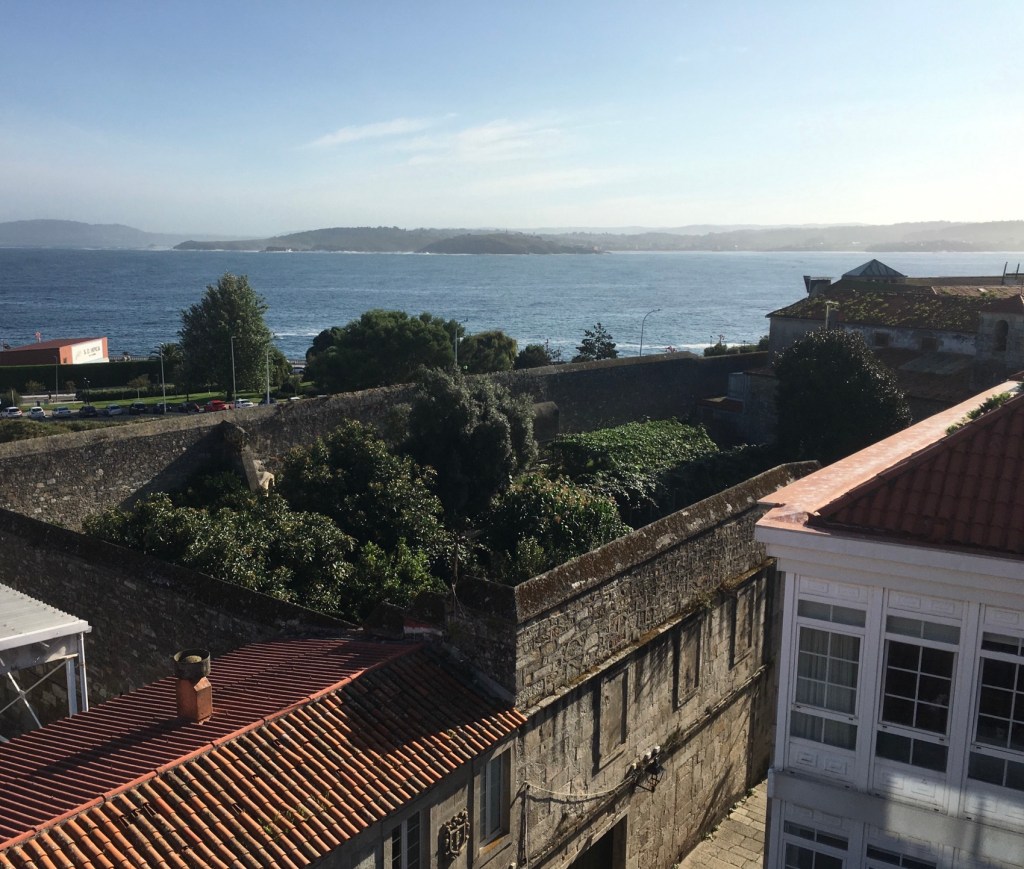
“In Coruña, people sit around on the sea walls or the rocks and stare out to sea, as if they expect Francis Drake to turn up again and sack the city. A contemplative lot, the Galicians”.

THE OLD TOWN
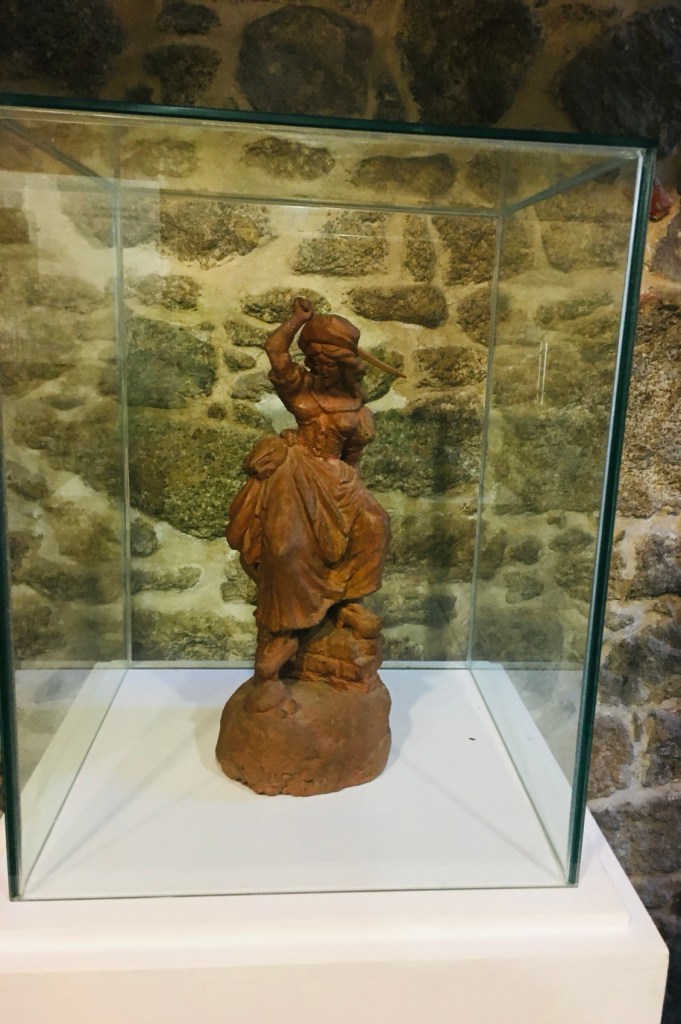
After obtaining maps from the Turismo in the Praza Maria Pita, the walkabout began by the imposing statue of the city’s most loved historical figure,Maria Pita,symbol of the defence of the citizens of Coruna against the attack by the English in 1589.

It is said that the English attackers opened a breach in the wall and began the assault on the old city. During the assault, they killed Gregorio de Rocamunde, María Pita’s husband; she, filled with rage, snatched the lance from the English flag and, with it, killed the ensign leading the assault. He was the brother of Admiral Francis Drake.
This demoralized the 12,000-strong English force and forced its retreat. Tradition says this was carried out to the cry (in Galician) of ”
Quen teña honra, que me siga” (which in Spanish means “whoever has honor, follow me”).)





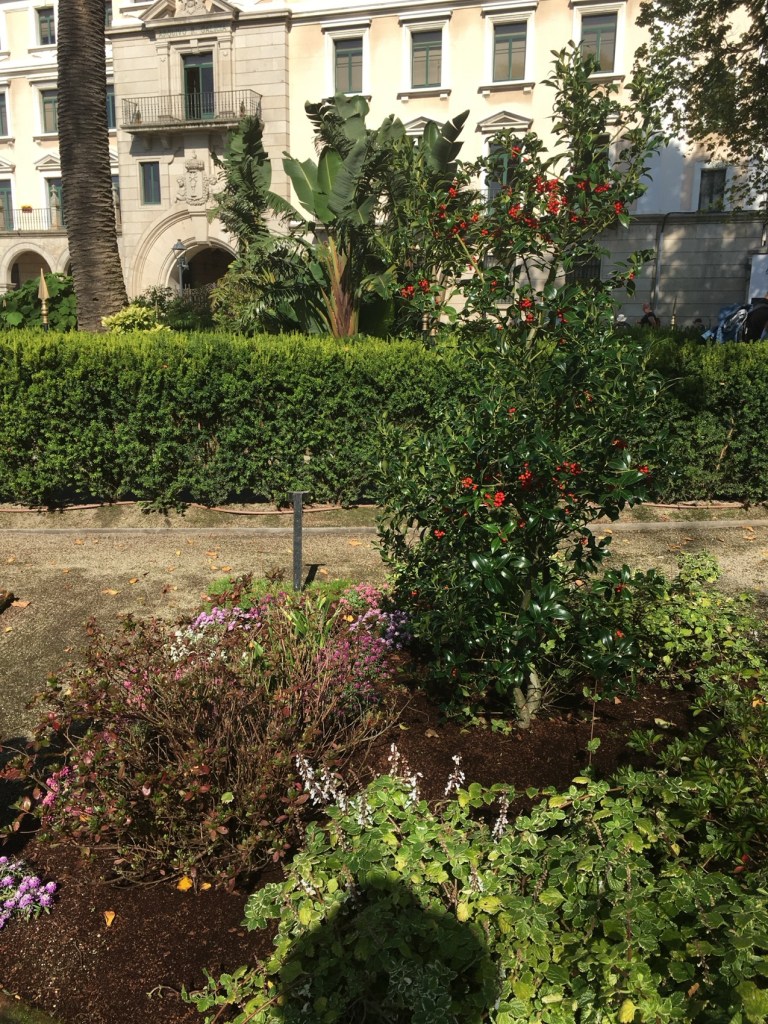


The garden of San Carlos is one of the most unique green spaces in A Coruña. It is a “hortus conclusus” created around the grave of the general Sir John Moore, Hero of the Battle of Elviña, who died in 1809.
In 1830, at the initiative of the British Government, a stone funeral chest dedicated to General Moore was erected on the site, and in 1834, Governor Francisco Marracedo transformed the grounds once again by creating an enclosed garden sheltered from the winds. The project, carried out by the local architect José María de Noya, created an oval space crossed by a set of radial paths starting from the centre, where the grave is located. The vegetation is distributed in flowerbeds, where there are several monumental centenary elm trees, currently included in the catalogue of singular trees of Galicia.




The Tower of Hercules has served as a lighthouse and landmark at the entrance of La Coruña harbour in north-western Spain since the late 1st century A.D. when the Romans built the Farum Brigantium. The Tower, built on a 57 metre high rock, rises a further 55 metres, of which 34 metres correspond to the Roman masonry and 21 meters to the restoration directed by architect Eustaquio Giannini in the 18th century, who augmented the Roman core with two octagonal forms. Immediately adjacent to the base of the Tower, is a small rectangular Roman building. The site also features a sculpture park, the Monte dos Bicos rock carvings from the Iron Age and a Muslim cemetery. The Roman foundations of the building were revealed in excavations conducted in the 1990s. Many legends from the Middle Ages to the 19th century surround the Tower of Hercules, which is unique as it is the only lighthouse of Greco-Roman antiquity to have retained a measure of structural integrity and functional continuity.
The walkabout was about nine miles in total and there are still plenty of things to see…on another day. A Coruna is fast becoming my favourite of all the Spanish cities visited over the many years of visiting Spain.

 ensuitepilgrim's Blog
You both look healthy and happy!
Continue to enjoy 👍🏼🕊️