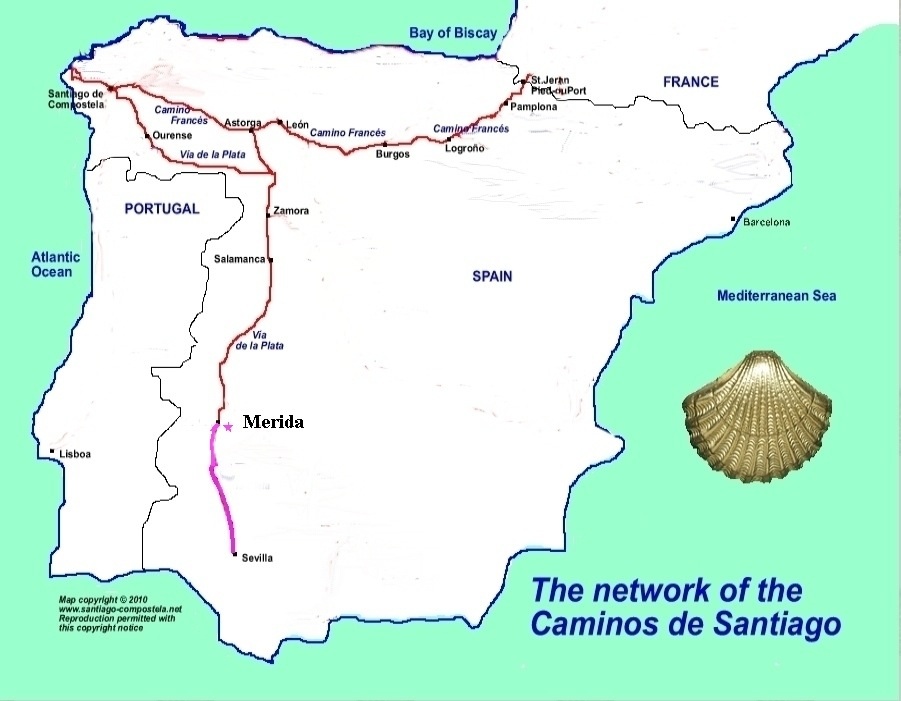
Archive | September, 2025

FAREWELL,A CORUNA. Sunday,21st Sept. 

22 Sep
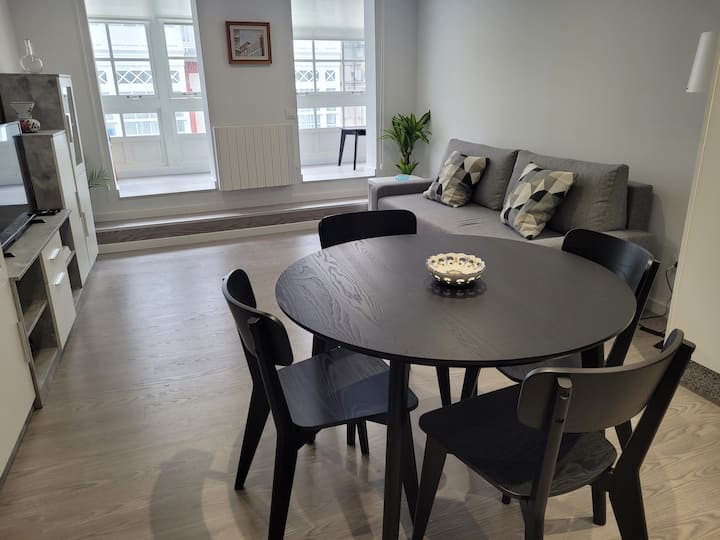
Dining / cooking area – a great apartment.

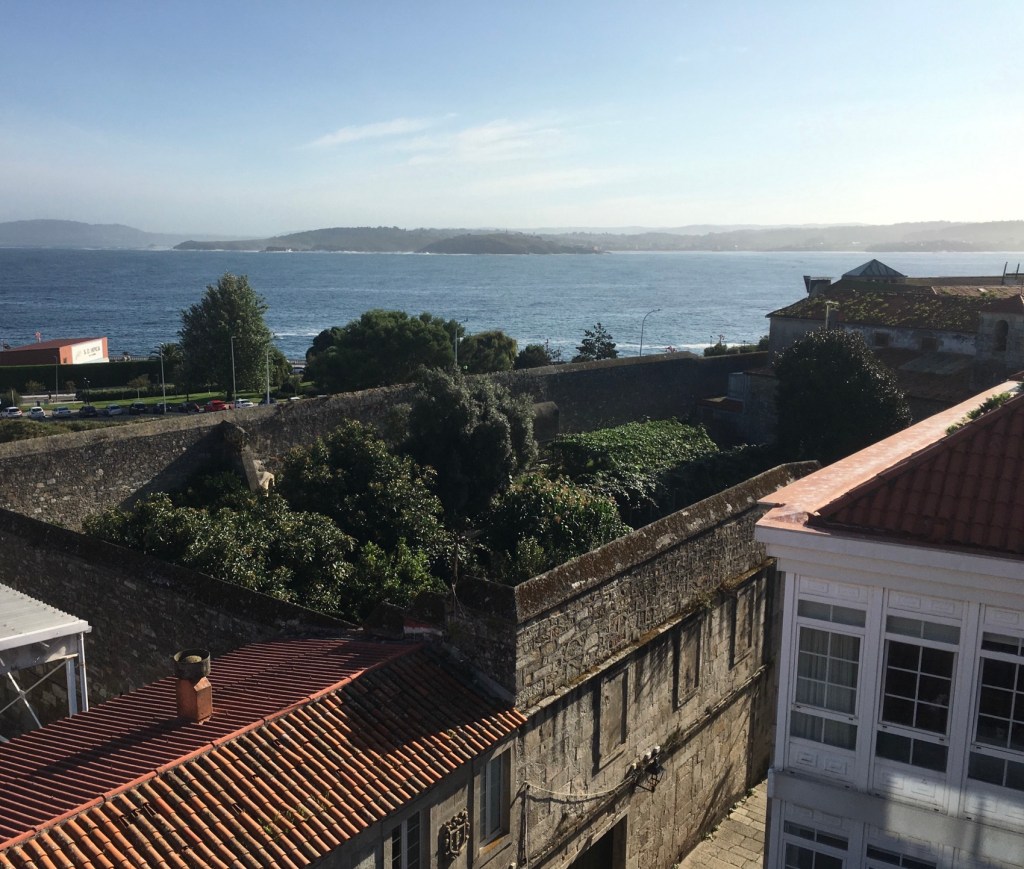
We left the apartment, Gallerias Pequenas, AIRbnB at 07.30 dropped off some non – organic rubbish – walked along quiet ,recently washed streets en route to the underground parking bay, a seven minute walk away. Card payment then up and off towards the city limits, passing a police patrol car half blocking the road – either drugs or alcohol – waved through and in no time at all out of the city onto the Auto via 8 ,direction Lugo. As deserted as expected and the only occasional hazard were sloughs of fog – coming across these for the next hour as it turned out. 

Fog patches but no problems.

The estimated journey time from A Coruna to Santander port is 4 hr 15 mins. I anticipated we should get there by 12.45, allowing for a coffee break. The Brittany ferry departure time was 14.00.

Unlike English motorways, Services stops in Spain tend not to be adjacent to the Motorway, but slightly off via a roundabout – this means they are in quieter settings – restful and fully serviced.

I took on some fuel before coffee and snacks in a pastoral setting, complete with children’s’ play area and sea and mountain views- This may seem like a minor detail, but it typifies the Spanish, long distance driving experience- uncrowded, no hold ups in roadworks and more for the passengers – some lovely views. 
They have to put up with me occasionally pointing out at direction signs and exclaiming ,” I stopped  there on the Ingles or Norte Camino “.

Eventually, after leaving Galicia we drove through the foothills of the Picos de Europa – awesome peaks – in the Asturias, after the traffic got a little busier around Oviedo and Gijon,mainly people en route to the beaches. We wished we had time to revisit San Vicente de Barquera, remembering a great camping stay there with the children in years gone by.

San Vicente de Barquera

The drive off the Autovia to the ferry port in Santander is further than you might expect but we made good time by 12.50.

A view from the queue of our ferry, the fairly new as it turned out SANTONA .
Santoña is a town in the eastern coast of the autonomous community of Cantabria, on the north coast of Spain. It is situated by the bay of the same name. It is 45 kilometres (28 mi) from the capital Santander.

I am always amazed at the capacity of these ferries.
Have to go there sometime.

Meanwhile, back on board we discovered that each cabin area has a “ legend” – on deck nine – we discovered that ours was the Camino de Santiago !

The cabinin was Ensuite with a porthole and more spacious than the outward crossing.
A cloudy start to Monday morning but a calm sea.
An hour or so off Portsmouth. A very calm crossing and a pleasant end to the North Western Spain road trip. The driving was a pleasure and unstressful. A Coruna is not well known in the UK – which for me is not a complaint – I cannot recall a visit too highly and the rest of Galicia,too.
Either during the day or at night, there is always life here. This is a city for strolling and enjoying oneself, with beaches beaches in the city centre and, with the Tower of Hérculesoverlooking it, a long promenade which goes almost all the way around.
The inhabitants of A Coruña are famous for living well, so follow their example. Sit at a café on the main square known as Plaza de María Pita and discover its fascinating history. Or stroll along the area of the Cantones and admire the famous glass windows, from the Modernist period. And if you would like to go shopping this is the perfect place, especially if you want to dress in style. 
Also, A Coruña has excellent museums, such as the Fine Arts museum, the Science Museum, the Domus or the Archaeological museum, located in the San Antón castle. And towards sunset, there is nothing like the cosy and romantic San Carlos gardens or if you prefer entertainment, the Méndez Núñez garden, right in the centre of the city. This is where the Kiosko Alfonso is located, which today is an exhibit centre and was formerly a cinema with two rooms separated by the screen, so you paid a lower fee if you watched the movie from behind the screen..

https://www.turismo.gal/que-visitar/cidades/a-coruna?langId=en_US

The above link is well worth a view.

A CORUNA – The Last Saunter up to Monte San Pedro Park – Fri.19/09, and Remembering Rosalia de Castro.

20 Sep

“I see my path, but I don’t know where it leads. Not knowing where I’m going is what inspires me to travel it.”Rosalia de Castro

The destination is bottom left hand side, starting beyond the beach.
Monte de San Pedro is top right.
A very calm sea this morning.
Leaving the beach behind we came upon the Obelisco Milenium.

The Millennium Tower is a monument built in the shape of an obelisk and located on the seafront of A Coruña. This tower was inaugurated on January 1, 2000, as the objective of this work was and is to commemorate the beginning of the 21st century. 
This 
Obelisk , which was born under the mantle of 
the Tower of Hercules and the 
Obelisk of the Cantones , reference works of A Coruña, is the work of the architect 
Antonio Desmonts , and the drawings that decorate it are made by the author 
Gerardo Porto . 
The construction of the 
Millennium Tower was not easy, since the work 
measures approximately 50 meters and is made up of more than 
170 rock crystals that arrived in the city of A Coruña from Holland. 

Furthermore, thanks to its drawings, this monument depicts different 
historical scenes from the city of A Coruña, including, for example, images of 
Christopher Columbus’s caravels , the 
Battle of Elviña , and, of course, the portrait of the city’s heroine: 
María Pita . 

This obelisk is also unique in that it houses more than 
140 spotlights , allowing visitors to discover the unique features of all the drawings depicted there at night.
A close up.

There is a funicular running up the mountainside but it was not operative and so we turned right and walked up along a shady pathway.

Opposite the path.

There were welcome drinking water fountains en route.

Climbing up above the new apartments.

This park was formerly a defensive point converted for the enjoyment of citizens and tourists since 1999. It has an extension of more than 90,000 square meters where you can do all kinds of hobbies. You can fly a kite, lie on the grass or watch the sunset. In addition, it has a great tourist attraction which are the two Vickers pieces of more than 17 meters of altitude that were acquired in 1929 and installed in 1933, made in the UK.
They were used on one occasion to deter German submarines.

But one of the main attractions of Monte de San Pedro are its evocative views. On one side you will see the Atlantic Ocean and the coastline to Arteixo and the Sisargas Islands that belong to Malpica de Bergantiños. And on the other side in the first term, the city and the Costa Artabra with the Ría de A Coruña, where we will find Mera, Santa Cruz and the coast of Oleiros and in the second term the Ría de Betanzos, the Ría de Ares, the Ría de Ferrol and the coast up to its outer harbour.
Viewpoint looking towards A Coruna.

Once at the top you will also find the only 360-degree covered viewpoint in Spain, the Cúpula Atlántica.
It was well worth the climb upwards and downwards.
On a counter in a cafe on the way back – Membrillo!
The paseo returning to the town.
This is the Rosalia de Castro Theatre just a few metres from our apartment .

Rosalia De Castro was a highly acclaimed and influential Galician writer and poet. Born on February 24, 1837, in Santiago de Compostela, Spain, she played a pivotal role in the revival of Galician literature and language during the 19th century.
Her works were praised for their lyricism, emotional depth, and ability to capture the essence of Galician culture. Through her writing, De Castro sought to raise awareness about the social inequalities and injustices faced by the Galician people, as well as celebrate their unique language, customs, and folklore.

A remarkable woman with a strong social conscience, de Castro’s antecedents were probably influential in predisposing her to identify with her poor and exploited countrymen. She was the illegitimate daughter of a priest. Her mother came from a well-to-do family, but de Castro spent the first 14 years of her life in the country. When she was 14, de Castro was ‘reclaimed’ by her mother.  She missed her country life intensely and no doubt her poems grew out of her feeling of longing and homesickness for the countryside, and the only home she had ever known until  she was displaced.  The sense of  something longed for and unfulfilled in these poems is so honest and sincere and uncontrived, that to read them is to almost directly experience them  oneself.
I suspect it was de Castro’s fervour and intensity which led to the her being able to accomplish as much as she did in a relatively short life. She died of Cancer at the age of 48. It seems clear that de Castro had a premonition she would not live long, and this sense of life’s brevity and fragility lends the keenest possible edge to her writing. We are blessed indeed to be her literary beneficiaries and to be able to relish her remarkable work, and through them to hear her lovely voice.

The first time I was made aware of Rosalia and her legacy was on a solo pilgrimage from Porto, 15 years ago when my hotel in Padron was next door to a museum dedicated to her life. Every city and town in Galicia will have at least a street with her name.

Good-bye Rivers, Good-bye Fountains.


Good-bye rivers, good-bye fountains;
Good-bye, little rills;
Good-bye, sight of my eyes:
Don’t know when we’ll see each other again.
Sod of mine, sod of mine,
Sod where I was raised,
Small orchard I love so,
Dear fig trees that I planted,
Meadows, streams, groves,
Stands of pine waved by the wind,

Little chirping birds,
Darling cottage of my joy,
Mill in the chestnut wood,
Clear nights of brilliant moonlight,
Cherished ringing bells
Of the tiny parish church,
Blackberries in the brambles
That I used to give my love,
Narrow footpaths through the cornfields,
Good-bye, for ever good-bye!
Good-bye, heaven! Good-bye, happiness!
I leave the house of my birth,
I leave the hamlet that I know
For a world I haven’t seen!
I leave friends for strangers,

I leave the lowland for the sea,
I leave, in short, what I well love…
Would I didn’t have to go!
But I’m poor and—base sin!—
My sod is not my own
For even the shoulder of the road
Is loaned out to the wayfarer
Who was born star-crossed.
I must therefore leave you,
Small orchard I loved so,
Beloved fireplace of home,
Dear trees that I planted,
Favourite spring of the livestock.

Good-bye, good-bye, I’m leaving,
Hallowed blades of grass in the churchyard
Where my father lies buried,
Saintly blades of grass I kissed so much,
Dear land that brought us up.
Good-bye Virgin of the Assumption
White as a seraph,
I carry you in my heart:
Plead with God on my behalf,
Virgin of the Assumption mine,
Far, very far away hear
The church bells of Pomar;
For hapless me—alas—
They shall never ring again.
Hear them still farther away
Every peal deals out pain,
I part alone without a friend…
Good-bye land of mine, good-bye!
Farewell to you too, little darling…!
Farewell forever perhaps…!
I send you this farewell crying
From the precious coastline.
Don’t forget me, little darling,
If I should die of loneliness…
So many leagues offshore…
My dear house! My home!
A poem by Rosalia de Castro

A CORUNA – Thursday, 18 th September Walkabout – monuments,flora and views.

19 Sep
This was the area we intended to cover.
Misty morning up at the Tower of Hercules. It began to clear later on in the morning.
Rocky coves and outlying rock formations make you realise why a lighthouse was built all those centuries ago .
The Tower of Hercules is the only fully preserved Roman lighthouse that is still used for maritime signaling, hence it is testimony to the elaborate system of navigation in antiquity and it provides an understanding of the Atlantic sea route in Western Europe. The Tower of Hercules was restored in the 18th century in an exemplary manner, which has protected the central core of the original Roman monument while restoring its technical functions.
Criterion (iii): The Tower of Hercules is testimony to the use of lighthouses in antiquity. The Tower is also proof of the continuity of the Atlantic route from when it was first organised by the Romans, during a large part of the Middle Ages, and through to its considerable development in the modern and contemporary eras.
Integrity and Authenticity
The architectural integrity of the property, in the sense of a structurally complete building, and its functional integrity are satisfactory. While the authenticity of the central Roman core is certain, the authenticity of the building only makes sense when judged from the point of view of a technological property that has required numerous renovations and functional adaptations.
The area around the lighthouse is protected though very accessible.
A customs patrol boat – drug smuggling is a problem.
Looking back at the town.
A narrow stretch of sandy beach.
Here he is – Hercules afloat.
During the Spanish Civil War (1936-1939), this was the site of a Muslim cemetery for soldiers from the Maghreb. Their remains were later moved to the San Amaro Cemetery, and although they were repatriated in 1957, a commemorative plaque can still be seen there. Today, the walls are adorned with texts referring to the city, in Latin, Greek, Arabic, Gaelic and old Spanish, which is why we now call it the House of Words.
Traditional Layout.
Pleasant,winding walk back to the beach
An exotic tree en route
A sudden swathe of mist across the beach.
Walking back to the main square we came across the church of San Jorge.
Sense of humour – good news for anyone with a baby giraffe.
Tinto Verano – Always good news.
A view of one of the towers from our dinner table .
In the square were a whole range of electric powered cars – someone must have thought that a Galician pipe band would encourage sales.
Cars came through this arch,after a brief commentary and were further accompanied by flashing lights and exhalations of steam!
And it was goodnight from us.

The name A Coruña is derived from the Phoenician ‘k . arn, meaning ‘the horn’, symbolizing its geographical prominence A CORUNA – Tuesday,16th September ‘25

17 Sep

“In Coruña, people sit around on the sea walls or the rocks and stare out to sea, as if they expect Francis Drake to turn up again and sack the city. A contemplative lot, the Galicians”. 

THE OLD TOWN

After obtaining maps from the Turismo in the Praza Maria Pita, the walkabout began by the imposing statue of the city’s most loved historical figure,Maria Pita,symbol of the defence of the citizens of Coruna against the attack by the English in 1589.


It is said that the English attackers opened a breach in the wall and began the assault on the old city. During the assault, they killed Gregorio de Rocamunde, María Pita’s husband; she, filled with rage, snatched the lance from the English flag and, with it, killed the ensign leading the assault. He was the brother of Admiral Francis Drake.
This demoralized the 12,000-strong English force and forced its retreat. Tradition says this was carried out to the cry (in Galician) of ” 
Quen teña honra, que me siga” (which in Spanish means “whoever has honor, follow me”).)
The next stop was at the house and museum of Maria Pita
The building has been completely restored by an inventive use of mezzanine floors.
Bedroom
Kitchen
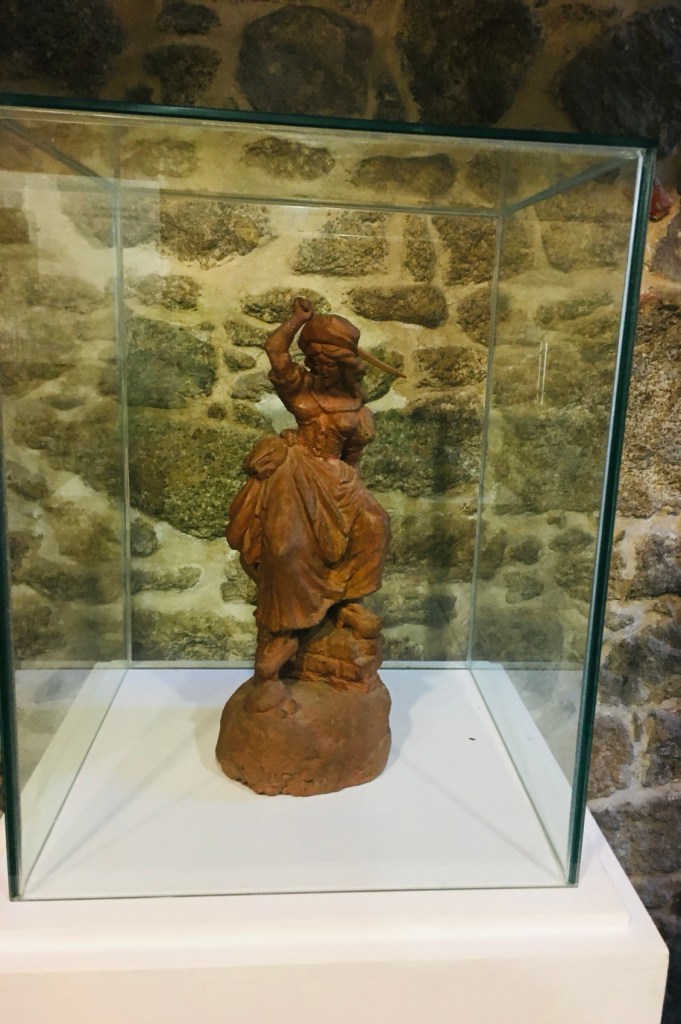
Statuette
Views from the rooftop of the house.
Praza das Barbaras
The convent on this leafy square was founded in the 14th century and was later incorporated into the Franciscan order. The nuns are cloistered and there contact with the rest of humanity is through this hatch
Where you can buy confectionery
A cooling fountain en route to the Garden of San Carlos.
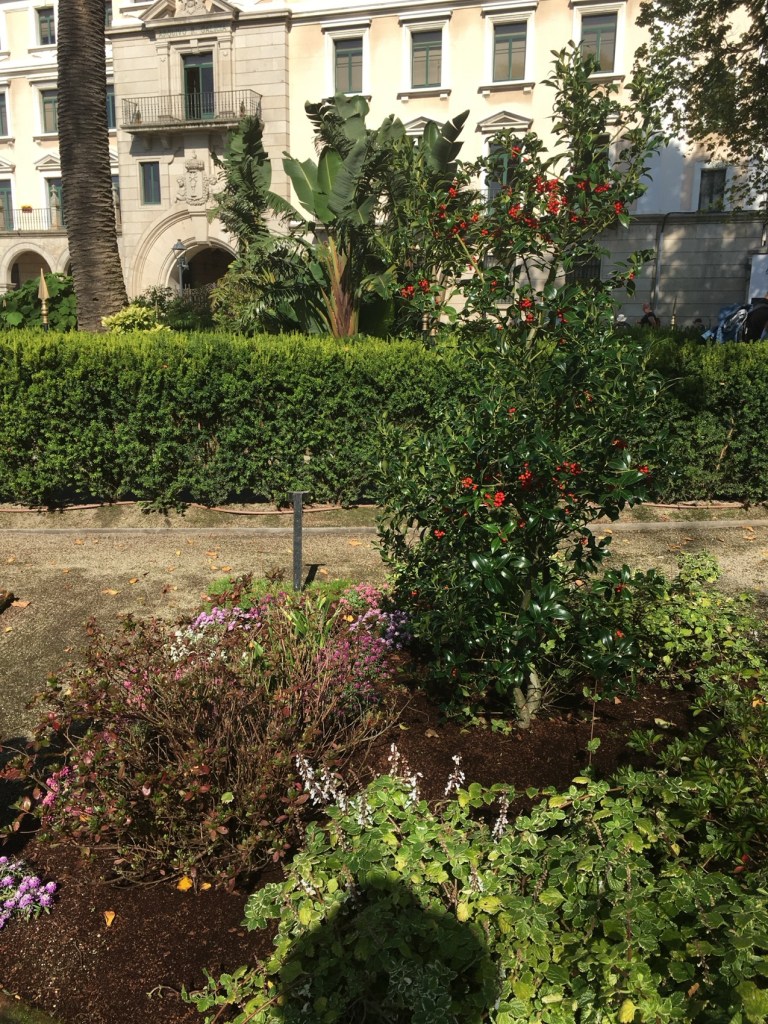
There seemed to be flowers and shrubbery at every turn.
The site once contained a stronghold built outside the city walls during the 14 th century and annexed to the city in the 16th century. It gradually became less important as a fortress and when its arsenal exploded,killing 200 people, it was abandoned until it was restored in the 18 th century as a garden .
It is divided into segments containing plants, trees and flowers from all the world’s continents

The garden of San Carlos is one of the most unique green spaces in A Coruña.  It is a “hortus conclusus” created around the grave of the general Sir John Moore, Hero of the Battle of Elviña, who died in 1809.
In 1830, at the initiative of the British Government, a stone funeral chest dedicated to General Moore was erected on the site, and in 1834, Governor Francisco Marracedo transformed the grounds once again by creating an enclosed garden sheltered from the winds.  The project, carried out by the local architect José María de Noya, created an oval space crossed by a set of radial paths starting from the centre, where the grave is located.  The vegetation is distributed in flowerbeds, where there are several monumental centenary elm trees, currently included in the catalogue of singular trees of Galicia.
The garden still preserves elements of the old fortress, such as the sentry boxes and the wall, and has a spectacular viewpoint overlooking the city’s port.
The church of Santiago,probably the oldest of the many churches in Coruña.
The tympanum depicts St James on horseback
St James
The beginning of the Camino Ingles adjacent to the church.
Traditional Camino waymarking.
Coffee time and deciding where next.
The renowned Galleries of glass facing the port.
Fishing boat for sale
A P & O Cruise ship dominates …
Impressive monument
Mary,patron of fishermen
A stroll along the seafront- the Paseo Maritimo – in glorious weather.
Praia de Santo Amaro –
The sea looked very inviting.
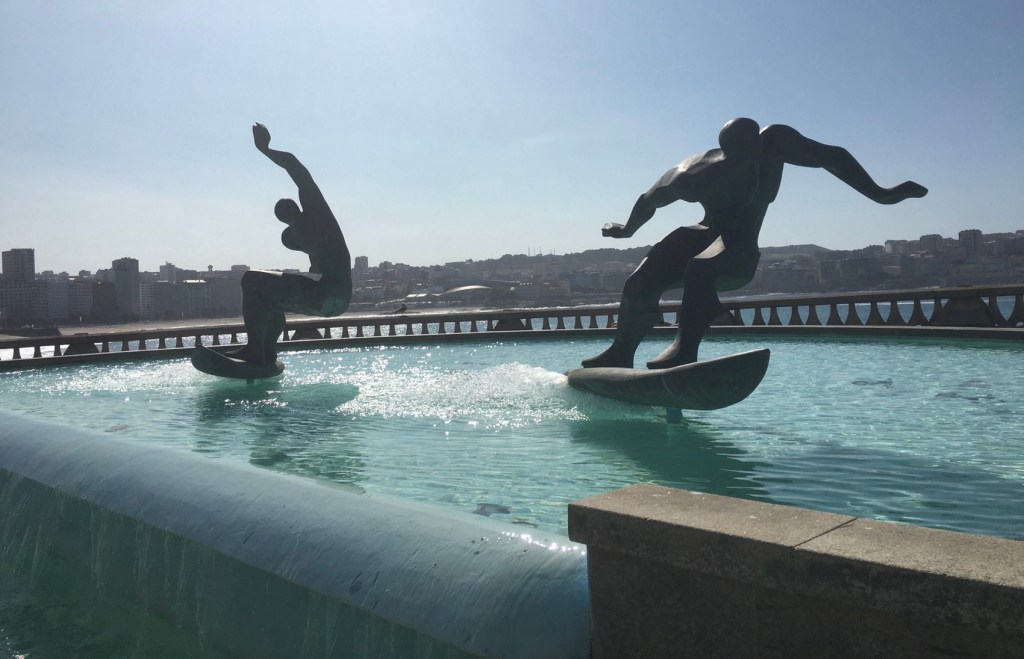
A surfing spectacular
Mermaid?
Walking further along – the site of Corona’s most famous landmark.
Mini Stonehenge?
Captions invited
THE TOWER OF HERCULES

The Tower of Hercules has served as a lighthouse and landmark at the entrance of La Coruña harbour in north-western Spain since the late 1st century A.D. when the Romans built the Farum Brigantium. The Tower, built on a 57 metre high rock, rises a further 55 metres, of which 34 metres correspond to the Roman masonry and 21 meters to the restoration directed by architect Eustaquio Giannini in the 18th century, who augmented the Roman core with two octagonal forms. Immediately adjacent to the base of the Tower, is a small rectangular Roman building. The site also features a sculpture park, the Monte dos Bicos rock carvings from the Iron Age and a Muslim cemetery. The Roman foundations of the building were revealed in excavations conducted in the 1990s. Many legends from the Middle Ages to the 19th century surround the Tower of Hercules, which is unique as it is the only lighthouse of Greco-Roman antiquity to have retained a measure of structural integrity and functional continuity.

The walkabout was about nine miles in total and there are still plenty of things to see…on another day. A Coruna is fast becoming my favourite of all the Spanish cities visited over the many years of visiting Spain.

One of the town hall towers
Dinner time starting with Padron Peppers and a bottle of ALBARINHO

SUNDAY BEGINS WITH A WALK UPSTREAM ALONGSIDE THE DUERO

14 Sep
Restored Mill on the edge of the Medieval bridge.

The Douro (UK/ˈdʊəroʊ, ˈdʊəruː/US/ˈdɔːruː, ˈdɔːroʊ/,[1][2][3][4] Portuguese: [ˈdo(w)ɾu]Mirandese[ˈdowɾʊ]SpanishDuero [ˈdweɾo]LatinDurius) is the largest river of the Iberian Peninsula by discharge. It rises near Duruelo de la Sierra in the Spanish province of Soria, meanders briefly south, then flows generally west through the northern part of the Meseta Central in Castile and León into northern Portugal. Its largest tributary (carrying more water than the Douro at their confluence) is the right-bank Esla.[5] The Douro flows into the Atlantic Ocean at Porto, the second largest city of Portugal.
We crossed the bridge and turned right,walking upto the “ Palace Gardens”,continuing along the Paseo Juana I de Castilla. The pavement turned to a dirt trail just beyond the Monasterio de Santa Clara.
The monastery has a fascinating history.
The monastery of the Poor Clares of Tordesillas has its origin in a palace built by Alfonso XI of Castile to commemorate the Battle of the Salado River (1340), where Leonor de Guzmán (1310-1351), the king’s lover, resided. Once she died, it passed into the hands of the widowed queen Maria of Portugal (1313-1357), and finally it was the property of Maria de Padilla († 1361), lover of Pedro I the Cruel (1334-1369). In 1362, Peter I left the palace to the Poor Clares in his will, with the aim of establishing a new monastery for that order. The convent was founded by Infanta Beatriz of Castile in 1363 with royal approval and a papal bull authorizing it in 1365. Despite this change, which meant the conversion of the royal palace into a convent, the monastery remained closely linked to the crown. A new palace was built next to it, and the monarchs remained closely associated with Tordesillas, favoring the community.
For the new functions of the house, the palace was adapted as a monastery using a temporary chapel (the Long Choir) until the monastic church was built next to it in the late 14th and early 15th centuries. During this same period, the house underwent reforms in terms of observance, introducing stricter rules and eventually forming a congregation that enjoyed a certain independence, until, at the beginning of the 16th century, it was incorporated into the regular observance of the Order of the Poor Clares. In 1509, Queen Joanna I of Castile (Joanna the Mad) was confined to the monastery palace, where she remained, practically isolated, until her death in 1555.
It was a monastery with a very large community thanks to royal patronage, which also made it possible to avoid the effects of the confiscations, nor did it suffer the effects of the French occupation in 1808. Overall, it is a construction with decorative elements in the Mudejar style, despite the modifications made to the original palace to adapt it as a monastic house and the successive reforms that were carried out, the complex preserves many ancient elements and a large and valuable furniture, which thanks to its unique protection characteristics, have been able to be preserved.
Looking back downstream to Tordesillas.
KM marker posts at every Kilometre .
A typical section of the pathway with river to the right.
The reflection of the A VI as we passed beneath.
The river seems much fuller and deeper than at Tordesillas. After a while we retraced our steps…
On the edge of town.
We made our way back through the riverside cafe where had a drink the other night and it was packed with locals,still celebrating the Fiesta,red is the chosen colour.

Fairs and festivals on the occasion of the Day of the Virgen de la Guía, patron saint of the town. The date varies depending on the day of the week when September 8th falls
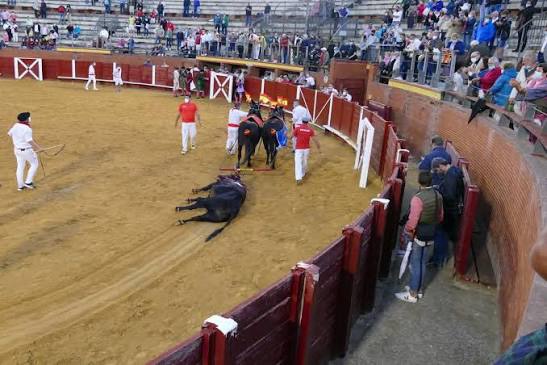
The Festivities always start on a Saturday with the “Lantern Parade”, in which the clubs compete to see who carries the most original lantern. The following Tuesday the famous “Toro de la Vega” takes place, declared of Regional Tourist Interest, being one of the most traditional bullfighting celebrations within the national panorama. –
Four of these on the go at the Tordeplaya, with a long line of tables bedecked in red paper table tops.

Another bullish evening in Tordesillas.

Great grills at the campsite restaurant
A great place – hopefully we’ll be back. Tomorrow we drive northbound to A Coruna.

TORDESILLAS “ A PLACE OF PRIVILEGE AND A LOT OF BULLS”

13 Sep

You meet him just after you cross the bridge into the town.

Friday, 12th and Saturday 13th September 2025

Towards the end of yesterday’s journey, a passing car driver pointed to the front of the car,indicating a problem. This morning ,after perusing underneath the car,I noticed some sort of rubber flap hanging down from below engine. Campsite Reception were really helpful,ringing their reliable and much used garage – unfortunately they were closed – shut down for a holiday! Therefore it meant a phone call to the breakdown service who after a lengthy discussion,promised a mechanic would be on site within 90 minutes.

We moved the car to the front of the site,in the car park hoping this would make it more accessible than by the bungalow.
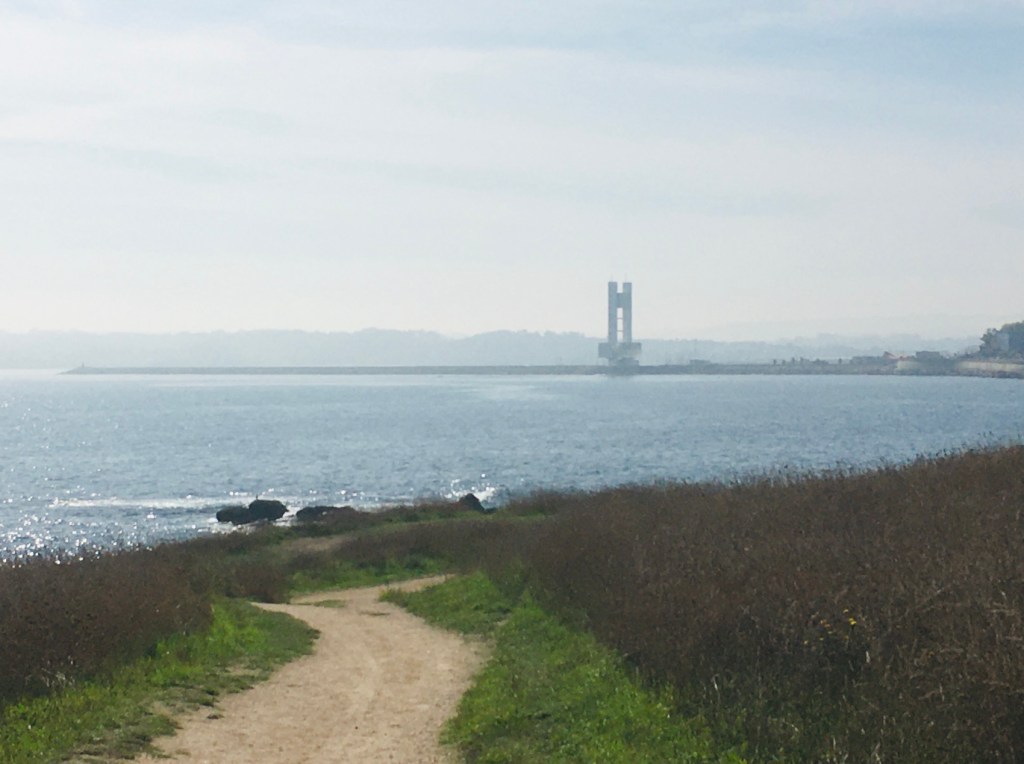
In the shade,too.

It took 3 hours before a mechanic came and “ sort of sorted it”. He jacked the car up and unscrewed a kind of rubberised tray from underneath the engine . He assured us that it would not affect the engine and to continue driving and to get it fixed back in the UK….So be it.

Strolled then into Tordesillas to the Dia supermarket and enjoyed the different experience of shopping abroad – especially pleasant was the lady behind the vast butcher’s stall who cut me up some beloved Morcilla sausage. Other goodies included some aioli and a jar of interesting flavouring for meat and salads, lime and chilli, and the wine,of course.

Morcilla de Burgos

A couple of interesting sights on the way back.

Calling on his neighbour on horseback
A group of sisters sharing a picnic on the side of the River Duero.
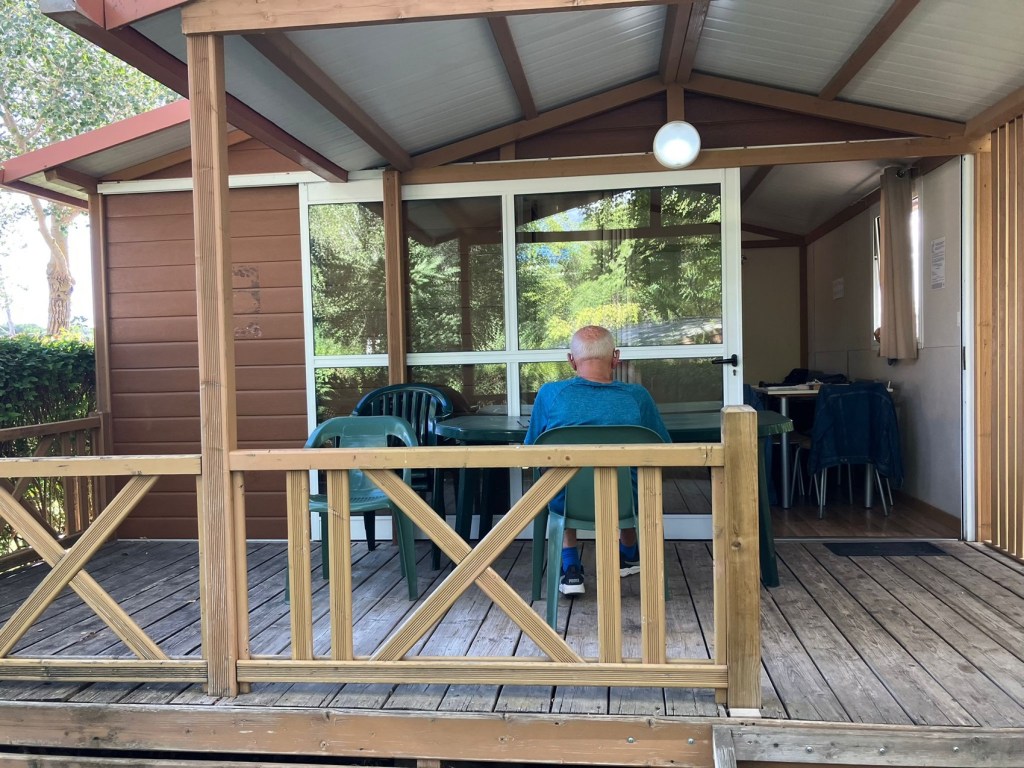
Blog writing time at the Bungalow,excuse my back

Relaxation time at the pool
Bar Playa for an aperitif with a river view
Table service with tasty bowls of nibbles,Muy buen..

SATURDAY 13 th SEPTEMBER

After breakfast a walk back to town across the bridge.

The remains of a mill below one of the bridge arches.
Various walks from here.
Riverside ramble

Back, up into the town via the bull ring .

As it was…
As it is now…
This is where they tether the bulls .
This is Matador’s playground
Walking towards the main square
Thank god there are none of those b…..St George Crosses…..there is a a
a fiesta taking place .
A corner of the square

A load of old bull…Still a big deal hereabouts.

FAROLES
History tells us that the tradition of such an important time for the people of Tordesillas originates from the guard patrol that used to take place on the ancient walls or fortifications. Like stars that make way through the crowd, this is how the Tordesillas lanterns shine. Authentic moving works of art that portray moments, events, or personalities that marked a before and after in the lives of the town’s inhabitants, years ago or in the immediate future.
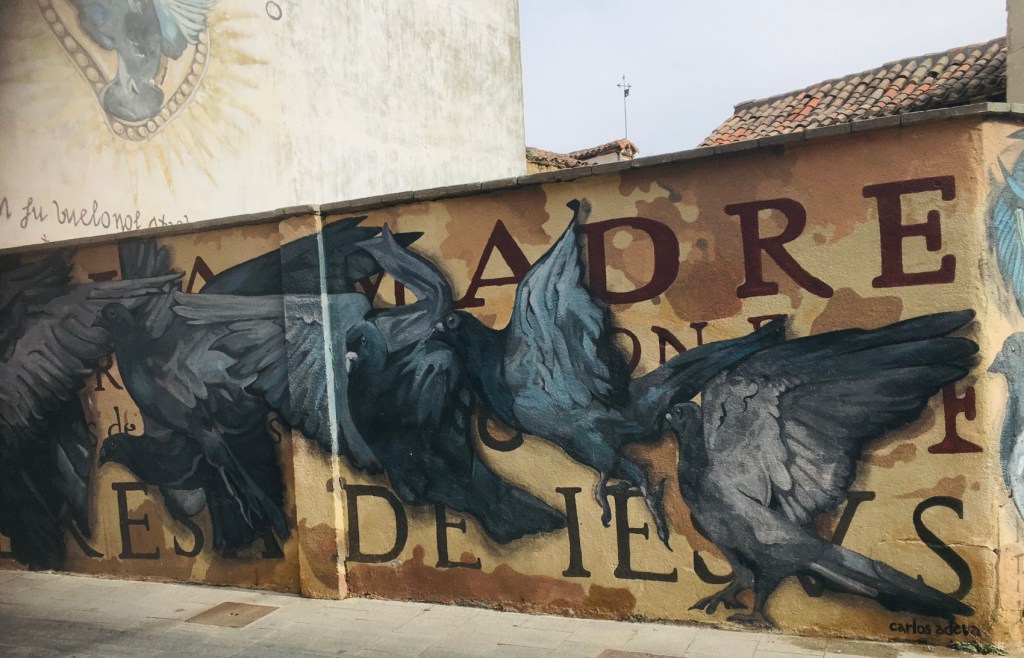
Street Art
A view from the old walls
Leading to the Paseo Juana I de Castilla
A Walk Through History, the events that marked the life of Joanna I of Castile and the importance of the Treaty of Tordesillas.
46 years she spent in the Royal Palace, her life and her fate.
And the Treaty that would determine the current configuration of America, which, 531 years later, is still alive.


The two most significant historical events in the town.
Queen Joanna I of Castile arrived in Tordesillas in 1509, remaining for 46 years in the Royal Palace ordered to be built by her great-grandfather Henry III in 1400.
This area also recalls the negotiations and consequences of the Treaty of Tordesillas, signed here on June 7, 1494, between ambassadors and cartographic experts sent by Isabella I of Castile and John II of Portugal.
The Treaty with its Meridian divisions
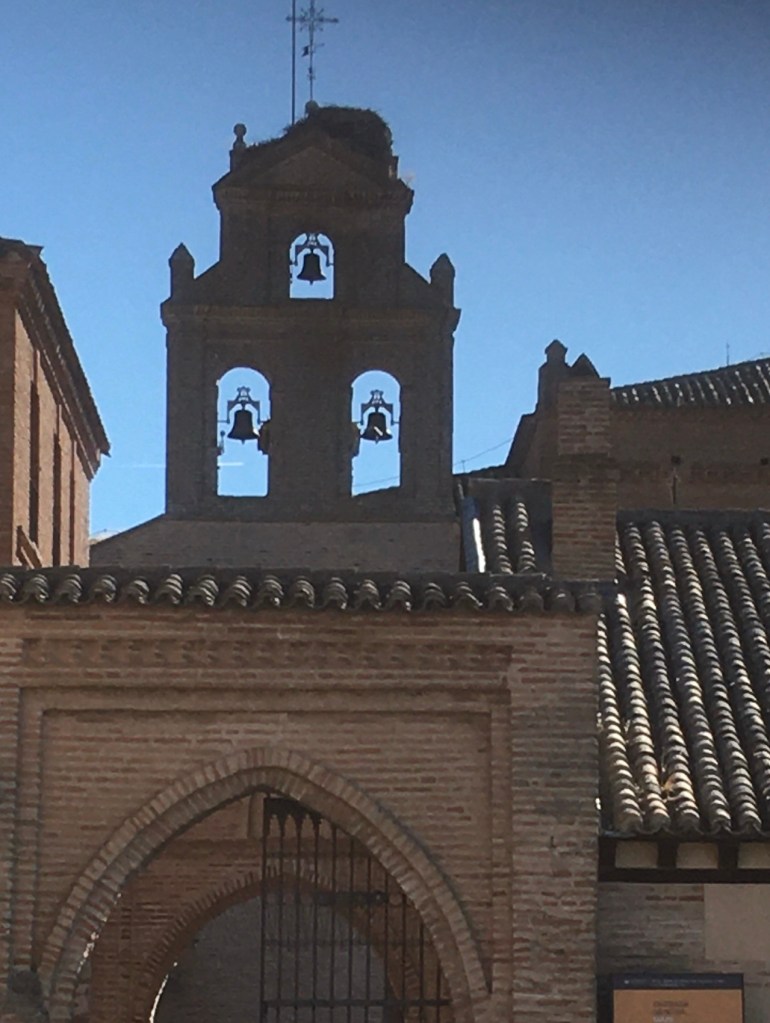
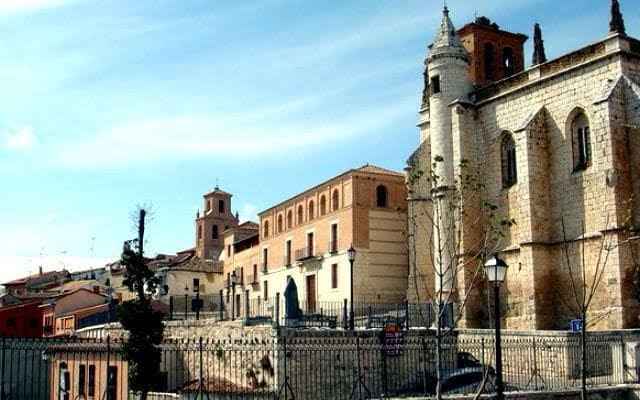
Many fine churches
Note the old tiled roof

BACK ON THE ROAD AGAIN….

12 Sep

Over five years since I said farewell to the motorhome and since then, Covid apart,wanderlust has been restricted to Caminos, packages and self organised breaks abroad. Losing the “ bus” felt like a bereavement at the time and one of the biggest losses was driving in Europe, especially Spain.

So it was greed that the car would be the substitute and Brittany Ferries was booked as long ago as January for a driving holiday in Northern Spain.

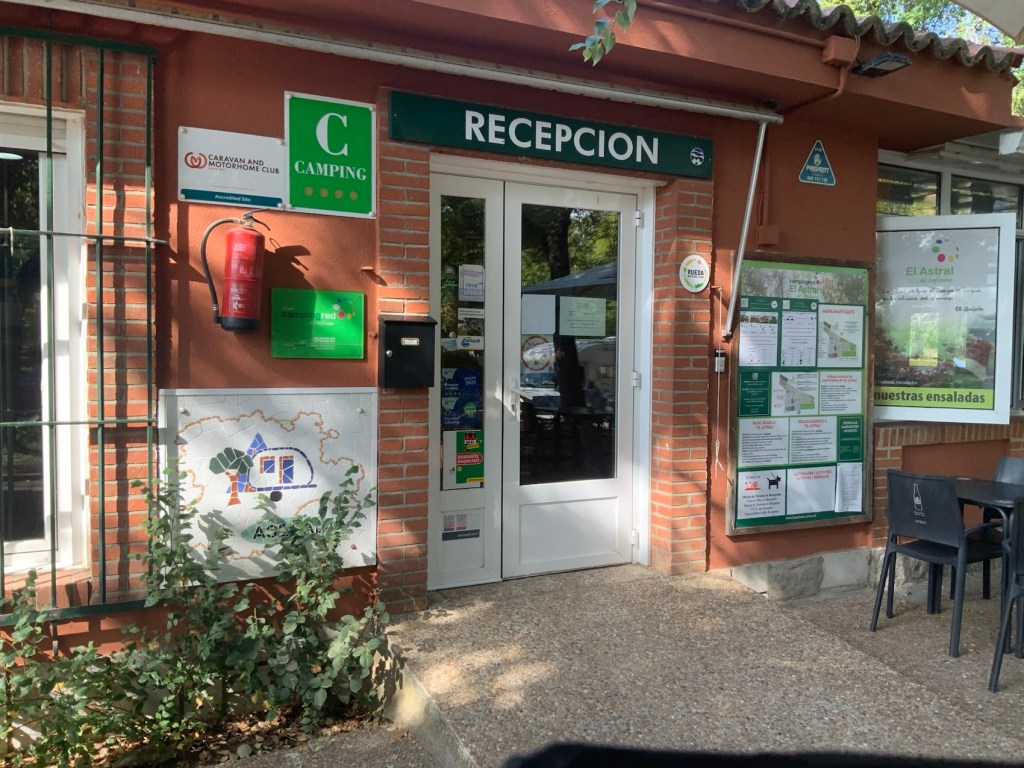
From Plymouth to Santander and then a drive down to Tordesillas ( near Valladolid), a town visited on several occasions over the last thirty years,usually as a stopover enroute to Portugal or Southern Spain. Camping L’Astral – It’s a gem of a place by the river – not an all singing/ all dancing kind of site.. A pool, a garden,a bar and restaurant and only a walk over the nearby medieval bridge into town.

The second half of the trip is to be in  A Coruna, a city I have long wanted to explore – this time in an Airbnb.

After five years non-motoring, you have to catch up with new requirements in Europe. One of the countless non- benefits of Brexit is the necessity for a UK sticker in the rear window, despite having a perfectly accessible GB sticker; at least it did not have the blemished St George’ s Cross on it.

Three high vis vests and two warning triangles makes sense.

After much fruitful research a list of “ things to do “ – “ SEE IT, SAY IT, DO IT” as they don’t say on the train – distances worked out, weather forecasts taken and books to read stored,it was time to go.

Wednesday 10 th September and the 15.45 crossing from Plymouth to Santander,after a 3 3/4 hours drive, the last hour in pouring rain , the maritime harbour was reached without incident. Although less hassle than Dover has become, there was still an hour and a half before embarking. There were a considerable number of Porsches of all types and sizes together with a range of classic sports cars – an interesting contrast – and I spotted my long time favourite….a yellow and black TR 4.

1964 TR 4

Once on board it was just a matter of locating the cabin from Deck 4 upto deck 8. Working out the bunks took  a while then all was set – clever shower/ loo cubicle,too.

The only off-putting thing was the “ entertainment “ operating even At 14.30 in the main lounge – a screechy singer and long queue for the bar. Fortunately, the self service restaurant area had a pleasant sea view lounge attached and after a gang of Bristol Girls’ Bikers left, it was a tranquil enough spot to wind done and enjoy the seascapes. 

THE INTERIOR

Overnight,the bunk beds and pillows were very comfortable and by 08.30 back to the self- serve lounge for breakfast. A full English, toast and two mugs of Earl Grey was great value at €09.00. The other early partakers of breakfast were mainly bikers which took me back to a previous Brittany Ferries crossing a few years back which coincided with Hannah’s birthday. As she opened her cards and presents a row of bikers adjacent to our table broke into a hearty rendition of “ Happy Birthday “ !

The only bugbear was the WiFi . You can have 90 minutes free once on the journey and then there were a number of packages you could pay for – Hannah paid for a spell this morning and found that it was as slow as the “ free” package.

There is no Roaming signal out here on the ocean and so time passed watching the waves – no whales spotted yet – and reading.

APPROACHING SANTANDER

Maybe it was because I only spotted one other ship in the mighty Bay of Biscay that I became interested in this unusual cargo ship.

It looks grey because these photos were taken from inside .

Disembarkation took about an hour as deck levels were called one at a time to avoid congestion. Straightforward after that,if a little slow. In no time at all we were on the A67 heading south. The A-67 is the Cantabrian Motorway, Toll-Free,a key road running through Cantabria, Spain, and it’s the most direct way to travel by car from Santander to areas south, such as Tordesillas. Ten minutes out of Santander and it was that idyllic driving experience I mentioned earlier – traffic free,no hold ups regardless of minor road works.

Scenic,winding route through hills and mountains

And then the edge of the Meseta,with signs off to villages I had stayed in on the recently walked Camino Frances, like Carrion des Condes. Two and a little more hours we reached L’Astral Campsite, a place we have stayed in several times over the years . Still untouched by sordid development and a friendly welcome as ever. The bungalow is a three minute walk from the bar/ restaurant where we are booked in for dinner and where I am finishing this post ferry part of the trip.
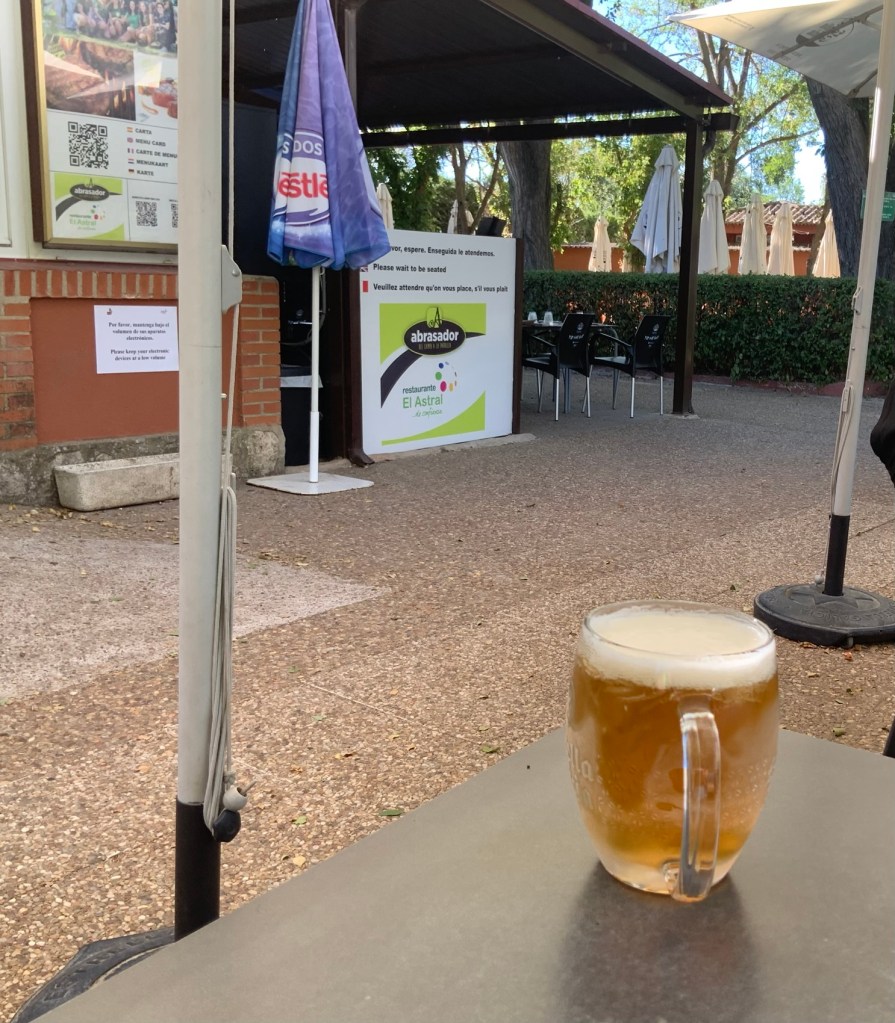
Estrella Galicia served in a frozen glass – nowhere serves it like Spain.

una buena comida