

“The last leg starts with a long segment along the sidewalk of the Via Cassia, very traffic congested. Once passed the Grande Raccordo Anulare (Great Ring Junction) the Path enters the green Insugherata Park, a wild oasis in the outskirts of Rome. Then it enters once again in the traffic of Via Trionfale, for then entering Monte Mario park. The view from the overlook of “Mont Gaudii”, the happiness’ Mount, will let you forget the pollution and the traffic, before of the descent to St. Peter’ square, your destination. Frequent eat and drink points and fountains along the itinerary.” GRONZE
Leaving Giustiniana, we cross above the A90 Autostrata tunnel,turn right and pass through the gates of the Insugherata Nature Reserve – an hour’s welcome respite.

History, nature, and spirituality merge in one of the largest green areas within the city: 740 hectares of a territory of an immense naturalistic and historical-archaeological value.
The Insugherata Nature Reserve hosts, in fact, numerous remains of sepulchers and Roman villas. The most famous is undoubtedly the so-called Nero’s Tomb, along the Cassia. Datable to the II-III century AD, it is actually the tomb of Publio Vibio Mariano, Prefect of the Third Gallic Legion. In the area of the Acqua Traversa, where Villa Manzoni is now located, the villa of the emperor Lucio Vero once stood (161-169 AD). The excavations carried out in 1999 for the construction of the new Octavia flyover have revealed the presence of tombs relating to an Etruscan settlement of the 6th century BC. Along Via Trionfale, bordering the reserve, the Traiano-Paolo aqueduct, built by the Roman emperor (98-117 AD) and restored in 1612 by Pope Paul V, passes through an underground path. It leads to the Trastevere district, the water of Lake Bracciano, and reaches the Gianicolo Fountain.
The area of the park, in part corresponding to the ancient estate already registered in the Alessandrino Land Registry (1660) with the name of Inzuccherata, also preserves the ancient Casale of the Insugherata, together with some publicly owned farms.
From here, too, passes the Northern trail of the Via Francigena, the ancient itinerary of faith, which for centuries has accompanied pilgrims and visitors from Central Europe to St. Peter’s Basilica.
https://www.turismoroma.it/en/places/insugherata-natural-reserve
Then through the Roman residential neighbourhood of Sant’Onofrio, two blocks on we reach the Via Trionfale,one of Rome’s historic main arterial roads – cafes, etc,.


The Monte Mario Nature Reserve extends in the north-western part of Rome and takes its name from the highest cliff (139 metres) of the Farnesina hills, which dominate the Tiber valley.
Geologically speaking, the area consists of sand and gravel, from which numerous fossil remains originate. Inhabited since prehistoric times, in the Roman age, Monte Mario housed numerous residential villas.
Used in the Middle Ages to plant vineyards and vegetable gardens, from the Renaissance on, the noble families chose the hill as place of residence due to its dominant position over the city.
One of the most distinguished examples of Renaissance villas is Villa Madama. In the park area are other historic mansions. Among them are Villa Mazzanti and Villa Mellini, home to the famous Astronomical Observatory.
Villa Mellini

Following footpaths we should get our first sight of Rome.

We descend along switchback paths to the lower gate of the park.


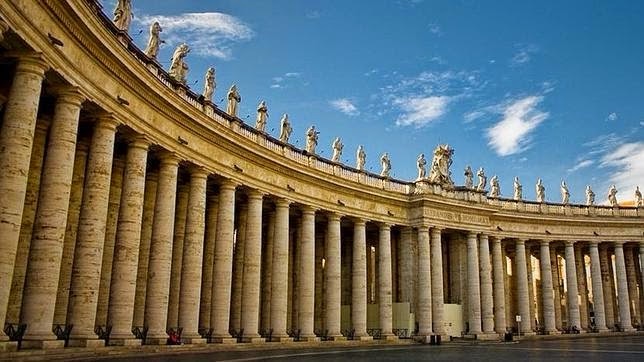
Gian Lorenzo Bernini designed the colonnade that frames St. Peter’s Square in Rome. The square’s elliptical shape and the colonnade are a defining feature of the square, symbolizing the Church’s embrace of the world. The colonnade, built between 1656 and 1667, is composed of 284 columns and 88 pilasters, arranged in four rows. 140 statues of popes,martyrs,evangelists and saints carved by Bernini and his students.

Sylvia Nilsen writes: “During the Holy Year of 2025, pilgrims who go on pilgrimage to the four Holy Doors of Rome (Basilica of St. Peter in the Vatican, Basilica of St. John Lateran, Basilica of Santa Maria Maggiore, Basilica of St. Paul Outside the Walls) will receive, on request, an official ‘testimonium’ – a certificate proving they have undertaken a pilgrimage to the Tombs of the Apostles Peter and Paul.
The testimonium can be collected at the official Jubilee InfoPoint, located in via della Conciliazione 7, in Rome. Info Point . This certificate is a testimony of the pilgrim’s spiritual participation in the Jubilee, a year of grace for all men and women in the world. The testimonium will be personalized by the volunteers at the InfoPoint with the name and surname of the pilgrim, and the date of the pilgrimage.
In addition, those who arrive in Rome on pilgrimage by foot or by bike, having travelled one of the many paths towards the eternal city, will be able to receive a special, even more personalized Testimonium.
The official Testimonium of the Jubilee will carry a special watermark, with unique properties, guaranteeing its authenticity and certifying it as an official document of the Jubilee. Thus, each certificate will become a unique and significant memorial of the spiritual journey undertaken.
Pilgrims are asked to apply only for the official Testimonium which can be collected only at the InfoPoint in via della Conciliazione 7. Info Point
For large groups it is advisable to book the Testimonium in advance by contacting the InfoPoint.”


5 ways to travel from Vatican City to Domus Sessoriana, Rome,according to the “Rome to Rio” website- Bus 13 mins, Taxi 3 mins,Subway 13 mins, Walk 28 mins.

“Good location, lots of options for public transport, very kind reception staff.”
“There were great places to eat nearby and a 24 hour bar across the street.” Two recent reviews

https://www.scribd.com/document/260035187/Travel-Guide-24-Hours-in-Rome
 ensuitepilgrim's Blog
Thanks John. Because of this description I’ve been reading the life of Gian Lorenzo Bernini the amazingly talented artist, designer and sculptur.