Quarteria ‘s ORBITUR campsite was the base for a five day stop by the sea. Situated at the edge of the town, easy access to beach and supermarkets, this is a very good site, which despite its size, was tranquil , well ran and highly recommended; ( except for its over lengthy checking-in procedures )like the town the majority of holiday makers were Portuguese families, staying in tents, caravans, bungalows and mobile homes. The terrace overlooking the pool was my favourite spot and the staff soon became accustomed to my request for a white port and tonic, with ice, only after 6 pm, I might add! 🍹
From a simple fishing village, Quarteira has become one of the major tourist centres in the Algarve, famous for its golden beaches, its high quality fish and for its woods of stone pine.
Quarteira has seen a lot of development in recent years, leaving it characteristically high-rise in and around the town. Quarteira has still, however, managed to retain its Portuguese character and is particularly popular with Portuguese holidaymakers. The best part is the lovely palm-lined promenade, Avenida Infante de Sagres, known as the “Marginal”, where you can spend time relaxing with lovely walks along the seafront and on the outdoor terraces of cafés and bars all around.
Quarteira Beach is beautiful and rock-free and there are plenty of eating places with the Avenida Infante de Sagres running along behind it, which you can call on for refreshments. Quarteira still boasts a local fishing community and the fishermen can be seen at work at the western end of the beach. The catches are sold at the nearby fish market early in the morning and will end up on your plate for lunch or dinner the same day.
There is little of historic or cultural interest in the town – very good fish market. It is dominated by apartment blocks, typical of the Algarve as a whole. We enjoyed a great fish dinner in the extensive garden of a restaurant on the beach and the quality and range of bars, cafes, etc, was extensive. Morning coffee is not complete without sampling Pastel de Nata,usually somewhere on Quarteria’ extensive promenade.
We went by local bus to Loule, to visit the castle museum and the markets,for which it is famous , coaches from all the resorts make their way here, on Saturdays and the big difference to where we were staying was the number of Brits. I used to be able to get a take on the ambience of a place by observing the number of earrings and tattoos on the men; it’ changed now ,though , to the women. Sipping coffee, outside Loule’s Moorish style market, was a vantage point for people observation. One memorable top carried the message” MADE YOU LOOK”; it should have been followed below by ” Bet You Wish You Hadn’t'”. But Loule retained its own, unspoilt atmosphere. The beginnings of Loulé are uncertain, some historians putting it as far back as 400BC, but others say it’s origins are Roman. It is a fact that when the Arabs invaded the Algarve in 715, Loulé was already an important town. It has been a part of Portugal since 1249 after the Algarve was recaptured from the Moors and in 1291 King Dom Dinis established the Algarve’s only medieval fair in Loulé, a sign of the wealth of the region.
Loulé castle (13th/14th century) built on an area previously settled by the Romans, is just a short distance down the road from the market on the left hand side. From this approach it isn’t very obvious that it is the castle as, through the arched gateway, you see the whitewashed walls of the ‘alcaidaria’ ( which was the living quarters for the castle commander and his garrison) surrounding a small courtyard and no visible signs of the castle walls. Across the courtyard lies the municipal museum, next door to which are some steps leading up to the remaining section of the castle walls.
The three remaining grey stone towers and short walkway between them are well preserved and apart from getting a great view of Loulé does also give a taste of the historical heritage of the Algarve. (There is a small charge for visiting the castle)
A little further along the street from the castle is the Convent of Espírito Santo which also houses the municipal art gallery.
The bus station in Quarteira had some eye catching murals; you wouldn’t find anything like these at Digbeth Coach Station.
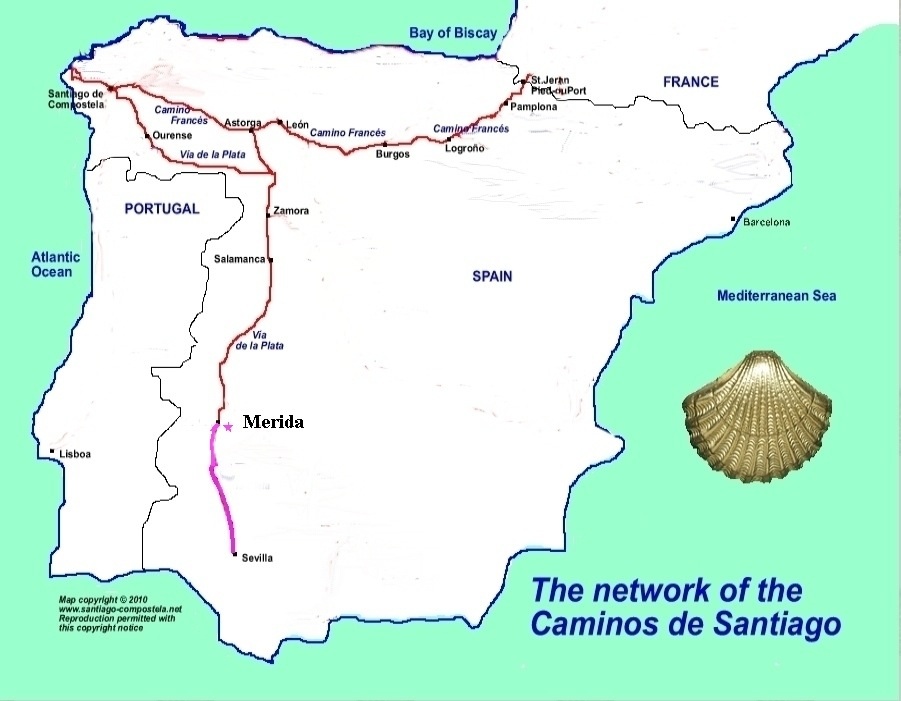
Feast day of St James ( Santiago ) , today, 25 th July. Hope it is a good one for all fellow caminoists and friends. By coincidence, we set off, tomorrow for Caceres, wonderful city on the Camino, Via de la Plata.

 ensuitepilgrim's Blog
Leave a comment